


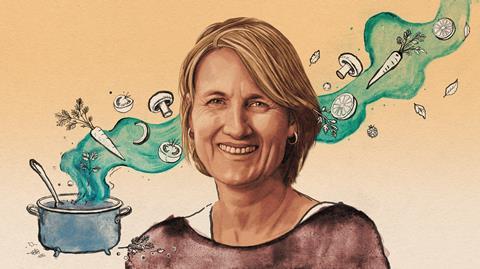
Perdita Barran is a professor and chair of mass spectrometry in the department of chemistry and director of the Michael Barber Centre for Collaborative Mass Spectrometry at the Manchester Institute of Biotechnology at the University of Manchester. She won the RSC’s Tilden Prize in 2025 for her work using ion mobility mass spectrometry in complex biological systems and breakthroughs in biomarker discovery, in particular, non-invasive sampling to diagnose Parkinson’s disease.
I think that the purpose of scientific practice is to provide a structure for curiosity. Science is something that everyone does; it’s about asking questions about the world. Children do it just normally and then as we go through education we constrain that curiosity in different ways and maybe we get to a point where people stop asking questions – that’s not a good place to be in. But the practice of science enables curiosity and provides frameworks that allow us to systematise that curiosity.
Science and arts are both creative subjects. I did a year in industry at Glaxo, now GSK, and I really enjoyed it. I was working with all sorts of different people. I had to develop a very small instrument: I loved creating something that could be useful, in this case, for the partitioning of drugs across the membrane. It really showed me how creative science could be.
Creativity doesn’t just have to be for blue-sky science. Creativity can be for utility. My motivation now is not to do science that can only be done by a brilliant postdoc on a Friday afternoon and get into a high ranked journal. We’re trained to be all about high impact and to do something that no one else can ever do. But now I want to do things that lots of other people could do.
I absolutely love cooking. The interesting thing about cooking is that you have some areas where precision is really important, and others where it isn’t. For example, I make a mean pulled pork, but I make it like George’s Marvellous Medicine – every time I’m putting different things in. My kids ask how does it always taste the same? What I like about cooking is that it bridges the precision part of science to the free form you might get more in art.
I have my group round every year and we do potluck where everyone brings something from their region, which is great because people are from all over the world in our lab. I love cooking for lots of people – I come from a very big family. As a family we often cater for family weddings and have 20 people for Christmas.
I always tell my students before their PhD exams: you are the expert. At the beginning of their PhD I usually say: ‘To start off I’ll know more than you but at some point, sometimes after six months, sometimes after a year and sometimes not until the end, you’ll take ownership of your problem.’ Because I remember being that person who just assumed that everyone knew more than me.
Small actions can make such a difference
The first talk I ever gave was at a public conference at the University of Exeter. It was the first year of my PhD and Harry Kroto was my supervisor. I was absolutely terrified. And he said to me – this is just before he won his Nobel – ‘oh, it doesn’t get any better’. I was like, ‘thanks!’
Covid provided a real turning point in my life. The pieces were there before, but the work I did for the Department of Health and Social care during Covid was so incredible. It made me so much more convinced that I must do things that have benefit to society and that I must train people to be able to do good science that will have that benefit.
I tell my students that you just have to act. I did a lot of acting when I was younger and so when I first started teaching, I would always take books in with me to show I have knowledge, because I have books. For me, a way to deal with feeling that sense of imposter syndrome is to say: ‘Okay, I might be an imposter, but I’m going to be the best version of that imposter I can be.’
I’m really proud of the fact that I have had 44 graduate students that have worked alongside me. They start off being trained and then they end up teaching me. 40 of them are still working in mass spectrometry or a related area, which is wonderful because it means I get to see them, but also because it means that what we do is relevant to society.
I’ve always really wanted to be just known as a good scientist rather than a good female scientist. But then a friend of mine, a policewoman, told me I should stop thinking like that and just be really proud to be a female scientist.
The group I have now has taught me to look at diversity in a way that I hadn’t before. They’ve taught me about intersectionality and how there are interdependent dimensions to inequality. Small actions can make such a difference. I knew that, but my current team have performed some pretty large actions to raise awareness of intersectionality, they have done it collectively and done it beautifully.
This article has been edited for brevity and clarity


