



Coquito, eggnog, hojarascas, glögg, lebkuchen, ma’amoul, mince pies, rugelach and more are just some of the festive treats that spice up autumn and winter holidays around the world. Many of these treats include something between a dash to a healthy dollop of cinnamon. Along with ginger and nutmeg, cinnamon is a ‘warm’ spice that is a staple of holiday dishes and drinks in the cooler seasons. The prevalence of cinnamon in the US sweet and savoury autumnal recipes provoked the popular food publication Mashed to ask: ‘could this fall favorite be America’s most overused spice?’
If the cinnamon supply was threatened, production of homemade goodies and industrial foodstuffs would grind to a halt. Such a stoppage to this year’s seasonal baking was recently feared when the Lior brand of ground cinnamon was recalled by the US Food and Drug Administration (FDA) due to elevated levels of lead.
The likely culprit is lead(II) chromate (PbCrO4), a member of the chrome yellow pigment family which has a long history as a colourant in legitimate and fraudulent endeavours. Lead(II) chromate has been intentionally added to spices like cinnamon ‘to increase their weight and enhance their color’ for years, with monetary gain being the motivation for this food fraud.1 The health effects of lead exposure – and to perhaps a lesser extent chromium exposure – are well enough known today and often prompt product recalls and intensive investigations.
The investigation into the Lior brand contamination is in the early stages, but a recent autumn-into-winter cinnamon contamination case illustrates the complexity of these types of whodunits. The FDA began such an investigation in late October 2023 when the agency was notified that four children in North Carolina had high blood lead levels.2 These children were from three unrelated households, with the North Carolina Department of Health and Human Services identifying a potential shared source of lead exposure – WanaBana brand apple cinnamon fruit puree pouches.
Within days of the FDA alert concerning WanaBana being posted and the company initiating a voluntary recall of all such puree pouches, two other brands of similar products were subject to recall – Schnucks cinnamon-flavoured applesauce pouches and Weis cinnamon applesauce pouches. A single manufacturer in Ecuador – Austrofoods – was the source of all these flagged pouches.
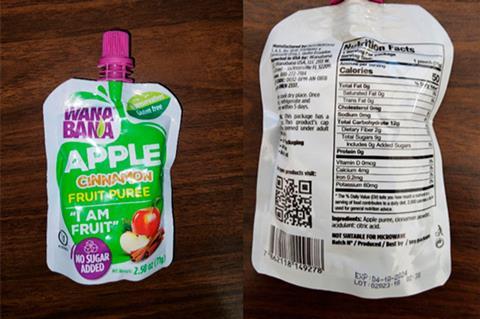
Lead can contaminate foodstuffs at various points including processing, handling and packaging. The FDA and partnering agencies in the US and Ecuador were able to focus in November 2023 on a single ingredient – cinnamon. Analysis of pouch flavours from the aforementioned brands that did not contain cinnamon had ‘not shown elevated levels of lead’ while the pouches of concern had lead concentrations far above the FDA’s action level ‘for fruit purees and similar products intended for babies and young children’.
The FDA Kansas City Human and Animal Food Laboratory confirmed the results of various US state public health partner laboratories via inductively coupled plasma mass spectrometry (ICP–MS). Samples of the ground cinnamon that Austrofoods had used to produce the problematic pouches had elevated levels of lead and chromium.3 Additional sample analysis by the FDA’s National Forensic Chemistry Center focused on identifying where the lead and chromium had come from.
The hunt for the source
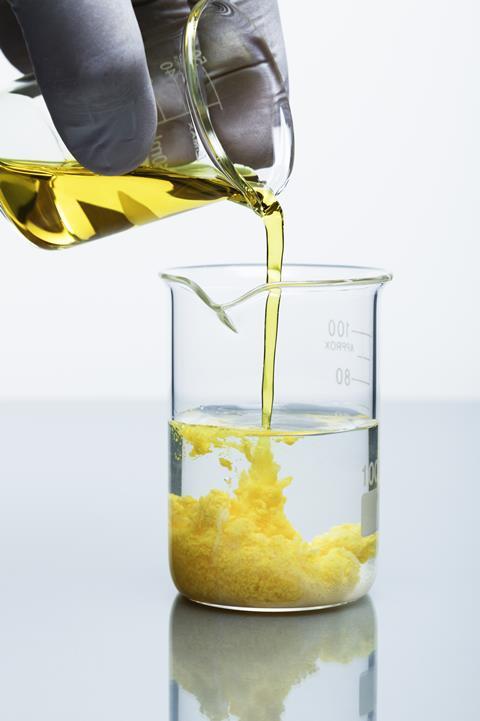
Was the source lead(ii) chromate from possible metal particles from cinnamon grinding equipment? From the cinnamon samples, suspected lead(ii) chromate particles were isolated and analysed by the non-destructive technique of Raman microspectroscopy. These sample particles were subject to nitric acid digestion for ICP–MS analysis. Combining Raman and ICP–MS in this fashion, and comparing the results with results from a lead(ii) chromate reference standard, identified this particular pigment as the chemical contamination source. The hunt continued to find the supply chain contamination source.
A detailed supply chain traceback investigation by what was now an international team revealed the cinnamon used was from a single supplier in Ecuador – Negasmart. While this company did not export cinnamon directly to the US, their cinnamon was in US products via Austrofoods – an indirect route common in modern, mass-produced foodstuffs. In partnership with Ecuadorian authorities, the FDA confirmed that of Negasmart’s direct customers, only Austrofoods shipped products to the US. But while Negasmart supplied cinnamon to Austrofoods, it was not the source of the lead contamination.
Ecuadorian authorities identified Negasmart’s in-country cinnamon supplier Carlos Aguilera as the likely source of contamination. Carlos Aguilera sourced cinnamon sticks from Sri Lanka, with Ecuadorian authorities determining that samples of these unprocessed sticks had ‘no lead contamination’.
In early 2024, Ecuadorian authorities reported that Carlos Aguilera was no longer in operation. The FDA placed cinnamon distributor Negasmart, doing business as Sanchez Obando Alexander Ricardo, on multiple import alerts including for ‘economically motivated adulteration’.
Continued vigilance is needed – as shown with this year’s Lior brand ground cinnamon recall. Whatever the season, food safety is always a staple.


