


It’s a first in the space construction industry: a robot has independently built a structure in space without the help of astronauts.
The achievement points towards a new era of building beyond Earth, an era less confined by what we can fit on a rocket.
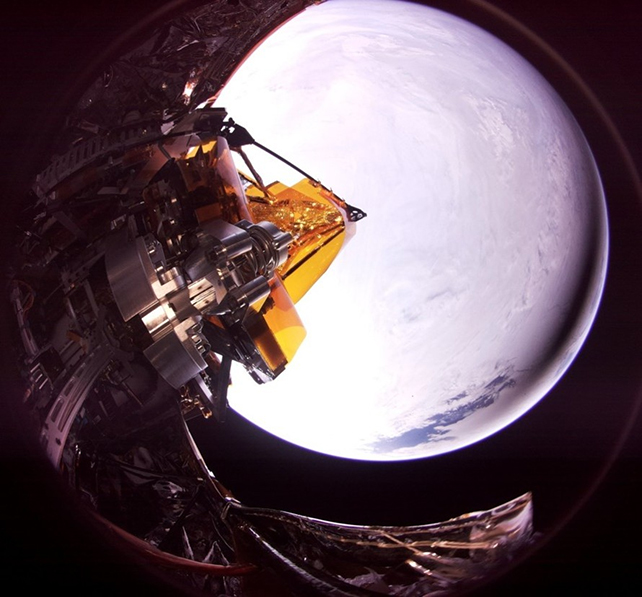
The robot used was the Autonomous In-Space Tensioned Reflector Assembly (ASTRA), developed by researchers at the California Institute of Technology (Caltech), and funded by the US Defense Advanced Research Projects Agency (DARPA).
ASTRA put together a series of composite fiber tubes and aluminum joints, step-by-step, to expand one bay of a planned reflector antenna some 1.4 meters (4.6 feet) in size.
While only the first part of the antenna is finished, it’s an important proof of the feasibility of the technology, its developers say.
The core materials and building blocks are packed together for transportation, and then the robot takes on the job of piecing them together.
When a piece is finished, it connects to the existing structure, and a new piece is started.
frameborder=”0″ allow=”accelerometer; autoplay; clipboard-write; encrypted-media; gyroscope; picture-in-picture; web-share” referrerpolicy=”strict-origin-when-cross-origin” allowfullscreen>
These techniques are also ready to be scaled up for bigger projects, too, according to the Caltech researchers.
“Developing a payload of this complexity on such a short timeline was an enormous undertaking for our small team,” says aerospace engineer Sergio Pellegrino, who leads the ASTRA team.
“As we wrap up the mission, we are finally able to start thinking about the new avenues of research opened by this demonstration.”
Before now, we’ve had two options for constructing something in space: Send it up in pieces and fix it together bit by bit, or pack it tightly on a rocket and then unfurl it to a larger size when it reaches its destination.
This is the beginning of a significant third option, and it promises to enable ever-larger structures to be placed in Earth’s orbit (there’s a lot of space in space, after all).
The ultimate aim is to build out over hundreds of meters or kilometers.
“Once you get to the size limit where structures cannot be prebuilt on the ground and unfolded, you have to think about how to build them in space,” says Pellegrino.
“So, this work could be useful not only for astronomy and astrophysics but also for communications and other areas, such as building very large solar arrays for space solar power.”
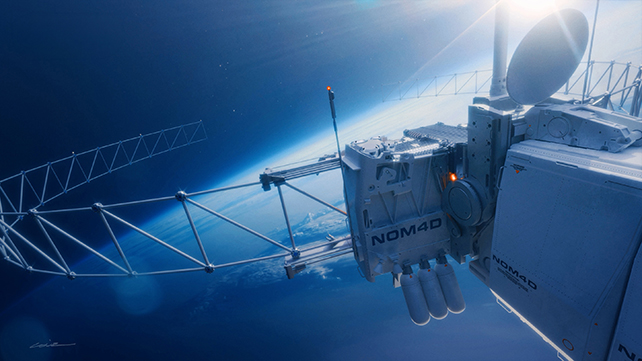
ASTRA was developed as part of DARPA’s Novel Orbital and Moon Manufacturing, Materials and Mass-efficient Design (NOM4D) program, launched in 2022 to explore ways to upgrade our capabilities in space.
Another NOM4D project is launching before the end of the year.
A team from the University of Illinois Urbana-Champaign in the US will send a machine to the International Space Station (ISS), to test the feasibility of on-orbit manufacturing.
Specifically, ISS astronauts will be testing out a method for transforming liquid materials into solid materials – again to reduce the size of the payloads that need to be launched on board rockets, and do more of the manufacturing in space.
“In a future space economy, we’re going to need large things,” says Andrew Detor, program manager of NOM4D.
“Think large space depots or habitats, large solar arrays to collect power, or large radio antennas to explore the edges of the Universe. Those things require size, and NOM4D gives us a path to accelerate creation of new capabilities.”
These efforts may be small-scale and limited now, but they represent the future of construction out in space. One day this could be how all space buildings, spaceships, and instruments are put together – and NASA has an entire mission devoted to in-space servicing, assembly, and manufacturing.
That’s for the future. For now, the Caltech team is celebrating ASTRA’s success.
“As a child, I was super curious about and interested in space structures,” says aerospace engineer Jaden Suh.
“Just like many other engineers working in this field, sending your stuff to space is what I’ve been dreaming of my entire life.”
This article was fact-checked by Carly Cassella and edited by Carly Cassella. While we pride ourselves on our process, we are only human. If you spot a mistake, please let us know.


