





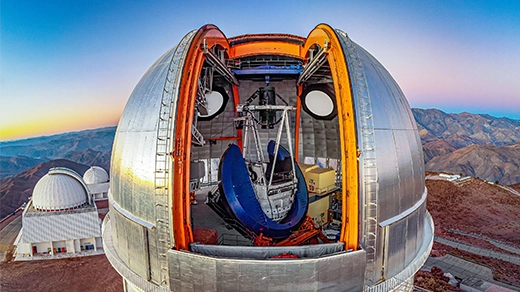
In 2024, the DESI collaboration dropped a bombshell report. When researchers added their shells to the existing dossier, they couldn’t get the Lambda-CDM model to fit all the data. What fit better was an exotic theory that replaced lambda, the constant vacuum energy, with a different form of energy that weakened over time. A year later, an analysis of more data found the same thing.
In the meantime, the DES collaboration continued to analyze the galaxies they had photographed. Those researchers focused on building a different contribution to the dossier: a detailed record of a cosmic tug-of-war.
While gravity pulls matter — mostly dark matter — together, dark energy fights back, pushing matter apart. By measuring how much matter has clumped together in different eras, cosmologists can infer the strength of dark energy over time.
DES assesses this clumping using three methods, explained Sujeong Lee, a physicist at Ohio University. First, DES measures how tightly galaxies of visible matter cluster together, which reveals how much dark matter floats around them. Second, it maps out visible matter in the foreground by looking for the ways it distorts light coming from galaxies in the background. And third, it maps out foreground dark matter in a similar way.
Each of these measurements involves comparing pair after pair of DES’s hundreds of millions of galaxies, looking for tiny distortions in their positions and shapes. After seven years of rigorous analysis, the collaboration published their final results in early 2026. “It’s been a real tour de force,” said Ferraro, who isn’t part of DES. “It pushed the analysis to a new level.”
Alongside these measurements, DES also reprocessed a catalog they had compiled of 1,600 recently observed supernovas, establishing the sharpest view yet of the modern universe. “I trust the DES-reanalyzed supernova data much more than I trust any other supernova dataset,” said Seshadri Nadathur, a DESI cosmologist.
Cosmologists have now assembled their thickest file on the universe to date. DES merged its map of matter clumping, its supernova catalog, DESI’s galaxy shells, and a CMB image, then checked to see how well Lambda-CDM could still account for the whole cosmic history.
The answer: not very well. In their final report, DES scientists found that their data fit somewhat better with the theory that dark energy is not stable and has slackened in recent eons. In the statistical language of physicists, DES reports a “three-sigma” preference for the new theory. That’s significant enough to make people pay attention, especially since it combines data collected in different ways, but it falls far short of the “five-sigma” confidence physicists need to claim a new discovery.


