

Dark Mode Light Mode
Chemistry, medicine, materials and the technology shaping tomorrow — the best science stories from trusted sources, every day.

Major Fossil Discovery in China Reveals Two New Secrets About The Home of Homo Erectus

Major Fossil Discovery in China Reveals Two New Secrets About The Home of Homo Erectus Major Fossil Discovery in China Reveals Two New Secrets About The Home of Homo Erectus


Every family has some secrets – and the human family is no exception. Analysis of newly found fossils has revealed two surprises about our ancestor, Homo erectus.

It’s the equivalent of discovering that grandpa had a secret vacation home in the tropics – and that he lived there for an extra 20 years after everyone thought he’d died.

Homo erectus was one of the most successful hominins the world has ever known. The species was around for almost 2 million years, may have been the first to figure out how to use fire, and is thought to have been the first to leave Africa.

H. erectus thrived in arid grasslands and savannas – open environments with sparse tree cover. And in the early Pleistocene, reduced global rainfall helped these habitats expand into new areas, and along with it went many of the animals that called these environments home.

That included H. erectus, which spread throughout Eurasia and Southeast Asia, following its favored habitat. It thrived in these areas for hundreds of thousands of years, giving rise to several descendant species.

But as the environments changed again, H. erectus struggled to adapt to life in jungles and rainforests, paving the way for those descendant species – including little old Homo sapiens – to take over.

Or at least, that’s how scientists have long thought the story went. But two new papers published in the journal Nature could change the narrative.

The findings come from a treasure trove of over 18,000 mammal fossils discovered in two caves, known as Baxian and Naxian, in southern China. Among the ancient remains of elephants, apes, pandas, tapirs, and rhinos, nine hominin teeth were recovered.
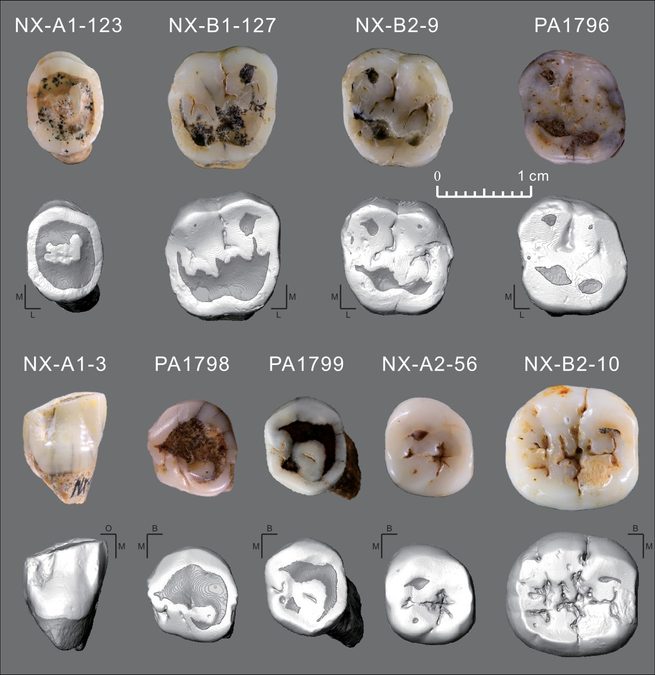
New Fossils Reveal Two Secrets About The Home of Homo Erectus
The nine hominin teeth found in the caves. All but PA1796 were definitively linked to Homo erectus. (Professor Kira Westaway/Macquarie University)

In one study, an international team of scientists closely examined the teeth, and found that eight of them “show a combination of features usually found in H. erectus specimens”. 

Next, the team analyzed proteins in five of the teeth, and found that four of them had a protein pattern linked to Homo erectus. 

That said, there was one tiny change which led the researchers to conclude that “these specimens represent a previously unsampled H. erectus population.”

One tooth, however, didn’t quite fit the bill, with neither its physical features nor protein profile matching Homo erectus. It also didn’t seem to be from a Neanderthal or modern human either. 

There’s a chance it’s from a Denisovan – it doesn’t match that protein sequence either, but there’s only one reference genome available for that species, so it could just be that we don’t have enough data, the team says.

Whatever it is, the strange tooth suggests that H. erectus wasn’t the only hominin in the area at the time.

Speaking of time, one of the most surprising finds was that these teeth are far younger than expected. Radiometric dating of the fossils and the sediments they were buried in indicated they were between 184,000 and 324,000 years old.

The fossil record for H. erectus in China is pretty rich and detailed for more than a million years – but it almost completely dries up around 400,000 years ago. The new specimens indicate the hominin survived in the area for much longer than previously thought.

The second study dug into how Homo erectus might have hung on for those extra millennia. By that time, the environment had shifted from its preferred grassland home to thick, tropical rainforests – a habitat thought homely only to Homo sapiens.

The team analyzed the isotopes and trace elements of some of the teeth to find out where their owners had hailed from, and what kinds of foods they’d eaten in life. 

Sure enough, the carbon in their teeth came mostly from the vegetation of tropical forests with a dense, closed canopy. That’s consistent with other fossil evidence showing that was the dominant environment in that place and time.

“This demonstrates that H. erectus was, at minimum, capable of persisting among rainforest fauna, even if such habitats did not represent its optimal ecological niche,” the researchers write.
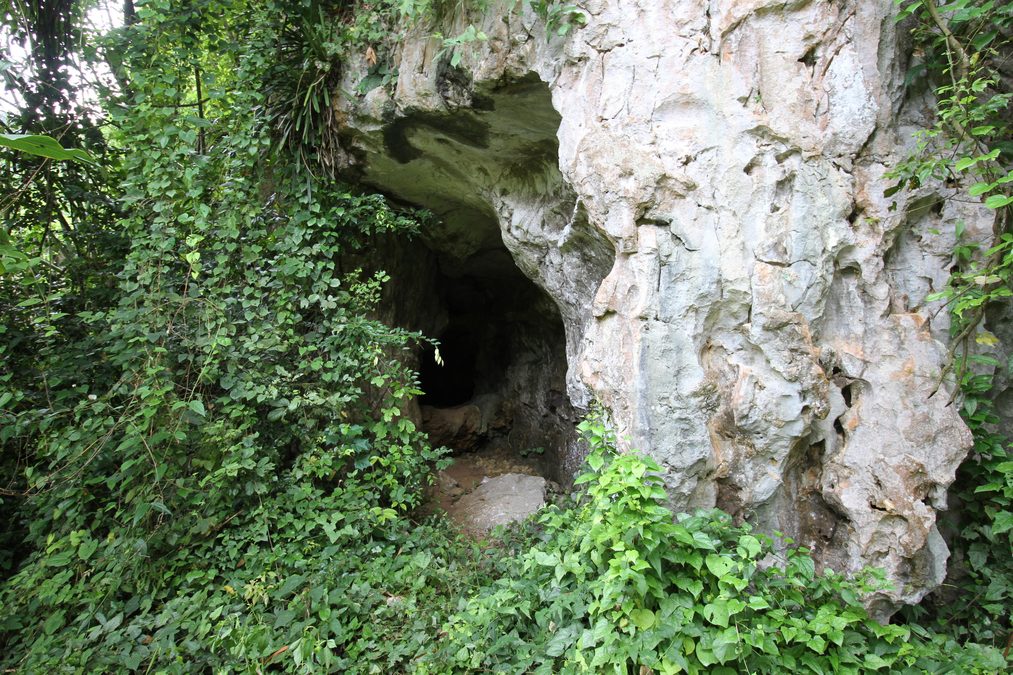
New Fossils Reveal Two Secrets About The Home of Homo Erectus
The mouth of Naxian cave, which contains a fossil chamber just 50 meters inside. (Professor Kira Westaway/Macquarie University)

Analysis of the strontium isotopes in the teeth revealed that this less-than-ideal environment didn’t ruin their travel plans.

They seemed to have migrated at times, possibly traveling as far away as what is now northern Vietnam – some 250 kilometers (155 miles) away from the caves where their remains were found.

The bottom line is that there’s always more to learn about our own family history – and we shouldn’t underestimate our ancestors.

“Rather than being restricted to open savanna or woodland habitats, as traditionally assumed, these populations persisted in closed-canopy tropical rainforests while simultaneously engaging in potential long-distance mobility across diverse ecological and geological landscapes,” the researchers write.

Both studies were published in the journal Nature.

This article was fact-checked by Fiona MacDonald and edited by Fiona MacDonald. While we pride ourselves on our process, we are only human. If you spot a mistake, please let us know.


Source link

Previous Post
Why Can Some People Lower Their Cholesterol Through Dieting While Others Can’t?

Why Can Some People Lower Their Cholesterol Through Dieting While Others Can’t?

Next Post
Scientists Show Earth’s Magnetic Field Helps Guide Moths in Massive Australian Migration

Scientists Show Earth's Magnetic Field Helps Guide Moths in Massive Australian Migration