




And even when the external world has granted all it can, there still remain the searchings of the mind and the longings of the heart.
—Arthur C. Clarke, Childhood’s End, 1953
As the world attempts to bring artificial intelligence into focus, it is hard to think of a modern scientific project with a wider range of implications for the future. Some hold that AI has already reached its maximum capabilities, while others maintain that we stand at the beginning of an exponentially expanding demigod, a singularity, the point beyond which it will be impossible for humans to comprehend the accelerating insights of a “super intelligence.”
If the more radical proposition holds, that a singularity is afoot, then the assumption is that everything we do, and even things we cannot dream of, will soon be done by machines. For science, this means that the utilitarian problems we seek to solve will be solved at ever faster rates by machines. What does this mean for scientists? Will there be anything left to do, or are scientists out of jobs?
Read more: “The Thrill of Science in 2042”
Astrobiologists must confront a similar thought that is discouraging for people who have dedicated their lives to discovery: What if an alien civilization somewhere out there has already come to know all the mysteries we hope to discover? More poignantly, what if such a species landed on our planet with all of their knowledge in hand (or in tentacle, or in ever-shifting amorphous goo)?
Well, there would be quite a lot of work to do. Communication with such a creature would be a challenge in itself. After that, considerable effort would be required to learn what they know. Such learning might proceed in stages and might take generations. There might be types of knowledge that do not overlap with ours for cultural and philosophical reasons, and we would need to debate the meaning of such differences with ourselves and perhaps with them. Our lives would be anything but boring, and the amount of interesting work to do might even expand.
Many AI researchers think that such an alien is about to land on, or rather grow out of, our planet. An intelligence that is alien both by virtue of the vastness of its knowledge base and the incomprehensibility of its solutions. Many assume that such a creature will rapidly eliminate the need for scientists, but this presumption focuses only on the utilitarian aspects of science—the idea that science is about producing solutions that are useful to society, typically expressed in economic terms.
Indeed, science triumphed in its utility as it contributed to medicine, a greater abundance of crops, aerospace transportation, digital computers, the internet, magnetic resonance imaging, and, perhaps, large language models. All perfectly adhering to the “Endless Frontier” predicted in postwar America. Utilitarianism is a good reason to invest in science, but it is shaky ground for a deep philosophy about the meaning of science. Technology is largely about optimizing on a task, science seeks something deeper, and this is often the pursuit of understanding, whose long-term benefits are impossible to predict. Even with tools in hand, such as AI, our focus should be on the challenge and meaning of engaging in tool-assisted activities as human beings. Consider the board games chess and Go, the marathon, and the mechanical watch.
In 1997, Deep Blue played, and beat, Garry Kasparov, widely considered one of the greatest players the game has known. In 2016, AlphaGo defeated Lee Sedol, the strongest Go player the world had ever seen. By 2017, AlphaZero had taught itself in nine hours to play chess at a level no human will ever match. The outcome was not the collapse of chess. On the contrary, more people play chess now than at any point in its history. Chess.com surpassed 150 million members in the post-AlphaZero era, and over-the-board tournament participation has grown in parallel. Top grandmasters now study with game engines, and tellingly, the engines have become coaches rather than replacements. The grandmaster’s relationship with the chess engine sharpened the grandmaster’s game, rather than retire the player. The moves played in human tournaments are the player’s own, and the game’s meaning is that of the players, not of the silicon that has long since outclassed them.
The fastest car in the world, the Bugatti Chiron, can complete the 26.2 miles of a marathon in around 12 minutes. Near-superhuman world record holder Sebastian Sawe, who completed the London Marathon in 1 hour, 59 minutes, and 30 seconds, is ten times slower than the car. No one watching Sawe would conclude that the car is faster than humans. The marathon was never a means of transport. It is a challenge to the body, and the physiological question is, how far can we push the flesh before it fails?
Seiko introduced the first quartz watch in 1969. The Seiko Astron was accurate to within a few seconds per month, far more accurate than any mechanical watch of the time. The mechanical watch was on the verge of extinction, and the Swiss watch industry was decimated by the so-called “quartz crisis” of the 1970s. However, the industry survived and flourished by creating ever more complex and ingenious mechanical timepieces. The tourbillon, for example, was invented in 1795 to compensate for gravity in pocket watches. Today, there are many wristwatches with a tourbillon that serve no purpose other than to demonstrate the skills of the watchmaker.
The pattern discernible across these three examples is a transition from the belief that utility is the unique metric of progress to the deeper understanding that what we care about is craft and meaning. The utility of the activity might have been an original focus, but people came to realize that what they more profoundly cared about was the craft, style, and meaning of the activity. And mastering the activity was measured against the tradition in which one was practicing. And from this constellation of craft, style, and meaning derives the very practical principles of curiosity, search, and abduction, from which truly novel discovery derives.
And similar epistemic disruption has already occurred in history. The separation of natural philosophy into natural science and philosophy, which can be compared with the breakup of the Beatles, the forced exile of Romeo from Verona, or the disintegration of the 1997–98 Chicago Bulls.
Scientists might say that we no longer need to be mystified by matter, as we can measure it, we can have theories about it, and we can even make predictions about it. Yet philosophers are not deterred by this progress, many new details and measurements which science has provided, have opened new territory for philosophy, making the philosophical problems of the nature of matter and the universe more expansive. Thus, for example, the strangeness of quantum mechanics led to so many deep philosophical questions that the physicists started to tell each other to “shut up and calculate” and to stop worrying about the strangeness of the quantum world and instead to use the mathematical tools of quantum mechanics. But the philosophers, of course, have continued to ponder over the problems of quantum mechanics, to the point of making quantum foundations an important part of fundamental physics.
If AI were to reach the singularity, and solve hard problem after hard problem exponentially, then we would be left to explore the frontiers of our most immediate problems and be astrobiologists post-contact or philosophers’ post-science. Humans would be trying to make sense of other humans, and the rest of life in the universe. After all, early Western scientists saw their task as understanding the mind of God, and they were not discouraged by the assumption that something supernatural already knew the answers to their questions. If anything, the belief in a designer gave them hope that there were rules to be uncovered. If AI were to go singular, it would do so at a rate that we cannot keep up with, and in a language that we do not, or cannot, understand. As our colleague Ted Chiang has observed, we may face a world of hermeneutics, in which we are constantly trying to decipher AI’s progress, communications, and actions.
As science changes, so too must our understanding of how to do it. The watchmaker’s case of the quartz movement which, by making accurate timekeeping so cheap and so universal, forced the mechanical watch into more elaborate and creative products of human hand and ingenuity, suggests that as science is relieved of the burden of the next predictive equation or of the next molecular structure, it can turn its attention to what science has always done underneath the surface of these things—namely to ask what on earth do these things mean?
Perhaps the most impressive example of how the pursuit of understanding can be successful is the history of neural networks themselves. Frank Rosenblatt, an American psychologist, was one of the pioneers of neural networks. In 1958, he described how a machine could learn by adjusting the weights of its connections in the same way as the brain adjusts the synapses between its neurons. However, in 1969, Marvin Minsky and Seymour Papert wrote the book Perceptrons in which they described neural networks as an interesting object of scientific study but a sterile direction of applied research into intelligence. For these and other reasons in the 1970s, neural networks fell out of favor in computer science, a so-called “AI winter.”
Geoffrey Hinton, who won the 2024 Nobel Prize in Physics for his work on neural networks, was discouraged by his PhD supervisor from working with them, suggesting that it would be a waste of time and effort. Hinton persevered under the belief that intelligence machines should learn bottom-up from the record of human behavior, and not top-down from definitions and abstractions of analytical reasoning. The project has been so successful that Hinton has become one of the most outspoken proponents of AI safety arguing for the regulation and slow-down of AI research.
In a further twist, much recent progress in AI has been driven by the application of GPUS (Graphic Processing Units) and TPUS (Tensor Processing Units) to training new Deep Neural Network architectures, neither of which were originally developed for AI application. GPUS were designed to solve the problems of real-time 3D graphics rendering in computer games, and TPUS are derived from Systolic Array technology invented to minimize memory bottlenecks in parallel computing. The application of these technologies to AI required an understanding that what all these problems had in common was the need for large matrix multiplications. The mathematical field of linear algebra, with its unifying concepts, is the glue connecting entertainment to edification.
The science of AI itself needs rethinking. If psychology had a replication crisis of some sort, where separate labs failed to replicate results, we face a replication catastrophe in AI research. Most methods are custom one-offs, applied to ever-changing, mostly proprietary models, part of a huge zoo of possibilities. Most studies are unconnected ephemera, disappearing in a distributed landscape. We need to make meaning, not only among machines, but of machines. It is still an open question how fully we can translate between different intelligences, even in a world without gods. It remains to be seen how well we can even understand what it is like to be a bat. Meaning making remains a human endeavor, even if some new intelligent species provides us with things and solves problems for us.
Whether the AI we have is all we get, or whether we come to inhabit a post-singularity world, there will be much to do. Thinkers of all types are needed now more than ever. At the very least, an individual must make meaning from new machine assisted discoveries: It is one thing to discover a new behavioral or pharmacological intervention, and altogether another challenge to verify, test for safety, educate, and diffuse the discovery into a complex society. It is of even greater importance to discuss, contextualize, and philosophize new discoveries, all activities without end. Perhaps we are back to the Greek ideal of eudaimonia —living among gods while living meaningful lives. The marathoner does not stop running because the car is faster, she runs because the running was always the point.
Enjoying Nautilus? Subscribe to our free newsletter.
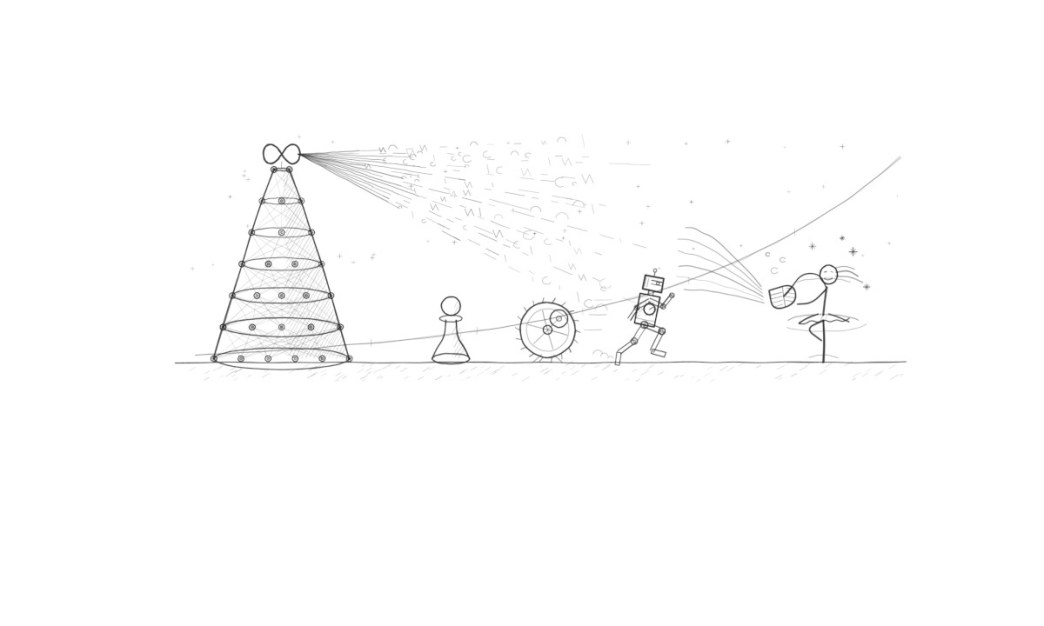
Lead Image: David C. Krakauer


