







Most of the matter in the Universe is completely invisible to our telescopes.
A galaxy spinning much faster than it should here. A suspiciously bulging pocket of spacetime there.
These are the calling cards of dark matter – a mysterious something producing gravity utterly disproportionate to the amount of normal matter we can see.
What is this invisible stuff? No one knows, although there are many theories. Whatever it is, however, there’s a lot of it. Based on its gravitational influence, there’s about five times as much of it as there is normal matter.
In a new attempt to bring it to heel, a team of physicists in the US and Canada has penned an absolute monster treatise proposing a new periodic table of dark matter – a shadowy counterpart to the periodic table of normal elements.
And it could help explain the ratio of normal matter to dark matter – as well as why it might not be a coincidence at all.
“The matter coincidence remains the strongest empirical indication that the visible and dark sectors may be connected non-gravitationally,” reads a study led by physicist Pouya Asadi of the University of California, Santa Cruz, uploaded to preprint server arXiv.
frameborder=”0″ allow=”accelerometer; autoplay; clipboard-write; encrypted-media; gyroscope; picture-in-picture; web-share” referrerpolicy=”strict-origin-when-cross-origin” allowfullscreen>
Although five times as much dark matter might sound like a huge difference, the two quantities are surprisingly close. They’re within an order of magnitude of each other – and there is, as far as we know, no reason for them to be.
This is known as the matter coincidence problem, and it’s been a persistent thorn in the side of physicists trying to understand the nature of dark matter.
But if matter and dark matter are somehow related, the matter coincidence might not be a coincidence – it could just be a natural consequence of their shared origin.
Or, as Asadi and his colleagues put it: “That the two sectors nevertheless end up with energy densities within a factor of a few could therefore be an important clue pointing towards a common origin of visible and dark matter abundances.”
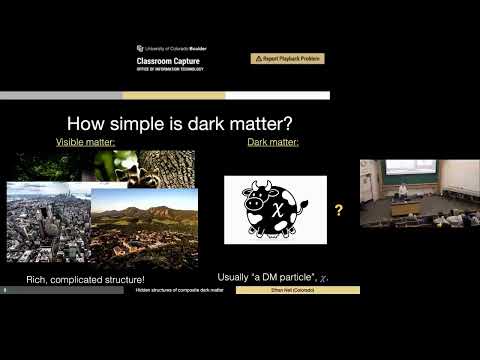
That’s a tantalizing prospect, but there’s just one problem. Many of the most widely studied dark matter candidates are very simple – a single type of particle, for example.
To explain the abundance similarity, a much more complicated set of ingredients may be required.
One possibility is that dark matter isn’t just a single mysterious particle, but an entire hidden family of particles and forces – a sort of mirror image of the familiar matter that makes up our Universe.
This idea underpins a theory known as the Mirror Twin Higgs – sort of the evil twin of the Standard Model, and the framework the researchers used to investigate what particles get up to when no one can see them do it.
The critical component is symmetry.
In the Mirror Twin Higgs, the two sectors – matter and dark matter – aren’t entirely independent, but are linked by a mathematical symmetry that relates the properties of their particles and forces. This link means that the relative masses of each sector might also be related.
frameborder=”0″ allow=”accelerometer; autoplay; clipboard-write; encrypted-media; gyroscope; picture-in-picture; web-share” referrerpolicy=”strict-origin-when-cross-origin” allowfullscreen>
In the scenario explored by Asadi and his colleagues, dark neutrons, which make up most of the dark matter, are around five times as massive as ordinary protons. If the early Universe produced roughly equal numbers of each, the result would be five times as much dark matter.
Suddenly, the mysterious ratio starts to make sense.
But this hypothetical mirror universe isn’t a perfect reflection of our own. And one of the differences has some rather provocative implications for its chemistry.
In our Universe, neutrons are slightly heavier than protons. Left to their own devices, free neutrons decay into protons, but protons are stable.
In the researchers’ mirror version, the relationship is reversed. Dark neutrons are lighter than dark protons, making neutrons the stable building blocks of most dark matter.
This raises an interesting new question. If the stability relationship is reversed, can protons and neutrons still combine to form stable atomic nuclei?
Surprisingly, the answer is yes.
According to the researchers’ calculations, the mirror universe could produce its own limited catalog of dark-matter versions of the chemical elements we know and love.
Depending on the conditions, these could include dark versions of helium, lithium, beryllium, boron, and even carbon.
In fact, under some conditions, the heaviest element that can form could account for most of the dark atoms – meaning a dark atomic population dominated by dark carbon is theoretically possible.
But there are some curious omissions. Hydrogen, the simplest and most abundant element in our Universe, would be unstable in the researchers’ mirror universe.
Because dark protons and dark electrons have opposite charges, they attract each other. And since dark neutrons are lighter than dark protons, a dark proton can capture an electron and turn into a neutron, destroying the hydrogen atom.
In our Universe, the same transformation would require additional energy, so ordinary hydrogen remains stable.
However, heavy hydrogen – deuterium – contains an additional neutron, which changes the energy balance and could allow it to survive in the dark matter universe.
The notion of dark elements is heady enough, but it has an even stranger repercussion. If dark particles can coalesce into atoms, those atoms might be able to form something even more complex.
The researchers suggest that heavier dark elements could potentially crystallize into solids, or even form tiny grains of dark dust.
Like ordinary cosmic dust, these grains could drift through space – but unlike ordinary dust, they would interact with their own dark version of light, rendering them invisible to conventional telescopes – an entire goth universe, darker than anything we could imagine.
And the possibilities don’t end there. The researchers even raise the prospect of mirror stars – hypothetical stellar objects made of dark matter that could be far smaller and denser than the stars illuminating our own Universe.
For now, of course, this aggregation of shadows remains hypothetical. But the researchers have identified ways we might be able to detect its presence – even if we can never see it directly.
One possibility lies in the way matter is distributed across the Universe.
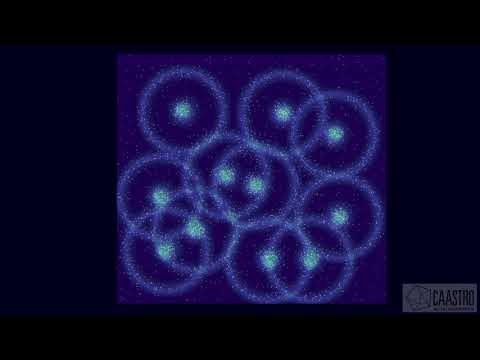
In the early cosmos, interactions between dark particles and dark radiation could have generated waves that left subtle imprints on the structure of the Universe today – analogous to the baryon acoustic oscillations, or BAO, in the normal Universe.
frameborder=”0″ allow=”accelerometer; autoplay; clipboard-write; encrypted-media; gyroscope; picture-in-picture; web-share” referrerpolicy=”strict-origin-when-cross-origin” allowfullscreen>
These are fossilized remnants of acoustic waves that traveled through the dense plasma of matter and light in the early Universe.
When the cosmos became transparent around 380,000 years after the Big Bang, the waves froze, leaving a subtle pattern in the distribution of matter: faint, circle-shaped overdensities about a billion light-years in diameter.
The researchers call the dark universe counterparts of these traces dark acoustic oscillations, or DAO, and suggest that their imprint might lie in the distribution of dark matter throughout the cosmos.
Unlike ordinary acoustic oscillations, however, the dark version could occur in two distinct stages, as different dark particles stopped interacting with one another. That two-part signature could provide a way to distinguish this particular model from other explanations for dark matter.
The researchers also suggest that future particle detectors might be sensitive enough to register the faint interactions between dark matter and ordinary matter, potentially revealing multiple dark particles with different masses.
Of course, like all other dark matter models, this one remains unconfirmed. But it’s foundational work like this that will support future efforts to identify the culprit.
“Our work constitutes the first detailed, systematic exploration of the combined nuclear, cosmological, and observational consequences of this class of models,” the researchers write.
“It demonstrates that a viable twin-neutron dark sector need not be phenomenologically sterile: a small, cosmologically selected nuclear and atomic component can provide observable traces of the underlying connection between flavor, naturalness, and dark matter.”
The research is available on preprint server arXiv.
This article was fact-checked by Peter Dockrill and edited by Peter Dockrill. While we pride ourselves on our process, we are only human. If you spot a mistake, please let us know.


