





The geometry of the bog-standard black hole is probably pretty familiar to you: a spherical region of space defined by light’s inability to escape it.
But the equations we use to describe our reality aren’t as strict as the reality itself seems to be. Einstein’s theory of general relativity works excellently to describe spacetime… but it does also allow some far stranger versions of it to exist.
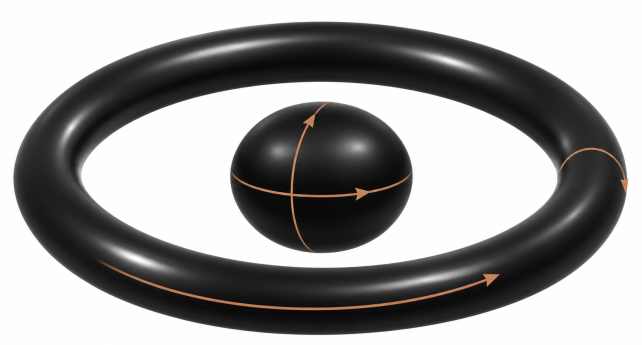
One such oddity is a five-dimensional black hole that does, in fact, have a hole – one shaped like a donut, or torus. And a second black hole can be plopped in the center, a configuration theoretical physicists call the Black Saturn.
The first mathematical description of a Black Saturn was published in 2007, but with a limitation: the two black holes could only rotate in one plane.
In five-dimensional spacetime, however, objects can rotate in two independent planes at once. Accounting for both rotations would allow physicists to explore configurations that the original solution couldn’t – but the mathematics is considerably more complicated.
Theoretical physicist Jay Armas of the University of Amsterdam has now picked up that gauntlet.
In a preprint uploaded to arXiv, he has laid out a mathematical solution that allows the Black Saturn to rotate in both planes, opening up new possibilities for exploring the strange behavior of gravity in higher-dimensional spacetime.
“The space of black holes in higher-dimensional vacuum gravity is richer than its four-dimensional counterpart,” he writes.
The spacetime we currently inhabit has, as far as we know, four dimensions – three spatial, and one temporal. Everything within it is governed by the laws of physics as they operate in those four dimensions.
Add one extra spatial dimension, however, and the rules shift. It’s not that general relativity has changed; the same underlying principles still apply. But the addition of another dimension permits solutions and geometries that aren’t available in just four dimensions.
In a five-dimensional spacetime, Einstein’s equations allow a ring-shaped event horizon to exist. Suddenly, Black Saturns are a thing.
These bizarre objects consist of two separate black holes: a spherical one in the center, and a ring-shaped one encircling it. Each has its own event horizon, the boundary beyond which escaping the black hole would require traveling faster than light (which is impossible).
The ring is held in a delicate balance by its rotation. Without sufficient angular momentum, its own gravity would cause it to collapse; spinning allows it to maintain its unusual shape. Meanwhile, the spherical black hole it girdles is more like the four-dimensional versions we know and love.
But the two black holes aren’t entirely independent. Both exist within the same spacetime, and, as with four-dimensional black holes, their gravitational influence extends beyond their event horizons.
So, as they rotate, they can drag the surrounding spacetime along with them, a phenomenon known as frame dragging.
In his new solution, Armas has mathematically described a Black Saturn where both black holes can rotate in both independent planes. It’s elegant work.
But that’s far from the sum total of it. The possibilities it reveals – inaccessible in the previous uniplanar model – enter into the realm of the truly bizarre.
For example, black holes have limits to how much angular momentum they can possess relative to their mass. When a black hole reaches that limit, it enters a state known as extremality, in which its Hawking temperature drops to absolute zero.
That means it emits none of the Hawking radiation generated by quantum interactions near the event horizon.

frameborder=”0″ allow=”accelerometer; autoplay; clipboard-write; encrypted-media; gyroscope; picture-in-picture; web-share” referrerpolicy=”strict-origin-when-cross-origin” allowfullscreen>
In five-dimensional spacetime, however, a black hole needs to rotate in both independent planes to reach extremality without its event horizon disappearing altogether.
Armas’s solution shows that both black holes in a Black Saturn can reach extremality simultaneously, each retaining its own event horizon.
It’s the first known exact mathematical solution to Einstein’s equations showing that two separate black holes can exist together in this state in an otherwise empty five-dimensional spacetime.
But even though both black holes have a Hawking temperature of absolute zero, they can’t achieve complete equilibrium.
That’s because equilibrium also requires their rotations to match in both planes – something Armas found they cannot do while maintaining a regular Black Saturn configuration.
Here’s the really delicious part. Each black hole can have its own intrinsic rotation – but because they drag on the spacetime around them, the surrounding ring can induce a rotation of the central black hole’s event horizon, even in a plane where that black hole has no angular momentum of its own.
Of course, there’s no evidence that Black Saturns actually exist, or that our Universe is somehow hiding the extra spatial dimension needed to accommodate them.
But solutions like this offer physicists a way to explore the possibilities of general relativity – put earlier predictions to new tests, and investigate how gravity behaves under conditions vastly different from those we observe.
Armas’s work also lays the groundwork for future research into the behavior of light and matter around these strange configurations, and even the geometry of the spacetime inside their event horizons.
And it leaves us with the dream of a strange realm beyond our ken, full of black hole donuts and their black hole donut holes.
That, and an absolute rip-snorter of a symphonic metal band name.
The paper is available on arXiv.
This article was fact-checked by Fiona MacDonald and edited by Fiona MacDonald. While we pride ourselves on our process, we are only human. If you spot a mistake, please let us know.


