




It was my turn to watch for polar bears, though I wasn’t entirely sure what watching for one on a hot beach in summer was supposed to look like. Around me, on a tiny island in James Bay in Quebec, Canada, the field team moved with practiced efficiency, unspooling barbed wire and setting up a camera trap. I found an elevated spot on the warm ground, and periodically glanced over my shoulder at the dense, low-slung pine forest behind us. Arctic terns darted like paper planes above our heads. Beluga whales crested against the horizon.
“Don’t worry, the bears are probably asleep right now,” Harry Erless, squinting into the midday sun, assured me. Erless, gregarious as he is knowledgeable, is an experienced ranger and trapper of the Cree Nation of Waskaganish, an Indigenous community on the southeast shore of James Bay.
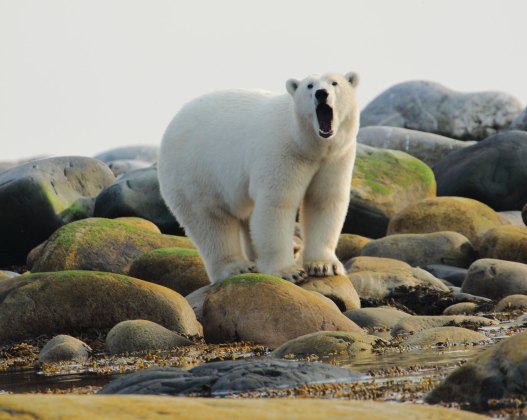
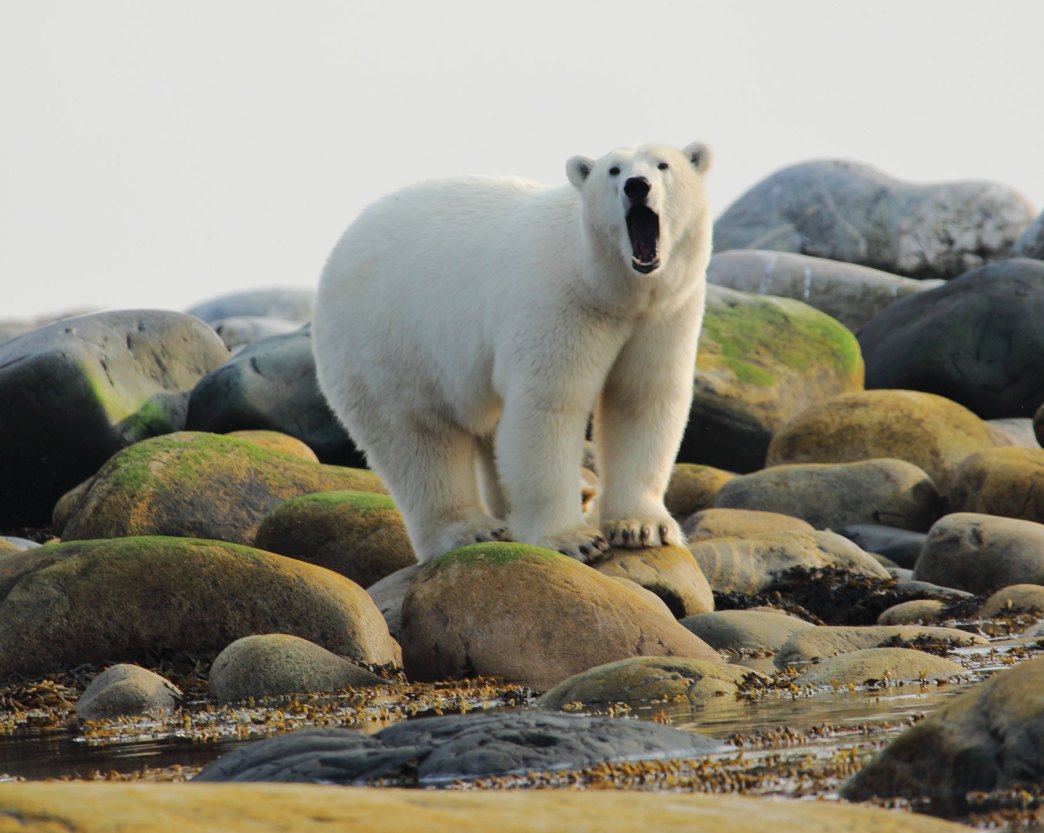
The scene felt entirely upside-down, and not just because I have never seen a polar bear in the wild. I had trouble picturing one here in the first place. This area, known as the Eeyou Marine Region, lies at the southernmost fringe of the polar bears’ global range, at roughly the same latitude as London, England. By every standard ecological narrative, polar bears should be disappearing from here. With warming global temperatures, the Eeyou Marine Region is seeing a trend toward longer summers and earlier sea ice breakup in the bay. Yet what brought me here was news of a paradox: The polar bears appear to be thriving.
In July 2026, I traveled to Waskaganish to learn more about this apparent contradiction. Since 2021, local Cree trappers and wildlife scientists have been building a partnership that pairs traditional Indigenous knowledge with Western field science. Their project offers a hopeful new framework for conservation in a rapidly changing Arctic.
“Our main objective with this work is to prevent conflict,” Sanford Diamond, son of a former chief of the Cree Nation of Waskaganish, told me shortly before we set out. From the Cree perspective, the true peril of a warming bay is that polar bears, unable to hunt on ice, are forced to spend more time on shore and come into increasing contact with coastal communities.
“Our people, we don’t harvest something when we don’t eat it. And we don’t eat the polar bear,” Diamond told me. But defense-of-life kills become unavoidable when a bear threatens human safety or property. The risk is highest during the annual spring goose hunt, when hunters and bears converge on the islands near the mainland.
For the scientists, the central question is: What makes this southernmost population of polar bears appear so resilient?
“It seems like there’s something special about James Bay that’s allowing bears to persist,” said Alexandra Langwieder, a doctoral researcher at McGill University who leads the scientific side of the project. Despite the diminishing ice, the bay and its small islands may offer the bears easy posts to prey on seals. They could also be feeding on terrestrial mammals like beavers and scavenging on carcasses of larger animals like caribou and belugas.
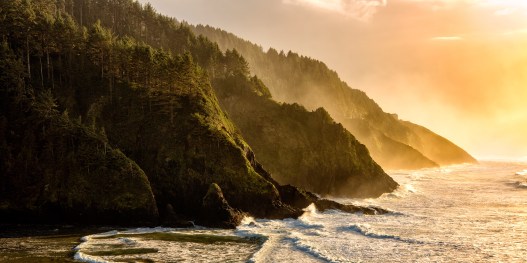
I spent a whole day zipping around the bay with the project’s field team, deploying polar bear monitoring stations scattered across 250 miles of the Eeyou Marine Region. We crisscrossed the east side of the bay in two open fiberglass fishing boats, the sound of our engines bouncing across the still water. It was a stunning clear day, with deep-blue skies and the shallow bay lying open like a dish.
I joined Eeyou Marine Region Wildlife Board scientist Manon Sorais in the boat captained by Erless, who navigated the vast expanse seamlessly by sight, reading water currents and subtle shifts in wind. His childhood friend and fellow trapper Bernard Diamond followed closely in the second boat with Sorais’ colleague, Félix Boulanger.
I watched as Bernard Diamond collected driftwood while Erless unspooled a coil of barbed wire. Working in a 10-foot triangle, he strung the wire hip-high across three steel T-posts pounded into the tundra substrate. In the center, Diamond liberally coated the driftwood with a pungent mixture of commercial fish oil and fryer grease, stacking rocks over it so the summer rain wouldn’t wash the scent away. This is to lure the polar bears. A few feet off the perimeter, Sorais and Boulanger hammered a fourth post to mount a motion-activated Reconyx camera inside a steel security box.
Such a design for monitoring polar bears is simple, elegant, and entirely noninvasive. When a curious bear steps into the triangle to sniff the lure, its flank brushes the wire, leaving behind a few strands of fur before it wanders off unharmed. Camera footage helps scientists identify the sex of the bear and provides a quick visual assessment of condition.
For decades, polar bear research meant chasing animals in low-flying helicopters, shooting them with tranquilizer darts, and strapping on radio collars—a practice long opposed by northern Indigenous communities concerned about animal welfare. By contrast, this network of monitoring stations, co-designed by Cree trappers and Langwieder, offers a community-led alternative that respects Indigenous sovereignty while yielding precise scientific data.
The hair snagged by the barbed wire is a gold mine of information. “We chop off the root of the hair to get the genetics, and we use the rest of the shaft for stable isotope analysis,” Langwieder told me. “That represents the diet while the hair is growing.”
This biochemical timeline captures the critical months when bears feed most actively to fatten up for winter or denning. Conventional ecological wisdom holds that bears forced ashore are essentially fasting, losing between 2 and 4.5 pounds of body mass per day without blubber-rich marine prey. By measuring isotope signatures, scientists can address the central paradox of why polar bears in the Eeyou Marine Region appear so healthy despite spending less time on the ice—pinpointing whether they successfully hunted marine mammals during this period or were forced to dine on terrestrial alternatives.
Since the project launched, hair snares and camera traps have cataloged 94 individual bears across the Eeyou Marine Region, with an even split between males and females. Visually, the data reveal a population that is well-fed. Using a standardized five-point fatness index, scientists found that nearly 80 percent of the bears photographed on these islands scored as “average” or “visibly fat.”
“A lot of it is related to fat on key points of the body—the shoulder, the hip, how low the belly is. It’s a qualitative measure of condition,” Langwieder explained.
However, she cautions against reading too much into this data. While early summer fat stores look promising, they cannot shield bears from the severe late-season depletion that lies ahead.
“It’s not hard to find healthy polar bears at the start of summer almost anywhere,” Langwieder said. The broader Southern Hudson Bay subpopulation of bears (of which the Eeyou Marine Region is one small part) reflects a sobering trend: Driven by an ice-free season that has expanded by up to a month since the 1980s, bear numbers have dropped by 17 percent between 2011 and 2016 alongside a steady, long-term decline in body condition.
What looks more promising, Langwieder said, are field observations in the Eeyou Marine Region of females accompanied by healthy cubs—including rare sightings of triplet litters, a biological luxury usually reserved for regions with prime, stable sea ice. “We see cubs every year—quite a few cubs,” Langwieder said.
At our next mooring, Erless took a moment to smoke a cigarette by the boat, and I hung back with him. He pointed out a deep hollow scooped into the embankment right at the water’s edge. “Do you see this blind?” he asked. “This is a polar bear blind, and you can see where they dug. They wait here for a seal, patiently, and that’s where they hunt.”
Observations like this offer a compelling explanation for why the bear population appears healthy despite a rapidly shrinking ice season in the Eeyou Marine Region. Perhaps the bears hunt seals from shorelines, adapting their predation techniques to bypass the need for ice floes. Local land users have observed bears stalking Canada geese, plundering bird nests for eggs, harvesting beavers, swimming after caribou, and scavenging beluga whale carcasses.
Later, I put the idea that polar bears could adapt to a land-based existence to Gregory Thiemann, professor of Arctic ecology at York University in Toronto and member of the IUCN Polar Bear Specialist Group. He was quick to offer a sharp reality check. “Polar bears need sea ice,” he said. “In the absence of sea ice, there are no polar bears. And the evidence for that is the fact that where there’s sea ice, there’s polar bears, and where there’s no sea ice, there’s no polar bears.”
Genetically, polar bears (Ursus maritimus) split from brown bears (Ursus arctos) relatively recently in evolutionary history, remaining close enough to interbreed and produce fertile hybrids, Thiemann explained. But ecologically, they are entirely distinct. While brown bears thrive on land, polar bears are marine mammals whose entire physiology, fat storage, and hunting strategy evolved around sea ice.
Thiemann cautioned against mistaking opportunistic foraging for long-term population adaptation. He is not surprised by reports from Cree community members that bears have been seen hunting on land.
“Polar bears will eat everything they can because they’re bears,” Thiemann said. “They’ll eat beavers, snow goose eggs, garbage, and Ski-Doo seats. But none of these terrestrial foods can sustain a population of polar bears—full stop.” If land-based calories could support a 1,000-pound marine carnivore, Thiemann argued, an ecological niche would exist for large coastal brown bears along Hudson Bay. But where brown bears overlap with tundra habitat, they are small and scrawny, scraping by on ground squirrels and roots.
In the scientific literature, roughly 180 days a year without sea ice is widely recognized as the critical biological threshold beyond which adult polar bear survival drops sharply. However, the exact limit depends on sex, age, body condition, and reproductive status, Thiemann said. Individual bears vary widely in their hunting habits and tolerance to sea ice loss.
In the Eeyou Marine Region, polar bears are surviving right up against that theoretical limit. While seasonal ice cover varies widely from year to year, multiple years since the start of the century have recorded 175 to 180 ice-free days in the year. The growing fear is that current observations of healthy bears in James Bay are just a temporary anomaly, a reprieve in time, before inevitable further erosion of the regional population. “We will see a range contraction, and we will lose bears,” Thiemann said.
But the polar bears in the Eeyou Marine Region are not the only quirky population that appears to defy climate-based survival projections. In 2022, a study from southeastern Greenland documented an isolated enclave of polar bears—roughly numbering 200 animals—that bypassed the use of seasonal sea ice altogether. Their habitat currently experiences an annual ice-free period that exceeds the estimated fasting threshold for the species by more than 100 days. Researchers established that rather than forage on sea ice, the bears survive by hunting seals year-round at the terminus of glaciers.
Despite the rapidly warming climate, Thiemann thinks it is too early to be fatalistic about the fate of polar bears in the Eeyou Marine Region. “The outlook certainly isn’t positive right now, but that doesn’t mean we shouldn’t do everything we can to help conserve them,” he said.
Langwieder is hopeful given her preliminary analyses of diet based on the snagged hair. “I have the raw data, and it does seem that the bears are feeding from the marine system rather than the terrestrial system,” she told me. She is preparing to submit the results for publication. If accurate, her work would support observations by the Cree community that bears are successfully foraging seals despite loss of sea ice, demonstrating resilience and adaptation.
Thiemann believes there is great value in the partnership between Langwieder’s team at McGill University, the Eeyou Marine Wildlife Board, and the Cree Trappers Association. “The project will likely have important implications for human-polar bear coexistence,” Thiemann told me. “If changing habitat conditions increase nutritional stress on bears, they may be more likely to come into coastal communities looking for food. If you know where, when, and what bears are eating, you may be better able to predict and mitigate conflict and benefit conservation.” This is precisely the sentiment of the Cree trappers. “The last bear we killed was in 2018. We didn’t like doing it,” Sanford Diamond told me.
Whatever lies ahead for the polar bears of the Eeyou Marine Region, the partnership between Cree trappers and scientists stands as a vital success. It offers something increasingly rare: a practical, ground-level framework for weaving distinct ways of knowing into modern conservation.
On our final stop, with the sun setting in a blaze of fire against the horizon, Erless recalled to me a similar evening in 2018, not too far from where we were standing. He was out on his knees picking wild cranberries, accompanied only by his son’s dog, when he felt the sudden prickle of being watched.
“I looked around at the rocks,” Erless told me. “It’s hard to tell because the rocks are white, but then I saw his head pop up. A big polar bear, watching me from about 300 meters away.” Erless kept his rifle close, but neither man nor bear moved aggressively. “He didn’t bother me, so I didn’t bother him. I just kept picking my cranberries.” He lit another cigarette and added jokingly, “You know, he probably knows me by this thing”—and motioned to the smoke drifting up and away from his hand.
Reporting for this article was made possible by an award from the Institute for Journalism and Natural Resources.
Enjoying Nautilus? Subscribe to our free newsletter.
Lead Image: Sanford Diamond


