
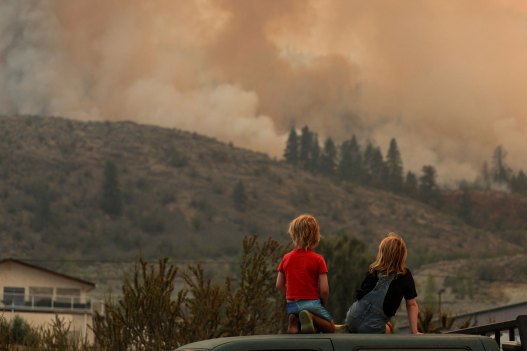




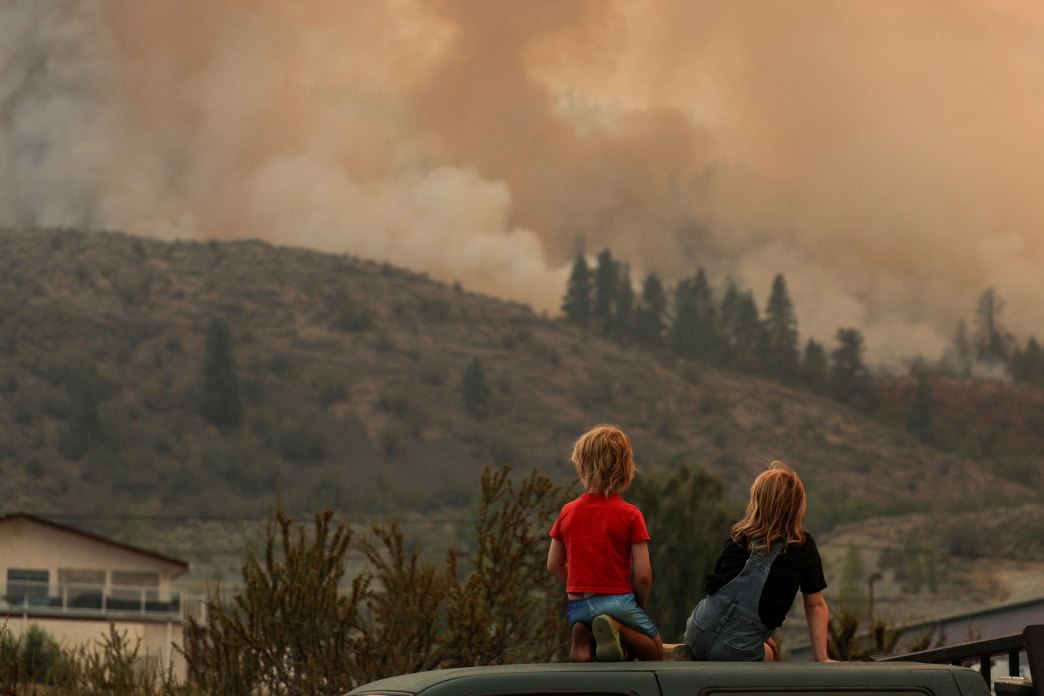
New Year’s Eve 2019 on the far south coast of Australia was a day without dawn. At nine that morning, the sun was obscured by bushfire smoke rendering the land dizzyingly dark at the height of antipodean summer, like a midday solar eclipse. As one of the region’s obstetricians would painfully discover in the weeks that followed, the black morning skies turned out to be an augur of grievous climate consequences suffered by the unborn.
This story is from “The Hot Issue,” the latest from Nautilus.
To get it in print, join by Nov 30.
Photos from that Australian day show a hellish, red-tinted world: hundreds of people in bright summer attire evacuated to strips of beach typically postcard picture-perfect. But the photos fail to capture the heat, a 104 degrees Fahrenheit stew that barely cooled at night. Nor do they show the 62 mile-per-hour gale force winds that fanned flames into explosive thunderclouds, injecting smoke from burning gum trees 100,000 feet up into the stratosphere. There, the sun-warmed smoke generated a self-sustaining vortex five miles tall and 600 miles across with its own ozone hole, the likes of which atmospheric scientists had never before seen.
December 2019 had been abnormally dry and hot across Eastern Australia, especially in New South Wales, where temperatures ran almost 6 degrees F hotter than the monthly average. By New Year’s Eve, 100 fires raged across the region, most sparked by dry lightning. The flames grew explosively, triggering 38 firestorms over eastern Australia that grew with the ferocity of volcanic eruptions. Atmospheric scientists later dubbed the spate of fire-induced pyrocumulonimbus thunderstorms that erupted the “Australian New Year Super Outbreak.”
On the ground, conditions tightened, like a violin string ready to snap. There were more fires, bigger fires, faster fires. “They were coming from the north and coming up from the south, and there was this impending sense of threat,” said Michael Holland, the senior obstetrician in Moruya, a beach town four hours south of Sydney, with a population of about 4,300. With highways out of town cut off and no safe egress, thousands had to shelter in place. “Every park had camper vans, mobile homes, caravans,” Holland recalled. “There were people with goats and there were people with sheep. It was almost biblical: people evacuating, waiting for the ark to be built.”
Holland was in his 60s and a fixture of Moruya’s maternity ward, located in the town’s small general hospital. A ruddy-faced, quiet-spoken man who embodies the stoic character of his country, Holland quickly teamed up with an ER physician to set up triage at his hospital.
Moruya had lost power, and the hospital emergency generator barely had power to run an X-ray machine. Food and meds were spoiling in lukewarm fridges and stalled sewage pumps stagnated toilet bowls. Holland’s own home was under evacuation, so he and his family slept on the floor of his medical practice for five days. It felt like the apogee of a longer arc of misery as the Black Summer burned its way through the season. Smoke lingered in an ever-present ceiling all summer long. “For months we didn’t see the stars,” Holland said.
By mid-January, rain and cooler temperatures finally provided respite. In the following weeks, as smoke finally cleared from the skies, Holland discovered something that surprised and then shocked him. Three women in their third trimesters experienced “fetal death in utero,” or stillbirths.
In a typical year of practice, Holland saw about 350 births at the Moruya hospital, of which one might be a stillbirth, typically from prematurity or fetal abnormalities. In the recent cluster of three stillbirths, each of the placentas was highly abnormal. The tissue was thin, calcified, grainy to the touch. Typically, placentas resemble a pizza-shaped liver, all spongy and deep burgundy.
Although Holland didn’t know it at the time of the fires, in late 2019 a team of Belgian scientists had published a study that claimed, for the first time, to find evidence of black carbon particulates on the fetal side of the placenta. Later studies found particulates from air pollution in fetal cord blood, too, proof that the microscopic constituents of wildfire smoke can pollute not just a mother’s blood but her fetus’ too.
Public health experts now estimate that some 15,000 pregnant Australians and their fetuses were exposed to the Black Summer fires. While most were spared the brutal losses suffered by Holland’s patients, the smoke’s impact was measurable. Pregnant people are especially vulnerable to poor air quality since they breathe for two, taking in about 50 percent more air in their day to meet growing oxygen demands. One analysis of pregnant women found those exposed to the Black Summer fires in early- to mid-pregnancy were more likely to have their water break before 37 weeks, a leading cause of preterm birth. That same study found that the 2019 Black Summer bushfires were associated with an 11 percent higher risk of stillbirth, although the incidence was mercifully small enough as to preclude statistical significance.
Today, Holland is retired from his medical practice and is a member of the Australian parliament. He spoke to me about his work as an obstetrician with a natural buoyancy, describing how shortly after clamping the umbilical cord, the uterus, previously ballooned to cocoon the baby, deflates and loosens the placenta, which birth practitioners typically examine. This practice of midwives and obstetricians gathering round the placenta always conjured ancient history for him. “It reminds me of some fortune teller in ancient Rome looking at the entrails or something,” he said.
It’s no longer the melting poles or ocean-logged Pacific Islands that are on the front lines of climate change, but our very own human bodies. And nowhere is that bodily toll so unfair, and unacknowledged, as when it is exacted in utero.
In earlier days of the climate change discourse, circa the early 2000s, the warming in store was presented as a straight-up temperature increase, like the thermostat of a house slowly rising. In Vancouver, my hometown, we were forewarned about shrinking ice caps and melting glaciers from the rising mercury, but never the concomitant burning.
For most of my adult life, the air around me cleared as fuel standards and regulations cleaned up exhaust—a welcome improvement given that air pollution is a major environmental cause of death worldwide. But over the past decade of escalating wildfire seasons, that positive trend is now being reversed as worsening wildfire smoke dials back those gains.
Since 2016, fire smoke has erased about 25 percent of the multi-decade progress made across North America to reduce air pollution. Across the western United States during bad fire seasons, fire smoke accounts for half of the fine particulate matter in the air that people breathe over a year.
Just as concerning, there is increasing evidence that the fine particulate matter from wildfires is a more toxic and carcinogenic beast than other sources of it, like automobile traffic. A 2021 study of emergency and urgent care pediatric admissions in San Diego County in California found it to be ten times more harmful to children’s respiratory health than air pollution from other sources. One hypothesis is that as the smoke travels vast distances over many days, its molecular make-up transforms to become more chemically unstable and reactive, increasing its toxicity to human cells.
There is a misconception that when a baby is developing in utero, they are protected in the womb, floating free of the worries that await outside the cocoon of their pregnant parent’s body. But evidence suggests they are far from inured and are the most vulnerable among us. Miniscule airborne pollutants in the smoke, whether they are near the source or lofted into the atmosphere where they can travel the world, can enter the parent’s bloodstream through the lungs. Those fine particulates can cross the placental barrier and circulate in the fetus.
In 2018, Amy Padula, a professor in the department of obstetrics, gynecology and reproductive science at the University of California, San Francisco, was completing her first grant application to study wildfire smoke and preterm birth when smoke from the Camp Fire, California’s deadliest blaze to date, descended on San Francisco. She was pregnant with her second child at the time. Her daughter, a toddler, was soon talking like Darth Vader from the airborne irritants, Padula said.
Padula remembers just how incapable she felt when it came to protecting her family from the smoke—their rental was drafty and the smoke didn’t just set up shop across the bay, but indoors too. The HEPA filters they ran to scrub the air proved inadequate in their leaky apartment. It really hit home. Here she was, pregnant, trying her hardest to protect her growing family from the malignant air, and articulating in her grant application the very questions that applied to the exact situation she found herself in. How is this affecting my unborn child? How is this affecting our children’s lungs as they’re developing?
Over the next five years, Padula and her colleagues found consistent links between wildfire smoke exposure and preterm birth, including one analysis of more than 5 million births in the state of California. “We’ve also looked at it in terms of, ‘Is it the duration of exposure or the cumulative number of days you’re exposed?’” said Padula, now interim director of the Program on Reproductive Health and the Environment at UCSF. “Basically, just more is worse.” She and her colleagues have published research on associations between wildfire smoke and structural birth defects in California as well as with increased risk of severe maternal morbidity. “These exposures are increasing and we’re not necessarily well equipped to protect this vulnerable group,” she said.
Up the coast in Vancouver, the British Columbia Centre for Disease Control has been conducting its own extensive research into the effects of wildfires on the unborn. So far, its studies have documented evidence of lower birth weight, higher rates of respiratory infections in baby’s early years, and first trimester pregnancy termination linked to wildfire exposure in the province.
“It’s clear these exposures during pregnancy and early life have long-lasting health impacts, probably lifelong health impacts,” Sarah Henderson, the center’s scientific director of environmental health, told me in 2023. “As a society, we’re not nearly focused enough on what these climatic changes mean for people who are young or who are not even born right now.”
In July 2015, I was pregnant with my daughter. My husband and I had left town for a short vacation to one of the islands that face Vancouver across the Salish Sea where we had recently finished building our off-the-grid cabin. The week-by-week fetus app on my phone told me that our baby was the size of a green olive. The air was soupy and muggy. A giant, uncontrollable fire burned in the Elaho Valley, famed for its old growth trees, across the water and over the coastal slopes facing us.
We had slept with the cabin windows open, lulled to sleep by the lapping of waves, but awoke to air that was pungent and wrong, as if someone had just doused a campfire with water, spluttering ash into our faces. Every surface of the cabin was coated in fine white ash. It was astonishing, and loathsome. I had never felt such a potent, intuitive desire to not breathe. I wanted to claw at my throat, where the taste of damp, smoldering newspaper was lodged. Instead, I began to wipe everything down.
More than 30,000 children who were in utero during British Columbia’s record wildfire season of 2017 were later studied by public health scientists. Those whose mothers lived in areas with the worst smoke exposure were likelier to be born smaller and preterm; they were also sicker, developing croup, laryngitis, and bronchitis at higher rates than other children. The researchers also detected a small increase in first-trimester pregnancy loss. The toll on those born as those fires raged also runs steep; a study by Health Canada and other federal Canadian departments estimated that in parts of the province hardest hit by the 2017 fires, wildfire smoke from that one fire season alone reduced life expectancy by a full year.
Vancouver emerged better than other parts of the province that summer, but I still remember days on end of cloying, singed air and an orange hue to the light at all hours. Our house didn’t have air conditioning, and like many Vancouver homes, we would simply open our windows at night to cool down and ease our slumber. But when the air outside was clogged with smoke, visibility obscured beyond several hundred meters, we faced the choice of either sweltering at night in oppressive heat, or opening our windows and breathing in the singed, yet cool, night air as we dreamt.
By early 2019, when my belly grew with her younger brother, my husband drilled giant holes through our home to Macgyver HEPA-filtered intake fans. We were lucky the summer he was born, and his tiny lungs were spared, but it was a temporary reprieve. By the time he was three, there had been multiple times when his outdoor daycare was cancelled because of wildfire smoke. Just as unfortunate, there were times the kids simply breathed in bad air all day. By the time he and his sister were in elementary school, the fire season was lasting longer into September and starting earlier in the summer. There were days that the school kids sheltered in their gym over recess and lunch because the air outside was too poisonous to play in.
In the fall of 2025, I learned that Michael Kobor, Canada Research Chair in Social Epigenetics at the University of British Columbia, was conducting a province-wide survey to study blood from newborns exposed to the last decade of fire seasons while in utero. He wanted to apply his lab’s expertise in studying DNA methylation—a natural biological process in which a chemical group (methyl) is added to the underlying genetic code—to understand if wildfire exposure was being embedded in the developing fetus, and to what end. Previous work in the field of epigenetics has demonstrated that environmental exposures can become biologically embedded through DNA methylation, which can be associated with disease risk later in life.
In a preliminary study focused on a couple hundred blood samples, Kobor’s lab found that exposure to wildfire activity was associated with changes to DNA methylation in a newborn’s blood. His team is now doing further analyses to see if these changes are associated with later health outcomes such as respiratory illness, mood and anxiety disorders, and ADHD. Kobor has also launched a new and ambitious project, the BC Wildfire Study. The goal is to recruit 1,200 children who were in utero between 2016 and 2024 and further study how wildfires are associated with changes in DNA methylation and health and developmental outcomes.
“I think really what we’re trying to answer is: Is there a biological legacy that’s carried into the next generation from prenatal wildfire exposure?” Kobor told me from his laboratory at the BC Children’s Hospital Research Institute. “How can we collectively see what’s happening at that molecular level and harness that information to ensure that as these wildfires happen and increase in severity and frequency, our next generation continues to go strong.” The scientists hope to publish the first findings related to the study in 2028.
The year after Rachel Carson’s “Silent Spring” was published in The New Yorker, and shortly afterward as a world-changing book, Carson gave the opening lecture to the Kaiser Foundation Hospitals and Permanente Medical Group’s annual symposium in San Francisco in 1963. It was the last public address she ever gave, as she passed away the following year from breast cancer.
Much of Carson’s lecture is timeless in its wisdom and as far as final words go, they resonate decades later. Our failings as she diagnosed them in 1963 remain just as true today. A recurrent theme was her reflection on our stubborn reluctance to concede that humans are as much at risk from the harms posed by environmental pollutants as fish in a river or a flock of birds in a marsh. “It seems to me to imply a sort of rejection of our past—a reluctance or an unreadiness to accept the fact that man, like all other living creatures, is part of the vast ecosystems of the earth, subject to the forces of the environment,” she told her audience.
For decades, we have been turning the dials on those “forces of the environment,” running a planet-scale experiment that has ripened the conditions for extreme weather. How could we expect to experiment with the flammability of Earth’s ecosystems without anticipating that we would become subjects of the test ourselves? We have given Mother Earth her fever. Did we think we would be spared her symptoms?
In November 2025, I went onto the website of the BC Wildfire Study and filled out the screening survey to submit my son as an official participant in the blood analysis of children who were in utero between 2016 and 2024. Days later, I received an email informing me that he had been accepted. Lab researchers, I was told, would retrieve his newborn blood sample from the bowels of BC Children’s Hospital, punch out a tiny hole in the card with his dried blood spots, extract DNA from it, and process it through a few additional steps to measure the level of DNA methylation in it.
I filled out an online survey. Had we ever seen a doctor about asthma? We had. Had he ever been treated for pneumonia and upper respiratory infections? He had. Weeks later, a buccal swab to collect additional DNA arrived in the mail to compare how methylated his DNA was now at age six compared to levels at birth.
I felt unsettled as I looked at the swab kit. I reflected on how the first years of my kids’ lives had been among the hottest on record, each strewn with record-breaking this and unprecedented that. I wondered about how these climate-related crises had and would affect them as they grew up. As I reviewed the steps with my son, I explained why our participation in the study was important (it’s to help scientists understand how smoke affects kids so they can better protect them).
I wanted him to get the gist of it, but not more than that. This was a burden I very much wanted to spare him, yet here I was actively seeking out the encumbrance of that knowledge myself. Then again, it hardly felt like a choice; I had to understand the thing that was threatening my child.
In the run up to Christmas 2025, the Pacific Northwest was clobbered by successive freight trains of atmospheric rivers dumping days of rain in a matter of hours. The rain was warm and it came down in heavy, fat drops, like a tropical monsoon. The weather systems crossing the Pacific Ocean toward us were subtropical in nature, meteorologists noted. The latest system that emptied its firehose over us drowned the Skagit Valley in Northwestern Washington State. Watersheds in Southern British Columbia were soon inundated, and Vancouver was cut off from the rest of Canada as the Trans-Canada highway was flooded and the highway route north was closed due to the high risk of mudslides. I barely batted an eye. I braved the rain to find a mailbox to send in my son’s DNA.
Enjoying Nautilus? Subscribe to our free newsletter.
Lead Image: Reuters / Jesse Winter


