

Millions of farmers around the world are living in fear that their crop yields will falter in the coming months. They blame the Iran war, which has reduced supplies of the phosphate fertilizer vital for a successful harvest by 40 percent and raised its price beyond the reach of many.
But few farmers will likely know that their reliance on Persian Gulf states for much of their phosphate fertilizer is an outgrowth of a global effort more than 30 years ago to banish a major environmental scourge — the sulfur emissions from power plants that caused acid rain.
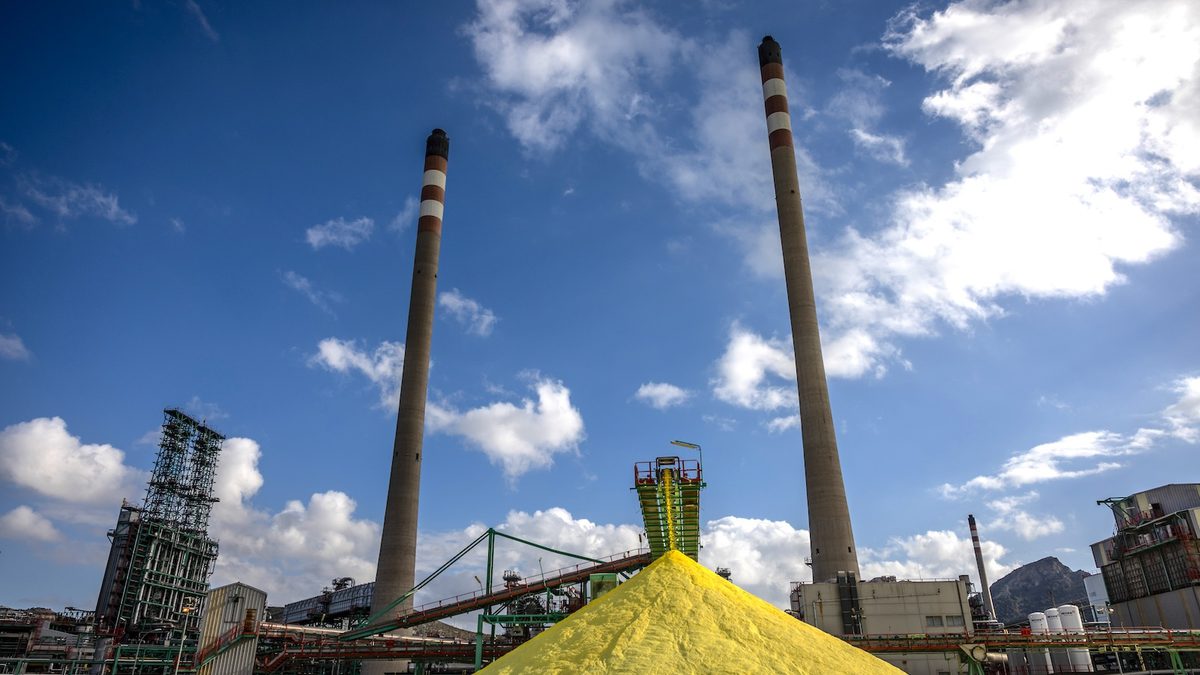
Those efforts required oil and natural gas refineries in the Gulf and elsewhere to strip sulfur from their products. That waste sulfur swiftly became the go-to feedstock for making sulfuric acid, the world’s most widely used industrial chemical, and one that is essential when processing phosphate rock to make phosphate fertilizer. Sulfur prices tumbled and, unable to compete, almost all the world’s sulfur mines shut. Soon, nearly half of internationally traded sulfur was being supplied by refineries in the Gulf. Or it was until those supplies were cut off in 2026.
Today, more than 95 percent of the world’s sulfur comes from oil and natural gas refineries.
There isn’t yet any reliable data on crop yields following the fertilizer drought: Most crops are still in the ground. But farmers from Brazil to India and southern Africa await with trepidation the impact on their upcoming harvests.
The rest of the world should be equally concerned. Analysts expect the crisis will cut crop yields in 2027 and beyond, raising food prices everywhere for years to come. The World Food Programme warns that, in combination with El Niño, the shortage could bring hunger to at least an additional 49 million people.
Meanwhile, analysts warn that the potential impact of the sulfur crisis on fertilizer production is likely to be just a foretaste of what will happen as the world phases out fossil fuels. An end to refining oil and natural gas would also halt the supply of waste sulfur at a time when demand is set to increase due to greater need for fertilizer and for refining metal ores for the fast-growing batteries market, says Mark Maslin, a geographer at University College London who has tracked the trade.
“My concern is that green tech outbids the fertilizer industry for the limited, more expensive sulfur supply,” he says, “creating an issue with food production, particularly in developing countries.”
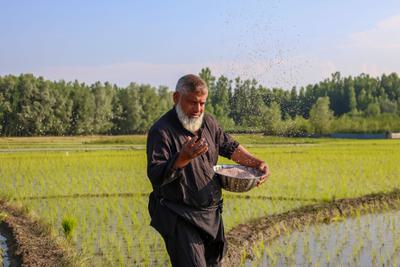
Ghulam Mohammad Mir spreads fertilizer on his land in Indian Kashmir.
Firdous Nazir / NurPhoto via AP
Using waste sulfur from refineries to make sulfuric acid should be a textbook example of how circular economies work, with one industry’s discards becoming the feedstock for another. Tens of millions of tons of waste sulfur from refineries is used in the manufacture of everything from rubber tires to paper. Before the war, the fertilizer industry absorbed more than half of the world’s available sulfuric acid to extract phosphorus from rocks and make a product that helps to feed the world. Sulfuric acid is also used to extract copper, nickel, and cobalt from ores to make the batteries that run electric vehicles — a critical part of international efforts to reach net-zero carbon emissions by midcentury.
And yet that green virtue in 2026 turned into a liability. During the Iran conflict, damaged production plants and the closure of the Strait of Hormuz, the main shipping route from Gulf refineries to sulfur markets, cut off 45 percent of the world’s trade in this strategically vital waste product. (While Gulf producers have been able to export some oil and natural gas through pipelines to the Red Sea, there are no pipelines that can handle dry, solid sulfur.)
This sudden sulfur shortfall has caught governments and producers without a Plan B, says MacDonald Amoah, an analyst of critical minerals for the Payne Institute for Public Policy at the Colorado School of Mines. Because sulfur has been regarded as a waste product, it has been little monitored by trade bodies. As it happens, this industrial material, essential for feeding the world, has no strategic reserves.
Many fertilizer producers have shut down because their ultimate customers, farmers, can no longer pay for the product.
In the 1980s, acid rain was a headline-grabbing environmental scourge. Emissions of sulfur dioxide from power stations burning sulfur-rich fossil fuels turned the rain across Europe and much of North America as acidic as lemon juice. Forests from the Appalachian Mountains to the Carpathians in Eastern Europe lost foliage and died; acid-drenched soils released toxic metals, killing fish in rivers and lakes.
The scourge was high politics, too. Canada’s environment minister complained to a visiting Ronald Reagan that his nation’s damaged forests and lakes were at the end of a “gigantic exhaust pipe” that began in the eastern United States. Swedish and Norwegian governments blamed British power stations for their hundreds of fishless lakes.
Governments eventually acted, requiring the scrubbing of sulfur dioxide from power station flue gases. Power companies in turn demanded that refiners supplying oil and natural gas remove the sulfur at source. The result of this international clean-up was a vast new waste stream of elemental sulfur that soon found a market as a feedstock for manufacturing sulfuric acid.
By century’s end, the world was awash with cheap waste sulfur. The market price had fallen by 80 percent, forcing mines from Sicily and Mexico to the salt domes of Texas out of business. Today, more than 95 percent of the world’s sulfur comes from oil and natural gas refineries, and almost half of international trade is through the Strait of Hormuz.

Cargo ships anchored in the Strait of Hormuz off the coast of Bandar Abbas, Iran.
Amirhosein Khorgooi / AP Photo
Most discussion about the resource implications of the Iran war has concentrated on disruption to the Gulf’s oil and natural gas exports. But the war has also hindered the production of the two most critical fertilizers in the world: nitrogen-based ammonia, which is made in the Gulf using hydrogen extracted from natural gas, and phosphate fertilizer, whose manufacture requires sulfur extracted from hydrocarbon refining. The conflict has cut the amount of nitrogen supplied to farmers by about a quarter but phosphate supplies by 40 percent.
As the war has progressed, the supply of sulfur has continued to shrink. In May, China, the world’s largest exporter of sulfuric acid, banned sales to foreign manufacturers to protect its own fertilizer supplies. Then in August, Ukrainian drones struck Gazprom’s Astrakhan gas processing plant, knocking out 60 percent of Russia’s sulfur production.
With supplies cut and prices up by more than a third, sometimes exceeding $1,000 per metric ton, much of the sulfur that has been available has been snapped up by the mining industry, which can afford the higher prices. The price hike has left phosphate fertilizer producers in a bind. Many have shut down because their ultimate customers, farmers, cannot pay for the product. Mosaic, one of the world’s biggest manufacturers, more than halved its U.S. production in 2026 and has announced plans to shut one plant for six months starting in December. “Without affordable sulfur,” production superintendent Hector Mier said last month, the company was “forced to curtail production. That means less fertilizer for farmers and less food grown in American farmland.” Saudi and Brazilian plants have also closed.
As less fertilizer is added to soils, says an analyst, there will be an “erosion of agricultural productivity in many countries.”
Brendan Rice, an agribusiness analyst for the Washington, D.C.-based International Food Policy Research Institute, warns that as less phosphate fertilizer is added to soils, there will be “a slow-rolling erosion of agricultural productivity in many countries” stretching through 2027 and beyond.
The first clear signs of the downturn may emerge in the next three months with the harvest of rice in India and Thailand, soy in Brazil, and corn in southern Africa. Amoah says it will “lock in grocery inflation for years.”
What will happen if the Gulf conflict continues to restrict sulfur supplies?
There is no immediate prospect of a revival of sulfur mining. Only two mines remain open: the Osiek Mine in southern Poland and the Kawah Ijen volcano on the Indonesian island of Java, where a few hundred intrepid miners armed with hand tools clamber down into the crater to dig out yellow blocks of elemental sulfur, which they haul to the surface in bamboo baskets. Neither mine could quickly increase production, analysts say. And a widespread reopening of closed mines would be a costly and risky enterprise when Gulf production of cheap sulfur could resume at least as quickly.
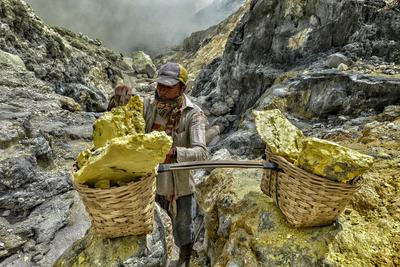
A miner gathers sulfur from Kawah Ijen, an active volcano on the Indonesian island of Java
Oscar Espinosa / SOPA Images / LightRocket via Getty Images
There is sulfur stockpiled at a few refineries — notably some 10 million metric tons around tar-sands deposits in the Canadian province of Alberta, some of which is sent to fertilizer manufacturers in Canada and the U.S. But scaling up distribution quickly for the international market would be challenging. “Every tonne must be excavated off the block, trucked to a melting site, melted, formed, and railed to Vancouver for vessel loading,” says Fiona Boyd, a director of London-based Acuity Commodities. “[It’s] a lengthy and expensive process.”
Experts predict that Gulf supplies of sulfur will eventually resume. But that will only postpone the day, says Maslin, when the world faces a long-term sulfur crunch as demand rises while supplies falter.
On the demand side, most observers expect a rapid increase in the use of sulfuric acid as more metals are refined to make batteries. And as the world’s population continues to rise, feeding more people will also likely require more sulfur to make more phosphorus fertilizer. Overall, Maslin sees the market growing by around 60 percent to 400 million metric tons by midcentury.
Farmers could reduce their use of synthetic fertilizers by nourishing their soils with animal manure and farm waste.
But at the same time, he says, supply is set to crash as the world’s energy system decarbonizes, with consumption peaking and then falling sharply over the next three decades, slashing the production of sulfur waste at refineries. In 2022, Maslin and his University College London colleagues calculated that shifting away from fossil fuels “could create a shortfall of sulfuric acid as large as 320 million [metric tons], or 130 percent of present-day production.”
The supply crunch would drive up the cost of sulfur, Maslin said. Then, as now, farmers — and the world’s food supply — would be the likely losers.
To address the shortfall, farmers could reduce their dependence on both nitrogen and phosphate fertilizers by nourishing their soils organically. Animal manure and organic farm wastes are rich in both chemicals. But few agriculturalists expect such methods to do more than moderate rising demand for artificial fertilizer — and the sulfur needed to make it.
So where will the sulfur come from? We could go back to large-scale mining. Unlike some strategic materials, the world is not short of geological sulfur. It is the 13th most abundant element in the Earth’s crust, found in volcanoes, salt domes, and in sedimentary deposits created by the evaporation of seawater.
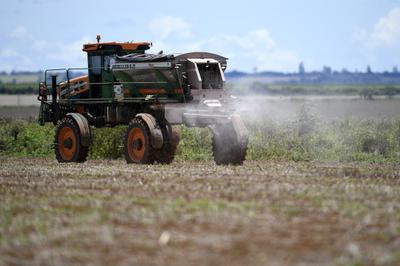
A tractor spreads fertilizer on a soybean field in Goias, Brazil.
Mateus Bonomi / Anadolu Agency via Getty Images
But Maslin cautions against that. “Direct mining of elemental sulfur is dirty, toxic, [and] destructive.” Instead, he says, “the world needs to cut demand by recycling and using alternative industrial technologies that avoid intensive use of sulfuric acid.” Widespread commercial recycling of sulfur has potential. Sulfuric acid is a major component of widely used lead-acid batteries, for instance. In the U.S. it is widely recycled along with lead.
Another approach is to cut demand for sulfur’s biggest use — making phosphate fertilizer — by recycling the phosphates found in human sewage, which is where much of the material used to grow our food ends up.
More than half the world’s population is now connected to sewage systems. Sewage sludge from treatment works may contain industrial contaminants but is generally considered safe for application to cropland and often sold or given to farmers in developed countries, notably the U.K. and the U.S. Sludge incinerators in Japan and Germany sell their leftover ash, still rich in phosphates, either to farmers or to fertilizer manufacturers. Willem Schipper, a Dutch consultant in industrial chemistry, calculates that current sewage systems worldwide could deliver around a million metric tons of phosphates each year. That is roughly 3 percent of what is mined each year, but it would trim the need for both sulfur and phosphate, a rock that is itself in increasingly short supply.
By removing phosphates from raw sewage at treatment works, recycling would also reduce the environmental impacts of high levels of phosphates in rivers, where the chemical spurs the growth of plants and algae that block sunlight from penetrating the water and lower oxygen levels. So, while one version of a circular economy might falter as fossil fuels are sidelined, another, smaller circular economy could emerge.