


Nature can cheat mathematics to create forbidden fivefold symmetry within a single crystal. The unusual structure organises fivefold helices into a densely packed array of pentagons, leveraging a small amount of disorder to relieve the geometric frustration across the crystal. These motifs occupy an unexplored ‘grey area’ on the spectrum between periodic structures and quasicrystals and hint at the untapped potential of symmetry engineering to uncover new crystalline structures, say the authors.
Although point fivefold symmetry is relatively common throughout nature, for example, in the petals of a flower or the arms of a starfish, its long-range repetition in crystalline units is vanishingly rare. Pentagons do not tessellate, so any planar arrangement necessarily includes gaps that create instability within the resulting crystal structure. Despite this, a few examples of elusive pentagonal symmetry have been engineered in specialist systems and mathematicians have modelled the various packing configurations to identify the ice-ray lattice – stripes of alternately inverted pentagons – as the densest possible arrangement.
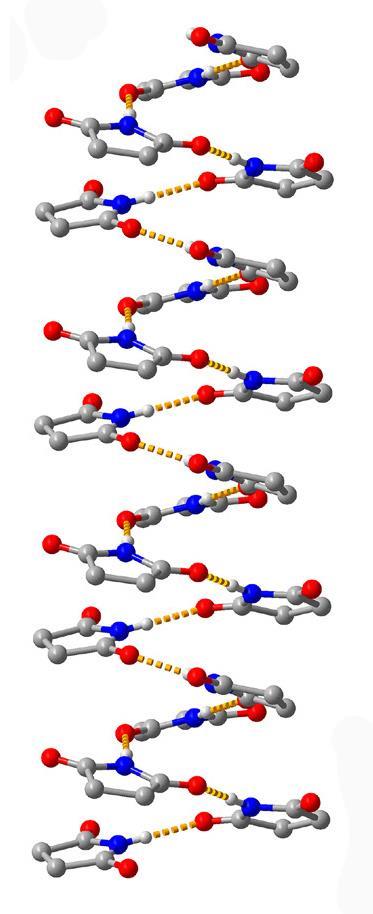
While exploring this challenging symmetry, Tomče Runčevski and his team at Southern Methodist University in the US uncovered a first-of-its-kind material that extends the dense ice-ray arrangement into a third dimension via mathematically forbidden fivefold helices. Each pentagonal unit within the ice-ray pattern is a separate helical prism, itself formed of repeating units of five hydrogen-bound molecules. ‘In order to have fivefold helices, you need to have at least five molecules in the asymmetric unit because how these helices are being formed is not allowed by symmetry,’ explains Runčevski. ‘But nature is cheating within the unit cell. The five molecules are oriented as a helix and nature just takes that unit cell and repeats it.’
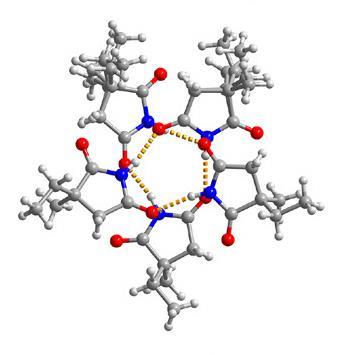
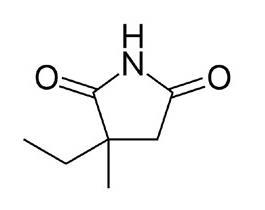
The complex structure self-assembled from molecules of the epilepsy drug ethosuximide, a previously unsolved crystalline compound that crucially contains five molecules within its basic unit cell. The varied functionality around the succinimide ring drives this unusual arrangement: hydrogen bonding between neighbouring imide functional groups fixes the molecules into a helical coil while the dangling aliphatic groups on the opposite side of the ring fill the problematic gaps between adjacent helices. Overall, strong hydrogen bonding maintains the vertical prismatic structure while weaker van der Waals forces hold together the ice-ray packing between the helices. ‘We are creating a remarkable anisotropy of stability in the structure: we have a very, very stable structure on the axis and not stable on the plane,’ says Runčevski. ‘That’s why we are forming single crystals that are sometimes centimetres long and thinner than a strand of hair.’
At present, the work is fundamental rather than application focused, although Runčevski notes that the needle-like structure of the crystals could have a potential role in dermal drug delivery. The more intriguing part, he says, is that these beautiful complex structures were hiding in plain sight. ‘When it comes to pentagons, we are looking at either quasicrystals or point symmetry – something that has no periodicity. But this shows that there is a grey area of disorder which has not been tapped by chemists,’ he says. ‘There’s so much more that we don’t know about the space of periodic structures that contain fivefold symmetry.’
For Paddy Royall, a collective phenomena and nucleation researcher at ESPCI Paris in France, this bridge to quasi-crystalline structures, which won the chemistry Nobel prize in 2011, is particularly attractive. ‘The pentagonal helices, in combination with the 2D pentagons, are very exciting,’ he says. ‘It would be interesting to investigate the microscopic mechanism for the crystallisation: is it difficult to assemble into this really complicated crystal? Does it go through an intermediate stage? How general is this?’
Given the rigid structural requirements, the same motif may prove difficult to replicate intentionally, but armed with this new insight, Runčevski hopes that looking back at past structures, we may find more of this type of symmetry hiding in plain sight.


