


Earth keeps a pretty detailed journal of its history, written in rock. But in some areas, up to a billion years of that story are missing.
The mystery, which has been dubbed the “Great Unconformity”, has puzzled geologists for over a century, but a new study could help explain where those layers disappeared to.
“Imagine a book where a huge section in the middle has been ripped out,” says Santosh Dhungana, environmental futures scientist at the University of Wollongong (UOW) in Australia.
“The Great Unconformity is that gap in Earth’s story, with the narrative jumping from the early chapters straight to a much later part of the story. Our research suggests these pages weren’t lost by chance.”
The story of Earth is read from the inside out. New layers of rock are laid down on top of existing ones, so the deeper layers are generally older than those higher up in a vertical stack.
If you know what you’re looking for, you can read almost the entire history of the planet from these layers.
You can see when different forms of life emerged and died out. When a region was a desert or deep beneath the sea. When the climate was warm and humid, or cold and dry.
The record is even punctuated by the occasional disaster, such as volcanic eruptions and asteroid impacts.
But sometimes the most intriguing part of a story is what’s left out.
The missing chapters were first noticed in the 1870s, when geologists exploring the Grand Canyon in the United States noticed that large sections didn’t ‘conform’ to the expected order of layers.
They noticed that vast swathes of rock, dating back a few hundred million years, were resting directly on top of layers that were roughly 2 billion years old. That means roughly 1.2 billion years of history was missing from the story.
Weirder still, those missing layers were indeed present in some parts of the canyon, which only made their absence more conspicuous in others.
The 19th-century team named this abnormality the Great Unconformity, and similar gaps have since been discovered in the geological record around the world.
Erosion seemed to be at play, but exactly how it happened remained unclear.
Now, geologists at UOW in Australia have tested key theories with supercomputers, and come up with a model that helps explain those missing millions of years.
The key, it seems, lies deep within the planet.
Earth’s crust is essentially floating on top of the much-squishier mantle. Not only does material in the mantle flow horizontally, but differences in temperature and texture cause bubbles of the stuff to move up and down like a giant lava lamp – which push and pull on the crust above.
Using the supercomputer Gadi, the researchers modeled the convection of the mantle over eons, seeing how that affected continents on Earth’s surface.
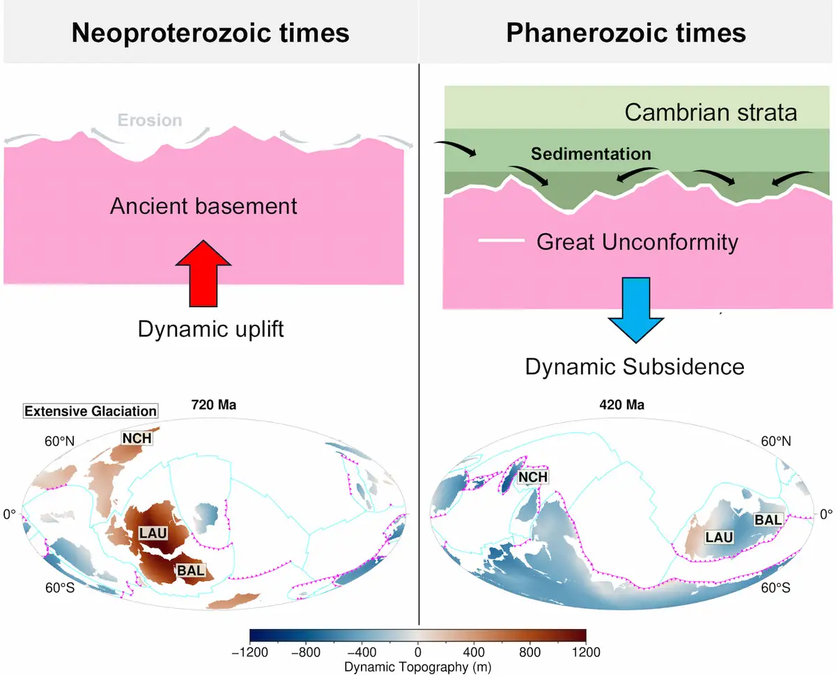
The simulations suggested that during the Neoproterozoic Era – which lasted from 1 billion to around 540 million years ago – movements in the mantle raised several continents upwards. After that, mantle convection caused these continents to begin sinking again.
That movement works to explain the Great Unconformity. The raised rock was exposed to the elements – and around 720 million years ago, the elements were working overtime to erode surfaces.
“Importantly, the uplift predicted by our models coincided with the Snowball Earth period,” the researchers write in an article in The Conversation.
“During this period, enormous ice sheets scraped over the surface of continents for tens of millions of years. Glaciers and ice sheets are more efficient than rivers at eroding continents, even on gentle slopes. The ice sheets would have slowly slid downhill across the uplifted continents, eroding away everything in their path.”
After the glaciers had erased hundreds of millions of years from the rocky record, the continents began to sink, allowing new sediments to be laid over the top.
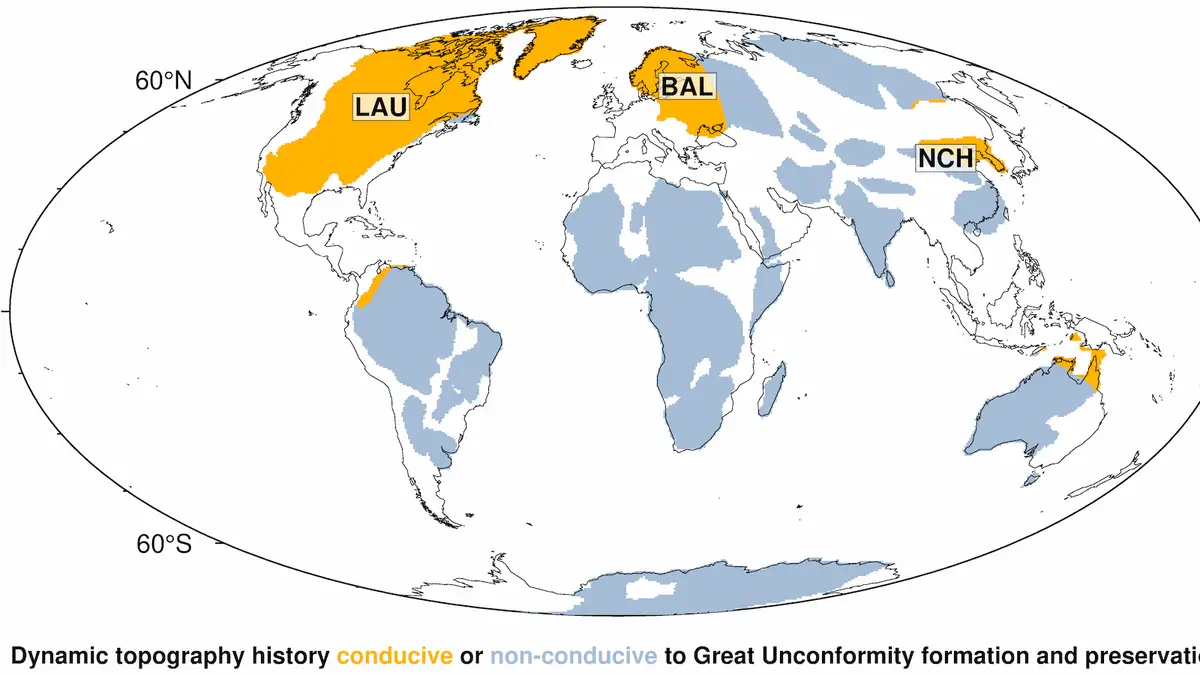
The smoking gun, however, is that the model suggested three ancient continents – Laurentia, Baltica, and North China – would be most affected by this process. Tellingly, the Great Unconformity is clearly seen today in the geology of these regions: North America, northeastern Europe, and northern China.
The model predicted that other continents, like Australia and South America, went through this up-and-down motion twice, which isn’t the right recipe for forming and preserving the Great Unconformity. And sure enough, there’s little evidence of the Great Unconformity in these regions.
“Sometimes what is missing can tell us more about the story of Earth than what we can see. A single, long period of uplift followed by a long period of sinking would have been the ideal recipe for removing the rock and preserving the worn surface,” says Nicolas Flament, a geoscientist at UOW.
Erosion has been the favored explanation since the anomaly was first discovered in the 19th century, but now we may have a better understanding of the specifics.
“Many explanations for the Great Unconformity had been proposed but few had been tested against how the Earth actually behaves over time,” says Flament.
“It is a thrill to be able to propose a solution to this geological puzzle.”
The research was published in the journal Nature.
This article was fact-checked by Peter Dockrill and edited by Peter Dockrill. While we pride ourselves on our process, we are only human. If you spot a mistake, please let us know.


