

Animals
All animal procedures were performed in accordance with guidelines set forth and protocols approved by the UCSD Institutional Animal Care and Use Committee and the US National Institutes of Health, as well as by the Government of Upper Bavaria, Germany (animal protocols 55.2-1-54-2532-168-2014, 55.2-1-54-2532-19-2015, 55.2-2532.Vet_02-20-05 and 55.2-2532.Vet_02-19-83). R6/2 mice16 transgenic for the 5′ end of the human huntingtin gene were obtained from Jackson Laboratories (stock no. 002810) and maintained by crossing R6/2 males to F1 C57BL/6–CBA females. Knock-in zQ175DN19,20 mice were obtained from Jackson Laboratories (stock no. 029928) and maintained on a C57BL/6 background. The presence of the transgene or knock-in was verified by PCR with the following primers: R6/2: forward, 5′CCGCTCAGGTTCTGCTTTTA-3′, reverse, 5′-TGGAAGGACTTGAGGGACTC-3′. zQ175DN: forward, 5′- GCGGGCTTATACCCCTACAG-3′, reverse, 5′-TCCAGGACAGCCAGAGCTAC-3′. CAG repeat length was determined by Laragen for all experimental groups. Spontaneous behavioural experiments on the wheel were performed at the Max Planck Institute for Biological Intelligence, and motorized ladder experiments were performed at the UCSD. Separate batches of R6/2 mice were used for these two sets of experiments, and the CAG repeat lengths were different between these two groups (202 ± 13 and 157 ± 6 for the Max Planck Institute and UCSD, respectively, mean ± s.d.), which led to different speeds of disease progression. Therefore, the stages of disease progression were matched across these batches of mice by monitoring their body weights (Extended Data Figs. 1a and 5b). Specifically, for R6/2 mice at the Max Planck Institute, early, middle and late stages were defined as postnatal days 49–56, 57–69 and 70–84, respectively. For R6/2 mice at the UCSD, early, middle and late stages corresponded to postnatal days 40–47, 48–55 and 56–65, respectively. Movement metrics were not used to define stages, avoiding circular logic. CAG repeat length for zQ175DN mice was 165 ± 5. Mice were group housed in cages with standard bedding in a temperature-controlled room (approximately 21 °C) with a reversed 12-h light–12-h dark cycle. Mice were allowed ad libitum access to food and water. Both male and female mice were used for all experiments.
Surgery
Surgical procedures were performed as previously described26,41,42. In brief, 3.5-week-old R6/2 mice or 5-month-old zQ175DN mice were anaesthetized with an intraperitoneal injection of ketamine–xylazine (130 and 8 mg kg−1 body weight, respectively) and a low dose of isoflurane (0.5% with constant flow rate of 1 l min−1 at 0.1 bar). After reaching a deep plane of anaesthesia, enrofloxacin (10 mg kg−1) and dexamethasone (5 mg kg−1) were injected subcutaneously to prevent infection and brain swelling, respectively.
For imaging experiments, a craniotomy (4 mm in diameter) was performed, as previously described26,41,42, over the right caudal forelimb area of M1 centred at 0.5 mm anterior and 1.5 mm lateral from bregma. For imaging S1 (0 mm anterior and 2 mm lateral) and V1 (3 mm posterior and 3 mm lateral) cortices, a 5-mm craniotomy spanning S1 and V1 was performed. For imaging and manipulating cortical inhibitory neurons, viruses (calcium sensors: AAV9-hSyn-FLEX-jGCaMP7f or AAV2/1-hSyn-FLEX-GCaMP6f, titre of approximately 1012 vg ml−1; opsin or control: AAV5-Syn-FLEX-rc[ChR-tdT] or AAV2/1-CAG-FLEX-tdT, titre of approximately 1013 vg ml−1; Addgene) were injected into the caudal forelimb area of M1 (or S1 or V1) using a beveled glass pipette (inner diameter of approximately 12–25 µm). Each injection consisted of an approximately 200 nl volume centred at a depth of approximately 400 µm below the pial surface. Three injections, separated by at least 500 µm horizontally, were performed in each craniotomy. For imaging CStr neurons, retrograde virus (rgAAV-hSyn-jGCaMP8s, titre of approximately 1013 infecting units per ml; Addgene) was injected into the dorsolateral striatum at 0.5 mm anterior and 3.17 mm lateral from bregma. Two injections, each consisting of an approximately 300 nl volume were performed at a 22° angle and at 2.2 mm and 2.0 mm below the pial surface, respectively. After virus injections, the glass pipette was left in place for 5 min to avoid backflow. Following injections, a round coverslip (VWR) was implanted into the craniotomy and affixed to the skull using histoacryl glue (B.Braun) and dental acrylic cement.
For longitudinal optogenetic stimulation experiments, viruses (AAV5-Syn-FLEX-rc[ChR-tdT] or AAV2/1-CAG-FLEX-tdT, titre of approximately 1013 vg ml−1; Addgene) were injected at two sites per hemisphere through small burr holes. Each injection consisted of an approximately 200 nl volume. Injection sites were at 0.5 anterior, ±1.5 lateral and 2.0 anterior, ±1.3 lateral from bregma. Fibre optic cannulas (Doric; core diameter of 600 µm and 0.22 NA diffuser tip) were implanted at a 15° angle onto the cortical surface of both hemispheres at 1.0 anterior, ± 1.0 lateral from bregma.
A custom-built head bar was glued and cemented to the skull to allow stable head fixation. An analgesic (buprenorphine (0.1 mg kg−1) or carprofen (5 mg kg−1)) was injected approximately 1 h before the end of the surgery to manage postoperative pain. Following surgery, mice were administered daily with Baytril, dexamethasone and analgesic for up to 3 days to manage postoperative infection, swelling and pain, respectively.
Behaviour
Handling and training
At the age of 5 weeks (R6/2) or 6 months (zQ175DN), mice were handled on 4 consecutive days for 10 min until they were familiarized with the trainer and routinely ran from hand to hand. In the subsequent behavioural task training, mice got adjusted to the experimental setup and head fixation. Training sessions (30 min each, 2 and 4 consecutive days for ladder and wheel, respectively) were performed in the dark with an IR light source for the camera. Thus, mice were never trained for more than several weeks, minimizing the possibility that the motor cortex disengages due to long-term training43,44.
Motorized ladder task
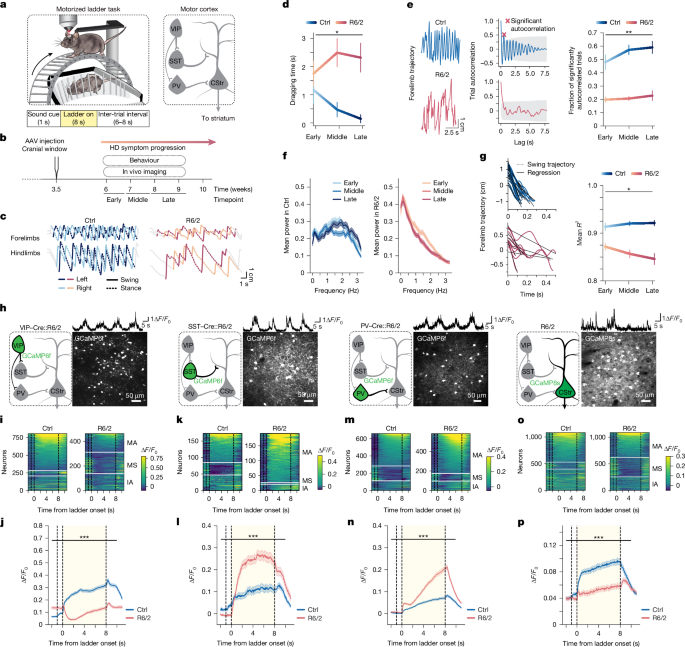
Head-fixed mice were positioned onto a custom-built, circular ladder (diameter of 19 cm, rung spacing of 1 cm), adapted from the KineMouse Wheel (https://hackaday.io/project/160744-kinemouse-wheel) and motorized by an electric DC motor (12 V, 60 rpm). Trial structure was controlled using BPod (v0.5). In each trial, 8 s of ladder rotation (speed of approximately 10 mm s−1) were preceded by a 1-s auditory cue (3 kHz). Trials were separated by a variable 6–8-s inter-trial interval. The auditory cue (= trial start) was indicated by an approximately 30-ms IR LED flash, facilitating the alignment of trials during video analysis.
Wheel paradigm
Head-fixed mice were placed on a freely rotating wheel (KineMouse Wheel, diameter of 19 cm, continuous surface)45. No cues or trial structure were provided and mice typically showed alternating active and inactive behavioural states. Running wheel motion was captured by a rotary encoder (1,000 CPR, 60-Hz sampling rate). Speed and directionality of the wheel were decoded online using a Teensy 3.2 processor board running custom written Arduino code, adapted from Janelia Open Science Laboratory Tools (https://www.janelia.org/open-science/encoder-interface-for-mouse-treadmill).
Behavioural videography
For both ladder task and wheel paradigm, two orthogonal views of the mouse were captured simultaneously through a mirror mounted at 45° inside the ladder and wheel. Mouse behaviour was tracked at 60–100 Hz with an IR-sensitive video camera (USB 2.0, 1/3″CMOS, 744 × 480 pixels; 8 mm M0814MP2 1.4–16 C, 2/3″, megapixel c-mount objective; The Imaging Source) and custom software (Input Controller, The Imaging Source).
In vivo two-photon imaging
Imaging during the motorized ladder task was performed using a commercial two-photon microscope (MOM, Sutter Instrument) equipped with a ×16/0.8-NA objective (Nikon) and a Ti:Sapphire excitation laser (Mai Tai, Spectra-Physics) tuned to 925 nm. Images (512 × 512 pixels, approximately 1 µm per pixel) were recorded at approximately 29 Hz for the duration of the behavioural session (approximately 12 min, 40–50 trials). Frame times were recorded and synchronized with behavioural recordings (videography).
Imaging during the wheel paradigm was performed using a commercial two-photon microscope (B-Scope, ThorLabs) equipped with a ×16/0.8-NA objective (Nikon) and an InsightDS+ laser (Spectra-Physics) tuned to 925 nm. Image acquisition was controlled through ThorImage 4.0 software. Images (768 × 768 pixels, 0.702 µm per pixel) were recorded at approximately 10 Hz for the duration of the behavioural session (10 min per field of view (FOV), 4–5 FOVs per session). Frame times were recorded and synchronized with behavioural recordings (videography, rotary encoder) using the ThorSync software.
Laser power at the objective was controlled with a Pockel’s cell (Conoptics) and ranged between 10 and 50 mW for all experiments. Coordinates for imaging areas, relative to bregma, were as follows: 0.5 mm anterior and 1.5 mm lateral for M1; 0 mm anterior and 2 mm lateral for S1; and 3 mm posterior and 3 mm lateral for V1. Depth of FOVs below the cortical surface was between 120 and 330 µm for VIP-INs, 120 and 550 µm for SST-INs, 160 and 530 µm for PV-INs and 130 and 530 µm for CStr neurons. For layer-specific analysis in M1, FOVs at a depth shallower and deeper than 400 µm below the cortical surface were defined as L2/3 and L5, respectively. For longitudinal repositioning, an epifluorescent image was acquired in the first imaging session to capture vasculature, and xyz coordinates provided by the microscope stage were documented for each FOV. The average projection two-photon image of 100 frames was used as a reference in later sessions and the z-plane was carefully adjusted to maximally match the imaging plane to the reference image.
Optogenetics
For data in Figs. 3 and 4, 12 mice were used for both behaviour and imaging (included in both Figs. 3 and 4), and 27 mice were used only for behaviour (included only in Fig. 4). Imaging on post-opto days (sessions 10 and 11) was not done for technical reasons, as some FOVs became cloudy and some animals could not be maintained for follow-up. Sessions 10 and 11 were already near the end of the lifespan of R6/2 mice (approximately 10 weeks), so it was not feasible to extend these experiments further.
For simultaneous in vivo two-photon imaging and optogenetic activation of VIP-INs during the ladder task, light from a red diode laser (Oxxius LBX-638-HPE, 638 nm) was delivered through a bifurcated silica fibre optic patch cord (Doric; core diameter of 400 µm and 0.22 NA) and through implanted light diffusing fibre optic cannulas (Doric; core diameter of 600 µm and 0.22 NA, diffuser tip). One cannula was implanted over the left M1, and another was placed close to the objective illuminating the area under the cranial window. To avoid interference between stimulation and imaging, each pulse of the optogenetic light was synchronized with the resonant scanner, delivering a sub-pulse of light at the turnaround of the scanner (an 18-µs sub-pulse every 56 µs). In a small number of titration experiments (Extended Data Fig. 8; n = 2 VIP–Cre control mice and n = 2 VIP–Cre::R6/2 mice), the effective power was varied as: 0.07, 0.2, 0.4, 0.7, 1.2 and 3.7 mW, measured at the tip of cannula. These pulses were delivered at the frequency of 25 Hz with a 50% duty cycle. On the basis of these titration experiments, the rest of the experiments used the power of approximately 2-mW sub-pulses for effective approximately 0.7-mW pulses (again at 25 Hz with a 50% duty cycle). Each session consisted of 50 trials, and light stimulation was applied in 40% of trials, starting at ladder onset and terminating at 1 s after the ladder movement offset.
For optogenetic behavioural experiments without imaging, red laser light was delivered through light diffusing fibre optic cannulas implanted over M1 of both hemispheres, without the sub-pulsing described above. We tested 0.7 mW (same as imaging experiments above) and 3.7 mW in separate cohorts of mice. Stimulation was applied at 25 Hz with a 50% duty cycle, starting from the auditory cue and ladder onset to 1 s after ladder offset for 0.7-mW and 3.7-mW cohorts, respectively.
In all optogenetic experiments, to avoid visual effects of the stimulation light, mice were presented with a red-masking LED light in all trials.
Image analysis
ROI identification and signal extraction
A combination of Suite2P and Cellpose46,47 software was used to generate regions of interest corresponding to individual neurons and to extract their fluorescence. ROI classifications by the automatic classifier were further refined by manual inspection. The time-varying baseline of a fluorescence trace (F0) was estimated using a custom-written MATLAB code by smoothing inactive portions of the trace using a previously described iterative procedure5. In brief, this process identified the active and inactive portions of trace, removing active portions and using the LOESS-smoothed inactive portions (interpolated across active periods) to estimate the time-varying baseline. The normalized ΔF/F0 trace was then calculated, where ΔF was found by subtracting the baseline trace from the raw trace, and F0 was the calculated time-varying baseline. A calcium activity event trace was constructed, which was zero except for frames with detected events, as previously described41. To match neurons across multiple imaging sessions, universally unique identifiers were assigned to individual neurons (ROIMatchGUI (https://github.com/sonjablumenstock/ROIMatchGUI)), followed by manual confirmation and corrections after automated detection.
Classification of modulated neurons
Movement-modulated neurons were classified as previously described41. In brief, the dot product of the binarized ladder movement trace (movements versus non-movements) and ΔF/F0 was calculated for each ROI. This value was compared with the dot products when shuffling the movement periods 1,000 times (or 5,000 times in the case of opto trials). Actual values above the 97.5 percentile of the shuffled distribution were classified as movement active, and actual values below the 2.5 percentile were classified as movement suppressed. All other cells were considered indiscriminately active. In optogenetics + imaging experiments, we classified the responses of individual neurons to stimulation. To this end, we compared mean ΔF/F values across light and no-light trials using Welch’s t-test. Resulting P values were corrected for multiple comparisons using the Benjamini–Hochberg false discovery rate procedure (P < 0.05). Neurons were classified as significantly increased or decreased in activity on the basis of the sign of the mean difference (ΔΔF/F light − no light). For the classification of neurons modulated by spontaneous active or inactive behaviours, the mean ΔF/F in a pre-active or pre-inactive (−2 to −0.2 s before transition) and active or inactive (0–3 s) window was compared, respectively, using a Welch’s t-test. Cells with significantly higher or lower activity in the active or inactive window (one-sided P < 0.05) were labelled active or suppressed, respectively.
Quantification of movement modulation
Movement-related neuronal modulation (ΔΔF/F0) in the ladder task was quantified for each neuron as the difference between mean ΔF/F0 during movement (0–8 s relative to movement onset) and mean ΔF/F0 during the pre-movement period (−1 to 0 s).
Relationship between movement quality and neural activity
The quality of movements on individual trials was quantified from videos using front-paw directness (R2), stride autocorrelation and hindpaw dragging time. Metrics were averaged across forelimbs where applicable, then z-scored across all trials; dragging values were inverted so higher scores indicated better performance. A composite behaviour score was obtained by averaging z-scores. Mean population ΔF/F during the movement period of each ladder trial was extracted from all recorded neurons, and relationships between behavioural composite and population activity were analysed by genotype using X-binned summaries (bin width of 0.3). In addition, for an animal-by-animal analysis, composite scores and mean movement-period population ΔF/F were averaged per mouse within stage, and association was assessed using Spearman rank correlation.
Behaviour classification
For deep-learning-assisted classification of innate behaviours from raw videos, we used DeepEthogram (DEG)21. A single DEG model was trained in an iterative manner. On the basis of our visual observations of mouse behaviour, we defined a set of behaviour classes of interest: locomotion, grooming, rest (an inactive state with both forelimbs resting on the wheel surface), sit (an inactive state with both forelimbs resting above the wheel surface), twitch (short, fast forelimb twitches) and chew (jaw movements, including licking). An initial model was trained on approximately 10,000 manually labelled frames from a total of six exemplary videos of control and R6/2 mice of different ages. Model predictions of the initial and a few additional videos were corrected manually and used for retraining the model for the next iteration. A total of 19 training iterations was performed on a final number of 66 videos, until all behavioural classes of interest were detected with high F1 scores > 0.7. The model also identified shake (a full-body twitching behaviour), which occurred in 1.1% of frames. However, shake almost always occurred concurrently with other behavioural classes and was excluded from further analysis.
Voluntary behaviour-related activity
To estimate the activity of individual neurons at the transition between active and inactive behaviours, we only considered neurons with a non-zero number of calcium events detected in a given session. The activity for each neuron (z-scored ΔF/F0) was aligned to the transition between behavioural classes. We considered locomotion and grooming, classified using DEG as active motor behaviours, whereas rest and sit classes jointly represented the inactive behavioural periods. We only considered transitions between classes that were at least 3 s long to avoid contamination of activity related to other behaviours. Chew and twitch generally did not meet this criterion and their transitions were not considered for this analysis. The activity of each neuron was averaged across all individual transitions. The total number of neurons slightly differed between the two transition types due to the exclusion of transitions that occurred near the beginning or end of a session and the fact that some transitions (for example, active periods continuing until the end of a recording) could not be captured in both directions. For analysis of population activity during identified behavioural classes, we averaged each neurons activity (ΔF/F0) across all episodes of a classified behaviour. We did not consider chew for this analysis, as it was rare (2.6% of frames) and almost never occurred in isolation without another concurrent behaviour (0.005% of frames).
Relationship between locomotion speed and neural activity
For analysing relationships between locomotion speed and IN activity, ΔF/F0 from individual INs were aligned to the onset of locomotion bouts detected from DEG behaviour annotations. For each bout, mean z-scored ΔF/F0 and mean locomotion speed was computed in the 3 s before (baseline) and 5 s after (response) movement onset. We then calculated ΔΔF/F0 and corresponding Δspeed (response − baseline) for each locomotion bout. Data were binned by Δspeed (20 mm s−1 bins; speeds > 200 mm s−1 were grouped into one bin) and averaged per mouse and bin. Bins containing 4 or more bouts per mouse and 2 or more mice per genotype were retained.
Gait analysis
Data preprocessing
We used Python 3.8 and relevant libraries to process and analyse behavioural data. To extract limb movement trajectories from behavioural videos, we used DeepLabCut (DLC, v2.3)17. A single DLC model was trained using video frames from across a sample of experiments. Limb movements were captured from two perspectives (side and bottom). Optical distortion through the mirror was corrected by aligning x coordinates of side and bottom perspectives. Corrected x coordinates from both perspectives, detected at more than 95% DLC likelihood, were averaged. Trial information captured with BPod (v0.5) was aligned, and experimental metadata was added to each session. To preserve the essential motion characteristics while filtering out high-frequency noise, we used a Butterworth filter with a normalized cut-off removing frequencies from paw trajectories that were greater than one-tenth of the Nyquist frequency (that is, half the video frame rate).
Hindlimb dragging analysis
We calculated the average Euclidean distance from left forelimb to right hindlimb and from right forelimb to left hindlimb and normalized the distance by the mouse body weight48. To calculate the time spent dragging, the cumulative time for which the normalized forelimb–hindlimb distance exceeded 2 s.d. above the control population mean was calculated for each trial (Extended Data Fig. 1c).
Autocorrelation analysis
To analyse regularity in gait patterns, we autocorrelated forelimb trajectories in each individual ladder trial. To this end, we centred the trajectories around zero for each trial, removing offsets. We used the statsmodels ACF package to compute the autocorrelation function for the x position of each forelimb, measuring self-similarity over lags up to 5 s in each 8 s trial. The maximum peak of the autocorrelation function was determined. A peak was considered significant if it exceeded the upper bound of the 95% confidence interval, indicating significantly rhythmic behaviour in the respective trial. The fraction of significantly autocorrelated trials was determined by dividing the number of significant trials by the total number of trials.
Fourier analysis
To capture movement frequencies during the gait cycle, we processed the x coordinate trajectories of forelimbs through Fourier transformation. In short, we converted the z-scored trajectory of each forelimb in each trial from the time domain to the frequency domain using the scipy fft function. The power spectrum was then computed as the squared magnitude of the Fourier coefficients, representing the energy associated with each frequency component. Average power spectra were obtained by calculating the mean power within 0.13-Hz bins. The power spectrum was normalized by dividing each binned power by the maximum power, scaling the values to a range between 0 and 1, allowing comparison across sessions and animals. The maximum of the normalized power spectrum was used to extract the dominant stride frequency per session and animal.
Linear regression analysis
To analyse the directness of strides, we used linear regression on isolated stride phases. The x coordinates of zero-centred forelimb trajectories of individual trials were segmented into swing and stride phases using the peakdetect library. We defined a minimum difference in the signal required to identify extrema in the trace (5 mm). On the basis of these extrema points, the trace was segmented and labelled swing and stance depending on whether the trace was rising or falling between extrema, respectively. We used linear regression on each swing trajectory to determine the R2 score, measuring the ‘directness’ of the trajectory.
Histology
Mice were transcardially perfused with 0.1 M sodium phosphate buffered saline (PBS) followed by 4% paraformaldehyde (wt/wt) in 0.1 M PBS. Brains were removed and postfixed in 4% paraformaldehyde overnight at 4 °C. Following postfixing, whole brains were stored in 30% sucrose in 0.1 M PBS at 4 °C for 2–3 days. Coronal sections (50 µm thick) containing the motor cortex were then prepared using a Leica SM 2000R sliding microtome. Floating sections were washed in 0.1 M PBS 3 × 5 min, mounted on slides using CC Mount (Sigma-Aldrich) and allowed to cure overnight before imaging.
Statistics
Statistical tests were selected on the basis of data distributions and significance was set at P < 0.05. For neuronal activity analysis, we averaged the activity of a neuron over trials or behavioural epochs in a given session. Longitudinal behavioural measures were averaged on the session level. All evaluated datasets were tested for normality, and non-parametric tests were used throughout the article where appropriate. No statistical methods were used to pre-determine sample sizes, but our sample sizes are similar to those reported in previous publications26,41.
To compare two or more groups (for example, genotypes, disease stage, and time before and after behaviour onset), mixed-effects models were used to account for the nested structure of the data and minimize effects introduced by inter-animal variability49,50. For statistical estimation of non-normally distributed datasets, we used an Aligned Rank Transform (ART) variant of mixed-effects models using the ARTool packaged from R, which allows non-parametric mixed-effects model testing. Multiple comparisons were corrected using the two-stage false discovery rate method.
Two-factor mixed-effects models for estimating mouse body weight across disease progression (Extended Data Figs. 1a and 5b) were constructed as follows:
$$y \sim \mathrm{group}\,\mathrm{identity}+\mathrm{week}+\mathrm{genotype}:\mathrm{week}+(1|\mathrm{animal})$$
with fixed main effect terms for group identity (control and R6/2) and mouse age in weeks, a fixed interaction term for the interaction between group identity and week, and a random effect term grouped by animal. If a significant interaction was detected, post-hoc pairwise Mann–Whitney U-tests were performed between groups for each week.
Two-factor mixed-effects models for estimating behaviour performance and activity levels across disease stages (Figs. 1d,e,g and 2f–h and Extended Data Figs. 1d,e and 4b,c,e) were constructed as follows:
$$y \sim \mathrm{group}\,\mathrm{identity}+\mathrm{timepoint}+\mathrm{genotype}:\mathrm{timepoint}+(1|\mathrm{animal})$$
with fixed main effect terms for group identity (control and R6/2) and timepoint (early, middle and late), a fixed interaction term for the interaction between group identity and timepoint, and a random effect term grouped by animal. If a significant interaction was detected, post-hoc pairwise Mann–Whitney U-tests were performed between groups for each disease stage.
Similarly, to compare population average activity aligned to ladder task trials or behaviour transitions (Figs. 1j,l,n,p, 2c–e and 3e,g,j,l,m and Extended Data Figs. 2b,d,f,j,n,r, 4g,i, 7c,d and 8h,j,k), the models were constructed as follows:
$$y \sim \mathrm{group}\,\mathrm{identity}+\mathrm{time}\,\mathrm{bin}+\mathrm{genotype}:\mathrm{time}\,\mathrm{bin}+(1|\mathrm{animal})$$
with fixed main effect terms for the group identity (genotype (control and R6/2), or trial type (no light or light) or timepoint (middle and late), depending on the comparison) and 2-s time bins (−2 to 0, 0–2, 2–4, 4–6, 6–8, 8–10 and 10–12 s relative to ladder onset or −2 to 0, 0–2 and 2–4 s relative to behaviour transition), the interaction term between group identity and time bin, and a random effect term grouped by animal. If a significant interaction was detected, post-hoc pairwise Mann–Whitney U-tests were performed between groups for each time bin.
Two-factor mixed-effects models for quantifying changes in movement modulation across experimental groups and timepoints (Extended Data Fig. 8l) were constructed as follows:
$$\begin{array}{l}y \sim \mathrm{group}\,\mathrm{identity}+\mathrm{timepoint}+\mathrm{group}\,\mathrm{identity}\\ \,:\mathrm{timepoint}+(1|\mathrm{animal})\end{array}$$
with fixed main effect terms for group identity (Ctrl-ChR, Ctrl-tdT, R6/2-ChR and R6/2-tdT) and timepoint (middle and late), the interaction term between group identity and timepoint, and a random effect term grouped by animal. One-factor mixed-effects models for quantifying within-group changes in movement modulation across timepoints (Extended Data Fig. 8l) were constructed as follows:
$$y \sim \mathrm{timepoint}+(1|\mathrm{animal})$$
with a fixed main effect term for timepoint (middle and late) and a random intercept grouped by animal. Analyses were restricted to no-light trials.
For the subset of longitudinally tracked neurons (Extended Data Fig. 8m), we additionally accounted for repeated measures within cells:
$$y \sim \mathrm{timepoint}+(1|\mathrm{animal})+(1|\mathrm{cell})$$
with random intercepts for animal and cell universally unique identifier.
To compare behavioural performance across task learning, genotype and actuator groups (tdT and ChR), we used separate two-factor mixed effects models for control and R6/2 mice of the form:
$$\begin{array}{l}y \sim \mathrm{actuator}+\mathrm{session}\,\mathrm{number}+\mathrm{actuator}\\ \,:\mathrm{session\_number}+(1|\mathrm{animal})\end{array}$$
with fixed main effect terms for actuator (tdT and ChR) and session number, the interaction term between actuator and session number, and a random effect term grouped by animal (Fig. 4b–e and Extended Data Fig. 10b–e). For Fig. 4f and Extended Data Fig. 11b, the fixed main effect was trial type (light and no light). If a significant interaction was detected, post-hoc pairwise Mann–Whitney U-tests were performed between actuator groups for each session number.
To compare neuronal activity as a function of behavioural performance or locomotion speed (Extended Data Figs. 3b,c and 6a–c), we fitted a two-factor linear mixed model of the form:
$$y \sim {\rm{a}}{\rm{c}}{\rm{t}}{\rm{u}}{\rm{a}}{\rm{t}}{\rm{o}}{\rm{r}}+{\rm{b}}{\rm{e}}{\rm{h}}{\rm{a}}{\rm{v}}{\rm{i}}{\rm{o}}{\rm{u}}{\rm{r}}\,{\rm{b}}{\rm{i}}{\rm{n}}+{\rm{a}}{\rm{c}}{\rm{t}}{\rm{u}}{\rm{a}}{\rm{t}}{\rm{o}}{\rm{r}}:{\rm{b}}{\rm{e}}{\rm{h}}{\rm{a}}{\rm{v}}{\rm{i}}{\rm{o}}{\rm{u}}{\rm{r}}\,{\rm{b}}{\rm{i}}{\rm{n}}+(1|{\rm{a}}{\rm{n}}{\rm{i}}{\rm{m}}{\rm{a}}{\rm{l}})$$
with fixed main effect terms for genotype (control and R6/2), binned behavioural measure (behaviour score: 0.3 bin size; locomotion: Δspeed bins of 25 mm s−1), their interaction and a random effect term grouped by animal. If a significant interaction was detected, post-hoc pairwise Mann–Whitney U-tests were performed between groups for each behaviour bin.
One-factor mixed-effects models for comparing behavioural performance in stimulated R6/2 mice during late stimulation sessions (sessions 8 and 9) versus post-sessions (sessions 10 and 11; Extended Data Fig. 10f) were constructed as follows:
$$y \sim \mathrm{session}\,\mathrm{period}+(1|\mathrm{animal})$$
with a fixed main effect term for session period (late and post) and a random intercept grouped by animal. Because one stimulated R6/2 mouse died after session 9, paired late-versus-post analyses were restricted to animals with data in both periods. For comparisons between stimulated and unstimulated mice in post sessions, two-sided Welch’s t-tests were used.
For animal-by-animal analyses relating behavioural performance to population activity (Extended Data Fig. 3d), behavioural composite scores and mean movement-period population ΔF/F0 were averaged per mouse within disease stage, and associations were assessed using Spearman rank correlation.
All statistical test results are summarized in Supplementary Data Table 1.
Reporting summary
Further information on research design is available in the Nature Portfolio Reporting Summary linked to this article.