


Plant materials and growth conditions
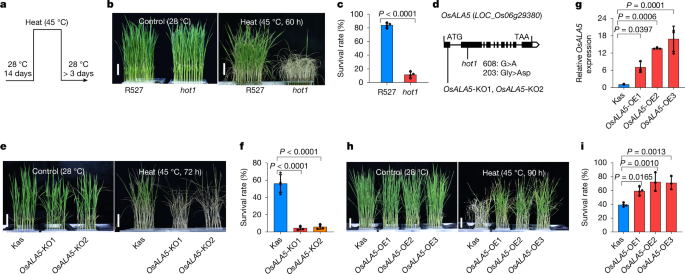
The hot1 mutant was isolated from an ethyl methanesulfonate-mutagenized M2 population of the indica cultivar Shuihui527 (R527). Approximately 3,000 M1 plants were grown in the paddy field, and one M2 family exhibiting an obviously reduced seed setting rate was identified during the 2017 summer season in Wenjiang, Chengdu, when field temperatures at the heading stage frequently exceeded 35 °C. Heat tolerance assay at the seedling stage (14-day-old plants, 45 °C for 60 h followed by at least 3 days of recovery) confirmed the heat-sensitive phenotype, and the mutant was designated hot1. For subsequent gene mapping, an F2 population was generated by crossing hot1 with R527.
For functional analyses of OsALA5, several transgenic lines were generated in different genetic backgrounds. A complementation line (OsALA5-C) was produced by introducing the OsALA5 genomic sequence driven by its native 2-kb promoter region into the hot1 mutant background. In the O. sativa cv. Kasalath (Kas) genetic background, two independent knockout lines (OsALA5-KO1 and OsALA5-KO2) were generated using a CRISPR–Cas9 system, and the overexpression lines (OsALA5-OE) were obtained by expressing OsALA5 driven by the CaMV 35S promoter. Additionally, a complementation line (CL) carrying a native promoter-driven OsALA5–GFP fusion construct was created in the OsALA5-KO1 background for subcellular localization and a series of subsequent physiological analyses. All transformation procedures and molecular verifications are described in ‘Generation of transgenic plants’. Unless otherwise stated, rice plants were cultivated in the experimental field of Sichuan Agricultural University (Chengdu, China).
To assess evolutionary conservation of OsALA5, we examined the corresponding Arabidopsis orthologues using both T-DNA and CRISPR–Cas9 mutants. A. thaliana Col-0 served as the wild type. T-DNA insertion mutants37 of ALA9 (ala9, SALK_073953, At1g68710), ALA10 (ala10-2, SALK_024877, At3g25610), ALA11 (ala11-2, SALK_107029, At1g13210) and ALA12 (ala12, SALK_111498, At1g26130) were obtained from the Nottingham Arabidopsis Stock Centre (NASC), and the homozygous lines were verified by PCR-based genotyping following the guidelines provided by the Arabidopsis Information Resource (TAIR; https://www.arabidopsis.org). Double mutants (ala9/12 and ala10-2/11-2) were generated by crossing and verified by PCR. Additional CRISPR–Cas9 knockout lines alleles (ala10-1, ala11-1 and ala10-1/11-1) were produced and confirmed by sequencing. Arabidopsis seeds were surface-sterilized and germinated on 0.5× Murashige and Skoog agar plates at pH 5.8 as described previously51. Ten-day-old seedlings were transferred to soil and grown at 22 °C under long-day conditions (16 h light:8 h dark, 150 µmol m−2 s−1) until harvest. Primers used for vector construction, genotyping and mutation confirmation are listed in Supplementary Table 1.
Heat tolerance assay at the seedling stage
For heat tolerance analysis at the rice seedling stage, healthy seeds were surface-sterilized with 3% sodium hypochlorite for 30 min, rinsed thoroughly with sterile distilled water, and soaked at 37 °C for 3 days to promote uniform germination. Germinated seeds were then placed into bottom-cut 96-well PCR plates and hydroponically cultured in Hoagland’s modified nutrient solution (Coolaber) in a controlled growth chamber (WIPGC-B2P84, BPC600H, Fujian Jiupo Biotechnology) under normal condition (28 °C, 14 h light:10 h dark photoperiod, 150 µmol m−2 s−1 light intensity, and 65% relative humidity). Fourteen-day-old seedlings were transferred to 45 °C for the indicated durations under the same light and humidity conditions and then returned to normal condition for at least three days of recovery.
Seedling survival was evaluated following established criteria52: seedlings that resumed growth and produced new green leaves were scored as alive, whereas those that remained fully bleached and failed to regrow were scored as dead. Survival rates were calculated as the percentage of living seedlings among the total number tested. For the PC spraying assays under heat stress, 14-day-old Kas and OsALA5-KO1 seedlings were prepared as described above. Seedlings were evenly sprayed with 3 ml of buffer control (2% Tween-20 and 2% glycerol), 10 μM PC (18:0/18:0) or 10 μM PC (18:1/18:1). After spraying, seedlings were held under normal growth condition for ~10 min to permit absorption and then subjected to heat treatment at 45 °C for the indicated durations. Survival rates were determined using the same criteria described above. For Arabidopsis heat tolerance assays, 10-day-old seedlings grown on 0.5× Murashige and Skoog agar medium were prepared as described in ‘Plant materials and growth conditions’. Plates were transferred to a 45 °C growth chamber for the indicated durations and then returned to normal condition (22 °C, 16 h light:8 h dark) for at least 3 days of recovery. Survival rates were determined using the same criteria as for rice. For all seedling stage heat tolerance assays, approximately 30 seedlings were grown per pot, and three independent pots were used per genotype for each biological replicate. Each experiment was independently repeated at least three times with consistent results. Data were analysed using GraphPad Prism (v8.0.2). The exact heat treatment durations and conditions for all genotypes and assays are summarized in Supplementary Table 2.
Gene identification
MutMap analysis was performed for gene mapping as previously described16. In brief, an F2 population of 300 individuals was generated by crossing the hot1 mutant with its wild-type parent R527. Genomic DNA from 30 F2 individuals displaying the extreme heat-sensitive phenotype was extracted and pooled in equal amounts for whole-genome resequencing (average depth ~25× per sample). Genomic DNA from R527 was resequenced and used as the wild-type reference. The SNP index was calculated for each site to identify genomic regions associated with the mutant phenotype. Candidate SNPs showing complete linkage with the heat-sensitive trait were validated by Sanger sequencing of PCR-amplified genomic fragments. Primers used for SNP validation are listed in Supplementary Table 1.
OsALA5 immunoblotting and immunoprecipitation ATPase assay
For OsALA5 immunoblotting and immunoprecipitation analyses, membrane proteins were extracted from 14-day-old hydroponically grown seedlings of wild-type R527 and the hot1 mutant using the procedure described in ‘Co-immunoprecipitation assay’. Immunoblotting was performed as described previously53 using anti-OsALA5 monoclonal antibody (generated as described in ‘Monoclonal antibody generation against OsALA5’) and anti-actin (Sangon Biotech, D191048) as a loading control; both antibodies were diluted 1:3,000. Signals were developed using ECL substrate and imaged using an e-Blot Touch Imager Pro. For ATPase measurements, OsALA5 complexes were immunoprecipitated as described in ‘Co-immunoprecipitation assay’. The resulting immunoprecipitates were then subjected to ATPase activity measurement following the procedure described in ‘ATPase activity assay’. ATPase activity measurements were obtained from four individual repeats with consistent results. Data were analysed using GraphPad Prism (v8.0.2).
For heat-induced protein accumulation analysis of OsALA5, 14-day-old Nipponbare (Nip) seedlings were exposed to 45 °C and sampled at 0, 5 min, 10 min, 30 min, 1 h and 3 h after treatment. Membrane proteins were extracted using the procedure described above, and OsALA5 immunoblotting was performed under the same conditions.
Generation of transgenic plants
For complementation of the hot1 mutant, the full-length genomic sequence of OsALA5 driven by its native 2-kb promoter amplified from R527 was cloned into the binary vector pCAMBIA1300. The construct was introduced into hot1 to generate the complementation line (OsALA5-C). More than 20 independent transgenic lines were obtained, and 1 T2 line plant with one copy insertion was used for subsequent analyses. For gene knockout in the Kas background, two independent OsALA5-knockout lines (OsALA5-KO1 and OsALA5-KO2) were generated using the CRISPR–Cas9 system. The backbone vectors were gifts from Y. Liu, and the vector construction followed the approaches described by Ma et al. (2015)54. The guide RNA site targeting the first exon of OsALA5 was designed using CRISPR-P 2.0 (http://crispr.hzau.edu.cn/CRISPR2/) and assembled into the pYLCRISPR-Cas9P35S-H binary vector. More than 30 independent transgenic lines were obtained, and two homozygous T3 lines with stable phenotypes were used for subsequent analyses. For overexpression, the OsALA5 CDS was cloned downstream of the CaMV 35S promoter in the pCAMBIA2300 vector and transformed into Kas. More than 15 independent transgenic lines were obtained, and three homozygous T3 lines with higher expression levels were used for subsequent analyses.
To determine the subcellular localization of OsALA5 in vivo, the OsALA5 CDS was fused in-frame with GFP under the native promoter and cloned into pCAMBIA2300. The construct was introduced into the OsALA5-KO1 background, generating the complementation line (CL). More than 15 independent transgenic lines were obtained, and a single-copy T2 line was used for subsequent analyses. For all rice transformations, recombinant plasmids were introduced into Agrobacterium tumefaciens strain EHA105 and subsequently transformed into rice calli derived from mature embryos. Transformed calli were selected on Murashige and Skoog medium containing the corresponding selection antibiotic, regenerated, and transferred to soil. Genotyping of knockout lines was performed by Sanger sequencing. Complementation lines were verified by PCR for promoter-CDS insertion, and overexpression lines were validated by qPCR.
For the generation of Arabidopsis knockout lines, CRISPR–Cas9 constructs targeting ALA10 and ALA11 were generated following the approach described by Ma et al. (2015)54. Single guide RNAs (sgRNAs) were designed using the CRISPR-P 2.0 and assembled into the pYLCRISPR-Cas9P35S-H binary vector using a dicot-compatible assembly strategy. Constructs were delivered into A. thaliana Col-0 plants via the floral-dip method55 using A. tumefaciens GV3101. T0 seedlings were selected on 0.5× Murashige and Skoog agar medium supplemented with 50 mg l−1 hygromycin B (sigma), transferred to soil, and grown under long-day conditions (22 °C, 16 h light:8 h dark). Target-site mutations were confirmed by PCR and Sanger sequencing using primers spanning the sgRNA recognition regions. More than 15 independent transgenic lines were obtained, and two homozygous T3 lines with stable phenotypes were used for subsequent analyses. All primers used for vector construction, genotyping and mutation confirmation are listed in Supplementary Table 1.
Yeast strains and heat stress treatments
The S. cerevisiae mutant strain ZHY709 (MATa his3 leu2 ura3 met15 dnf1Δ dnf2Δ drs2::LEU2)56, which lacks endogenous plasma membrane P4-ATPase activity, was used for co-immunoprecipitation, lipid uptake and FLIM–FRET assays involving OsALA5 and OsALIS2. BY4741 (MATa his3 leu2 ura3 met15; EUROSCARF) served as the wild-type control. Plasmid construction for heterologous expression in yeast followed previously described procedures25. In brief, full-length OsALA5 and OsALIS2 cDNAs were cloned into the yeast expression vectors pMP4062 and pMP3864, respectively. These vectors, designed for GAL-promoter-driven expression of plant P4-ATPases in yeast were gifts from R. L. López-Marqués. Single knockout strains dnf1∆ (YDR093W, 6162) and dnf2∆ (YDR093W, 4028) were obtained from the Yeast Knock-Out Collection39, and the dnf1∆ dnf2∆ double mutant was generated by homologous recombination using a PCR-based deletion strategy39,57. Yeast transformations were performed using the standard lithium acetate method58, and transformants were selected on synthetic defined medium lacking the appropriate auxotrophic markers.
For heat tolerance assay, yeast cells of BY4741, dnf1Δ, dnf2Δ and the dnf1Δ dnf2Δ double mutant were cultured overnight in YPD medium at 30 °C with shaking (200 rpm) until OD600 ≈ 0.3. Cells were then diluted to OD600 = 0.3 in fresh YPD and exposed to 55 °C for 1 h to induce heat stress, while control cultures were maintained at 28 °C. After treatment, tenfold serial dilutions (100 to 10−3) were spotted onto YPD agar plates and incubated at 30 °C for 2 to 3 days to assess growth recovery. For flow cytometric analysis of membrane integrity, control or heat-treated cells were resuspended in PBS (pH 7.4) containing 5 µg ml−1 propidium iodide (IP50308, Solarbio) and incubated for 10 min in the dark. Propidium iodide fluorescence was measured in the FL2-A channel using a BD Accuri C6 Plus flow cytometer controlled by BD Accuri C6 Plus software (BD Biosciences). No additional post-acquisition gating was applied, and all acquired yeast events were analysed under identical acquisition settings. Representative raw FSC-A/SSC-A and propidium iodide area (PI-A) plots are provided in the Supplementary Fig. 2. Membrane integrity loss was quantified as the mean propidium iodide fluorescence intensity (FL2-A) of the acquired yeast events. Each assay included four independent biological replicates with consistent results. To validate the flow cytometric results, aliquots of heat-treated cells (55 °C, 30 min) were stained with propidium iodide and imaged using a Zeiss LSM 800 confocal laser-scanning microscope controlled by ZEN software (Zeiss, v2.3) under identical acquisition settings. The percentage of propidium iodide-positive cells was calculated from at least three independent biological replicates. All data were analysed with GraphPad Prism (v8.0.2). Primers used for yeast strain construction, verification, and plasmid assembly are listed in Supplementary Table 1. The exact heat treatment durations and conditions are summarized in Supplementary Table 2.
RNA extraction and qPCR
Fourteen-day-old seedlings grown hydroponically in Hoagland’s nutrient solution were used for all expression analyses. For expression analysis of OsALA5-OE lines, total RNA was extracted using Plant Total RNA Isolation Kit (FOREGENE). Approximately 500 ng total RNA was reverse-transcribed using the RT Easy II Kit (with gDNase; FOREGENE) to synthesize first-strand cDNA. qPCR was performed on a Bio-Rad CFX96 system using AceQ qPCR SYBR Green Master Mix (Vazyme) and OsALA5-specific primers. UBQ5 (AK061988) was used as the internal reference for normalization. For heat-induced expression analysis of OsALA5, 14-day-old Nip seedlings were exposed to 45 °C and sampled at 0, 5 min, 10 min, 30 min, 1 h and 3 h after treatment. Total RNA extraction, first-strand cDNA synthesis, and qPCR were performed as described above. Relative expression levels for the OsALA5-OE lines and heat-induced expression analyses were calculated using the 2−ΔΔCt method based on Ct values obtained from the Bio-Rad CFX96 system. In each experiment, one control sample was used as the calibrator (ΔΔCt = 0), and its relative expression value was set to 1.0.
For expression analyses of haplotype accessions and NIL of OsALA5, RNA extraction and cDNA synthesis followed the same procedures as above. qPCR was conducted using a QX400 Real-Time PCR System (Sichuan JLM Technology). Relative expression values for these analyses were obtained directly from the instrument software after normalization to the internal reference gene. The accessions used for haplotype expression analysis are listed in Supplementary Table 3, and all primers used for qPCR are listed in Supplementary Table 1. Relative expression levels were calculated using the 2−ΔΔCt method, and data were analysed with GraphPad Prism (v8.0.2).
Phylogenetic tree analysis
To identify the potential ALIS proteins in rice, full-length protein sequences of Arabidopsis ALIS1–ALIS5 were retrieved from TAIR (https://www.arabidopsis.org/) and used as queries for BLASTP searches against the O. sativa genome in JGI Phytozome (https://phytozome-next.jgi.doe.gov/). Six homologous sequences were identified in rice but could not be assigned in a one-to-one manner to the Arabidopsis members; these were therefore designated OsALIS1–OsALIS6 according to chromosomal position: LOC_Os02g07750 (OsALIS1), LOC_Os03g02830 (OsALIS2), LOC_Os03g57170 (OsALIS3), LOC_Os05g45370 (OsALIS4), LOC_Os06g45430 (OsALIS5) and LOC_Os09g38768 (OsALIS6). To retrieve OsALIS2 orthologues in other representative species, the full-length OsALIS2 protein sequence was subsequently used as a query for BLASTP searches against the corresponding genomes in JGI Phytozome. For phylogenetic analyses, full-length protein sequences were aligned using ClustalW version 2.1 via the GenomeNet web server, and a phylogenetic tree was constructed in MEGA 5.1 with the Jones-Taylor-Thornton (JTT) substitution model and 1,000 bootstrap replicates. Representative species included O. sativa (Os), Triticum aestivum (Ta), Zea mays (Zm), Sorghum bicolor (Sb), Hordeum vulgare (Hv), Setaria italica (Si), A. thaliana (At), Glycine max (Gm), Arachis hypogaea (Ah), Chenopodium quinoa (Cq), Helianthus annuus (Ha), Saccharum officinarum (So), Cucumis sativus (Cs), Solanum lycopersicum (Sl), Solanum tuberosum (St), Malus domestica (Md), Nymphaea colorata (Nc), Physcomitrium patens (Pp), Marchantia polymorpha (Mp), Selaginella moellendorffii (Sm) and Chlamydomonas reinhardtii (Cr). To examine the evolutionary conservation of OsALA5 across plant species, putative OsALA5 orthologues were retrieved from the representative species above using BLASTP searches in JGI Phytozome and analysed using the parameters described above. Species names and corresponding gene identifiers are listed in Supplementary Table 4.
Bimolecular fluorescence complementation assay
To identify the potential β-subunit(s) interacting with OsALA5, BiFC assay was performed as described previously59. In brief, full-length coding sequences of OsALA5 and the six OsALIS homologues were amplified and subcloned into the pCAMBIA-35S-YN and pCAMBIA-35S-YC vectors. All constructs were verified by Sanger sequencing and introduced into A. tumefaciens strain GV3101. Agrobacterium cultures carrying the corresponding YN and YC constructs were mixed in equal volumes (OD600 = 0.5 in infiltration buffer: 10 mM MES, 10 mM MgCl2, 150 µM acetosyringone, pH 5.6) and co-infiltrated into N. benthamiana leaves. After incubation for 48 h under standard growth conditions (25 °C, 16 h light:8 h dark), YFP fluorescence in leaf epidermal cells was imaged using a Zeiss LSM 800 confocal laser-scanning microscopy (excitation 514 nm/emission 525–560 nm). Each BiFC assay was independently repeated at least three times with consistent results. Primers used for BiFC vector construction are listed in Supplementary Table 1.
Monoclonal antibody generation against OsALA5
A mouse monoclonal antibody against OsALA5 was custom-generated by Absea Biotechnology. The antigen corresponded to amino acids 116–308 of OsALA5 (cytoplasmic loop region). The antigenic fragment was expressed in E. coli as a His-tagged recombinant protein, purified by Ni-NTA affinity chromatography, and used to immunize BALB/c mice following the manufacturer’s standard protocol. Hybridoma clones producing OsALA5-specific antibodies were identified by ELISA and immunoblotting, subcloned by limiting dilution, isotyped, and expanded for Protein G-based purification. Antibody specificity was validated by immunoblotting as previously described53. In brief, total proteins extracted from 14-day-old seedlings of wild-type and OsALA5-KO1 plants were resolved by SDS–PAGE, transferred to PVDF membranes, and incubated with the anti-OsALA5 antibody (1:3,000 dilution) followed by a horseradish peroxidase (HRP)-conjugated secondary antibody (Proteintech, SA00001-1). Actin (Sangon Biotech, D191048) served as a loading control. Signals were visualized using an enhanced chemiluminescence (ECL) substrate (Bio-Rad, 1705061) and imaged on an e-Blot Touch Imager Pro. The validated monoclonal antibody was subsequently used for plasma membrane fraction analysis and immunolocalization assays.
Co-immunoprecipitation assay
To examine the physical interaction between OsALA5 and OsALIS2 in yeast, full-length coding sequences of both genes were cloned into the pMP4062 (HIS3) and pMP3864 (URA3-Flag) vectors, respectively. The recombinant plasmids were co-transformed into S. cerevisiae strain ZHY709, which lacks endogenous plasma membrane P4-ATPase activity, using the lithium acetate method. Transformants expressing only OsALA5 or OsALIS2 alone served as negative controls. Positive transformants were selected on synthetic defined (Solarbio) dropout medium and cultured in 30 ml YPG medium (Coolaber) at 28 °C with shaking (150 rpm) for 36 h.
Cells were harvested by centrifugation (3,000g, 5 min, 4 °C), and total membrane proteins were isolated using the Minute Plasma Membrane Protein Isolation Kit (Invent Biotechnologies). Membrane proteins were solubilized in Minute Non-Denatured Protein Solubilization Reagent (Invent Biotechnologies). Approximately 2 mg of total membrane protein was incubated overnight at 4 °C with the monoclonal anti-OsALA5 antibody in TBS-T (Tris-buffered saline, 0.05% Tween-20, pH 7.5). Subsequently, 20 μl of Protein A/G agarose beads (Thermo Scientific), prewashed three times in TBS-T, were added and incubated for 2 h at 4 °C with gentle rotation. Beads were collected using a DynaMag-2 magnetic rack (Invitrogen), washed five times with TBS-T, and bound proteins were eluted with 0.1 M glycine (pH 2.8) for 30 min at 4 °C. Eluates were resolved by SDS–PAGE and analysed by immunoblotting53 using anti-Flag (Proteintech, 66008-4-Ig) and anti-OsALA5, both diluted 1:3,000. Primers used for vector construction are listed in Supplementary Table 1.
Two-phase partitioning
To determine the subcellular distribution of OsALA5, plasma membrane and other subcellular fractions were isolated using a PEG/dextran 2PP21 procedure with minor modifications. Fourteen-day-old rice seedlings (~200 plants, fresh weight ~40 g fresh weight) were rinsed 3 times with ice-cold deionized water, blotted dry, and homogenized on ice in pre-chilled homogenization buffer (1:5, w:v) containing 50 mM Tris-HCl (pH 7.5), 250 mM sucrose, 2 mM EDTA, 150 mM NaCl, 0.5% BSA, 1.5 g l−1 PVP 360, and 1× protease inhibitor cocktail. Homogenates were lysed on ice for 15 min, filtered twice through double-layer gauze, and centrifuged at 700g for 10 min at 4 °C to obtain the nuclear pellet. The supernatant was centrifuged at 85,000g for 1 h at 4 °C in a Beckman Optima XE-90 ultracentrifuge, yielding a microsomal pellet and a cytosolic supernatant. The microsomal pellets were gently resuspended in 3 ml resuspension buffer (250 mM sucrose, 5 mM phosphate buffer pH 7.8, 1× protease inhibitor cocktail) and subjected to 2PP separation.
For phase partitioning, the resuspended microsomes were layered onto a pre-equilibrated, ice-cold two-phase system (final preparation per batch: 20 g of 20% Dextran T-500, 10.3 g of PEG-3350, 3.3 ml of Na3PO4 solution, and 17.9 ml of ddH2O). After gentle mixing (~30 inversions), samples were centrifuged at 2,000g for 10 min at 4 °C to resolve upper and lower phases. Approximately 90% of the upper phase was transferred to fresh lower phase, mixed, and re-partitioned; the original tube was replenished with fresh upper phase. This partitioning step was repeated for three times. Pooled upper phases were diluted 2–3× in resuspension buffer and centrifuged at 85,000g for 1 h at 4 °C to yield the plasma membrane pellets. Pooled lower phases were processed in parallel to obtain intracellular organelle (endomembrane) fractions. All membrane pellets (plasma membrane and organellar) were solubilized in membrane protein solubilization buffer (25 mM Tris-HCl pH 7.5, 150 mM NaCl, 1.5% DDM) on ice prior to analysis. Finally, the subcellular fractions (nuclear, cytosolic, organellar, and plasma membrane) were analysed by immunoblotting as described53, using 2 µg total protein per lane. OsALA5 distribution was detected with an anti-OsALA5 monoclonal antibody (1:3,000). Fractional purity was assessed with specific marker proteins: H+-ATPase (plasma membrane marker; Agrisera, AS07 260; 1:5,000), BiP (endoplasmic reticulum marker; Agrisera, AS09 481; 1:5,000), UGPase (cytosolic marker; Agrisera, AS14 2813; 1:5,000), and Histone H3 (nuclear marker; Proteintech, 17168-1-AP; 1:5,000). HRP-conjugated Goat Anti-Mouse IgG(H + L) (Proteintech, SA00001-1; 1:3,000) and HRP-conjugated Goat Anti-Rabbit IgG(H + L) (Proteintech, SA00001-2; 1:3,000) were used as secondary antibodies.
Free-flow electrophoresis
Plasma membrane pellets obtained from 2PP were gently resuspended in the resuspension buffer prior to FFE purification. The resuspended plasma membrane vesicles (≥0.5 mg ml−1 total protein; ≥100 ml per batch) were further purified by continuous zone FFE (ZE-FFE)21,60,61 using an FFE-32 instrument (Biochine Biotechnology). The electrophoresis medium (chamber buffer) consisted of 10 mM triethanolamine, 10 mM acetic acid, 5 mM glucose, 250 mM sucrose, and 0.5 mM MgCl2 (pH 6.5, adjusted with 1 N NaOH), with an osmolarity of ~270 mosm and conductivity of ~5.9 × 10² µmho. The electrode buffer contained 100 mM triethanolamine and 100 mM acetic acid (pH 6.5). All buffers were freshly prepared and degassed prior to use. Electrophoresis was conducted at a field strength of ~130 V cm−1 (≈500 V total) with a current limit of 100 mA, while maintaining the chamber at 6–10 °C. Chamber buffer flowed at 2.9 ml per fraction per hour, and the plasma membrane suspensions were injected through channel 8 at 404 μl min−1. Approximately 12 ml plasma membrane sample was processed per run. Individual fractions were collected and monitored by UV absorbance at 280 nm. Fractions corresponding to the major UV peak (fractions 8–19) were analysed to identify plasma membrane-enriched material. Equal amounts of protein (2 µg per fraction) were analysed by immunoblotting using antibodies against specific organelles: BiP (endoplasmic reticulum marker; Agrisera, AS09 481; 1:5,000), COXII (mitochondrial inner membrane marker; Agrisera, AS04 053 A; 1:5,000), IDH (mitochondrial matrix marker; Agrisera, AS06 203 A; 1:5,000), V-ATPase (vacuole marker; Agrisera, AS07 213; 1:5,000), Tic40 (chloroplast marker; Agrisera, AS10 709; 1:5,000), Sec21p (Golgi apparatus marker; Agrisera, AS08 327; 1:5,000), H+-ATPase (plasma membrane marker; Agrisera, AS07 260; 1:5,000), and the anti-OsALA5 monoclonal antibody (1:3,000). Microsomal fractions obtained before and after 2PP served as controls to assess enrichment and depletion across subcellular compartments.
Subcellular localization
To determine the subcellular localization of OsALA5 in vivo, a complementation line expressing OsALA5 fused to GFP under the control of its native promoter (proOsALA5::OsALA5–GFP; the complementation line) was generated as described above. Transgenic seedlings exhibiting restored growth phenotype (Extended Data Fig. 3d,e) and confirmed expression of the OsALA5–GFP fusion protein (Extended Data Fig. 3c) were used for microscopy. Roots of 6-day-old seedlings were incubated in 5 μM FM4-64 (US Everbright) for 5 min (ref. 62), briefly rinsed, and imaged on a Zeiss LSM 800 confocal microscope (GFP: excitation 488 nm/emission 500–540 nm; FM4-64: excitation 488 nm/emission 640–750 nm). For plasmolysis assays, roots were treated with 10% (w/v) mannitol for 1 h and imaged in the same solution following standard procedures63.
To characterize the subcellular localization of OsALIS2, the β-subunit that interacts with OsALA5, transient expression assays were performed in rice protoplasts and N. benthamiana epidermal cells as described previously64,65. In brief, the full-length coding sequence of OsALIS2 was fused to GFP under the CaMV 35S promoter (35S::OsALIS2–GFP). In rice protoplasts, OsALIS2–GFP was co-expressed with HDEL–mCherry (endoplasmic reticulum marker)66 or stained with FM4-64 prior to imaging. For localization analysis in N. benthamiana, A. tumefaciens GV3101 suspensions (OD600 = 0.5 in 10 mM MgCl2, 10 mM MES, 150 μM acetosyringone, pH 5.6) carrying 35S::OsALIS2–GFP were infiltrated into 4-week-old leaves; co-localization assays were performed by co-infiltrating HDEL–mCherry or PIP2A–mCherry (plasma membrane marker)66 at equal optical densities. Fluorescence was examined 48 h after infiltration using a Zeiss LSM 800 with sequential acquisition of GFP (excitation 488 nm/emission 500–540 nm), mCherry (excitation 561 nm/emission 580–650 nm), and FM4-64 (excitation 488 nm/emission 640–750 nm) channels under identical settings.
To examine the spatial association between OsALA5 and its β-subunit OsALIS2, co-localization assays were conducted in both rice protoplasts and N. benthamiana epidermal cells. Full-length OsALA5 and OsALIS2 coding sequences were fused to GFP and mCherry (35S::OsALA5–GFP and 35S::OsALIS2–mCherry), and introduced using the same transformation methods as above. Fluorescence was acquired sequentially on a Zeiss LSM 800 using identical laser power and detector settings across samples (GFP: excitation 488 nm/emission 500–540 nm; mCherry: excitation 561 nm/emission 580–650 nm). All plasmids were confirmed by Sanger sequencing, and primers used for vector construction are listed in Supplementary Table 1.
Protein expression and purification
Full-length coding sequences of OsALA5 and OsALIS2 were cloned into the mammalian expression vector pCAG with C-terminal Flag (DYKDDDDK) and His8 tags for heterologous expression in HEK293F cells. The OsALA5(D433N) mutant was generated by in-fusion cloning using primers introducing a G-to-A substitution at nucleotide position 1297. All constructs were confirmed by Sanger sequencing, and primers are listed in Supplementary Table 1. Protein expression and purification were performed following established procedures for membrane transporters67 with minor modifications. HEK293F cells were purchased from Sino Biological and cultured in SMM 293T-II medium (M293TII, Sino Biological) at 37 °C with 5% CO2 and 130 rpm shaking. HEK293F cells were not further authenticated or tested for mycoplasma contamination after purchase. Plasmids encoding OsALA5 alone, OsALA5 + OsALIS2 or OsALA5(D433N) + OsALIS2 were transiently transfected using polyethylenimine (PEI), followed by sodium butyrate induction. Cells were collected by centrifugation and lysed in buffer containing 25 mM Tris-HCl (pH 7.4), 150 mM NaCl, and protease inhibitors (Cocktail, Roche). Membrane proteins were solubilized in 1.5% (w/v) n-dodecyl-β-d-maltoside (BLUEPUS) with 0.3% (w/v) cholesteryl hemisuccinate for 2 h at 4 °C, and insoluble material was removed by ultracentrifugation (12,000g, 60 min, 4 °C). Flag–His8-tagged proteins were purified using anti-Flag M2 affinity resin (Sigma-Aldrich), washed in buffer containing 25 mM Tris-HCl (pH 7.4), 150 mM NaCl, and 0.05% DDM, and eluted with Flag peptide. For downstream biochemical assays—including PLO assays, ATPase activity measurements and proteoliposome reconstitution—the eluates were passed through desalting columns to remove Flag peptide and equilibrate the samples into assay buffer (25 mM Tris-HCl, pH 7.4; 150 mM NaCl; 0.05% DDM). Protein concentration was quantified by BCA assay, and purified proteins were aliquoted, flash-frozen in liquid nitrogen, and stored at −80 °C until use.
Protein lipid overlay assay
PLO assays were conducted as described previously22 with minor modifications. To assess the binding of OsALA5 to major membrane phospholipid classes, six plant phospholipids—phosphatidic acid (PA 16:0/16:0), phosphatidylserine (PS 16:0/16:0), phosphatidylethanolamine (PE 16:0/16:0), PC (16:0/16:0), phosphatidylglycerol (PG 16:0/16:0), and phosphatidylinositol (16:0/16:0) (Echelon Biosciences)—were dissolved in chloroform at 1 mg ml−1 and spotted (1 µl) onto PVDF membranes (n = 3 per lipid). Spotted membranes were air-dried for 1 h at room temperature and blocked in TBS-T (20 mM Tris-HCl, pH 7.5; 150 mM NaCl; 0.05% Tween-20) containing 3% (w/v) BSA for 1 h. Purified OsALA5–OsALIS2 complex (30 µg in blocking buffer) was applied to the membranes and incubated for 5 min at either 28 °C or 45 °C. Membranes were washed three times (5 min each) in TBS-T, incubated overnight at 4 °C with anti-OsALA5 monoclonal antibody (1:3,000 in TBS-T + 3% BSA), washed, and then probed with HRP-conjugated anti-mouse IgG (Proteintech; 1:3,000) for 1 h at room temperature. Signals were developed using ECL substrate and imaged using an e-Blot Touch Imager Pro. To evaluate binding specificity across PC molecular species, PC (16:0/16:0), PC (16:0/18:1), PC (16:0/18:2), PC (18:0/18:0), PC (18:0/18:1), and PC (18:1/18:1) (Echelon Biosciences) were spotted onto PVDF membranes following the same spotting and blocking procedures. Incubation, washing, antibody probing, and signal detection steps were identical to those described above.
NBD-PC uptake assay in yeast cells
NBD-PC uptake assays were performed as described previously28 with minor modifications. NBD-labelled PCs (NBD-PC 16:0/12:0 and NBD-PC 18:1/12:0; Avanti Polar Lipids) were dissolved in DMSO to 4 mM and stored at −20 °C. Yeast strains BY4741, ZHY709 and ZHY709 expressing OsALA5–OsALIS2 were grown overnight in selective SG medium (Solarbio) at 28 °C (200 rpm) to mid log phase (OD600 ≈ 0.5), washed once with assay buffer (10 mM Tris-HCl, pH 7.4; 150 mM NaCl), and resuspended to OD600 = 0.5. To ensure equal cell input across samples, an aliquot of each culture was stained with FM4-64 (US Everbright) and fluorescence was recorded using a FlexStation 3 microplate reader controlled by SoftMax Pro software (Molecular Devices, v7.1) at excitation 510 nm/emission 750 nm under identical settings. For NBD-PC uptake measurements, 200 µl of cell suspension was transferred into a temperature-controlled black 96-well plate in FlexStation 3, and baseline fluorescence was recorded for 30 s (excitation 460 nm/emission 535 nm). NBD-PC (16:0/12:0 or 18:1/12:0) was then added to a final concentration of 4 µM, rapidly mixed, and fluorescence was monitored continuously for 300 s to measure incorporation into the plasma membrane. To quench NBD-PC in the exoplasmic plasma membrane leaflet, freshly prepared sodium dithionite (100 mM in 1 M Tris-HCl, pH 10.0) was added to a final concentration of 10 mM, and fluorescence was recorded for another 300 s. Finally, 2 µl 30% Triton X-100 was added to permeabilize cells and allow dithionite access to all remaining NBD-labelled lipids. All uptake assays were performed at either 28 °C or 45 °C, and fluorescence was acquired every 10 s under identical detector settings. Relative NBD fluorescence was calculated as: FI(t)/FI(0) = (Ft − FTriton)/(F0 − FTriton). F0 is the initial fluorescence before dithionite addition, Ft is fluorescence at time t, and FTriton is the residual signal after Triton X-100 treatment. Curve fitting and plotting were performed using GraphPad Prism (v8.0.2). All experiments were repeated three times with consistent results.
Artificial liposome-based NBD-PC transport assay
Artificial liposome-based NBD-PC transport assays were performed as described previously29 with minor modifications. Two types of NBD-labelled liposomes were generated from POPC:POPG:NBD-PC at a 25:25:1 molar ratio, in which the fluorescent lipid component was either NBD-PC (16:0/12:0) or NBD-PC (18:1/12:0) (Avanti Polar Lipids). Lipid mixtures were dissolved in chloroform, dried under nitrogen, desiccated for 1 h, hydrated in transport buffer (25 mM Tris-HCl, pH 7.4; 150 mM NaCl; 1 mM ATP) to 5 mg ml−1, subjected to ≥10 freeze–thaw cycles, and extruded through 200 nm polycarbonate membranes (Avanti) for 20 times to obtain unilamellar liposomes. For protein incorporation, liposomes were incubated with 0.5% (w/v) DDM for 20 min at 4 °C, followed by addition of purified OsALA5–OsALIS2 or OsALA5(D433N)–OsALIS2 at a lipid:protein mass ratio of 100:1. The mixture was rotated overnight at 4 °C, and detergent was removed using Bio-Beads SM-2 (Bio-Rad). Proteoliposomes were collected by ultracentrifugation (100,000g, 1 h, 4 °C), and resuspended in transport buffer. Liposome size distribution was verified by dynamic light scattering, confirming uniform vesicle populations, and successful protein reconstitution was validated by immunoblotting using Flag and OsALA5 antibodies.
For transport measurements, 200 µl of proteoliposomes (or mock liposomes) were equilibrated in a black 96-well plate of FlexStation 3 (Molecular Devices) at either 28 °C or 45 °C. ATP (1 mM final concentration; Sigma) was added immediately before fluorescence acquisition. Baseline fluorescence was recorded for 30 s (excitation 460 nm/emission 535 nm), and fluorescence was monitored continuously for 300 s. Sodium dithionite (100 mM in 1 M Tris-HCl, pH 10.0) was subsequently added to 10 mM to selectively quench outer leaflet NBD-PC, and fluorescence was recorded for another 300 s. Finally, 2 µl 30% Triton X-100 was added to permeabilize liposomes and enable dithionite quenching of all remaining NBD-labelled lipids. Relative NBD fluorescence was calculated as: FI(t)/FI(0) = (Ft − FTriton)/(F0 − FTriton). F0 is fluorescence before dithionite addition, Ft is fluorescence at time t, and FTriton is the residual fluorescence after Triton X-100 treatment. Curves were generated using GraphPad Prism (v8.0.2). Experiments were independently repeated three times with consistent results.
ATPase activity assay
ATPase activity was measured using the ATPase Colorimetric Assay Kit (Innova Biosciences) as described previously67 with minor modifications. To evaluate PC-dependent ATP hydrolysis under normal (28 °C) and heat stress (45 °C) conditions, purified OsALA5–OsALIS2 or OsALA5(D433N)–OsALIS2 complexes (5 µg) were incubated with 2 µg of the indicated PC species in a 50 µl reaction containing 25 mM HEPES-KOH (pH 7.4), 150 mM KCl, 10 mM MgCl2, 0.01% (w/v) DDM, and 1 mM ATP. Reactions were carried out for 5 min at either 28 °C or 45 °C. Following incubation, released inorganic phosphate was quantified using the ATPase Colorimetric Assay Kit according to the manufacturer’s instructions, and absorbance was measured at 650 nm using a Biomate 3S spectrophotometer (Thermo Scientific). Each reaction was measured in technical triplicate, and all experiments were independently repeated three times with consistent results.
Characterization and orientation analysis of plasma membrane vesicles
Plasma membrane vesicles were isolated from the FFE fractions enriched for the H+-ATPase and OsALA5 (fractions 10–13; Extended Data Fig. 3b). Fractions from Kas, OsALA5-KO1, and the complementation line under control (28 °C) and heat stress (45 °C for 1 h) conditions were pooled and centrifuged at 100,000g for 1 h at 4 °C. Pellets were gently resuspended in the 2PP resuspension buffer (250 mM sucrose, 5 mM phosphate buffer pH 7.8, 1× protease inhibitor cocktail) and kept on ice for further analysis. Plasma membrane vesicle morphology and purity were examined by transmission electron microscopy (TEM). Vesicle suspensions were adsorbed onto glow-discharged carbon-coated grids, negatively stained with 2% (w/v) uranyl acetate, air-dried, and imaged using a Talos L120C TEM (Thermo Fisher) at 120 kV. TEM analyses were independently repeated three times with consistent results.
As leaflet-resolved lipidomic analysis requires right-side-out plasma membrane vesicles, we next examined vesicle orientation using two established leaflet-specific probes. Annexin-CF594 (excitation 593 nm/emission 614 nm; Biotium), which binds phosphatidylserine on the cytoplasmic plasma membrane leaflet68, was used to identify inside-out vesicles. Concanavalin A-FITC (ConA-FITC, excitation 488 nm/emission 500–540 nm; Alpha Diagnostic International), which binds glycoproteins exposed on the exoplasmic plasma membrane leaflet, was used to identify right-side-out vesicles61. Microsomes isolated before 2PP and after 2PP served as reference controls. Microsomes and FFE-purified plasma membrane vesicles (fractions 10–13) were incubated simultaneously with Annexin-CF594 and ConA-FITC in binding buffer (10 mM HEPES, 150 mM NaCl, 2 mM CaCl2, pH 7.4) for 20 min in the dark, washed twice with the same buffer, and imaged using a Zeiss LSM 800 confocal microscope under identical acquisition settings.
Lipidomics analysis
Plasma membrane vesicles were isolated from the FFE fractions 10–13, corresponding to H+-ATPase- and OsALA5-enriched plasma membrane fractions as verified by immunoblotting and vesicle orientation analysis. Fractions from Kas, OsALA5-KO1 and the complementation line (CL) under control (28 °C) or heat stress (45 °C, 1 h) conditions were pooled, pelleted by ultracentrifugation (100,000g, 1 h, 4 °C), and gently resuspended in the 2PP resuspension buffer. Vesicles were kept on ice for subsequent analyses.
Because leaflet-resolved lipidomics requires complete removal of exoplasmic phospholipids while preserving the cytoplasmic leaflet, PLA2 digestion conditions were empirically optimized. Plasma membrane vesicles (60 µg total protein; Kas, fractions 10–13) were incubated at 37 °C in a digestion buffer (10 mM Tris-HCl, pH 7.4; 10 mM CaCl2; 5% (w/v) BSA) containing PLA2 (0.5 U mg−1 membrane protein, corresponding to 0.03 U PLA2 per reaction; P6534, Sigma) for 0, 5, 10, 20, 30, 40, 50, 60 and 120 min. Reactions were terminated by immediate addition of aristolochic acid (1.5 µM; MCE) to inactivate PLA2. Digestion kinetics were monitored by quantifying surface-exposed phosphatidylserine, total phosphatidylserine, and lysophosphatidylcholine (lysoPC). Surface phosphatidylserine was measured directly from intact vesicles, whereas total phosphatidylserine was measured after dissolving vesicles in methanol:chloroform (3:1, v/v). Phosphatidylserine was quantified using a phosphatidylserine ELISA kit (MBS731866; MyBioSource), and lysoPC using a lysoPC ELISA kit (MBS2031889; MyBioSource). All measurements were repeated at least twice independently, with consistent results. Based on digestion curves (Extended Data Fig. 6d–f), a 10-min PLA2 digestion was selected for all subsequent leaflet-resolved lipidomic analyses. For lipid extraction, PLA2-treated and untreated plasma membrane vesicles (60 µg total protein per sample) were inactivated with hot isopropanol according to a modified protocol69. Extraction solvent (chloroform:methanol: 300 mM ammonium acetate = 30:41.5:3.5, v/v/v) was added, and samples were incubated at 4 °C for 30 min at 1500 rpm. After centrifugation, the clear supernatant was transferred to fresh tubes. The inactivation and extraction steps were repeated once, and pooled lipid extracts were dried in a SpeedVac (Genevac). Dried lipids were stored at −80 °C until liquid chromatography–mass spectrometry analyses.
Lipidomic analyses were performed at LipidALL Technologies using a Shimadzu Nexera 20AD-HPLC coupled with SCIEX QTRAP 6500 PLUS as described previously70. For normal phase analysis of polar lipids, individual species were separated using a TUP-HB silica column (internal diameter 150 × 2.1 mm, 3 µm) under the following conditions: mobile phase A (chloroform:methanol:ammonium hydroxide, 89.5:10:0.5) and mobile phase B (chloroform:methanol:ammonium hydroxide:water, 55:39:0.5:5.5), the gradient started with 2% B that was maintained for 2 min, then increased to 20% B over 1 min, which was increased to 45% B over 3 min and then increased to 75% B over 1.5 min, before increasing again to 100% B over 1 min. The gradient was maintained at 100% B for 4.5 min, before returning to 2% B over 0.5 min and equilibrated for another 1.5 min prior to the next injection. For reverse phase LC/MS, lipids were analysed using a modified version of reverse phase (RP)-HPLC/ESI/MS/MS as reported previously70. In brief, separation of the aforementioned lipids was carried out on a Phenomenex Kinetex 2.6 µm-C18 column (internal diameter 4.6 × 100 mm) using an isocratic mobile phase chloroform:methanol:0.1 M ammonium acetate (100:100:4) at a flow rate of 300 µl/min for 10 min. Quantification of individual lipid species were carried out by referencing to spiked internal standards; namely d9-PC32:0 (16:0/16:0), d7-PE33:1 (15:0/18:1), d31-PS (d31-16:0/18:1), d7-PA33:1 (15:0/18:1), d7-PG33:1 (15:0/18:1), d5-CL72:8 (18:2)4, d7-LPC18:1, d7-LPE18:1, DMPS, DMPA, DMPG, MGDG 34:0, DGDG 36:0, d5-DAG17:0/17:0, and d5-DAG18:1/18:1 obtained from Avanti Polar Lipids and LIPID MAPS. Dioctanoyl phosphatidylinositol (PI) (16:0-PI) was purchased from Echelon Biosciences and used together with d7-PI33:1(15:0/18:1) (Avanti Polar Lipids) for phosphatidylinositol quantification. TAGs were quantified using TAG (14:0)3-d5, TAG (15:0)3-d29, and TAG (18:0)3-d5 obtained from CDN isotopes obtained from CDN isotopes. Free fatty acids were quantified using d31-16:0 (Sigma-Aldrich). Six biological replicates were analysed for each genotype and treatment. Data were processed using GraphPad Prism (v8.0.2).
Membrane fluidity analysis
Freshly isolated rice protoplasts were used to assess plasma membrane fluidity. Protoplasts were prepared from 14-day-old hydroponically grown seedlings of Kas, OsALA5-KO1, and the complementation line as described above. Cell density was quantified using a haemocytometer (Solarbio), and suspensions were adjusted to 1 × 10⁶ cells per ml in W5 solution. For each measurement, 100 µl of protoplast suspension (1 × 10⁵ cells) was dispensed into wells of a black 96-well plate. Membrane fluidity was monitored using two established fluorescent probes, TMA-DPH and ANS, following previously described procedures33,71. TMA-DPH (Sigma) was prepared as a 2 × 10⁻³ M stock in tetrahydrofuran and diluted in 1× PBS to 2 × 10⁻⁶ M as the working solution. Protoplasts were incubated with 2 μM TMA-DPH for 45 min at 30 °C in the dark to allow probe incorporation. ANS (Sigma) was prepared as a 4 × 10⁻³ M stock in ethanol and added to protoplasts to a final concentration of 5 × 10⁻⁵ M; fluorescence acquisition was initiated 1 min after dye addition.
Temperature treatments were applied during fluorescence acquisition. The microplate reader FlexStation 3 (Molecular Devices) was pre-equilibrated to either 28 °C or 45 °C, and protoplast suspensions were incubated for 5 min in the chamber to achieve thermal equilibration before recording. Fluorescence was detected at excitation 360 nm/emission 430 nm for TMA-DPH and excitation 400 nm/emission 510 nm for ANS. Membrane fluidity was expressed as fluorescence anisotropy (r) for both probes. For ANS, fluorescence intensity was recorded directly and used as the fluorescence anisotropy readout. For TMA-DPH, fluorescence anisotropy was calculated as: r = (Ivv − G × Ivh)/(Ivv + G × Ivh). Ivv and Ivh are vertically and horizontally polarized emissions under vertical excitation, and G is the grating correction factor. Higher anisotropy reflects lower membrane fluidity. All experiments were independently repeated three times with consistent results, and data were analysed using GraphPad Prism (v8.0.2).
Differential scanning calorimetry assay
DSC was performed to determine the gel-to-fluid phase transition of reconstituted liposomes using a Nano DSC system (DSCRun, TA Instruments, v4.7.1)34,48. Liposomes were prepared following the same procedure described above for liposome construction and protein reconstitution, except that a 1:1 molar mixture of PC (18:0/18:0) and PC (18:1/18:1) was used, and 1 mM ATP was included in the hydration buffer to allow ATP encapsulation during vesicle formation. In brief, 50 mg phospholipids were dissolved in chloroform, dried under nitrogen, and vacuum-desiccated for 1 h. The dried lipid film was hydrated in ATP-containing reconstitution buffer, subjected to ≥10 freeze–thaw cycles, and extruded through 200 nm polycarbonate filters to generate unilamellar vesicles. Purified OsALA5–OsALIS2 complexes or the OsALA5(D433N)–OsALIS2 complex were incorporated into liposomes using the same proteoliposome reconstitution strategy described above. Empty liposomes processed in parallel served as controls. To remove unencapsulated ATP, proteoliposomes were washed twice with ATP-free transport buffer (25 mM Tris-HCl, pH 7.4; 150 mM NaCl) by ultracentrifugation (100,000g, 1 h, 4 °C). DSC scans were conducted from 20 to 60 °C at a rate of 1 °C min−1. Each sample was analysed in three independent biological repeats, yielding reproducible thermograms. Data were processed using NanoAnalyze (TA Instruments, v3.11.0), and phase-transition curves were plotted in GraphPad Prism (v8.0.2). For clarity, only the main phase-transition region (35–55 °C) is shown in the final presentation.
Electrolyte leakage analysis
Electrolyte leakage was quantified as described previously12,72. In brief, 14-day-old hydroponically grown seedlings of Kas, OsALA5-KO1 and the complementation line were exposed to either 28 °C or 45 °C for 6 h. After treatment, 0.5 g of leaf tissue was excised, briefly rinsed with deionized water, and transferred into 50 ml tubes containing 20 ml deionized water. Samples were incubated at 28 °C for 2 h, and the initial conductivity (R1) of the bathing solution was measured using a DDSJ-308F conductivity meter (LeiCi). Tubes were then heated in a boiling water bath for 15 min to release total electrolytes, cooled to room temperature, and the final conductivity (R2) was recorded. Electrolyte leakage (EL) was calculated as: EL (%) = (R1/R2) × 100%. Values represent mean ± s.d. from at least three independent biological replicates. Data were analysed using GraphPad Prism (v8.0.2).
Trypan blue staining
Trypan blue staining was performed as described previously36. In brief, 14-day-old hydroponically grown seedlings of Kas, OsALA5-KO1 and the complementation line were exposed to either 28 °C or 45 °C for 6 h. After treatment, leaves were immersed in 0.04% Trypan Blue solution (Solarbio; diluted in PBS, pH 7.4), heated in a boiling water bath for 10 min, and then incubated at room temperature for 12 h. Stained tissues were transferred to 25 mg ml−1 chloral hydrate (Sigma) solution and destained for 24 h, with several solution exchanges to reduce background staining. Samples were subsequently stored in 50% (v/v) glycerol and imaged using a Leica S6D stereomicroscope.
Haplotype analysis
Haplotype identification of OsALA5 was performed using sequence polymorphisms across the 1.2-kb promoter region and the full-length genomic sequence retrieved from 2,236 Asian cultivated rice accessions in the RiceVarMap v2.0 database (http://ricevarmap.ncpgr.cn/)41,73. Accessions lacking complete sequence coverage in either region were excluded, and only haplotypes represented by at least two accessions were retained for subsequent analysis. Transcript abundance of representative haplotypes was measured in selected accessions by qPCR. RNA extraction, cDNA synthesis, and qPCR followed the procedures described in the corresponding Methods subsection. Expression values were normalized to internal reference genes, and relative expression levels were compared across haplotypes to identify alleles with distinct transcriptional activities. Promoter activity analysis of representative haplotypes was conducted in rice protoplasts as described previously52. Full-length promoter sequences of Hap1, Hap2, and Hap7 were amplified from corresponding genomic DNA and cloned in the pGreenII 0800-LUC vector containing both firefly luciferase (LUC) and Renilla luciferase (REN). Constructs and corresponding empty vectors were independently transformed into rice protoplasts. After 16–18 h incubation at 28 °C in the dark, promoter activity was quantified as the LUC/REN ratio using the Dual Luciferase Reporter Assay Kit (Beyotime). All assays were performed with at least three independent biological replicates. Data were analysed using GraphPad Prism (v8.0.2). Primers are listed in Supplementary Table 1.
Heat tolerance assessment of the Hap7 allele
A NIL carrying the OsALA5Hap7 allele (NIL-OsALA5Hap7) was generated from a cross between Nip (recurrent parent, Hap2) and Kas (donor parent, Hap7). Introgression of the Kas-derived chromosomal segment encompassing OsALA5 was confirmed by targeted sequencing. Fourteen-day-old hydroponically grown seedlings of Nip and NIL-OsALA5Hap7 were used for transcript analyses, and OsALA5 mRNA transcript abundance was quantified by qPCR following the procedures described in ‘RNA extraction and qPCR’.
Seedling stage heat tolerance was performed using the standard heat stress protocol described in ‘Heat tolerance assay at the seedling stage’ subsection. Heading-stage heat tolerance was assessed as previously described protocol with minor modifications52. Field-grown plants were transferred to pots approximately one week before heading and allowed to stabilize. Panicles predicted to flower synchronously were tagged, and plants were moved into controlled-environment chambers (KOOLAND Technology) one day before flowering. Chambers were programmed with diurnal temperature regimes of 22–32 °C (control) or 32–40 °C (heat stress), with relative humidity maintained at 65–80%, following the profiles in Extended Data Fig. 10e. Plants were exposed to the respective regimes for 2 days during flowering and returned to the field until harvest. Seed setting rate and grain yield per plant were quantified from tagged panicles. Whole-life-cycle heat tolerance was assessed by transferring 14-day-old seedlings into chambers set to 22–28 °C (control) or 30–36 °C (heat stress), following the profiles shown in Extended Data Fig. 2a, with relative humidity maintained at 65–80%. To assess Hap7 performance across natural thermal environments, multi-location field trials were conducted in Chengdu, Sichuan (30.67° N, 104.06° E), Yongchuan, Chongqing (29.36° N, 105.93° E), and Changsha, Hunan (28.23° N, 112.94° E). These sites represent distinct agroclimatic regions, with Yongchuan and Changsha experiencing frequent summer heat episodes typical of humid subtropical climates, thereby providing contrasting thermal environments for evaluating heat responses under field conditions. Air temperature was recorded by on-site automated weather stations installed at each field site. At maturity, agronomic traits—including plant height, tiller number, panicle traits, 1,000-grain weight, seed setting rate, and grain yield per plant—were assessed for both chamber-based whole-life-cycle and field trials. All data were analysed with GraphPad Prism (v8.0.2). Primers are listed in Supplementary Table 1. The exact heat treatment durations and conditions for all genotypes and assays are summarized in Supplementary Table 2.
FLIM–FRET assay
To examine heat-induced conformational change in OsALA5, FLIM–FRET assays were performed in yeast cells co-expressing OsALA5 and OsALIS2 using an established method32,74. Using the structurally characterized yeast P4-ATPase Drs2p as a reference, OsALA5 was aligned and visualized with the ESPript v3.2 web server (https://espript.ibcp.fr/ESPript/cgi-bin/ESPript.cgi) to map the TM1–TM4 region surrounding the predicted substrate-binding pocket. Guided by this alignment, a recombinant mRuby2–OsALA5–Clover construct was generated by inserting mRuby2 (amino acids 1–237) at amino acid 105 of OsALA5 and Clover (amino acids 1-239) at amino acid 351 of OsALA5, corresponding to the extracellular loops between the M1–M2 and M3–M4 transmembrane regions. The fusion sequence was cloned into the yeast expression vector pMP4062 and transformed into the S. cerevisiae ZHY709 strain expressing OsALIS2 using the lithium acetate method. A donor-only construct (OsALA5–Clover) generated in the same vector and transformed into the same background served as the control for FRET. Yeast strains carrying the respective constructs were grown in YPG medium to an optical density of OD600 ≈ 0.5 and used for FLIM–FRET measurements.
FLIM measurements were conducted using the STELLARIS 8 FALCON system (Leica). Samples were excited using a 500 nm white-light laser (66% intensity), and fluorescence was collected using an HC PL APO CS2 63×/1.40 oil objective. Emission from Clover (donor) was detected using HyD S detectors with a 516–563 nm detection window. Images were acquired with a 7.7 µs pixel dwell time, 0.1 µm pixel resolution (zoom 3.77, 512 × 512), and 8× line accumulation to obtain sufficient photon counts for lifetime fitting. Measurements were performed under control (28 °C) and heat stress (45 °C, 5 min) conditions. FRET efficiency was calculated based on the reduction in donor lifetime, and donor-acceptor distances were estimated according to Förster theory (R0 = 6.3 nm) for the Clover–mRuby2 pair. At least 30 cells were analysed for each condition. Data were processed using GraphPad Prism (v8.0.2), and primers used for construct generation are listed in Supplementary Table 1.
Statistics and reproducibility
Statistical analyses were performed using GraphPad Prism. Data are presented as mean ± s.d. unless otherwise stated. The indicated n values denote biological replicate numbers or numbers of independent samples, as specified in the figure legends. Statistical tests used for each panel are stated in the corresponding figure legends. For comparisons between two groups, two-sided Student’s t-tests were used. For multiple comparisons, one-way or two-way ANOVA followed by Tukey’s, Dunnett’s or Šídák’s multiple comparisons tests was used, as indicated in the figure legends. Exact P values are shown in the figure panels where applicable. For panels with extensive multiple comparisons, letter-based significance groups are used, and the corresponding significance thresholds are defined in the legends. Representative results were obtained from at least three independent experiments with similar results unless otherwise stated.
Software and data processing
Fluorescence data from the FlexStation 3 microplate reader were collected using SoftMax Pro software (Molecular Devices, v7.1). Confocal fluorescence images were acquired using ZEN software (Zeiss, v2.3). Flow cytometry data were collected using BD Accuri C6 Plus software (BD Biosciences). FLIM–FRET data were acquired using LAS X software (Leica Microsystems, v4.7.0) on a STELLARIS 8 FALCON system. Phylogenetic analyses were performed using ClustalW version 2.1 via the GenomeNet web server for sequence alignment and MEGA (v5.1) for tree construction. DSC data were collected using DSCRun software (TA Instruments, v4.7.1) and analysed using NanoAnalyze software (TA Instruments, v3.11.0). Statistical analyses and graph generation were performed using GraphPad Prism (v8.0.2). Microsoft Excel 2019 was used for data processing and table preparation. Microsoft PowerPoint 2019 and Adobe Illustrator 2023 were used for figure preparation.
Reporting summary
Further information on research design is available in the Nature Portfolio Reporting Summary linked to this article.