Ethics
Human peripheral blood was obtained from de-identified healthy donors through the NIH Clinical Center, Department of Transfusion Medicine, Research Blood Donor Program, under a protocol approved by the NIH Institutional Review Board (IRB no. 99CC0168). All donors provided written informed consent before participation.
Cell culture
HeLa cells (American Type Culture Collection (ATCC), CCL-2) were cultured in DMEM (Thermo Fisher Scientific, 10313021) supplemented with 2 mM L-glutamine (Thermo Fisher Scientific, 25030164) and 10% bovine calf serum (BCS, HyClone, SH30073.03; DMEM-BCS). THP-1 cells (ATCC, TIB-202) were cultured in RPMI 1640 (Thermo Fisher Scientific, 21870092) supplemented with β-mercaptoethanol (55 mM, Sigma, M3148), 2 mM L-glutamine and 10% FBS (Seradigm, FBS, 97068-085, RPMI-primary). THP-1 cells were differentiated into M0 macrophages through the addition of phorbol 12-myristate 13-acetate (PMA, 162 nM, Sigma-Aldrich, P1585) with 1.5 × 10⁶ cells per 6-well plate (for protein) or 0.375 × 10⁶ cells per 12-well plate (for RNA and luminescence) for 16–24 h. THP-1-derived M0 cells were cultured in RPMI-primary medium for 24 h before transfection. HeLa and THP-1 cells were not authenticated. MEFs from a frozen cryovial were thawed and cultured in DMEM with 15% FBS and 1% l-glutamine. Primary monocytes were isolated from human peripheral blood using an EasySep Direct Human Monocyte Isolation kit (Stem Cell Technologies, 19669) according to the manufacturer’s instructions, followed by the addition of 25 mM HEPES (Quality Biological, 118-089-721), 50 ng ml–1 recombinant human IL-4 (Peprotech, 200-04) and 50 ng ml–1 recombinant human GM-CSF (Sigma-Aldrich, GF-304) in RPMI primary medium to generate MoDCs.
The SINAP technology relies on several auxiliary proteins: scFv–sfGFP to label the nascent peptides, MCP–RFP to label the RNA and the E3 ligase TIR1 from Oryza sativa (OsTIR1) for the auxin-inducible degron to deplete the mature proteins29. Two U-2 OS cell lines expressing these auxiliary proteins were used in this study: one for live-cell imaging (scFv–sfGFP, OsTIR1 (ref. 51) and MCP–RFP–CAAX), and the other for fixed-cell (scFv–sfGFP, OsTIR2 (ref. 52)) experiments. These U-2 OS cells (ATCC, HTB-96) were maintained in DMEM–FBS (Corning, 10-013-CM and Millipore Sigma, F4135), 100 U ml–1 penicillin and 100 µg ml–1 streptomycin (Millipore, P0781). Cells were cultured at 37 °C in a 5% CO2 incubator and passaged approximately every 3 days. Monthly mycoplasma contamination testing was performed to ensure sterility.
Flow cytometry
The following antibodies were used for flow cytometry experiments: PE-conjugated anti-Hu/NHP CD25 antibody ((CD25-4E3), eBioscience, 12-0257-42), APC-conjugated anti-HuCD14 antibody ((61D3), eBioscience, 17-0149-42), PerCP/cyanine5.5-conjugated anti-human CD11c antibody ((3.9), BioLegend, 301624) and PE-conjugated anti-CD209 (DC-SIGN) antibody ((9E9A8), BioLegend, 330105). In brief, 0.1–1 × 10⁶ cells were stained in 100 µl staining buffer (1% FBS in PBS) for 30 min at room temperature in the dark, washed twice with PBS and resuspended in 1% paraformaldehyde containing staining buffer. Flow cytometry acquisition was performed on a BD FACSymphony A5 and data were examined using FACSDiva software (v.9.3.1, BD Bioscience). Data were further analysed using FlowJo (v.10.8.1, BD).
Cloning
To generate a 5×C-stretch in the N-terminally Flag-tagged FLuc sequence3, a PCR strategy was used to introduce synonymous mutations of proline 197 and 198 (Supplementary Table 1). After confirmation of the mutation by Sanger sequencing, WT-5×C FLuc was back cloned into the original (WT-5×U FLuc) plasmid with BsrGI (NEB, R3575) and Bsu36I (NEB, R0524). Single-nucleotide insertion next to the C-rich sequence was accomplished by inserting a mutated DNA fragment (IDT) using BsrGI and Bsu36I. The sequence for the C=U NanoLuc reporter was purchased as a DNA fragment (IDT) and cloned using BbsI-HF (NEB, R3539) and BsmI (NEB, R0134).
In vitro transcription and polyadenylation
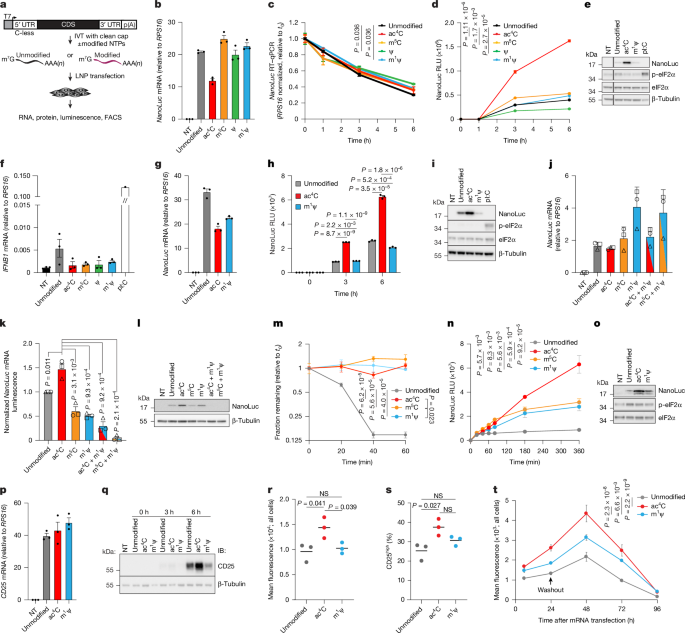
Linearized and purified plasmid DNA (purchased from Genscript; see Supplementary Table 1 for sequences) was IVT with T7 polymerase (NEB, M0251L) or G47A+884G mutant T7 (gift from Y.-X. Wang’s Laboratory) in combination with inorganic pyrophosphatase (Escherichia coli, NEB, M0361L). Co-transcriptional capping was achieved with CleanCap AG (TriLink, N-7113) according to the manufacturer’s instructions (TriLink). SINAPs reporter mRNAs were post-transcriptionally polyadenylated with E. coli poly(A)polymerase (NEB, M0276) supplemented with murine RNase inhibitor (NEB, M0314) for 30 min at 37 °C according to the manufacturer’s instructions. For modified transcripts, ac4CTP (Jena Bioscience, NU-988L) or m5CTP (TriLink, N-1014-5) replaced CTP, and m1ΨTP (TriLink, N-1081) or ΨTP (TriLink, N-1019-5) replaced UTP in the reaction mix. Purification of polyadenylated RNA was achieved by magnetic separation using RNAClean XP beads (Beckman Coulter, A63987) according to the manufacturer’s instructions. Denaturing agarose gel electrophoresis was performed using NorthernMax 10× Denaturing gel buffer (Thermo Fisher Scientific, AM8676). Gels were stained after electrophoresis using SYBR Green II RNA gel stain (1:10,000 in TBE, Thermo Fisher Scientific, S7564) for 30 min in the dark to visualize RNA. ac4C-modified IVT mRNAs were diluted before gel loading to account for increased staining intensity.
Nucleoside mass spectrometry
Modified and unmodified IVT mRNAs (100 ng each) were digested in 35 µl using snake venom phosphodiesterase (0.2 U, Abnova, P5263), calf intestinal phosphatase (2 U, Promega, M1821) and benzonase (2 U, Millipore Sigma, E1014) prepared with 1 mM MgCl2 (Quality Biological, 351-033), 5 mM Tris (pH 8, Invitrogen, AM9855G), 10 nmol butylated hydroxytoluene (Sigma-Aldrich, B1378) and 5 µg tetrahydrouridine (Calbiochem, 584222) (modified from a previously described method53) and incubated for 2 h at 37 °C. Samples were diluted with 15 µl LC–MS buffer A (0.0075% formic acid (Supelco, 5330020050) in ultrapure water) and filtered for 35 min at 3,273g and 4 °C through 0.2 µm Supor AcroPrep Advance 96-well plates (Cytiva, 50-206-3147). Of the filtrate, 39 µl was subjected to mass spectrometry analysis on an Agilent Technologies triple quad 6495C mass spectrometer. For HPLC (Agilent 1290 Infinity II), buffer A (described above) and buffer B (0.0075% formic acid in acetonitrile (Honeywell, LC015) were used in combination with an alkyl reversed-phase column (Zorbax RRHD StableBond Aq, 2.1 × 150 mm, 1.8 µm, 80 Å, Agilent Technologies, 859700-914); concentration buffer B: 0–1 min 0%, 1–1.4 min 0.1%, 1.4–2.8 min 0.4%, 2.8–4.2 min 0.9%, 4.2–5.6 min 1.6%, 5.6–8 min 4%, 8–11.5 min 15%, 15–15.5 min 50%, 15.5–16.5 min 50%, 16.5–17 min 0% and 17–18 min 0%.
In vitro translation
In vitro translation assays were performed by incubating 50 ng unmodified or modified luciferase mRNA for 3 min at 65 °C before adding 3.5 μl RRL (Promega, L4960) in a final volume of 5 μl at 30 °C. Reactions were stopped at 20, 40, 60, 80, 180 and 360 min by placing on dry ice. In vitro translation assays incorporating [35S]-L-methionine/cysteine were performed by incubating 100 ng unmodified or modified luciferase mRNA for 3 min at 65 °C before adding 3.5 μl RRL containing an amino acid mixture (minus methionine) and 10 μCi [35S]-L-methionine/cysteine (Revvity, NEG772002MC) in a final volume of 5 μl at 30 °C according to the manufacturer’s instructions. Reactions were stopped at 80 min by adding 2× Laemmli loading buffer. Proteins were denatured for 10 min at 70 °C before separation on 14% SDS–polyacrylamide gels for PAGE. Radioactive signals were captured on a phosphoscreen for 72 h before detection with a Typhoon molecular bioimager (GE).
IVT mRNA transfections
For NanoLuc, NanoLuc synthesized with G47A+884G mutant T7 polymerase, C=U NanoLuc and CD25 experiments in HeLa cells, cells were transfected in suspension with 2.5 µg IVT mRNA per 1 × 10⁶ cells using 3.75 µl MessengerMax reagent (Invitrogen, LMRNA015) in OptiMEM (Thermo Fisher Scientific, 31985062) according to the manufacturer’s instructions. After 5 min (standard condition) or 24 h (extended transfection) of exposure to the mRNA–LNP complexes, the cells were washed twice with PBS, resuspended in fresh DMEM–BCS and seeded separately for protein, RNA and luminescence experiments. At the indicated time points, cells were lysed directly in TRIzol reagent (100 µl, Thermo Fisher Scientific, 15596026) or scraped into PBS before lysis in supplemented RIPA buffer (protease and phosphatase inhibitor). For FLuc experiments, plated HeLa cells were transfected at about 50% confluency with around 2.5 µg IVT mRNA per 6-well plate with 3.75 µl MessengerMax reagent in OptiMEM, as described above. Cells for RNA analysis were lysed immediately after transfection in TRIzol reagent. At 6 h after transfection, cells for protein analysis were washed twice with PBS, scraped into PBS and lysed in cell culture lysis buffer (Promega, E1500) supplemented with protease and phosphatase inhibitor. To generate dsRNA-treated controls, HeLa cells were transfected with 0.5 µg ml–1 polyI:C (Millipore Sigma, P1530) for 2 h, using 12 µl MessengerMax reagent and 4 ml OptiMEM, according to the manufacturer’s instructions. Cells were collected for protein and RNA analyses 6 h after polyI:C treatment. THP-1-derived M0 macrophages, primary human MoDCs and MEFs were transfected with 1 µg IVT mRNA per 1 × 10⁶ live cells in suspension before plating (MoDCs and MEFs) or in seeded adherent cells (THP-1). For U-2 OS experiments, 500,000 cells were seeded 24 h before transfection of 1 μg RNA using 1.5 μl Lipofectamine MessengerMax according to the manufacturer’s protocol. Anisomycin (Sigma Aldrich, A9789-5MG) control cells were treated at 0.2 μg ml–1. The cells were collected with supplemented RIPA buffer (protease and phosphatase inhibitor) after 1.5 h. For titration experiments, RNA and MessengerMax reagent were each serial-diluted 1:10 before forming LNP complexes. Conditions were otherwise as described for HeLa cells.
Electroporation
HeLa cells (1.1 × 10⁶) were resuspended in 100 µl Neon NxT resuspension buffer R, and aqueous RNA (1.1 μg in 10 μl) was added and gently mixed. The mixture (100 μl) was aspirated into a 100 μl Neon NxT Tip on a respective pipette and docked into a Neon NxT Pipette Station with the tube containing 2 ml buffer E100. Electroporation was performed using the HEK293 mRNA1 protocol, and the cells were immediately transferred to complete medium for plating.
Luminescence
For in vitro translation assays, reactions were diluted with 95 μl of 1 mg ml–1 BSA, then 10 μl of the dilution was mixed with 40 μl PBS and 50 μl Nano-Glo reagent (Promega, N1120) according to the manufacturer’s instructions. In NanoLuc-transfected cells, 100 µl Nano-Glo assay reagent was used per 10,000 cells. For detection of FLuc luminescence, cleared lysate was diluted to correspond to 10,000 transfected cells in 10 µl Cell Culture lysis buffer (Promega, E1500). Luminescence was determined by adding 100 µl Luciferase assay reagent according to the manufacturer’s instructions, followed by detection using a SpectraMax iD3 (Molecular Devices) instrument.
Protein stability
To inhibit the proteasome, HeLa cells transfected with IVT mRNA were cultured with 25 µM MG132 (Cell Signaling Technologies, 2194S) in DMEM–BCS for 6 h, followed by protein lysis. To assess protein stability, 100 µg ml–1 cycloheximide (Sigma, C7698) was added to HeLa cells 12 h after transfection. Cells were collected for protein analyses at the indicated time points.
PKR inhibition
After 5–6 days of differentiation, MoDCs were counted and pretreated with the PKR inhibitor C16 (1.5 μM, 0.0075% DMSO, Sigma, 527450) for 10 min. The cells were washed and transfected with 1 μg RNA per 1 × 10⁶ cells as described above and treated for 6 h before collection.
Western blot analysis
Cell lysates were cleared by centrifugation at full speed for 15 min at 4 °C, and the protein concentration was quantified using a Pierce BCA Protein Assay kit (Thermo Fisher Scientific, A55865). For general expression analysis, equal amounts of protein (5–30 μg) were loaded on 4–12% Bis-Tris NuPAGE gels (Thermo Fisher Scientific, NP0321), separated using NuPAGE MOPS SDS running buffer (Thermo Fisher Scientific, NP0001) and transferred onto 0.2 μm nitrocellulose membranes from a Trans-Blot Turbo RTA Mini kit (Bio-Rad, 1704270) according to the manufacturer’s instructions. For CHX-chase, an equal volume of lysate (10 μl) was analysed.
Membranes were blocked with 5% milk in 0.05% Tween-20 TBS buffer and incubated in a solution containing 5% milk in 0.05% Tween-20 TBS buffer and the following primary antibodies: rabbit anti-eIF2α (1:1,000, Cell Signaling Technology, 9722), rabbit anti-p-eIF2α ((E90), 1:1,000, Abcam, ab32157), mouse anti-NanoLuc ((965808),m1:500, R&D, MAB10026), rabbit anti-TNF ((EPR22598-212), 1:1,000, Abcam, ab255275), mouse anti-β-tubulin ((D3U1W), 1:1,000, Cell Signaling Technology, 86298), rabbit anti-CD25 ((SP176), 1:300, Abcam, ab231441), mouse anti-Flag ((M2), 1:1,000, Sigma-Aldrich, F1804), mouse anti-JNK ((1A12E1), 1:1,000, Proteintech, 66210-1-Ig), rabbit anti-phospho-SAPK/JNK ((Thr183/Tyr185) (81E11) 1:1,000, Cell Signaling Technology, 4668S), rabbit anti-phospho-p38 MAPK (Thr180/Tyr182) (1:1,000, Cell Signaling Technology, 9211S), rabbit anti-p38 MAPK (1:1,000, Cell Signaling Technology, 9212S), rabbit anti-TLR8 (1:1,000, Thermo Fisher Scientific, PA5-102413), rabbit anti-TLR7 ((EPR2088(2)), 1:1,000, Abcam, ab124928), rabbit anti-lamin B1 ((EPR8985(B)), 1:1,000, Abcam, ab133741), rabbit anti-ZNF598 ((5H5L17), 1:1,000, Thermo Fisher Scientific, 703601), mouse anti-PKR ((1441CT628.33.40), 1:1,000, Thermo Fisher Scientific, M5-37667), rabbit anti-phospho-PKR/EIF2AK2-T446 ((ARC0293), 1:1,000, ABclonal, AP1134) and mouse anti-GAPDH ((6C5), 1:1,000, Santa Cruz Biotechnology, sc-32233). After overnight incubation at 4 °C, membranes were washed 3 times in 0.05% Tween-20 TBS buffer, followed by incubation with the horseradish-peroxidase-conjugated secondary antibodies anti-mouse IgG (1:5,000, GE Healthcare, NA931) or anti-rabbit IgG (1:10,000, Cell Signaling Technology, 7074). Western blots were visualized by enhanced chemiluminescence using ECL Western Blotting Detection Reagents (Cytiva, RPN2209), SuperSignal West Pico PLUS Chemiluminescent Substrate (Thermo Fisher Scientific, 34580) or SuperSignal West Femto Maximum Sensitivity Substrate (Thermo Fisher Scientific, 34096). Chemiluminescence was detected using a ChemiDoc Imaging System (Bio-Rad). Densitometry was performed using ImageLab software (Bio-Rad).
RNase T2 treatment
RNA (500 ng) was diluted with water. Human RNase T2 protein (sf9, His, MedChemExpress, HY-P76006) was added at the indicated concentrations in sodium acetate buffer (final 50 mM, pH 4.5) and EDTA (final 2 mM, pH 8.0). After incubation at 37 °C for 5 min, reactions were quenched with denaturing gel buffer, heated to 65 °C for 5 min and separated on a denaturing gel.
Translation imaging
Microscopy
Fixed-cell data were acquired on a wide-field upright Nikon Eclipse Ni microscope, which was controlled by Nikon Elements software. The system was equipped with a Spectra X LED light engine (Lumencor), an Orca 4.0 v.2 sCMOS camera (Hamamatsu) and a ×60 oil-immersion objective lens (1.4 NA, Nikon). The x-y pixel size was 108.3 nm.
Live-cell data were acquired using a custom inverted Nikon Eclipse Ti-2E microscope, which was controlled by Nikon Elements software. The setup included an iLas2 Ring TIRF system with a ×60 apochromatic oil-immersion TIRF objective lens (1.49 NA, Nikon MRD01691), an ORCA-Fusion BT sCMOS camera (Hamamatsu) with a 6.5 µm pixel size, an LUNF-XL multilaser unit with 405 nm, 488 nm, 561 nm and 640 nm lasers (50 mW, 60 mW, 50 mW and 40 mW, respectively), with a TRF89901-EMV2 ET quad-band filter set (Chroma) optimized for 405, 488, 561 and 640 nm wavelengths for TIRF application. The x-y pixel size was 108.3 nm.
Fixed-cell smFISH–IF experiments
smFISH–IF was performed following previously described protocols32,36. In brief, 12 mm no. 1 German glass coverslips (Electron Microscopy Sciences, 72290-03) were carefully distributed into the wells of a 24-well tissue culture plate (Falcon, 353226) and cleaned with 3 M sodium hydroxide for 5 min followed by 3 washes in Dulbecco’s PBS (DPBS) (Corning, 21-031-CM). The coverslips were coated with a 1:400 dilution of fibronectin (Sigma-Aldrich, F1141-2 mg) in DPBS for 30 min at 37 °C, followed by one wash with DMEM. Next, 25,000 U-2 OS cells stably expressing the SINAPs accessory proteins OsTIR2–IRES–scFV–sfGFP were seeded on each coverslip. One day after seeding, the medium was exchanged and supplemented with 1 µM 5-phenyl-indole-3-acetic acid (Fisher Scientific, NC195789). IVT mRNA (10 ng) was transfected into the cells using 1 µl Lipofectamine MessengerMAX transfection reagent (Invitrogen, LMRNA003) following the manufacturer’s protocol. Cells were incubated with the transfection reagent for 10 min, washed 3 times with prewarmed DMEM–10% FBS and left to incubate for an additional 1 h in DMEM–FBS. The cells were washed 3 times with PBS supplemented with 5 mM magnesium chloride (PBSM, Millipore, M2670), then subsequently fixed at room temperature for 10 min in 4% paraformaldehyde (Electron Microscopy Sciences, 50-980-492) diluted in PBSM. Three 5-min washes were performed with 1× PBSM to remove the fixation buffer. Cells were permeabilized in a buffer (PBSM + 5 mg ml–1 BSA (VWR, 0332) + 0.1% Triton-X100 (Millipore, T8787)) at room temperature for 10 min, followed by another three 5-min washes with 1× PBSM. The cells were treated with a pre-hybridization buffer consisting of 2× SSC (Corning, 46-020-CM), 10% formamide (Millipore Sigma, F9037) and 5 mg ml–1 BSA for 30 min. During the pre-hybridization step, the final hybridization solution was prepared: 60 nM SunTag_v4-Cy5 smFISH probes, 60 nM MBS_v5-Cy3 smFISH probes36, chicken anti-GFP antibody (1:1,000, Aves Labs, GFP-1010), 100 units ml–1 SUPERase·In (Thermo Fisher Scientific, AM2694), 1 mg ml–1 competitor E. coli tRNA (Millipore Sigma, 10109541001), 2 mM ribonucleoside vanadyl complex (NEB, S1402S), 10% formamide, 2× SSC and 10% w/v dextran sulfate (Millipore Sigma, D8906). The coverslips were incubated for a total of 3 h in the hybridization solution at 37 °C. After hybridization, the coverslips were washed 4 times with a solution of 10% formamide in 2× SSC. The coverslips were stained with a secondary antibody (Alexa-488-goat anti-chicken IgY secondary antibody, Thermo Fisher Scientific, A-11039) in a buffer (10% formamide, 2× SSC) twice at 37 °C for 20 min. The cells were quickly washed 3 times with 2× SSC to remove any unbound secondary antibodies before a final 5-min wash in 2× SSC. The coverslips were carefully removed from the culture dish and mounted with ProLong Diamond antifade reagent containing DAPI (Invitrogen, P36962) on a pre-cleaned frosted glass slide (Thermo Fisher Scientific, 12-552-3). The coverslips were left in the dark for more than 24 h and sealed with clear nail polish. Fixed-cell imaging was performed on the day following each respective smFISH–IF experiment.
smFISH–IF time-course experiments with balancer mRNAs
Cells were transfected with a mixture of 10 ng SINAPs reporter mRNA and 490 ng CD25 balancer mRNA with the same nucleotide modification using 1 µl Lipofectamine MessengerMAX transfection reagent (Invitrogen, LMRNA003) following the manufacturer’s instructions. All experimental wells were transfected at the same time with the same master mix of reagents. Cells were incubated with the transfection mixture for 10 min, after which the transfection medium was removed and cells were washed three times with pre-warmed, equilibrated culture medium, at which point the time was marked as zero (t = 0). At 10, 20, 30, 60, 120 and 240 min after the wash, different wells were fixed and subject to the smFISH–IF procedure as described above.
Ribosome runoff experiments
For live-cell imaging experiments, U-2 OS cells stably expressing OsTIR1–IRES–scFV–sfGFP and tdMCP–mScarlet–tagRFPT–CAAX were seeded onto 35 mm glass-bottom dishes (Cellvis, D35-20-1.5-N) 48 h before transfection (around 80,000 cells per dish). The medium was refreshed 24 h before transfection, and 500 µM 3-indoleacetic acid (Millipore Sigma, I2886) was added to degrade mature proteins and to minimize background fluorescence.
On the day of the experiment, each dish was transfected with 100 ng IVT mRNA diluted in 125 µl Opti-MEM mixed with 5 µl Lipofectamine MessengerMax transfection reagent (Invitrogen, LMRNA003) diluted in 120 µl Opti-MEM following the manufacturer’s protocol. Cells were incubated with the transfection reagent for 1 h, washed 3 times with prewarmed DMEM–FBS and then rinsed with FluoroBrite DMEM (Gibco, A1896701) supplemented with 10% FBS. Following 1 h of incubation in imaging medium, dishes were transferred to the microscope stage for live-cell imaging. Cells were maintained at 37 °C and 5% CO2 during imaging inside a Toki hit temperature-controlled stage top incubator. Positively transfected cells actively undergoing translation were identified by detecting translation signals in the GFP channel as well as positive RFP signal in the RNA channel, with each cell displaying approximately 20–40 tethered mRNAs.
Harringtonine treatment and ribosome runoff experiments were performed according to a previously established protocol32. In brief, for each experiment, 3–4 positively transfected cells with active TLSs and close to each other were selected for imaging. After saving the cell positions and microscope focus, 0.75 ml imaging medium was removed from the dish and mixed with harringtonine in a 1.5 ml centrifuge tube, then added back to the dish, gently and thoroughly mixed to a final concentration of 9 µg ml–1 with the original medium in the dish by pipetting. Imaging started 1 min after adding harringtonine and the selected cells were imaged every 10 s for 30 min, with sequential laser excitation at 488 nm and 561 nm. Both channels were captured with a 500 ms camera exposure time.
smFISH–IF experiments with harringtonine ribosome runoffs
Cells were transfected with 10 ng SINAPs reporter mRNA using 1 µl Lipofectamine MessengerMAX transfection reagent (Invitrogen, LMRNA003), following the manufacturer’s instructions. All experimental wells were transfected at the same time with the same master mix of reagents. Cells were incubated with the transfection mixture for 10 min, after which the transfection medium was removed, and cells were washed 3 times with prewarmed, equilibrated culture medium, at which point the time was marked as zero (t = 0). Harringtonine treatment was performed as described above, with the final concentration of harringtonine as 9 µg ml–1. At 0, 3, 5 and 15 min after harringtonine addition, the cells were washed 3 times with PBS supplemented with 5 mM magnesium chloride (PBSM, Millipore, M2670), then subsequently fixed at room temperature for 10 min in 4% paraformaldehyde (Electron Microscopy Sciences, 50-980-492) diluted in PBSM. The subsequent smFISH–IF procedure was performed as described above.
Ribosome runoff experiments after knocking down ZNF598
At 48 h before imaging, 5 pmol DsiRNA (Integrated DNA Technologies; ZNF598: hs.Ri.ZNF598.13.1-3; or control siRNA: 51-01-14-03) was diluted in 50 µl Opti-MEM mixed with 1.5 µl Lipofectamine RNAiMAX transfection reagent (Invitrogen, 13778). While the transfection mixture was incubated at room temperature for 10 min, U-2 OS cells stably expressing OsTIR1–IRES–scFV–sfGFP and tdMCP–mScarlet–tagRFPT–CAAX were seeded onto 4-chamber 35 mm glass-bottom dishes (Cellvis, D35C4-20-1.5-N) (30,000 cells per well). The transfection mixture was added to the dish immediately after cell seeding. Ribosome runoff was performed as described above with the following modifications: 20 ng mRNA was transfected per well, and a final concentration of 9 µg ml–1 harringtonine was added per well to initiate the runoff.
Image analysis and quantification
Ribosome runoff
Single-molecule imaging analysis with a Matlab pipeline built around U-Track has been previously described36,54. The first step involved the detection of mRNAs and TLSs in each frame using the AirLocalize algorithm55,56. The second step used the U-Track software for tracking individual mRNAs and TLSs separately. The third step used a custom-built colocalization algorithm to link the detected mRNA and TLS tracks. After automatic detection, all tracks were manually inspected and verified using a custom-built TrackViewer in Matlab. To calculate ribosome off-time, we only analysed tracks with translating mRNAs at the beginning (the first five frames when harringtonine was added), and when the RNA signal persisted after the disappearance of the translation signal (for 3 frames). This approach ensured that we did not count mRNAs leaving the imaging field due to untethering from the membrane. The ribosome runoff time was defined as the time point when the TLS intensity dropped below 10% of the one at t = 0. We calculated the Kaplan–Meier survival probability with all runoff times (Fig. 4d).
smFISH–IF
Fixed-cell smFISH–IF experiments were analysed using a custom-built Matlab pipeline as previously described32. To detect RNA, we first manually segmented cell boundaries of successfully transfected cells and their DAPI-stained nuclei with FISH-Quant57. After filtering, an intensity threshold was used to identify potential fluorescent spots in the image. The locations and the fluorescent intensities of the candidate spots were fitted using a 3D Gaussian function. The SunTag and MS2 FISH probes were labelled with two different colours and detected separately. To correct chromatic aberration, we prepared 100 nm TetraSpek multicolour beads (Invitrogen, T7279) on a coverslip and imaged at the same channels as our experimental samples58. SunTag and MS2 spots were colocalized with a nearest-neighbour analysis with a 3-pixel threshold after chromatic correction. We focused on intact mRNAs that contained both SunTag and MS2 FISH signals. To calculate the TLS intensity, we fit a 15 × 15-pixel region around the SunTag FISH spot in the IF channel to a 3D Gaussian function. To measure the intensity of a single mature protein, a similar single-particle detection method was performed in the IF channel excluding the 15 × 15-pixel RNA-containing region. By normalizing the total integrated intensity of the TLS by the median single-peptide intensity in the same cell, we estimated the number of ribosomes actively translating on the mRNA.
ZNF598–HaloTag colocalization detection and track analysis
To quantify interactions between ZNF598–HaloTag and TLSs, we developed a custom colocalization detection script in Matlab (R2021a) tailored for weak live-cell single-molecule fluorescence intensity time series. For each trace, the fluorescence intensity of ZNF598 was first smoothed using a 3-frame moving average filter to reduce frame-to-frame noise. Positive events were defined as contiguous time windows when the smoothed signal exceeded a threshold for at least 5 frames, corresponding to 10 s at a 2-s frame rate. The threshold was user defined (typically 1.5 times the background intensity and may be adjusted to slightly higher for traces with low signal variability). To tolerate brief signal disappearance (for example, due to molecules moving out of the evanescent field), we incorporated a merging criterion. Events separated by fewer than 3 frames were merged if the gap region exceeded 75% of the threshold or the pre-gap and post-gap intensities were similar (normalized difference less than 20%). The colocalization detection events were saved in a logical mask variable for each trace. These variables were subsequently used to compute interaction durations, ZNF598–HaloTag intensities and the fraction of colocalization. The detection was visually validated on more than 50 randomly selected traces per condition to ensure accuracy and robustness across replicate datasets. We confirmed correct colocalization start and end points and verified that the script appropriately merged or excluded brief subthreshold gaps.
Mouse studies
DLin-MC3-DMA was purchased from MedKoo Biosciences. 18PG and DMG-PEG-2000 were obtained from Avanti Polar Lipids. Cholesterol was from Sigma-Aldrich.
LNP synthesis and characterization
Parameters for LNP synthesis were as previously described24,25,26. In brief, to prepare the organic phase, a mixture of DLin-MC3 DMA, cholesterol, DMG-PEG2000 and 18PG was dissolved in ethanol. To prepare the aqueous phase, corresponding mRNA was prepared in magnesium acetate buffer (25 mM, pH 4.0, Fisher Scientific, SB85-1). All mRNA samples were stored at −80 °C and thawed on ice before use. For LNP synthesis, the aqueous and ethanol phases prepared were mixed at a 3:1 ratio in a flash nanocomplexation device using syringe pumps, purified by dialysis against deionized water using a 100-kDa molecular weight cutoff cassette (Thermo Fisher Scientific) at 4 °C for 24 h and stored at 4 °C before injection. The size, polydispersity index and zeta potentials of LNPs were measured using dynamic light scattering (ZetaPALS, Brookhaven Instruments). Diameters are reported as the intensity mean average.
Characterization of the encapsulation efficiency of mRNA LNPs
The encapsulation efficiency of mRNA in LNPs was evaluated using a Quant-iT RiboGreen assay (Thermo Fisher Scientific, R11490). To disrupt the LNP structure and release the encapsulated mRNA, LNP samples were treated with 0.5% w/v Triton X-100 (Sigma-Aldrich, T8787). Both Triton-treated and untreated LNP samples were diluted to a concentration of less than 1 μg mRNA per ml before being mixed with an equal volume of RiboGreen working solution (200-fold dilution). Standard curves were prepared using free mRNA solutions with or without 0.5% w/v Triton X-100, covering a concentration range of 0.1–1.0 μg mRNA per ml. Fluorescence measurements (excitation of 480 nm, emission of 520 nm) were recorded, and the concentrations of free mRNA (untreated samples) and total mRNA (Triton-treated samples) in the LNP formulations were quantified by comparing the fluorescence intensities against the corresponding standard curves59.
Animals
All animal procedures were performed with ethical compliance and approval by the Johns Hopkins Institutional Animal Care and Use Committee (protocol no. MO23E31). Female BALB/c mice (6–8 weeks) were obtained from the Jackson Laboratory and randomly grouped. Mice were generally fed a diet containing low fibre (5%), protein (20%) and fat (5–10%). The pelleted feed was supplied. Mice were supplied feed free choice and they ate 4–5 g a day (12 g per 100 g body weight per day). Water was supplied free choice and they usually drank 3–5 ml a day (1.5 ml per 10 g body weight per day). Water was supplied using automatic waterers. Mouse rooms were maintained at 30–70% relative humidity and a temperature of 18–26 °C (64–79 °F) with at least 10 room air changes per hour. The mice were housed in standard shoebox cages with filter tops under standard specific pathogen-free conditions with a 12-h light–dark cycle. Mice were provided with corncob as bedding. Sample sizes were selected based on our previous published work using similar mRNA–LNPs in vivo immune profiling and biodistribution studies25, for which comparable group sizes were sufficient to detect biologically meaningful differences. The in vivo IVIS experiments were independently replicated twice, and the datasets were pooled for analyses. Mice were randomly allocated into experimental groups. In vivo experiments and data collection were performed blinded to group allocation. Investigators remained blinded during data analysis whenever feasible.
The LNPs were intravenously injected into mice via the lateral tail vein at a predetermined dose per mouse. The mice were intraperitoneally injected with 100 μl of 30 mg ml–1 Nano-Glo Fluorofurimazine In Vivo substrate (FFz, Promega, N4100) solution and were anaesthetized in a ventilated anaesthesia chamber with 1.5% isoflurane in oxygen and imaged at 5 min after the injection with an in vivo imaging system (IVIS, Perkin-Elmer). Luminescence was quantified using Living Image software (Perkin-Elmer).
Sucrose density centrifugation
At 1.5 h after transfection, HeLa cells transfected with IVT mRNA were washed with ice-cold PBS and scraped into lysis buffer (50 mM HEPES pH 7.4, 100 mM potassium acetate, 15 mM magnesium acetate, 1 mM DTT, 1% Triton X-100 and emetine (360 µM, Sigma, 324693-250MG)) on ice. Lysates were incubated at 4 °C for 10 min before clearing for 10 min at 4 °C and 10,000g. RNA concentration was determined using a Qubit 4 Fluorometer (Thermo Fisher Scientific) and about 60 µg was diluted to a total volume of 600 µl with lysis buffer before layering on top of 10–45% sucrose gradients (25 mM HEPES pH 7.4, 100 mM potassium acetate, 5 mM magnesium acetate and 1 mM DTT) prepared with a Biocomp Gradient Master. Centrifugation to separate ribosome fractions was performed for 1 h and 45 min at 41,000 rpm (SW41Ti, Optima XPN-80, Beckman Coulter) at 4 °C. Gradients were fractionated, and UV (A260) absorbance across the gradients was measured using a top-down Biocomp Piston Gradient Fractionator with a Triax flow cell per the manufacturer’s instructions. To each fraction, 2 volumes of 100% ice-cold ethanol was added and the RNA was precipitated at −80 °C. RNA was isolated by pelleting for 30 min at 18,500g and 4 °C, followed by resuspension in LET buffer (25 mM Tris pH 8.0, 100 mM LiCL and 20 mM EDTA), addition of 1% SDS and double acid phenol–chloroform–LET extraction. Supernatants containing RNA were isolated after ammonium acetate–ethanol precipitation containing 1 µl GlycoBlue Coprecipitant (Thermo Fisher Scientific, AM9516) per sample.
RNA isolation and RT–qPCR
Unless described otherwise, total RNA was prepared by lysing cells at the indicated time points in TRIzol (100 µl reagent per 1–2 × 10⁵ cells) or adding an equal volume to in vitro lysates and extracted according to the manufacturer’s instructions. RNA was reverse transcribed with oligo(dT) primers or random hexamers using a Superscript IV system (Thermo Fisher Scientific, 18090200) according to the manufacturer’s suggestions, followed by qPCR with specific primers (Supplementary Table 1) using LightCycler 480 SYBR Green I master mix (Roche, 04887352001) in a LightCycler 96 Instrument (Roche).
RNA-seq library preparation and analysis
In brief, 1 µg modified and unmodified mRNA of the +1 FS FLuc reporter was used to generate cDNA libraries with a NEBNext Ultra II Directional RNA Library Prep kit for Illumina (NEB, E7760) starting from the fragmentation step. NEBNext Multiplex Oligos for Illumina (96 Unique Dual Index Primer Pairs, NEB, E6440) were used with 6 cycles of PCR amplification. The concentrations of the indexed libraries were analysed on an Agilent 4200 TapeStation (Agilent Technologies) using a D1000 kit (Agilent Technologies). Equimolar amounts of the indexed libraries were pooled to obtain a 2 nM library mixture. After further dilution, the final 750 pM library was sequenced single-end with dual index (122 × 8 × 8) using Illumina NextSeq2000 P1 reagents (100 cycles) on an Illumina NextSeq2000 instrument following the manufacturer’s instructions (Illumina).
RNA-seq analysis
The quality of raw reads was assessed using FastQC (v.0.12.1)60. The average per-base quality score across all the files was greater than 32, and contamination of Illumina adapters was observed at the 3′ end of the reads. These adapters were removed using Trim Galore (v.0.6.11)61. As the sequenced RNA was from a construct with a known open reading frame, the libraries (both raw and trimmed) were aligned using bowtie2 (v.2.5.3)62,63. The average alignment rate of the raw reads was 94% and increased to 99.52% for the trimmed reads. The aligned reads were sorted, indexed and summary statistics (flagstat) were obtained using samtools (v.1.23)64. The mapped sequences with MAPQ > = 5 were used to calculate the insertion and deletion rate in terms of per nucleotide using Qualimap (v.2.2.1)65 across the open reading frame. The libraries were visualized using IGV66,67.
Ribo-seq sample and library preparation
Hela cells were grown to 70–80% confluency before co-transfection with 3 µg mRNA for the WT 5×U FLuc reporter per 10 cm dish for each modification (unmodified, ac4C and m1Ψ) using MessengerMax reagent (22.5 μl per dish). Three 10 cm2 plates were transfected for each modification. After 3 h, the cells were washed with PBS and the samples were collected on wet ice in 500 µl of lysis buffer (see the section ‘Sucrose density centrifugation’ with inclusion of complete mini protease inhibitor cocktail, Roche, 11 836 153 001). Cell lysates were next triturated 10 times and clarified by centrifugation at 20,000g for 10 min at 4 °C.
Ribosome profiling and RPF purification was performed according to a published protocol68 but with modifications. In brief, for ribosome profiling, micrococcal nuclease I (MNase I, 2,400 U) was used to digest clear lysate equivalent to an optical density of 3.5 at room temperature for 40 min. MNase I was used in place of the more commonly used RNase I because both ac4C and m1Ψ confer resistance to RNase I cleavage69,70, which would have introduced systematic bias against modified transcripts and precluded direct comparison of ribosome footprint densities across modification states. Reactions were stopped using 10 mM EGTA and 5 μl SUPERaseIn. Digested lysates of unmodified, ac4C-modificed and m1Ψ-modified samples were loaded onto 10–45% sucrose gradients as described above for 1 h and 40 min. The monosome fraction was collected and RNA was isolated from ribosome-protected fragments using the phenol–chloroform–LET method (described in the section ‘Sucrose density centrifugation’). Next, 25–35 bp size RNA was purified from 15% urea–PAGE using gel extraction buffer (300 mM sodium acetate (pH 5.5), 1 mM EDTA and 0.25% (w/v) SDS). Library preparation was performed using a QiaSeq miRNA Library kit (Qiagen, 331502) and sequenced on a miSeq Illumina platform.
Ribo-seq analysis
Raw sequencing reads were processed to remove adapter sequences and to extract unique molecular identifiers (UMIs) using UMI-tools (v.1.1.5)71 with the following settings: –extract method=regex –bc pattern=‘.+(?P
RPFs exhibiting clear periodicity were identified using the length_filter function from the riboWaltz (v.2.0) package47, with parameters set to length_filter_mode = “periodicity” and periodicity_threshold = 50. P-site offsets were subsequently estimated using the psite function, with the following settings: flanking = 6, cl = 99, and extremity = “auto”. The computed offsets were then applied to assign P-site positions to individual reads using the psite_info function from riboWaltz.
Immunoprecipitation and mass spectrometric analysis
Lysates from HeLa cells transfected with IVT WT or +1FS FLuc reporter mRNAs with or without MG132 treatment were prepared as described above. Immunoprecipitation of Flag-tagged FLuc was performed using Flag M2 beads (Sigma-Aldrich, F3165). In brief, 900 μg and 350 μg Hela cell lysate from cells transfected with 5×U FLuc and +1FS-5×U FLuc reporter mRNA in the presence of MG132, respectively, was used for immunoprecipitation. Next, 5 μg and 2 μg of Flag-M2 antibody, respectively, was used for immunoprecipitation at 4 °C for 2 h followed by the addition of Protein-G Sepharose beads for 30 min. Affinity-purified beads were washed 3 times with TBS and resuspended in 25 mM HEPES, pH 8.0, heated at 95 °C for 5 min to denature the proteins, followed by digestion overnight with trypsin (Thermo Fisher Scientific) at 37 °C. Digests were purified using the proprietary peptide clean up columns from an EasyPEP Mini MS Sample Prep kit (Thermo Scientific, A40006). Peptide mixtures were vacuum centrifuged to dryness and stored at −80 °C until analysis by mass spectrometry.
Dried peptide fractions were reconstituted in 0.1% TFA and subjected to nanoflow liquid chromatography (Thermo EASY-nLC 1200, Thermo Fisher Scientific) coupled to an Orbitrap LUMOS mass spectrometer (Thermo Fisher Scientific). Peptides were separated using a low pH gradient with 5–50% acetonitrile over 120 min in mobile phase containing 0.1% formic acid at 300 nl min–1 flow rate. Mass spectrometry scans were performed in the Orbitrap analyser at a resolution of 120,000 with an ion accumulation target set at 4 × 10⁵ and max IT set at 50 ms over a mass range of 385–2,000 m/z. Ions with determined charge states between 2 and 5 were selected for fragment ion scans. A cycle time of 3 s was used, and a quadrupole isolation window of 1.4 m/z was used for tandem mass spectrometry (MS/MS) analyses. An Orbitrap at 15,000 resolutions with a normalized AGC set at 100 followed by maximum injection time set at 100 ms with a normalized collision energy setting of 30 was used for MS/MS analyses.
Acquired MS/MS spectra were searched against a fasta file containing the luciferase protein sequence along with potential different slippage proteins using a SEQUEST HT in Proteome Discoverer 2.4 software (Thermo Fisher Scientific). The precursor ion tolerance was set at 10 ppm, and the fragment ion tolerance was set at 0.02 Da, along with methionine oxidation included as dynamic modification. Carbamidomethylation of cysteine residues was set as a static modification. Trypsin was specified as the proteolytic enzyme, with up to two missed cleavage sites allowed. Searches used a reverse sequence decoy strategy to control for the false peptide discovery, and identifications were validated using fixed value PSM Validator algorithms. Both highly confident and medium confident peptides were considered as potential true positives. Untransfected Hela cells were used as a negative control.
Reporting summary
Further information on research design is available in the Nature Portfolio Reporting Summary linked to this article.