
Dark Mode Light Mode

Keep Up to Date with the Most Important News

By pressing the Subscribe button, you confirm that you have read and are agreeing to our Privacy Policy and Terms of Use
Join us on a journey where chemistry meets creativity, and the wonders of science unfold. Quench your intellectual thirst with thought-provoking articles that transcend the boundaries of conventional knowledge.

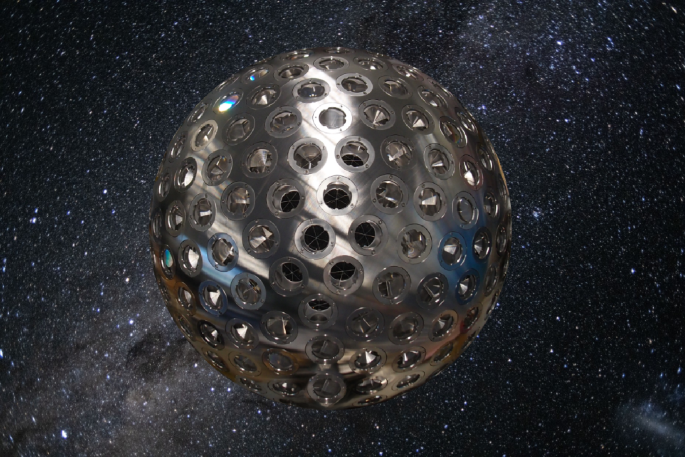
LARES-2 satellite measures frame-dragging effect around the Earth

LARES-2 satellite measures frame-dragging effect around the Earth LARES-2 satellite measures frame-dragging effect around the Earth


  • Will, C. M. & Yunes, N. Is Einstein Still Right?: Black Holes, Gravitational Waves, and the Quest to Verify Einstein’s Greatest Creation (Oxford Univ. Press, 2020).

  • Thorne, K. S., Price, R. H. & Macdonald, D. A. The Membrane Paradigm (Yale Univ. Press, 1986).

  • Apostolatos, T. A., Cutler, C., Sussman, G. J. & Thorne, K. S. Spin-induced orbital precession and its modulation of the gravitational waveforms from merging binaries. Phys. Rev. D 49, 6274 (1994).

    Article 
    ADS 
    CAS 

    Google Scholar
     

  • O’Connell, R. F. A note on frame dragging. Class. Quantum Grav. 22, 3815–3816 (2005).

    Article 
    ADS 
    MathSciNet 

    Google Scholar
     

  • Ciufolini, I. Dragging of inertial frames. Nature 449, 41–47 (2007).

    Article 
    ADS 
    CAS 
    PubMed 

    Google Scholar
     

  • Ciufolini, I., Matzner, R., Gurzadyan, V. & Penrose, R. A new laser-ranged satellite for General Relativity and Space Geodesy III. De Sitter effect and the LARES 2 space experiment. Eur. Phys. J. C 77, 819 (2017).

    Article 
    ADS 

    Google Scholar
     

  • Smith, T. L., Erickcek, A., Caldwell, R. & Kamionkowski, M. Effects of Chern–Simons gravity on bodies orbiting the Earth. Phys. Rev. D 77, 024015 (2008).

    Article 
    ADS 

    Google Scholar
     

  • Stephon, A. & Yunes, N. New post-Newtonian parameter to test chern-simons gravity. Phys. Rev. Lett. 99, 241101 (2007).

    Article 
    MathSciNet 

    Google Scholar
     

  • Ciufolini, I. et al. A new laser-ranged satellite for general relativity and space geodesy: I. An introduction to the LARES 2 space experiment. Eur. Phys. J. Plus 132, 336 (2017).

    Article 
    ADS 

    Google Scholar
     

  • Müller, J. et al. Lunar Laser Ranging: a tool for general relativity, lunar geophysics and Earth science. J. Geodesy 93, 2195 (2019).

    Article 
    ADS 

    Google Scholar
     

  • Pearlman, M. et al. Laser geodetic satellites: a high-accuracy scientific tool. J. Geodesy 93, 2181 (2019).

    Article 
    ADS 

    Google Scholar
     

  • Ciufolini, I. & Pavlis, E. C. A confirmation of the general relativistic prediction of the Lense–Thirring effect. Nature 431, 958–960 (2004).

    Article 
    ADS 
    CAS 
    PubMed 

    Google Scholar
     

  • Ciufolini, I. et al. An improved test of the general relativistic effect of frame-dragging using the LARES and LAGEOS satellites. Eur. Phys. J. C 79, 872 (2019).

    Article 
    ADS 

    Google Scholar
     

  • Everitt, C. W. et al. Gravity Probe B: final results of a space experiment to test general relativity. Phys. Rev. Lett. 106, 221101 (2011).

    Article 
    ADS 
    CAS 
    PubMed 

    Google Scholar
     

  • Lense, J. & Thirring, H. Uber den Einfluss der Eigenrotation der Zentralko¨rper auf die Bewegung der Planeten und Monde nach der Einsteinschen Gravitationstheorie. Phys. Z. 19, 156–163 (1918).


    Google Scholar
     

  • Einstein, A. Grundgedanken der allgemeinen Relativitätstheorie und anwendung dieser theorie in der astronomie, sitzungsher. Preuss Akad. Wiss. 778–786, 799–801 (1915).


    Google Scholar
     

  • Zeldovich, YaB & Novikov, I. D. Relativistic Astrophysics Vol. I Stars and Relativity (Univ. Chicago Press, 1971).

  • Landau, L. D. & Lifshitz, E. M. The Classical Theory of Fields 3rd rev., English edn. (Pergamon, 1971).

  • Weinberg, S. Gravitation and Cosmology: Principles and Applications of the General Theory of Relativity (Wiley, 1972).

  • Hawking, S. W. & Ellis, G. F. R. The Large Structure of Space-time (Cambridge Univ. Press, Cambridge, 1973).

  • Misner, C. W., Thorne, K. S. & Wheeler, J. A. Gravitation (Freeman, 1973).

  • Hawking, S. & Penrose R. The Nature of Space and Time (Princeton Univ. Press, 2010).

  • Will, C. M. Theory and Experiment in Gravitational Physics (Cambridge Univ. Press, 2018).

  • Will, C. M. The confrontation between general relativity and experiment. Living Rev. Relativ. 17, 4 (2014).

    Article 
    ADS 
    PubMed 
    PubMed Central 

    Google Scholar
     

  • Ciufolini, I. & Wheeler, J. A. Gravitation and Inertia (Princeton Univ. Press, 1995).

  • Kopeikin S. et al. Frontiers in Relativistic Celestial Mechanics Vol. 2 (de Gruyter, 2014).

  • Penrose, R. Gravitational collapse and space–time singularities. Phys. Rev. Lett. 14, 57 (1965).

    Article 
    ADS 
    MathSciNet 

    Google Scholar
     

  • Abbott, B. P. et al. Tests of general relativity with GW150914. Phys. Rev. Lett. 116, 221101 (2016).

    Article 
    ADS 
    CAS 
    PubMed 

    Google Scholar
     

  • Thorne, K. S. LIGO and gravitational waves, III: Nobel lecture, December 8, 2017. Ann. Phys. 531, 1800350 (2019).

    Article 

    Google Scholar
     

  • Riess, A. G. et al. Observational evidence from supernovae for an accelerating universe and a cosmological constant. Astron. J. 116, 1009–1038 (1998).

    Article 
    ADS 

    Google Scholar
     

  • Perlmutter, S. et al. Measurements of Omega and Lambda from 42 high-redshift supernovae. Astrophys. J. 517, 565–586 (1999).

    Article 
    ADS 

    Google Scholar
     

  • Caldwell, R. R. Dark energy. Phys. World 17, 37 (2004).

    Article 

    Google Scholar
     

  • Ciufolini, I. Measurement of the Lense–Thirring drag on high-altitude laser-ranged artificial satellites. Phys. Rev. Lett. 56, 278 (1986).

    Article 
    ADS 
    CAS 
    PubMed 

    Google Scholar
     

  • Ciufolini, I. A comprehensive introduction to the Lageos gravitomagnetic experiment: from the importance of the gravitomagnetic field in physics to preliminary error analysis and error budget. Int. J. Mod. Phys. A 4, 3083–3145 (1989).

    Article 
    ADS 
    CAS 

    Google Scholar
     

  • Ciufolini, I. et al. The LARES 2 satellite, general relativity and fundamental physics. Eur. Phys. J. C 83, 87 (2023).

    Article 
    ADS 
    CAS 

    Google Scholar
     

  • Kaula, W. M. Theory of Satellite Geodesy (Blaisdell, 1966).

  • Ciufolini, I. Theory and experiments in general relativity and other metric theories. PhD Dissertation, Univ. Texas, Austin (1984).

  • Ries, J. C. Simulation of an experiment to measure the Lense–Thirring precession using a second LAGEOS satellite. PhD Dissertation, Univ. Texas, Austin (1989).

  • Peterson, G. E. Estimation of the Lense–Thirring precession using laser-ranged satellites. PhD Dissertation, Univ. of Texas, Austin (1997).

  • Tapley, B. D. & Ciufolini, I. Measuring the Lense-Thirring Precession Using a Second LAGEOS Satellite CSR-UT Report 89-3 (Texas Scholar Works depository, 1989); https://doi.org/10.26153/tsw/63964

  • Ciufolini, I. et al. A new laser-ranged satellite for general relativity and space geodesy: II. Monte Carlo simulations and covariance analyses of the LARES 2 experiment. Eur. Phys. J. Plus 132, 337 (2017).

    Article 
    ADS 

    Google Scholar
     

  • Ciufolini, I. et al. A new laser-ranged satellite for general relativity and space geodesy: IV. Thermal drag and the LARES 2 space experiment. Eur. Phys. J. Plus 133, 333 (2018).

    Article 
    ADS 

    Google Scholar
     

  • Ciufolini, I. et al. ASI-NASA Study on LAGEOS III (NASA, 1989); https://ntrs.nasa.gov/citations/19910004157

  • Ray, R. D. & Merrifield, M. A. The semiannual and 4.4-year modulations of extreme high tides. J. Geophys. Res. Oceans 124, 5907–5922 (2019).

    Article 
    ADS 

    Google Scholar
     

  • Bertotti, B. & Carpino, M. Supplementary satellites and tidal perturbations. In ASI-NASA Study on LAGEOS III (ed. Ciufolini I. et al.) (NASA, 1989); https://ntrs.nasa.gov/citations/19910004157

  • Pucacco, G. & Lucchesi, D. M. Tidal effects on the LAGEOS–LARES satellites and the LARASE program. Celest. Mech. Dyn. Astr. 130, 66 (2018).

    Article 
    ADS 

    Google Scholar
     

  • Gurzadyan, V. G., Ciufolini, I., Khachatryan, H. G., Mirzoyan, S. & Paolozzi, A. On the Earth’s tidal perturbations. II. LARES 2 satellite. Eur. Phys. J. Plus 140, 512 (2025).

    Article 
    ADS 

    Google Scholar
     

  • Ries, J. C. et al. Development and Evaluation of the Global Gravity Model GGM05C CSR-16-02 (ICGEM, 2016); https://icgem.gfz.de/tom_longtime.

  • Tapley, B. D., Bettadpur, S., Watkins, M. & Reigber, C. The gravity recovery and climate experiment: mission overview and early results. Geophys. Res. Lett. 31, L09607 (2004).

    Article 
    ADS 

    Google Scholar
     

  • Landerer, F. W. et al. Extending the global mass change data record: GRACE follow-on instrument and science data performance. Geophys. Res. Lett. 47, 12 (2020).

    Article 

    Google Scholar
     

  • Chen, W. & Shen, W. New estimates of the inertia tensor and rotation of the triaxial nonrigid Earth. J. Geophys. Res. 115, B12419 (2010).

    ADS 

    Google Scholar
     

  • Petit, G. G. & Luzum, B. (eds) IERS Technical Note No. 36, 2010 IERS Conventions, Frankfurt am Main Verlag des Bundesamts für Kartographie und Geodaesie (IERS, 2010).

  • Ray, R. D. Precise comparisons of bottom-pressure and altimetric ocean tides. J. Geophys. Res. Oceans 118, 4570 (2013).

    Article 
    ADS 

    Google Scholar
     

  • Ray, R. D. Documentation for Goddard Ocean Tide Solution GOT5: Global Tides from Multi-mission Satellite Altimetry TM-20250002085 (NASA, 2025).

  • Otsubo, T. et al. Rapid response quality control service for the laser ranging tracking network. J. Geod. 93, 2335–2344 (2019).

    Article 
    ADS 

    Google Scholar
     

  • Lucchesi, D. M. & Balmino, G. The LAGEOS satellites orbital residuals determination and the Lense–Thirring effect measurement. Planet. Space Sci. 54, 581 (2006).

    Article 
    ADS 

    Google Scholar
     

  • Pavlis, D. E. et al. GEODYN Systems Description Vols. 1 and 3 (NASA, 1998).

  • Pavlis, E. C. & Luceri, V. The ILRS contribution to ITRF2020 (ITRF, 2022); https://itrf.ign.fr/docs/solutions/itrf2020/The_ILRS_contribution_to_ITRF2020_description_2022.09.23.pdf

  • Sośnica, K. & Gałdyn, F. Orbital relativistic correction resulting from the Earth’s oblateness term. J. Geod. 99, 52 (2025).

    Article 
    ADS 

    Google Scholar
     

  • Soffel, M. et al. Relativistic effects in the motion of artificial satellites: the oblateness of the central body I. Celest. Mech. Dyn. Astr. 42, 81–89 (1987).

    Article 
    ADS 
    MathSciNet 

    Google Scholar
     

  • Will, C. M. Relativistic gravity in the Solar System. III. Experimental disproof of a class of linear theories of gravitation. Astrophys. J. 185, 31–42 (1973).

    Article 
    ADS 
    MathSciNet 

    Google Scholar
     

  • Will, C. M. & Nordtvedt, K. Jr. Conservation laws and preferred frames in relativistic gravity. Astrophys. J. 177, 757–774 (1972).

  • Nordtvedt, K. Jr & Will, C. M. Conservation laws and preferred frames in relativistic gravity. II. Experimental evidence to rule out preferred-frame theories of gravity. Astrophys. J. 177, 775–792 (1972).

    Article 
    ADS 
    MathSciNet 

    Google Scholar
     

  • Will, C. M. Theoretical frameworks for testing relativistic gravity. II. Parametrized post-Newtonian hydrodynamics, and the Nordtvedt effect. Astrophys. J. 163, 611–627 (1971).

    Article 
    ADS 
    MathSciNet 

    Google Scholar
     

  • Thorne, K. S. & Will, C. M. Theoretical frameworks for testing relativistic gravity. I. Foundations. Astrophys. J. 163, 595–610 (1971).

    Article 
    ADS 
    MathSciNet 

    Google Scholar
     

  • Nordtvedt, K. Jr. Equivalence principle for massive bodies. II. Theory. Phys. Rev. 169, 1017–1025 (1968).

    ADS 

    Google Scholar
     

  • Chandrasekhar, S. & Contopoulos, G. On a post-Galilean transformation appropriate to the post-Newtonian theory of Einstein, Infeld and Hoffmann. Proc. R. Soc. A 298, 123–141 (1967).

    ADS 

    Google Scholar
     

  • Schiff, L. I. in Relativity Theory and Astrophysics, 1: Relativity and Cosmology (ed. Ehlers, J.) 105 (American Mathematical Society, 1967).

  • Chandrasekhar, S. The post-Newtonian equations of hydrodynamics in general relativity. Astrophys. J. 142, 1488–1512 (1965).

    Article 
    ADS 
    MathSciNet 

    Google Scholar
     

  • Freire, P. C. C. & Wex, N. Gravity experiments with radio pulsars. Living Rev. Relativ. 27, 5 (2024).

    Article 
    ADS 

    Google Scholar
     

  • Particle Data Group. Experimental Tests of Gravitational Theory (2025).

  • Soffel, M. et al. The IAU 2000 resolutions for astrometry, celestial mechanics and metrology in the relativistic framework: explanatory supplement. Astron. J. 126, 2687–2706 (2003).

    Article 
    ADS 

    Google Scholar
     

  • Brumberg, V. Essential Relativistic Celestial Mechanics (CRC, 2017).

  • Damour, T., Soffel, M. & Xu, C. General-relativistic celestial mechanics. I. Method and definition of reference systems. Phys. Rev. D 43, 3273–3307 (1991).

    Article 
    ADS 
    MathSciNet 
    CAS 

    Google Scholar
     

  • Roh, K.-M., Kopeikin, S. M. & Cho, J.-H. Numerical simulation of the post-Newtonian equations of motion for the near-Earth satellite with an application to the LARES satellite. Adv. Space Res. 58, 2255–2268 (2016).

    Article 
    ADS 

    Google Scholar
     

  • Ashby, N. & Bertotti, B. Relativistic perturbations of an Earth Satellite. Phys. Rev- Lett. 52, 485–488 (1984).

    Article 
    ADS 
    MathSciNet 

    Google Scholar
     

  • Ashby, N. & Bertotti, B. Relativistic effects in local inertial frames. Phys. Rev. D 34, 2246–2259 (1986).

    Article 
    ADS 
    MathSciNet 
    CAS 

    Google Scholar
     

  • Bertotti, B., Ciufolini, I. & Bender, P. L. New test of general relativity: measurement of de Sitter geodetic precession rate for lunar perigee. Phys. Rev. Lett. 58, 1062–1065 (1987).

    Article 
    ADS 
    MathSciNet 
    CAS 
    PubMed 

    Google Scholar
     

  • Huang, C. et al. Relativistic effects for near-earth satellite orbit determination. Celest. Mech. Dyn. Astr. 48, 167–185 (1990).

    Article 
    ADS 

    Google Scholar
     

  • Rubincam, D. P. Yarkovsky thermal drag on LAGEOS. J. Geophys. Res. Solid Earth 93, 13805–13810 (1988).

    Article 

    Google Scholar
     

  • Rubincam, D. P. Drag on the LAGEOS satellite. J. Geophys. Res. Solid Earth 95, 4881–4886 (1990).

    Article 

    Google Scholar
     

  • Andrés de la Fuente, J. I. & Noomen, R. Enhanced Modelling of the Non-Gravitational Forces Acting on LAGEOS. In Proc. 15th International Workshop on Laser Ranging Instrumentation (ILRS LW15) (Delft University of Technology, 2006).

  • Couhert, A. et al. Self-consistent determination of the Earth’s GM, geocenter motion and figure axis orientation. J. Geodesy 94, 113 (2020).

    Article 
    ADS 

    Google Scholar
     

  • Gao, D. & Ni, W.-T. Frame-dragging effects in a gravitational quantum field theory. Phys. Rev. D 111, 084039 (2025).

    Article 
    ADS 
    MathSciNet 
    CAS 

    Google Scholar
     

  • Hartle, J. B. & Thorne, K. S. Slowly rotating relativistic stars. II. Models for neutron stars and supermassive stars. Astrophys. J. 153, 807–834 (1968).

    Article 
    ADS 

    Google Scholar
     

  • Kerr, R. P. Gravitational field of a spinning mass as an example of algebraically special metrics. Phys. Rev. Lett. 11, 237–238 (1963).

    Article 
    ADS 
    MathSciNet 

    Google Scholar
     

  • Abac, A. G. et al. GW250114: Testing Hawking’s area law and the Kerr nature of black holes. Phys. Rev. Lett. 135, 111403 (2025).

    Article 
    ADS 
    CAS 
    PubMed 

    Google Scholar
     

  • Chandrasekhar, S. On stars, their evolution and their stability: Nobel lecture, December 8, 1983. Science 226, 497–505 (1984).
    Article 
    ADS 
    CAS 
    PubMed 

    Google Scholar


  • Source link

    Keep Up to Date with the Most Important News

    By pressing the Subscribe button, you confirm that you have read and are agreeing to our Privacy Policy and Terms of Use
    Add a comment Add a comment

    Leave a Reply

    Your email address will not be published. Required fields are marked *

    Previous Post
    In vivo feasibility study of humanoid robots in surgery

    In vivo feasibility study of humanoid robots in surgery

    Next Post
    Anatomy of a seafloor spreading event captured by in situ seismogeodesy

    Anatomy of a seafloor spreading event captured by in situ seismogeodesy

    Advertisement