


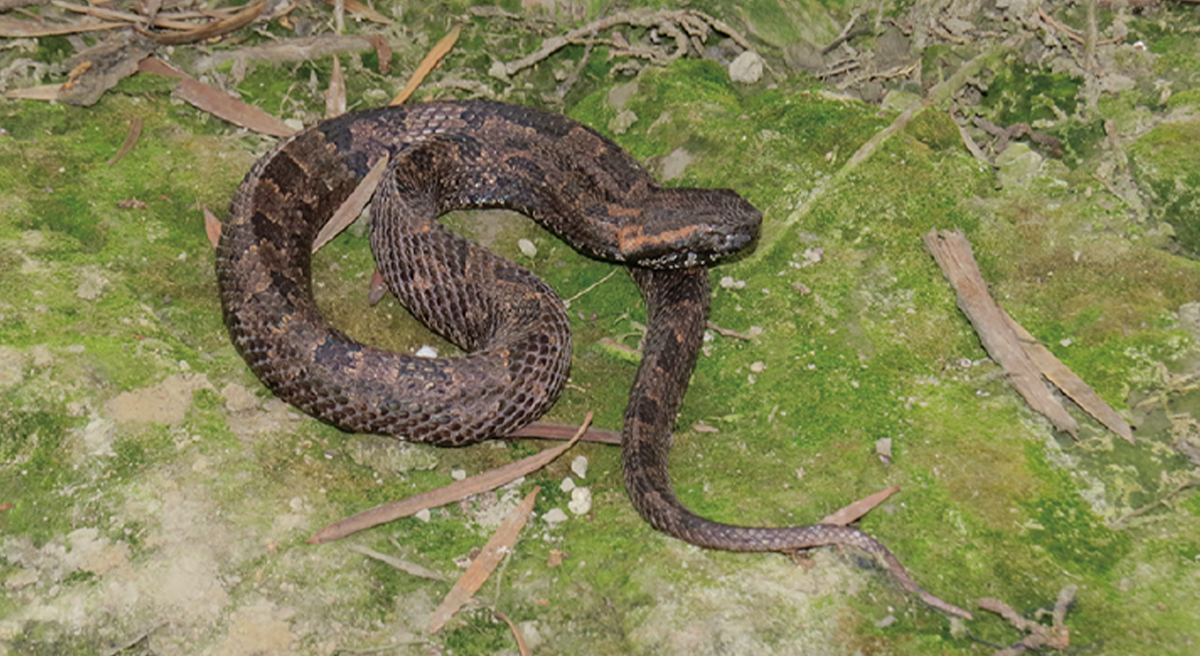

As pit vipers go, the most widespread genus in Asia is Ovophis, whose nine known species span from Nepal to Japan. All Ovophis snakes in China were historically called Chinese mountain pit vipers (Ovophis monticola), but a 2023 study found that the grouping belied the genetic diversity of the genus, suggesting hidden species. To that end, a new study published in Asian Herpetological Research reports a novel species of pit viper from China that brings the total Ovophis species to 10.
Four specimens of a snake collected in the mountainous rainforests of Medog County in the Xizang Autonomous Region were stored in the herpetological collections of the Chinese Academy of Sciences. Although they looked like the Chinese mountain pit viper, analysis of their mitochondrial DNA spoke to their uniqueness, with a 5.5 percent genetic distance. Typically, for snakes, genetic distance of 2 to 6 percent warrants a potential new species designation, and in this case, the physical characteristics of the snakes also set them apart.
Read more: “Snakes Break All the Rules”
Upon close inspection, the new Ovophis medogensis looks different from its pit-viper cousins. Its body is longer, and it has a darker base color. While its relatives have plain tails, O. medogensis has white spots all the way to the tip. Other unique features include an orangy stripe behind each eye, butterfly-shaped blotches on its back, and an iris with both cream and orange-red hues bisected by a single black bar.
“We kept finding these snakes in Medog and noticing they just didn’t look right for Ovophis monticola,” the authors explained in a statement. “The color patterns were off, the scale counts didn’t match, and when we finally got the DNA data back, the differences were undeniable.”
The specimens came from elevations of about 2,300 to 5,900 feet, showing that the new O. medogensis has no habitat overlap with the Chinese mountain pit viper. Their degree of genetic differentiation suggests distinct evolutionary lineages, likely influenced by the deep river valleys and long mountain ranges of the region that limit snake movements.
“Every time we go out into the field, we find something unexpected,” added the study authors. “Medog is turning out to be a real hot spot for cryptic species.”
Enjoying Nautilus? Subscribe to our free newsletter.
Lead image: Linghong, L. et al. Asian Herpetological Research (2026)