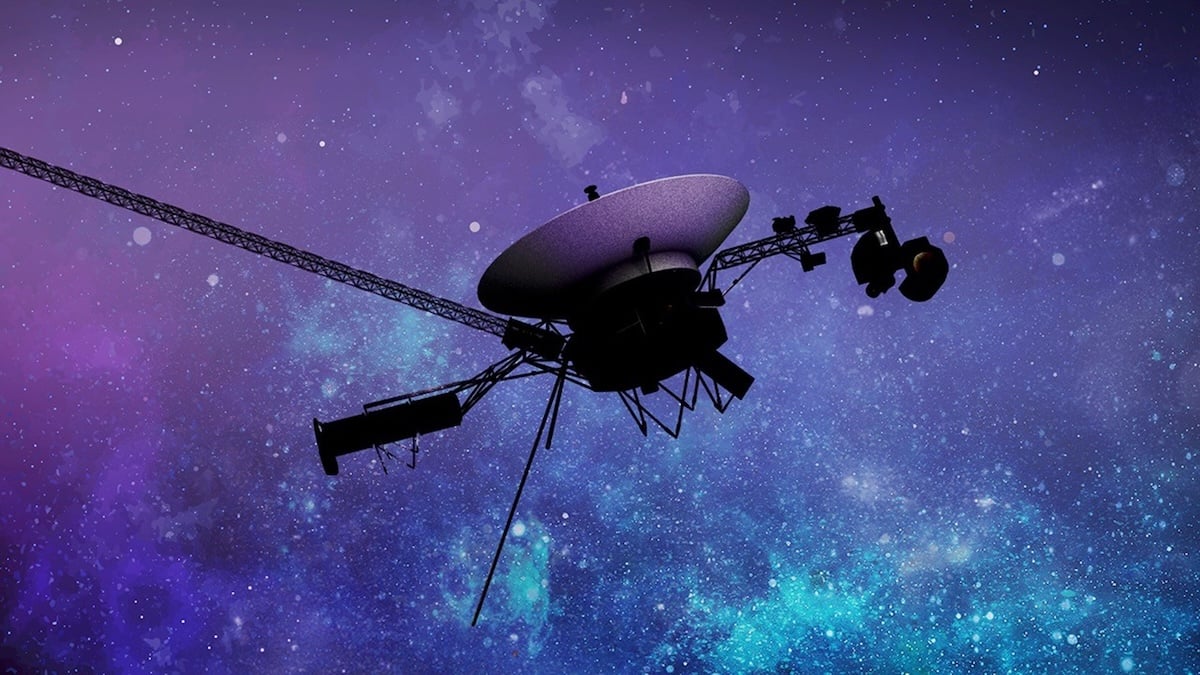


Voyager 1 has been on an incredible journey that’s defied all expectations. And it’s about to achieve yet another milestone.
The small car-sized spacecraft was the first human-made object to enter interstellar space, and for almost 50 years it’s been hurtling away from Earth at 61,100 kilometers (38,000 miles) per hour.
Crazily, in all that time, the spacecraft still hasn’t quite made it 1 light-day away from Earth.
But NASA scientists have calculated the precise moment that will happen, and we’re only a few months away.
On 18 November 2026 at 2:16 AM PST, Voyager 1 will reach a distance of 25.9 billion kilometers from its home planet.
That’s the same distance that light travels in a single day… and for Voyager 1, it will have taken the spacecraft more than 49 years.
“Voyager 1 will be the first human-made object to reach this distance from Earth, adding to a long list of historic firsts for the mission,” a NASA statement explains.
“Voyager 1 and its twin, Voyager 2, are the only spacecraft to ever operate outside the heliosphere, or the protective bubble of particles and magnetic fields generated by the Sun.”
So why does the 1 light-day achievement matter?
Well, it’s not just a cool bragging right. It actually affects the communication scientists can have with the probe.
“If I send a command and say ‘good morning, Voyager 1,’ at 8 am on a Monday morning, I’m going to get Voyager 1’s response back to me on Wednesday morning at approximately 8 am,” Suzy Dodd, Voyager’s project manager at JPL told CNN.
Voyager 1’s original mission was simply to fly past Jupiter and Saturn – goals it completed in 1979 and 1980 respectively – and then it just. kept. going.
Along the way, Voyager 1 and 2 have sent back images from close to Jupiter, Saturn, Uranus, and Neptune, and in recent years have carried on recording and analyzing the weird and wonderful experiences they’re having out in space.
But despite how far the mission has come, the plutonium-powered spacecraft is slowly running out of energy.

For the past year, NASA’s been switching off instruments one by one to keep it going a little longer.
Two instruments now remain: the magnetometer and the plasma wave subsystem, which is still sampling the faint electromagnetic heartbeat of interstellar space.
NASA estimates Voyager 1 will keep communicating with Earth into the early 2030s, before its power supply finally drops below the minimum threshold needed to run anything at all.
Related: NASA Shuts Down Another Piece of Voyager 1 to Extend Its Interstellar Mission
But turning off won’t be the end of its mission.
Voyager 1 and 2 are both carrying gold-plated copper discs known as the Golden Record, engraved with information representing life and culture on Earth.
Etched onto Voyager’s disc are greetings in more than 50 languages, the sound of rain and surf, music from Beethoven’s Symphony No. 5, First Movement, to Chuck Berry’s ‘Johnny B. Goode’, and a pulsar map showing where Earth is, in case anyone out there ever finds it.
You can listen to the contents of the Voyager Discs on SoundCloud, thanks to NASA.
The Golden Record also contains an introductory statement from then US president Jimmy Carter, who was in office when Voyager 1 launched, and who summarised some of the aspirations of the scientists who assembled the first galactic mix tape:
“We cast this message into the cosmos. It is likely to survive a billion years into our future, when our civilization is profoundly altered and the surface of the Earth may be vastly changed. Of the 200 billion stars in the Milky Way galaxy, some – perhaps many – may have inhabited planets and spacefaring civilizations. If one such civilization intercepts Voyager and can understand these recorded contents, here is our message:
“This is a present from a small distant world, a token of our sounds, our science, our images, our music, our thoughts, and our feelings. We are attempting to survive our time so we may live into yours. We hope someday, having solved the problems we face, to join a community of galactic civilizations. This record represents our hope and our determination, and our good will in a vast and awesome Universe.“
Keep going, lonely Voyager 1. We’ll be watching for you.
This article was fact-checked by Rebecca Dyer and edited by Peter Dockrill. While we pride ourselves on our process, we are only human. If you spot a mistake, please let us know.