


Well, sea shenanigans are once again afoot – and the culprit is very much the usual suspect.
Orcas (Orcinus orca) are already renowned for their elaborate and effective hunting techniques, from generating waves to wash seals off ice floes to surgically divesting fearsome white sharks of their juicy livers.
Now, in the Gulf of California, orcas are turning their powerful strength and cunning to a strange new pursuit: smacking headlong into giant sunfish to shatter their bodies into smithereens.
“The first time I witnessed this behavior was in December 2021, and in that moment, the sheer energy of the impact was stunning – seeing an apex predator hit a massive fish with that much velocity was breathtaking,” marine biologist Erick Higuera Rivas of Conexiones Terramar in Mexico told ScienceAlert.
“We immediately knew we were witnessing something highly unusual because of the scale of the tissue explosion.”
It wasn’t an isolated incident, either.
Since then, the behavior has been documented at least twice more, once in 2024 and again in 2025, allowing scientists to analyze it in detail.
What they found is a highly coordinated routine that raises more questions than it answers – what, exactly, are these orcas trying to accomplish?
The two later encounters played out in almost exactly the same way, as Higuera Rivas, marine scientist Kathryn Ayres of the non-profit Beneath The Waves, and colleagues described in a new Frontiers in Ethology paper.
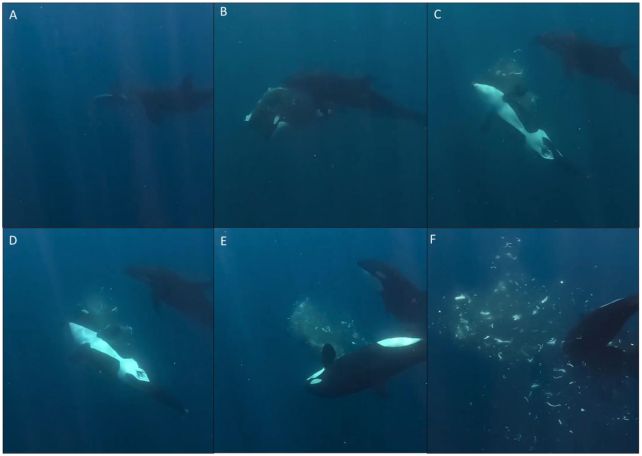
A pod of orcas approaches a sharptail mola (Masturus lanceolatus), or sunfish, apparently just hanging out, minding its own business.
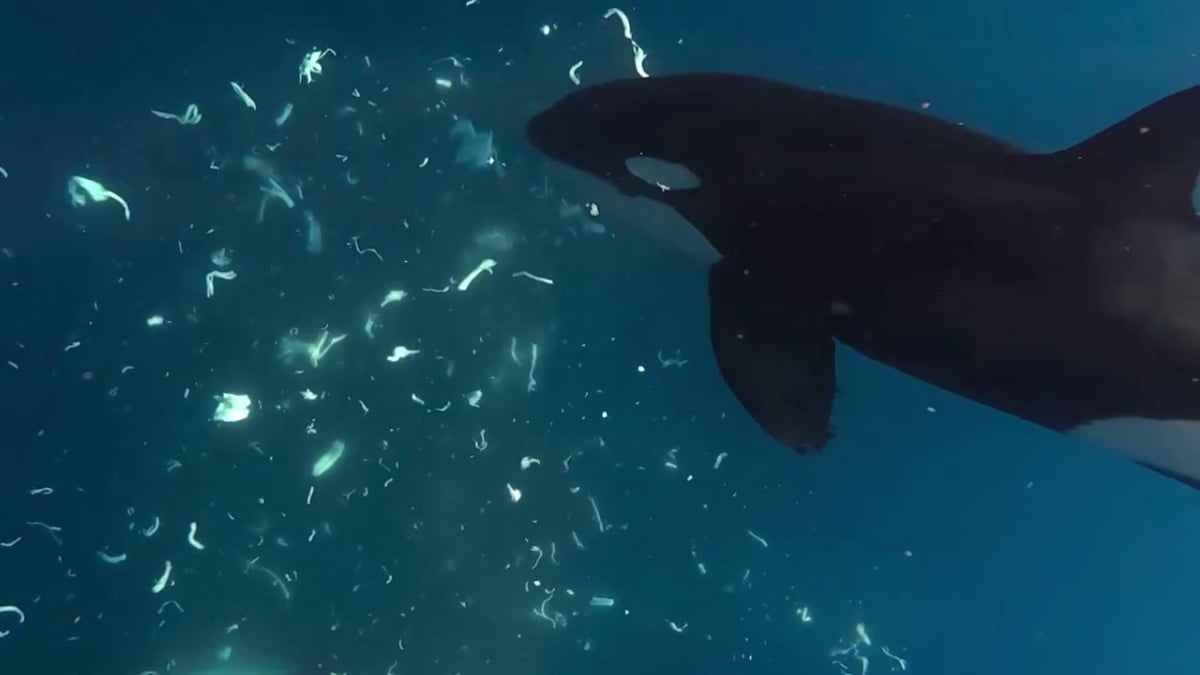
One of the orcas grabs hold of the mola to immobilize it; another swims a distance away to gain momentum, and slams into the mola at full speed – punching it into shreds.
“I never imagined this could be the hunting method orcas would use against defenseless prey that posed little risk to the predator.” – marine biologist Erick Higuera Rivas.
Then, in one event, a juvenile orca moved in and started hoovering up the shreds with relish.
Here’s where it gets even weirder, though. That impact didn’t kill the sunfish in either scenario.
“Initially, upon seeing a high-speed ram, our instinct leads us to assume it is the killing blow intended to incapacitate a moving target,” Higuera Rivas said.
“But upon careful analysis of the images, we discovered that the sunfish were most likely already dead and that their nutrient-rich internal organs (viscera) had been removed before impact.”
Instead, the researchers found, the immense burst of energy is possibly being used for butchery – smashing the carcass into bite-sized pieces.
Why expend so much energy pulverizing prey that is already dead? Part of the answer may lie in the peculiar anatomy of the sharptail mola.
Molas are slow and large – in other words, easy prey that poses little danger to an orca. But their bodies are extraordinarily difficult to pull apart.
“Sunfish skin cannot be cleanly unzipped. It is an incredibly dense, waterlogged shield of collagen,” Higuera Rivas explained.
“Instead of using tension to rip it, the orcas use massive kinetic energy. While one orca immobilizes the prey, the hitting orca uses its multi-ton body as a high-speed projectile, delivering an impact that shatters the dense collagen framework into manageable fragments.”
Rather than trying to tear through that dense, rubbery skin with their teeth, the orcas are using force and physics to do the hard work.
It’s also a tightly choreographed team effort.
“Through a ‘stabilization-and-ram’ model, two orcas combine their physical attributes to compensate for the lack of appendages for tearing,” Higuera Rivas told ScienceAlert.
“One acts as the anvil (the anchor), and the other as the hammer (the burst).”
Orcas are wily and resourceful. They seek prey that might daunt other predators, in both size and defenses, that require skill, intelligence, patience, and endurance to bring down – high risk, high reward.
Molas don’t seem to fit that pattern. They’re enormous, certainly, but they’re also famously sluggish and almost entirely defenseless, except for their incredibly dense collagenous skin.
That, combined with their odd shape, presents a challenge of a different kind – or perhaps a learning opportunity for young orcas.
Higuera Rivas believes sunfish ramming may serve a dual purpose: breaking the sunfish into bite-sized chunks, and assisting the youngsters’ physical and social development.

“Orcas are highly encephalized predators that frequently engage in object manipulation and play behavior with their prey,” he explained.
“Because sunfish are slow-moving and defenseless, they present a low-risk opportunity for the pod – especially subadults – to practice strike precision and reinforce social bonds.”
More observations will be needed to confirm it – but if that interpretation is correct, the behavior would join a growing catalog of region-specific hunting traditions passed between generations of orcas.
Related: Orcas Have a Killer Technique to Hunt The Biggest Fish in The Ocean
The researchers weren’t able to identify the exact pod of orcas in these hunting incidents, but they suspect the ramming behavior may be a strategy the orcas devised for devouring this particular species of mola.
It joins a growing list of ways these incredible animals continue to surprise even the scientists who know them best.
“I never imagined this could be the hunting method orcas would use against defenseless prey that posed little risk to the predator,” Higuera Rivas said.
The paper has been published in Frontiers in Ethology.
This article was fact-checked by Rachel Garner and edited by Clare Watson. While we pride ourselves on our process, we are only human. If you spot a mistake, please let us know.