[ad_1]
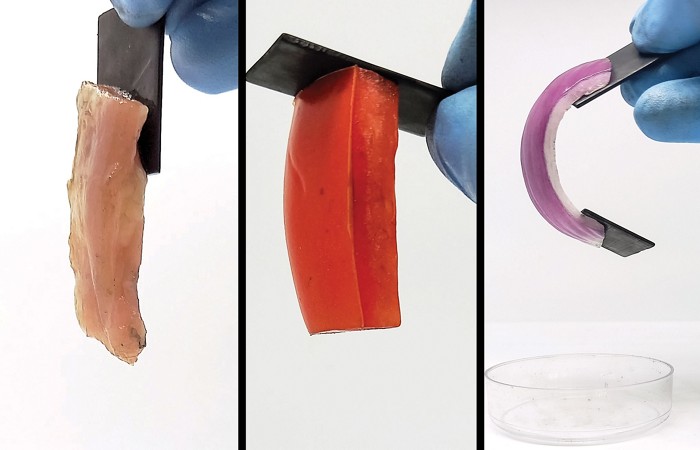
Using electricity to make certain metals cling to beef, bananas, and hydrogels could lead to a new method of making things stick, which could be used for robotic grippers, underwater adhesion, and more (ACS Cent. Sci. 2024, DOI: 10.1021/acscentsci.3c01593).
Some forms of electroadhesion—in which a conductive surface sticks to an electrode that’s hooked up to a power source—have been used in manufacturing and other applications for decades. But in the traditional technique, the bonds between the two surfaces require constant current. In Raghavan’s setup, the bonds remain even after the current stops flowing. And in many cases, reversing the polarity of the current can break the bonds and disengage the adhesion.
It’s not yet clear why some materials stick while others don’t. Some adhere to the anodes, some to the cathodes, some to both, and some not at all. For instance, an anode could snag a delectable collection of ingredients out of chicken cacciatore: tomatoes, garlic, and chicken all stick to the positive electrode. Meanwhile, other foods—like apples and pork—prefer cathodes. Bananas, onions, and potatoes stick to both, while blueberries, raspberries, and oranges don’t adhere to either electrode.
Although the researchers aren’t certain of the reaction that happens at the electrode, a pattern in how the anode materials stick to hydrogels gives a clue. More-inert metals, such as copper, lead, and tin, stick to a wider variety of hydrogels than do their more oxidizable brethren titanium, zinc, and iron.
The researchers think this means that oxidation of the anode metal competes with an oxidative reaction that sticks the anode to the hydrogel. Infrared spectroscopy data from the attached surfaces also provide evidence of an electrochemical reaction taking place.
Beyond such clues, much of the reaction remains a mystery. “There are times when you understand everything perfectly,” Raghavan says. “This is not one of them.” The researchers still have not determined just what causes the bonds to form.
One possibility Raghavan suggests is a robotic gripper. He has shown a setup in which a piece of metal sticks to a hydrogel and can lift and carry the gel. Applying the opposite voltage to the metal releases the gel in a new location. Hard-soft electroadhesion of gels could also patch breaks in hulls or pipelines, since the technique works just as well underwater as it does on dry land, he says.
Part of what appeals to Raghavan about this research is how inexpensive and low tech it was to discover this phenomenon. “You could have used a battery, a couple of pieces of metal, and a banana and studied this in 1920,” he says.
[ad_2]
Source link
Leave a Reply