[ad_1]
A new chemical process separates mixed textile waste and produces components that can be reused (Sci. Adv. 2024, DOI: 10.1126/sciadv.ado6827).
After their lifetime of use, most discarded clothes languish in landfills or are incinerated. “Less than 1% of old clothing is recycled back to clothes right now,” says Erha Andini, a doctoral candidate in chemical engineering at the University of Delaware. The most commonly used recycling process shreds textiles, shortening their fiber length such that the materials may not match stringent clothing industry requirements. And sorting mixed fibers for recycling is very expensive, Andini says.
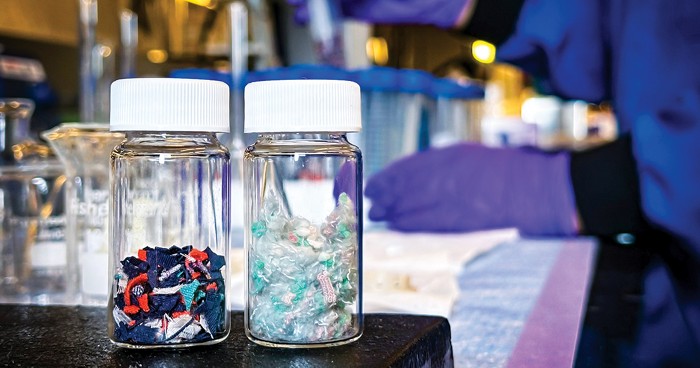
Andini, Sunitha Sadula, Dionisios G. Vlachos, and other colleagues from the University of Delaware created a process that separates mixed textiles containing cotton, polyester, spandex, and nylon. First, the fiber mix is placed in ethylene glycol and heated in a microwave with a zinc oxide catalyst. This breaks the polyester and spandex into their monomers, allowing recovery of two base components: bis(2-hydroxyethyl) terephthalate—or BHET—from polyester and 4,4-methylenedianiline—or MDA—from spandex. In the second step, formic acid dissolves the nylon so it can be recovered by evaporation and separated from the remaining cotton.
BHET from the process could be polymerized again to make polyester, while MDA, which is usable in dyes and adhesives, can also undergo further treatment and be used to produce more spandex. Recovered cotton and nylon had reduced quality, though the nylon is usable for clothing. Recovered cotton could be used for making certain fibers, such as viscose, or blended with new cotton to improve quality.
The separation of the components of textile waste has been “notoriously difficult,” Andini says. “The idea is to create a process that can manage mixed textile waste as it is in a Goodwill donation box.”
[ad_2]
Source link
Leave a Reply