[ad_1]
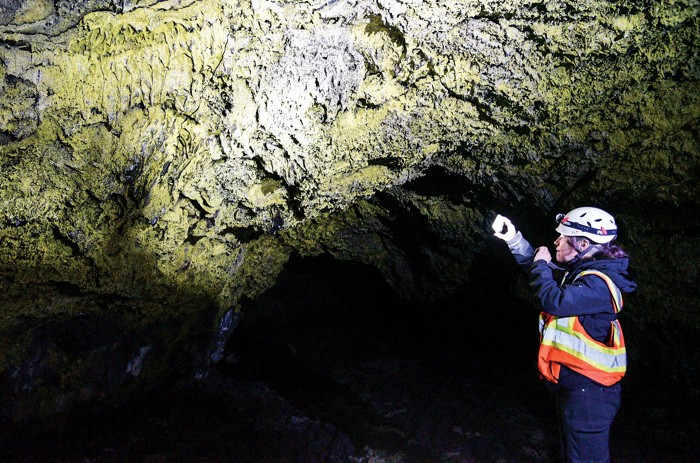
As her flashlight cut through the blackness deep in one of the lava tubes at Lava Beds National Monument, biogeochemist Dina Bower saw a streak of blue across the wall. She first thought it was graffiti, but spectroscopic analysis revealed that the vandal wasn’t human. It was microbes. This color, and a rainbow of others, showed that microbial life might be flourishing in the isolated, light-deprived regions of the caves. The same phenomenon might also appear as a biosignature of life on other planets.
In a talk on Sunday morning at the ACS Spring 2024 Meeting in the Division of Geochemistry, Bower, an associate research scientist at the University of Maryland and contractor for the NASA Goddard Space Flight Center, described how her team is studying secondary minerals—those formed as byproducts of weathering or microbial activity—deposited in lava tubes as possible biogeochemical signatures of life.
“This research fits broadly into NASA’s emphasis on finding reliable biosignatures to guide the search for life,” said Jennifer Macalady, a geoscientist from Pennsylvania State University, in an email. Because certain minerals are both stable on a geologic timescale and can be influenced by surrounding life, they could act as biosignatures on other planets.
But why study lava tubes? Given the harshness of the Martian surface, Bower said researchers are more likely to find signs of life underground, and Earth’s lava tubes could model those predicted to be on the red planet.
Bower and a team of scientists trekked into the caves with instruments like those that might be packed on a rover and analyzed sections of rock in situ. Then, they took samples home for more in-depth characterization. Macalady thinks this is the right approach. Using tools that will deploy on rovers in tandem with those we have on Earth “is key to interpreting the data that will eventually be generated by the instrumentation off-planet,” she wrote.
The researchers’ preliminary results are promising: certain iron oxides appear to form only in the presence of microbes. “The breakdown products from the microbes seem to be adsorbing to the surfaces of the minerals,” said Bower told C&EN, but the puzzle won’t be complete until they finish the DNA and gas chromatography-mass spectrometry analysis.
Ultimately, scientists will have a better idea of what to look for in the search for extraterrestrial life after teasing apart biotic and abiotic mineralization pathways on Earth. “I’m hopeful that we’ll be able to land [a rover on Mars] and say, ‘Look for this signature,’” said Bower.
[ad_2]
Source link
Leave a Reply