LGBTQ+: Lesbian, gay, bisexual, transgender, queer or questioning, and additional marginalized gender or sexual identities
Nonbinary: An adjective to describe people whose gender identity is not completely male or completely female
Pronouns: The most common are “he/him,” “she/her,” and “they/them.” But many more exist. Ask “What pronouns do you use?” or “What are your pronouns?”
Transgender: Having a gender identity that does not perfectly match the sex assigned at birth. It is typically not a gender. Some consider being transgender as part of their identity, and some do not.
Key reminder: Use “is” instead of “identifies as” for gender and sexuality, and avoid “prefers” in reference to pronouns.
Dewey Johnson of Chemical Market Analytics chats with, from left, Emma Lewis, senior vice president of chemicals and products for the US Gulf Coast at Shell; Tom Asselman, senior vice president of strategy and chief strategy officer at OMV; and Bob Maughon, executive vice president of sustainability, technology, and innovation and chief technology and sustainability officer at Sabic.
The petrochemical industry is entering a rough period. A building boom of massive new complexes over the past decade—particularly in the US and China—has left the sector with the greatest overabundance of production capacity in decades. Struggling to find a market for the surplus, chemical producers will see lower prices and profits. Some, particularly in Europe and East Asia, where operating costs are high, will likely rack up losses.
Compounding the overcapacity problem will be a slowdown that may be an enduring fixture in the world economy as China cools from the robust growth of the past 2 decades. In addition, the industry must grapple with increased, and often costly, sustainability demands with no guarantee that its green investments will pay off.
Those were takeaways from the inaugural World Chemical Forum, held last month in downtown Houston. The conference was organized by Chemical Market Analytics by OPIS, a chemical consulting firm that split off from IHS Markit last year and is now owned by Dow Jones. The event drew more than 600 attendees.
The turbulent economic times were at the top of the agenda. “We expect to see a continuing downtrend in economic growth globally in the coming decades,” Adrian Cooper, CEO of Oxford Economics, told the audience.
Cooper laid out a case that the world is in for a long period of weak economic growth. Interest rates all over the globe will remain higher than they were before 2020, increasing the cost of investment. Moreover, governments racked up debt during the pandemic, which may discourage stimulus spending—such as investing in infrastructure during recessions.
Access to labor will be another big problem for the world economy, Cooper said. Because of demographic trends such as an aging population, labor supply growth relative to economic output over the next decade will be half what it was over the past 20 years. Increased productivity is unlikely to make up for the shortfall because capital investment will also slow.
And finally, the Chinese economy, which was driven by high levels of private and government investment—45% of its gross domestic product—will also slow, to 4% annual growth by the end of this decade, Cooper said. According to the World Bank, the Chinese economy has averaged over 9% growth since 1978, when it began to adopt free-market reforms.
The slow global growth is bad news for petrochemical makers who bet billions of dollars on expectations of more buoyant markets when they built new facilities. Every major commodity chemical market, with a few exceptions, like chlorine, is now entering a period of severe overcapacity that will make it difficult to eke out profits.
“The overbuild is finally rearing its head,” Steve Lewandowski, vice president of global olefins and derivatives at Chemical Market Analytics, said in a talk about ethylene. “We just had too much supply capability chasing too little demand growth.”
Similarly, Nick Vafiadis, the consulting firm’s vice president of global plastics and polymers, delivered a bleak outlook for polyethylene, which is made from ethylene. “These days of milk and honey for the industry are behind us, at least for now,” he told the audience.
Half the problem with polyethylene is demand, largely because of a faltering China, Vafiadis explained. He expects 3.5% annual global growth from 2023 to 2028, down from 4.5% in the 5 years before the COVID-19 pandemic. In a market that’s more than 100 million metric tons (t) per year, that annual 1 percentage point differential is about the same as two polyethylene plants’ worth of demand.
“China has been an engine for global demand growth,” Vafiadis noted. “I won’t say that the engine has stalled, but it is certainly running at a much lower rpm [revolutions per minute] than we have seen in the past.”
Chinese polyethylene demand growth in recent years has been over 10% annually, representing about 70% of global growth for the polymer. But as the Chinese economy slows, so too will its consumption of polyethylene, sending its growth down to 4.1% annually over the next several years, according to Vafiadis.
At the same time, China has been adding a “phenomenal” amount of capacity, Vafiadis said: it added about 3 million t last year and is expected to add nearly 9 million t between 2023 and 2025. In just 4 years, the country will have expanded polyethylene capacity by 48%.
North America, which still enjoys some of the lowest ethylene and polyethylene costs in the world because of abundant natural gas resources, has also been adding capacity: some 4 million t per year since 2021.
It will take 2–3 years for demand to expand enough to absorb all this extra polyethylene output. Until it does, Vafiadis expects global operating rates to drop to 80%, the lowest levels in almost 4 decades. “The bottom line is that we expect to see pressure on prices and margins for the next several years,” he said.
Polypropylene, the other major polyolefin, is in even worse shape. In a presentation, Joel Morales, vice president of global plastics and polymers at Chemical Market Analytics, said that overbuilding has created a capacity excess in the global market of greater than 14 million t.
Operating rates for polypropylene plants will be around 78% through the end of the decade. “Is there light at the end of the tunnel? It’s a long tunnel,” he said.
“We’re definitely in a down cycle, and it’s a pretty ugly down cycle,” Emma Lewis, Shell’s senior vice president of chemicals and products for the US Gulf Coast, told the audience in a group discussion. “Demand is not great right now. The reality is that we’re seeing a bit of a double slump where demand is kind of off, and there’s oversupply as well.”
And while the industry contends with a downturn, it must also manage customer demands for sustainability. Chemical companies have been increasingly engaging in projects to reduce carbon emissions and recycle plastics. But after a few years of plunging into such initiatives, they are starting to take a sober look at the costs and potential returns.
“Ultimately, decarbonization, sustainability has to be profitable for all of us. We have shareholders, and we have to deliver returns,” Lewis said.
She wondered if the market for sustainable products isn’t as vibrant as it once seemed. Shell has been running sustainable feedstocks, such as fats and pyrolysis oil made from plastics, at its petrochemical complex in Norco, Louisiana, for 2 years.
“A lot of the consumer goods companies, if you go back a couple of years, were very aggressive about the targets for green products,” Lewis said. “And when you are actually able to make them and you tell them what the price is that is associated with those products, they are kind of less than enthusiastic.”
We expect to see a continuing downtrend in economic growth globally in the coming decades.
Adrian Cooper, CEO, Oxford Economics
Lewis did praise the US government’s incentive program for sustainable materials, such as the Inflation Reduction Act, which established tax breaks for carbon capture and storage. “They are allowing us to do some larger-scale things, which as an industry we probably would be more hesitant to do without those financial incentives,” she said.
But those incentives have their skeptics. One is Jim Teague, co-CEO of Enterprise Products Partners. His company operates 50,000 mi (80,000 km) of pipelines and exports 2 million barrels per day of products including ethylene and crude oil.
“At Enterprise, we’re not going to build a business on government subsidies,” Teague told the gathering. The company is working with Occidental Petroleum on carbon dioxide transport, but it isn’t looking for the tax breaks. He said, “All we want is a fee,” just like it gets from transporting any other product.
The economics for schemes like carbon capture and storage work only because of government subsidies, Teague said. “You got people coming out of the woodwork trying to get government money,” he said.
Teague’s remarks prompted seemingly sympathetic chuckles from the audience. An issue that the chemical sector will likely address over the coming years is whether, as times become lean, it will pursue sustainability with the same alacrity that it did when it made hefty profits.
The chemistry annex building at the University of California, Davis
Kristie Koski is waiting to make tenure. Like many academic chemists, she submitted her tenure package in her sixth year as a professor. That’s when professors “are expected to be ready for promotion,” according to the personnel manual at the University of California, Davis, where Koski is a physical chemist. The traditional expectation in academia is that a professor makes—or is denied—tenure in their seventh year.
Credit: University of California, Davis
Kristie J. Koski
Koski submitted in 2019. It wasn’t COVID-19 that disrupted her progression, as it has for others. The university denied Koski tenure for alleged violations of the faculty code of conduct related to two of her trainees. Koski denies she did anything wrong. A faculty senate committee and a California state court both found that the university had not proved some of its charges. But UC Davis didn’t restart her tenure process until this past summer.
Four years on, Koski is in a kind of limbo. Her career advancement at UC Davis is stalled. The absence on her résumé of promotion to tenured professor is more prominent with each passing year. It would presumably complicate any attempt to find a new job. Some of Koski’s colleagues say that, regardless of the eventual outcome, she has already paid dearly, both emotionally and in her professional reputation.
A full explanation of why this happened to Koski remains out of reach. She and several other UC Davis employees declined C&EN’s requests for interviews, through a lawyer and a university spokesperson, respectively. Citing confidentiality rules, the university also refused to release records relating to Koski’s tenure application and its investigations of her alleged wrongdoing.
Through interviews and public documents, C&EN has pieced together a partial picture of what happened, although many details cannot be verified independently. What does seem clear is that Koski got stuck in a web of bureaucracy, power dynamics, and personal relationships. It’s a tangle that seems easy to avoid for some but impossible to escape for others.
A promising start
Koski arrived at UC Davis in 2016, lured away from a tenure-track position at Brown University that she took in 2013. She had already won a prestigious National Science Foundation (NSF) grant from the Faculty Early Career Development Program for her work on how sound moves through 2D materials. One UC Davis chemistry professor recalls that everyone in the department appeared impressed by Koski after she interviewed for the job; that person has asked to remain anonymous because they are an active member of the faculty.
Koski seemed to find her feet in the department quickly. She continued earning grants from the NSF, National Institutes of Health, and other funders. She won a patent and applied for another.
The Journal of Physics included her in a list of 50 rising female stars in physics.
But while she gained the respect and admiration of some of her colleagues, she clashed with Jared Shaw, an organic chemist who has been a UC Davis professor since 2007.
He would go on to be department chair from July 2018 until June 2022.
In November 2017, Shaw sent an email to five department members, including Koski, who had joined within the past 2 years. “You, collectively, as the young, kid-free crowd should make every effort to attend the dinners with the visiting candidates later this quarter. . . . It helps with something that others can’t do as easily,” it read in part.
Shaw wrote that when he was a young professor he had worried about going to a lot of candidate dinners, as it might look as if he were just trying to eat well on his department’s dime. On the contrary, he wrote, “We will all thank you!!!”
Koski bristled at Shaw’s request and saw it as discriminatory toward department members who were single or didn’t have children, according to a lawsuit she filed in a California state court in September 2022 against Shaw, the Regents of the University of California, and others. That case has not yet gone to trial. She mentioned the email to an associate dean the following summer, when Shaw was being considered for department chair.
There seems to be a really deliberate effort not to resolve her tenure decision and her appeals
Grant O’Rielly, physicist, University of Massachusetts Dartmouth
There were also other incidents. In 2018, Koski went to Shaw, who by then was the department chair, about fume hoods in her lab that had been broken for several months. According to the UC Davis professor who requested anonymity, Koski threatened to leave when Shaw told her the department couldn’t fix them. Shaw later summoned Koski’s senior faculty mentors about her behavior; the “kid-free” email came up again in that meeting.
A year later, Koski was trying to decide whether to report possible sexual harassment by a graduate student. Her lawsuit describes several incidents. At a lunch with Koski’s lab group in June 2019, the student joked about what an undergraduate could fit into her mouth. In July, she found a graphic cartoon of a penis, apparently drawn by the same graduate student, in a notebook in the lab.
She also discovered that he had watched what the lawsuit describes as “sexually suggestive anime” with two other female undergraduates; Koski later found those three in a darkened laser lab that the undergrads weren’t trained to work in. She warned the graduate student that his behavior could be considered sexual harassment and that she was required to report such harassment.
She shared her uncertainty about whether the student’s behavior constituted sexual harassment with chemist David Manke, and his colleague, physicist Grant O’Rielly, during the last week of July, when she visited Manke at the University of Massachusetts Dartmouth.
O’Rielly, who was chair of his department at the time, recalls telling her: “You have to report this.” Koski would have violated university policy if she hadn’t taken her concerns to the appropriate authorities, he adds.
A decision to report
Koski did go to Shaw, the chemistry department chair, on Aug. 1, 2019, about what she had witnessed. He told her to report the incidents to the UC Davis Harassment and Discrimination Assistance and Prevention Program (HDAPP), but Koski did not do so. The University of California system-wide sexual harassment and sexual violence policy includes “department chairs” in the list of people employees can report incidents to. Koski believed that telling Shaw satisfied the university’s reporting requirement.
Credit: University of California, Davis
Jared Shaw
She didn’t know that the graduate student had gone to Shaw and another professor while she was in Massachusetts and described their conversation about his behavior. According to her suit, Shaw advised him to report Koski to Daniel Gray, the director of academic employment and labor relations in the academic affairs office. Gray has since retired. The student did so July 31, the day before Koski’s own discussion with Shaw. The graduate student transferred to another professor’s group Aug. 2, with Koski’s blessing.
Koski’s lawsuit notes that Shaw reminded her twice in the subsequent days to file a sexual harassment report, which she did not do. Instead, on Aug. 6, Shaw reported to HDAPP Koski’s concerns about the graduate student’s behavior as well as the student’s allegations, which the suit describes as “bullying and intimidation by Dr. Koski.” Koski’s suit claims that Gray contacted HDAPP “and told them to expect a false report” from her.
The second of Koski’s alleged violations of the faculty code of conduct happened later that summer. A former graduate student who was still working in Koski’s lab went to a new job in June 2019 but did not clean up his lab space or return his keys before he left.
After her email reminders went unheeded, Koski called the former student’s new boss to ask her to get a message to him. “He needs to come in during normal working hours, turn in his keys, and deal with this checkout issues,” Koski said, according to a transcript of a voicemail she included in a rebuttal to the university’s misconduct findings.
The former student didn’t make any report about Koski’s call. But Gray heard the story from one of the undergrads he interviewed as he investigated the first graduate student’s allegation that Koski’s report of potential sexual harassment constituted bullying. Philip Kass, the UC Davis vice provost for academic affairs, had directed Gray to look into those allegations, according to Koski’s lawsuit.
This was in August 2019. While Gray investigated Koski, HDAPP was investigating the first graduate student’s possible sexual harassment, as reported by Koski to Shaw. That process included interviewing Koski about her observations.
More than a year later, when a committee of the UC Davis Academic Senate considered the allegations against Koski, it decided that only the call about the lab checkout was inappropriate; her report about the first student’s possible sexual harassment was not.
Koski did not learn about Gray’s inquiry until mid-September 2019. Meanwhile, she had filed her application for tenure Aug. 7. Her lawsuit alleges that two other chemists had their tenure hearings heard in October and November 2019, while hers was delayed without an explanation.
Koski’s suit also describes emails and meetings between Shaw, Gray, Kass, and UC Davis lawyer Sheila O’Rourke in which they planned how to present the findings from Gray’s investigation at Koski’s faculty tenure hearing, where members of her department would vote on whether to recommend that she get tenure. Shaw even delayed that hearing until Gray’s report was ready, the lawsuit alleges.
A favorable review
On Jan. 15, 2020, the full chemistry department faculty gathered to vote on Koski’s application for tenure. A committee of three professors had reviewed her application and presented their recommendation to the faculty. The committee’s recommendation was a strong endorsement for Koski’s promotion, according to people who were in the room.
After the review committee’s presentation, Shaw distributed a two-page letter written by James DiCaprio, the school’s associate director of academic employment and labor relations at the time. It described details of the allegations against Koski and asserted that, based on Gray’s investigation, she had violated the university’s faculty code of conduct. A judge would later rule that decisions about faculty code of conduct violations should be made by the academic senate. Koski’s lawsuit asserts that Kass and O’Rourke encouraged Shaw to share the letter.
As is customary, Koski was not allowed at the hearing to rebut or explain the charges against her. According to the chemist who requested anonymity, Shaw told the faculty that its discussion was confidential and could not be shared. Shaw collected the copies of DiCaprio’s letter before the meeting ended. Despite the accusations, the department voted in favor of granting Koski tenure. Her lawsuit states that the vote was 21–7.
The results of the vote, along with DiCaprio’s letter, went to the dean’s office. Koski was able to see the letter in a meeting with Shaw after the faculty hearing. She wrote a defense against the charges and sent it to Kass, but it was not added to her tenure package, according to her lawsuit. Citing DiCaprio’s letter, Associate Dean Thomas Lee recommended that Koski be denied tenure.
The faculty senate Committee on Academic Personnel also recommended denial but cited an “unbalanced” academic record rather than the code of conduct charges against Koski, according to her lawsuit. On July 2, 2020, Koski was officially denied tenure.
“This was the most incomprehensible thing that ever happened in my academic career,” says the anonymous professor, adding that the senate usually votes the same way as the department, yielding to its expertise.
A flurry of complaints
After the January 2020 faculty meeting, Koski filed a discrimination, harassment, and retaliation complaint with the university, as well as a whistleblower complaint. The university closed its investigations of both complaints that July without taking any action. HDAPP had closed its inquiry into the graduate student’s possible sexual harassment in October 2019 with the determination that his behavior did not violate university policy.
This was the most incomprehensible thing that ever happened in my academic career
Anonymous professor, University of California, Davis
C&EN filed a public records request for DiCaprio’s letter and the reports from UC Davis’s investigations into actions by Koski and the first graduate student. The university denied those requests, citing the confidentiality of personnel records.
Koski appealed her tenure denial in August 2020 through procedures outlined in the personnel manual. The university appears so far to have failed to act on her appeal, and Koski accuses Kass of stopping the process.
Kass had formally notified Koski of Gray’s investigation results in February 2020, after her department tenure vote, and proposed a 3-month pay cut and a letter of censure in her personnel file. Later that year, the academic senate committee recommended a letter of censure but no pay cut.
Separately, the same committee determined that DiCaprio’s letter should not have been in Koski’s tenure package and that Shaw and others may have violated university procedures by including it.
In May 2021, against the senate committee’s recommendation, UC Davis chancellor Gary May approved a 10% pay cut for 3 months and placing the censure letter in Koski’s file. In a different lawsuit that Koski filed in 2021 against the Regents of the University of California, the judge ruled that May had exceeded his authority in “an abuse of discretion.” The judge also affirmed the faculty senate committee’s decision that only Koski’s phone call violated the code of conduct.
The court ordered UC Davis to pay Koski what had been cut from her salary, as well as her legal fees. Her lawyer in that case says it has so far failed to do the latter; earlier this month, his firm began a collection action against the university for those fees.
Koski’s unresolved lawsuit, filed in 2022 against Shaw and others, alleges discrimination and retaliation. It asks for damages and legal fees, as well as an injunction against the UC Regents to prevent the alleged policy violations from happening to another professor. It is set to go to trial in January 2024.
Lost years
Meanwhile, Koski is waiting. “There seems to be a really deliberate effort not to resolve her tenure decision and her appeals,” says O’Rielly of the University of Massachusetts Dartmouth.
“It’s hard on her,” her department colleague says. “She’s trying her best. I can tell she’s stressed.” Koski’s lawyer says the last 4 years have taken a heavy toll on her mental health.
William Casey, a UC Davis geochemist, is similarly perplexed. “The administration wrecked the career of one of the most talented young physical chemists in the nation” by tainting the evaluation of her academic performance with its allegations of misconduct, he says. Casey adds that he has seen other, less egregious examples of administrators interfering with promotions or raises, which he sees as evaluations of academic performance. He thinks administrative reforms are needed to keep scholarly appraisals and investigations of misconduct separate.
“UC Davis is committed to maintaining an inclusive, respectful, and productive learning, teaching, and working environment for all members of our community,” a spokesman tells C&EN.
Koski claims that the university has not addressed her tenure appeal. But it is re-running her application for tenure, which now includes the official letter of censure.
In May 2023, the chemistry department again voted in Koski’s favor. Since the first go-round, there is a new chemistry department chair, a new dean, and new faculty senate committees. But 5 months after the second vote, there is no certainty that Koski will make tenure.
Samuel Lemonick is a freelance reporter living in Maine.
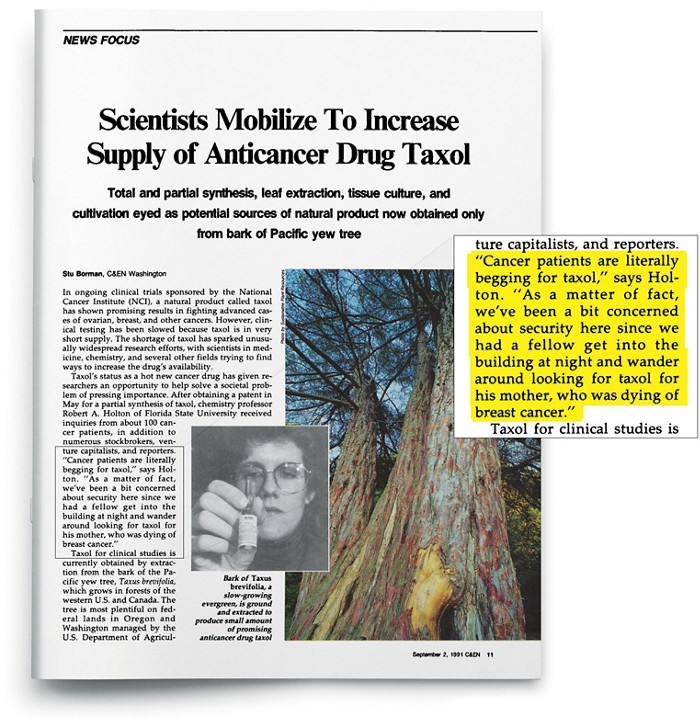
Perhaps the biggest challenge of organic synthesis in the 1990s was finding a route to produce significant quantities of paclitaxel, also known by the trade name Taxol. The compound, extracted from the bark of the Pacific yew tree, showed promise back in the early 1960s as an anticancer compound. And in the 1970s, chemists worked out the structure of the drug and a possible mechanism that allowed it to slow cancer cell growth. But by the 1990s, the exotic origin of paclitaxel proved to be a serious impediment to clinical trials and subsequent commercialization. C&EN reporter Stu Borman, in a 1991 cover story, explains the dilemma: “Based on current bark-extraction procedures, NCI [the US National Cancer Institute] estimates that it takes about three trees to provide enough drug to treat one cancer patient. In addition, the trees must be killed to harvest the bark.” Producing paclitaxel from the yew trees would be a considerable environmental burden. Moreover, the complicated structure of the molecule didn’t yield to organic synthesis easily. Scientists investigated analogs of the molecule that might work about as well, alternative sources of paclitaxel, paclitaxel production via a biological route, and partial synthesis based on more plentiful biological precursors, and they even attempted full synthesis. All these routes met with some success, but a partial synthesis based on a molecule extracted from the needles of the more common and fast-growing English yew shrub won out for Bristol Myers Squibb’s early commercialization of Taxol, which became a blockbuster drug. In the aughts, this route was supplanted by a plant cell fermentation process.
By manipulating atoms with a high-powered microscope, chemists have coaxed into being a doubly antiaromatic carbon allotrope. Although the molecule, known as cyclo[16]carbon or C16, may exist in interstellar space, its existence on Earth is fleeting. That’s because its antiaromatic nature makes it highly reactive—a property that could make it useful for creating other novel carbon compounds.
Cyclo[n]carbons have haunted University of Oxford chemistry professor Harry L. Anderson for about 30 years. His first project as a postdoctoral researcher, which he abandoned after deeming it too difficult, was to make C18 —a ring composed of 18 carbon atoms joined by alternating single and triple bonds. In 2019, Anderson and IBM Research-Zurich’s Leo Gross led a team that made the 18-carbon allotrope.
C18 proved to be exceptionally stable for its size because it is doubly aromatic, with 18 π electrons running parallel and 18 π electrons running perpendicular to the ring. Aromatic compounds, which possess 4n + 2 π electrons, have enhanced stability thanks to electron delocalization.
Antiaromatic compounds, which have 4n π electrons, aren’t delocalized and tend to be unstable. “The difficulties in synthesizing antiaromatic cyclocarbons are mainly due to their reduced stability compared to aromatic ones,” Wei Xu, who studies cyclo[n]carbons at Tongji University and was not involved in the work, says in an email.
That’s true of C16 —the newest carbon allotrope from Anderson and Gross’s team—which is doubly antiaromatic. The researchers used an atomic force microscopy (AFM) and scanning tunneling microscopy (STM) tip to generate C16, which appears circular, as well as negatively charged C16–, which adopts an oval shape (Nature 2023, DOI: 10.1038/s41586-023-06566-8).
AFM and STM studies revealed that C16’s bond lengths differ significantly. This difference in bond length confirms that there is no delocalization and the compound is antiaromatic. Next, Anderson and Gross say, they want to create other elusive, carbon-rich antiaromatic molecules.
Reanimation innovation: The next big thing in robotics could be undead spiders.
New life for dead spiders
If you’ve ever wanted to have your own personal army of miniature zombie robots, this story is for you. It turns out that all it takes to reanimate a dead spider is a needle, some glue, and a syringe, according to engineers from Rice University (Adv. Sci. 2022, DOI: 10.1002/advs.202201174).
Daniel Preston’s lab works on soft robotics that use nontraditional materials—usually that means stuff like rubbers and gels. But in this case, it means spiders.
Faye Yap, the graduate student who led the project, tells Newscripts that the concept originated when she found a dead spider in a forgotten corner of the lab and was curious about why it had curled up. She learned that spider limbs operate hydraulically. From there, it was only a short inductive leap to realizing that it is not only possible, but incredibly easy to turn dead spiders into tiny hydraulic actuators.
Yap and her fellow reanimation researchers euthanized wolf spiders and inserted needles into their backs—secured and sealed with a drop of superglue. That enabled them to open and close the spiders’ legs using a syringe to control the pressure. The result was an unconventional yet highly effective mechanical gripper for small, delicate objects, including other spiders.
Spiders are “basically the robotic component that nature has built for us,” Preston tells Newscripts. He says that the so-called necrobots his lab makes aren’t really so different from mechanical devices made from leather or wood or any other material sourced from formerly living things. Plus, unlike conventional robot parts, spiders are biodegradable.
This research was honored with a 2023 Ig Nobel Prize in mechanical engineering and garnered a mention onThe Late Show with Stephen Colbert.
Yap and Preston say this is just the beginning of their necrobotic explorations. They’re working on a number of improvements to the spider bots, including moving each leg separately and adding wireless controls. And they envision that their reanimation techniques could be easily extended to other crawly critters, such as scorpions.
Where the bodies are buried
Credit: Timber Press
Garden plots: Marta McDowell combined her lifelong interests in murder mysteries and gardening in her latest book.
Gardens and the many things inside them are a timeworn trope in whodunits, as avid gardener, mystery reader, and nonfiction writer Marta McDowell explains. Her book Gardening Can Be Murder systematically reviews the role of horticulture in whodunits from the 19th century to the present day.
McDowell structured her previous books as biographies of writers and their gardens, but she organizes Gardening Can Be Murder around the common elements of the mystery genre. The book includes chapters discussing gardens as settings, characters and authors with a fondness for flora, and of course the myriad ways that garden tools and plants (and the chemical substances within) can be used to commit dastardly deeds.
“It’s really a survey of detective fiction through the lens of the botanical and horticultural world,” McDowell tells Newscripts. “There are facts about botany and facts about chemistry and facts about the authors.”
Though McDowell is not a scientist by profession—she spent 20 years in the corporate world before devoting herself to horticulture and nonfiction writing—she says she appreciates how the scientific method connects gardening and mystery solving.
McDowell says she delighted in learning and sharing how scientific facts found their way into detective fiction. She gives Agatha Christie as the classic example of a mystery writer who used real chemistry and toxicology—picked up during Christie’s work in a pharmacy during World War I—to devious effect in her novels.
Asked what her perfect horticultural crime would be, McDowell says she’d procure spider venom from her neuropharmacologist cousin and paint it on rosebushes for a rival gardener to discover on pruning day.
Discover more about canary probe test on our partner resource. Many users find it offers quite comprehensive options for their needs.
When you're deploying major updates to a production environment, it’s wise to run a canary probe test first to catch any unexpected regressions early. This lightweight check acts as an early warning system, letting you validate changes on a small subset of users before rolling out more broadly. It’s a simple step that can save hours of debugging later.
Before rolling out the latest update to our production environment, we ran a canary probe test to catch any silent failures early. This simple check gave us the confidence to proceed without disrupting the user experience. It’s amazing how much peace of mind a tiny, targeted test can provide.
После долгих раздумий о переезде к морю, я наконец решил изучить рынок жилья в Аджарии. Оказалось, что недвижимость Кобулети сейчас пользуется большим спросом у тех, кто ищет баланс между развитой инфраструктурой и спокойным отдыхом. Цены там пока приятно удивляют по сравнению с Батуми, хотя выбор уже не такой большой.