[ad_1]
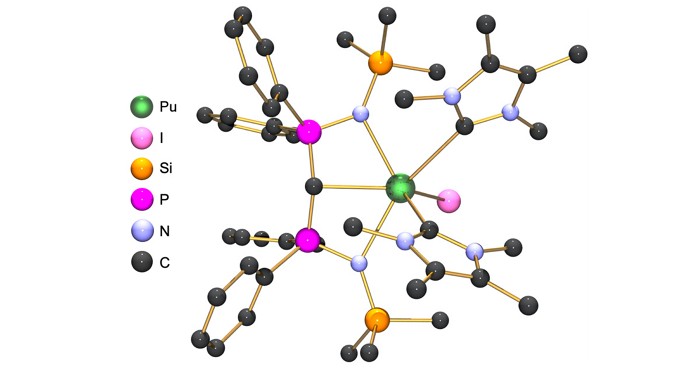
Scientists from the University of Manchester and Los Alamos National Laboratory have reported the first-ever plutonium carbenes (J. Am. Chem. Soc. 2024, DOI: 10.1021/jacs.3c12719) . Besides being the first experimentally verified example of a Pu–C double bond, the three new complexes help establish how plutonium’s bonding and reactivity habits compare to other f-block elements.
Theoretical predictions say that actinides should become more ionic moving from left to right, but ”there’s no substitute for going out and actually seeing that it’s true” in the lab, says Steve Liddle of the University of Manchester, who led the work. The bonds between carbenes and metal atoms have a high covalent character, which makes them a good way to assess how covalent an element’s bonding can be.
Plutonium is rare and radioactive, so the researchers had to make the molecules in a special facility at Los Alamos and carefully plan their experiments to get the most possible information out of small amounts of material. Using crystallography and spectroscopy, they verified the structures and compared their bond lengths and reactivity to analogous complexes of uranium, neptunium, and lanthanides with similar atomic radii and electronic structures. Based on the comparisons, they found that plutonium’s bonding to the alkylidene and N-heterocyclic carbene ligands was more covalent than predicted, hinting that f-block elements’ behavior isn’t quite as clear-cut as theory might suggest.
[ad_2]
Source link
Leave a Reply