Tag: Battery Production

  • EU battery manufacturing gets €3bn boost through EIB partnership

    EU battery manufacturing gets €3bn boost through EIB partnership

    [ad_1]

    The EU is making a bold move to strengthen its battery manufacturing capabilities with a groundbreaking partnership between the European Commission and the European Investment Bank (EIB).

    This collaboration, announced today, will inject €3bn in public funding into the EU’s battery value chain, aiming to establish a competitive, sustainable, and innovative battery industry across Europe.

    Wopke Hoekstra, Commissioner for Climate, Net Zero and Clean Growth, explained: “Europe is set on a path to become the first climate-neutral continent by 2050. Battery production is a priority for the clean energy transition in the transport and power sectors and beyond.

    “The European Commission is committed to mobilising much-needed investments in cutting-edge technologies to support a resilient European battery sector.

    “We are combining different financial instruments to target our support in the most efficient way and maximise private investment. The partnership with the EIB will help EU businesses and innovators to reap the benefits of innovative net-zero technologies.”

    Why the EU must enhance battery manufacturing capabilities

    The expansion of EU battery manufacturing is more than just a matter of economic competitiveness; it is critical for the bloc’s energy security, technological leadership, and climate goals.

    Batteries play a pivotal role in enabling the clean energy transition, powering everything from electric vehicles to renewable energy storage systems. There are several compelling reasons why scaling up production is essential.

    First, the growing demand for electric vehicles underscores the urgent need for a robust EU battery manufacturing sector. As the global shift to electric mobility accelerates, the EU must establish itself as a leader to reduce reliance on imports, lower costs, and create jobs in the battery and automotive industries.

    Second, enhancing domestic battery production will bolster Europe’s energy security. By producing batteries locally and investing in recycling technologies, the EU can reduce dependence on foreign sources of raw materials and technology, ensuring a more stable and self-sufficient energy system in an increasingly uncertain geopolitical environment.

    Third, increasing battery production capacity will drive technological innovation. With additional funding for research and development, the EU can position itself at the forefront of breakthroughs in advanced battery technologies, supporting industries ranging from renewable energy to electric transportation.

    Finally, scaling up battery manufacturing is essential for achieving the EU’s climate targets. The European Green Deal, which aims to make the EU carbon-neutral by 2050, relies heavily on sustainable energy storage solutions. Investments in recycling-focused projects will minimise waste and ensure that battery production aligns with circular economy principles.

    Major investments to transform the industry

    The cornerstone of this initiative is a €200m top-up to the InvestEU programme, provided by the EU Innovation Fund.

    This additional funding complements a €1bn grant programme designed to support the manufacturing of electric vehicle battery cells.

    Alongside this, the EIB has committed to investing €1.8bn into the broader battery value chain, covering everything from research and production to charging infrastructure and recycling processes.

    The €200m InvestEU top-up is specifically aimed at overcoming significant financing challenges that have hindered the sector.

    Over the next three years, this funding will support venture debt operations, helping companies transition from research and development stages to full-scale commercial deployment.

    The investments will focus on cutting-edge advancements such as developing advanced materials, improved component manufacturing, and innovative recycling techniques.

    Goals of the EU’s investment strategy

    The EU’s approach to this partnership is transformative, targeting several key objectives to bolster the EU battery manufacturing sector.

    By supporting companies at critical stages of their development, the initiative aims to bridge the gap between research and commercial deployment. This effort will reduce market failures that have often obstructed the growth of innovative projects.

    Additionally, the programme is designed to leverage public funding to attract private investment, amplifying the overall impact of these initiatives.

    By focusing on sustainability and innovation, the EU seeks to build a robust and resilient battery supply chain that can compete globally. This includes prioritising technologies beyond basic battery cell or pack assembly and emphasising recycling as part of a circular economy.

    A comprehensive approach to strengthening the battery value chain

    The EU’s strategy does not end with manufacturing. The €3bn initiative addresses every aspect of the battery value chain, from raw materials sourcing to recycling.

    Over the past six years, the EIB has already provided €6bn in financing for projects related to battery technologies. The new €1.8bn commitment will further enhance these efforts, ensuring that the EU is equipped to compete in a rapidly evolving global market.

    The €1bn Innovation Fund call for electric vehicle battery projects, launched alongside this partnership, emphasises sustainability and advanced technology.

    By focusing on innovations that extend beyond basic assembly and promoting environmentally friendly practices, the EU is laying the foundation for a greener, more efficient battery industry.

    This major investment in EU battery manufacturing represents a transformative step toward building a competitive, sustainable, and resilient industry.

    With batteries at the heart of the clean energy revolution, the EU’s strengthened manufacturing capabilities will not only drive economic growth but also play a pivotal role in achieving long-term environmental sustainability.

    [ad_2]

    Source link

  • Leading innovation in Montreal’s academic landscape

    Leading innovation in Montreal’s academic landscape

    [ad_1]

    The Innovation Platform spoke with Effrosyni Diamantoudi, Dean of Graduate Studies at the University, to discuss Concordia’s unique contributions to Montreal’s academic landscape and the forward-thinking initiatives that tackle real-world challenges.

    Montreal is widely regarded as one of the world’s top university cities, offering a vibrant and diverse educational landscape that welcomes students from across the globe. Among the prominent institutions contributing to this dynamic environment is Concordia University. Although relatively young, Concordia is rapidly making a name for itself in research and graduate studies.

    What sets Concordia apart is its innovative approach to education. The university fosters a spirit of creativity and collaboration, creating an inclusive atmosphere where students and researchers can thrive. The Innovation Platform spoke with Effrosyni Diamantoudi, Dean of Graduate Studies at the University to discuss Concordia’s unique contributions to Montreal’s academic landscape, emphasising its commitment to interdisciplinary learning, substantial research funding, and forward-thinking initiatives that tackle real-world challenges.

    Montreal is often ranked among the world’s top university cities. How does Concordia fit into Montreal’s academic landscape?

    Montreal is a charming city that has a unique ability to welcome newcomers. I first arrived here in the 1990s as an international student and never left; the city truly embraced me. This experience is common in Montreal, where the rich multicultural environment creates a sense of belonging for its residents.

    Additionally, Montreal is an affordable and safe city, making it an excellent choice for students seeking to advance their education and researchers looking to develop their careers. The city provides a lively atmosphere where one can enjoy life and connect with people from around the globe. With a significant concentration of universities, Montreal serves as a bustling hub for education and research.

    Numerous centres and institutes across various universities promote collaboration, establishing the city as a remarkable centre for innovation. Furthermore, as a major urban centre, Montreal is filled with industries and NGOs, offering countless opportunities for partnerships with non-academic entities.

    What makes Concordia stand out when it comes to research and graduate studies?

    Concordia University is a relatively young institution, having recently celebrated its 50th anniversary. Being a younger university provides us with unique advantages; we are not bound by traditional academic practices, which allows us to be forward-looking, agile, and highly adaptable in our approach to education, research, and experiential learning. For instance, the university’s District 3 Innovation Hub offers students and researchers an incubator environment to develop entrepreneurial skills and work on real-world projects, a departure from the more theory-heavy focus of traditional academic scenes.

    Our dedicated School of Health plays a significant role in shaping our academic landscape, offering innovative programmes that emphasise the importance of health and wellness in society. In addition, we boast a variety of interdisciplinary programmes within our School of Graduate Studies, such as the Individualized Program (INDI) Graduate Studies, which allows students to create customised degrees that transcend traditional academic boundaries. Interdisciplinary focus enables our students and researchers to tackle complex real-world challenges from multiple perspectives, fostering creativity and innovation along the way.

    At Concordia, we hold research in high regard, and this is clearly demonstrated through the substantial funding we allocate to support our graduate students and researchers. Our financial commitments ensure that our students have access to the resources they need to pursue groundbreaking research initiatives. Our commitment is reflected not just in words but in actions. We actively support a wide array of initiatives, such as the AI Institute, fostering collaborative research initiatives that address pressing issues and advance our understanding in various domains.

    By cultivating an academic landscape that encourages exploration and creativity, Concordia University continues to push the boundaries of traditional education and research, preparing our students to be innovative leaders in their fields. A great example of this is Milieux Institute, a transdisciplinary research hub that fosters creativity and exploration at the intersection of arts, culture, and technology.

    How do Concordia’s foundation for research excellence contribute to securing a major investment in electrification research from the government of Canada?

    Volt-Age is an innovative initiative designed to advance society’s electrification in a sustainable and inclusive manner. Last year, the federal government provided $123m in funding to establish the programme and support its objectives.

    The programme has made significant progress in its early stages, notably by launching a recruitment drive for 250 new PhD students who will contribute to various research areas within Volt-Age. This influx of new talent is a promising development for the initiative, as these students will bring fresh perspectives and innovative ideas to the table.

    In pursuit of its mission, Volt-Age has forged several strategic partnerships with diverse organisations and stakeholders such as tech startups, legal experts, industry leaders like Hydro-Québec, government agencies, non-profits and international research networks. The initiative encompasses a broad range of electrification aspects, including the crucial technical components of developing advanced batteries and solar panels.

    Moreover, Volt-Age is committed to community engagement and collaboration. We are actively working with Indigenous communities, recognising their invaluable knowledge and sustainable practices related to land and energy resources. Additionally, we are partnering with the Climate Change Group and other key organisations to promote the transition to clean energy sources and address the challenges posed by climate change.

    It is truly inspiring to witness the collaboration among such a variety of disciplines – engineering, environmental science, community leadership, and public policy – coming together to work towards this larger, unifying project. This synergy not only enhances the effectiveness of our efforts but also fosters a shared vision for a more electrified and sustainable future.

    How does Volt-Age contribute to Concordia’s research strengths?

    Volt-Age contributes in four major ways: attracting new students, hiring talented faculty, improving our infrastructure, and providing critical funding for our researchers. This funding enables existing researchers to pursue innovative projects and expand their work, ultimately enhancing the academic landscape of our institution.

    Through Volt-Age, we are successfully expanding our graduate and post-doctoral recruitment efforts, reaching out to more people, and bringing in a wider variety of students who might not have considered joining us before. This added diversity will foster a more inclusive academic environment and enrich the overall learning experience.

    At the same time, we are enhancing our infrastructure significantly. This includes upgrading existing facilities and investing in new technologies to create a more conducive atmosphere for learning and research. These improvements are essential for accommodating our growing student body and facilitating advanced research programmes.

    Furthermore, an important aspect of our development through Volt-Age is the recruitment of highly qualified faculty members. By hiring experienced educators and researchers, we are strengthening our academic programmes and ensuring that our students receive top-notch instruction and mentorship.

    Concordia is actively recruiting PhD students worldwide to join Volt-Age. What makes this opportunity appealing, and why should they consider applying?

    This programme is a generous opportunity for students, providing a substantial stipend of $35,000 per year for four years. This financial assistance is crucial for graduate students as they embark on their academic journeys, allowing them to focus on their studies.

    However, the benefits extend beyond mere financial support. Students who participate in this programme will become integral members of a vibrant and expansive community of researchers dedicated to a significant and impactful project. This collaborative environment fosters meaningful connections and friendships, creating a robust support network that students can rely on both during their studies and long after they graduate.

    In addition to the foundational financial backing, Volt-Age enhances the student experience by offering a variety of additional resources. Among these are specialised workshops designed to develop skills in entrepreneurship and professional development, uniquely tailored for Volt-Age programme participants. These workshops aim to empower students to refine their research agendas and cultivate their overall career trajectories in academia and beyond.

    Furthermore, students will have the invaluable opportunity to engage with a diverse range of non-university partners with whom Volt-Age collaborates. This exposure will not only broaden their professional network but also provide them with insights into different industries and potential career paths, setting them up for success in their future endeavours. Overall, this opportunity is designed to equip students with the tools they need to thrive both academically and professionally.

    Please note, this article will also appear in the 20th edition of our quarterly publication.

    [ad_2]

    Source link

  • US announces $70.8M funding boost for EV battery recycling

    US announces $70.8M funding boost for EV battery recycling

    [ad_1]

    The United States Department of Energy (DOE) has announced a major investment of $70.8m to optimise the nation’s electric vehicle (EV) ecosystem.

    This funding is designed to drive innovation in EV battery recycling, bolster manufacturing capabilities, and propel the United States closer to its clean energy goals.

    By partnering with state and local governments, the initiative aims to uplift small- and medium-sized manufacturers (SMMs) in sectors such as automotive, smart manufacturing, and battery recycling.

    Retooling manufacturing for the future

    A substantial $50m from the Inflation Reduction Act (IRA) is being allocated to five states with robust automotive industries.

    These funds will modernise vehicle manufacturing facilities to cater to the surging demand for electric, hybrid, and fuel-cell vehicles.

    Michigan leads the charge, receiving $22.6m, followed by Indiana, Kentucky, Tennessee, and Illinois. These investments will ensure that SMMs in these states can adapt to advanced vehicle supply chains while safeguarding high-quality jobs.

    The grants are part of the DOE’s $2bn Domestic Automotive Manufacturing Conversion Grant program, underscoring a commitment to transforming traditional manufacturing hubs into centres of clean energy innovation.

    Expanding EV battery recycling capabilities

    Another critical element of this initiative is the $11.5m allocated to seven state and local governments to enhance EV battery recycling.

    This funding, drawn from the Bipartisan Infrastructure Law, will make recycling more accessible for consumers and improve the nation’s waste management and resource recovery systems.

    Battery recycling is a key pillar of sustainable EV growth. With rising EV adoption, the ability to efficiently recycle lithium, cobalt, and nickel from spent batteries is essential to reducing environmental impact and avoiding supply chain bottlenecks.

    Tennessee, Michigan, Nevada, New York, Wisconsin, Iowa, and Indiana will spearhead innovative programs to modernise EV battery recycling infrastructure, setting the stage for a circular economy in the EV sector.

    Why optimising battery recycling is crucial for America’s clean transport goals

    The US transition to a clean transportation future hinges on a reliable, sustainable supply chain for EV components.

    Batteries, the heart of EVs, are particularly resource-intensive to produce. Recycling spent batteries can recover critical materials like lithium and cobalt, mitigating reliance on mining.

    Moreover, expanded recycling capabilities help stabilise supply chains, addressing potential shortages as EV adoption soars.

    By investing in battery recycling, the US can reduce dependency on foreign sources for raw materials and foster a domestic ecosystem that supports sustainable growth.

    Recycling also aligns with broader climate goals by cutting emissions tied to raw material extraction and battery production.

    This dual benefit of environmental stewardship and resource efficiency makes EV battery recycling a linchpin in America’s clean energy strategy.

    Advancing smart manufacturing technologies

    In a complementary move, $9.3m will support the adoption of smart manufacturing technologies in five states.

    These funds aim to assist SMMs in integrating advanced tools like high-performance computing and automation to improve efficiency, reduce costs, and lower energy consumption.

    Projects in Illinois, Michigan, Oregon, Tennessee, and Virginia will provide technical assistance, training, and financial support to manufacturing firms.

    By enabling smarter processes, the initiative ensures a robust supply chain for clean energy technologies while reducing environmental impact.

    A pathway to sustainable growth

    The DOE’s investment signals a strong commitment to fostering innovation in EV battery recycling, advanced vehicle manufacturing, and smart technologies.

    These efforts lay the groundwork for a future where clean energy and equitable economic growth go hand in hand.

    As the United States transitions to clean transport, these investments will play a vital role in reducing emissions, creating jobs, and securing a sustainable energy future.

    By addressing key challenges in battery recycling and manufacturing, the country is positioning itself as a leader in the global clean energy race.

    [ad_2]

    Source link

  • Faraday report highlights Africa’s role in the battery supply chain

    Faraday report highlights Africa’s role in the battery supply chain

    [ad_1]

    The UK Foreign Secretary, David Lammy, has released a pivotal report showcasing Africa’s potential to become a key player in the global battery supply chain.

    Unveiled at a growth and renewable energy reception in Lagos, the report –’From Minerals to Manufacturing: Africa’s Competitiveness in Global Battery Supply Chains’ – outlines investment opportunities that could boost Africa’s battery manufacturing sector.

    Director for Economic Development and Partnerships at the UK Foreign Commonwealth and Development Office, Helen King, commented: “This report shows that investors should give serious consideration to Africa’s potential as a future manufacturer of batteries, not just a buyer.

    “The UK Government has a clear mission to support global growth that is inclusive of people and planet, and this sector presents real opportunity for African growth and jobs.

    “We look forward to engaging with policymakers and investors on taking forward the outcomes of this report and doing the hard work to realise the opportunity it represents.”

    Africa’s competitive edge in battery minerals

    Commissioned under the UK’s Manufacturing Africa programme in partnership with the Faraday Institution, the report reveals that refining essential battery minerals such as lithium, nickel, manganese, and copper in Africa could be up to 40% more cost-effective than in other regions by 2030.

    This competitive edge could be achieved with the establishment of a single high-quality refinery for each mineral, which would generate approximately $6.8bn in annual revenue and create around 3,500 jobs within Africa’s battery supply chain.

    Battery production prospects in Morocco and Tanzania

    Beyond mineral refining, the report suggests that certain African nations like Morocco and Tanzania could produce batteries at costs competitive with Europe, especially with strategic support like subsidies.

    For example, Morocco’s production costs could reach $72/kWh, while Tanzania’s could achieve $68/kWh, aligning closely with Europe’s $68/kWh rate. These figures underscore Africa’s potential to be a global hub in the battery supply chain.

    The CEO of the Faraday Institution, Professor Martin Freer, added: “Given the abundance of critical natural minerals in Africa, African nations could play a significant role in the global battery supply chain if they could overcome investment, infrastructure and workforce challenges.

    “The report contains a wealth of information and analysis on the subject that will be valuable to a variety of stakeholders, including potential investors in projects in other parts of the battery value chain beyond mining.”

    Strategic partnerships and future initiatives

    The Lagos event also highlighted partnerships with UK-based companies, including smart-meter firm SteamaCo and e-waste recycler Hinckley Recycling, both of which have invested in Nigeria’s clean energy sector.

    Foreign Secretary Lammy emphasised the UK’s commitment to supporting Africa’s green energy journey, echoing his call for a Global Clean Power Alliance made in a recent address at Kew Gardens.

    This report signals a new era of opportunity for Africa’s role in the battery supply chain, setting the stage for economic growth, job creation, and sustainable development in the global renewable energy landscape.

    [ad_2]

    Source link

  • Electrochemical impedance spectroscopy boosts EV battery safety

    Electrochemical impedance spectroscopy boosts EV battery safety

    [ad_1]

    A team of researchers at KAIST has developed a groundbreaking technology that enhances the diagnosis and monitoring of electric vehicle (EV) batteries.

    Using a refined approach based on electrochemical impedance spectroscopy (EIS), this new system promises to significantly boost the long-term stability and efficiency of EV batteries, marking a major leap forward in sustainable transportation.

    High-precision battery diagnostics with low current

    Accurately assessing the health and efficiency of EV batteries is crucial for their safe and long-term use.

    Traditional methods, while effective, often require high currents that can cause electrical stress and lead to potential failures or safety risks.

    The innovative technology developed by KAIST researchers addresses this issue by utilising electrochemical impedance spectroscopy with much smaller current disturbances, minimising the risk of damage and overheating during the diagnostic process.

    This advanced EIS system, developed by Professors Kyeongha Kwon and Sang-Gug Lee from KAIST’s School of Electrical Engineering, operates with a current disturbance as low as 10 milliamperes (mA).

    This ensures high-precision measurements while preventing the thermal effects and safety concerns associated with traditional, higher-current systems.

    This is expected to vastly improve the safety, reliability, and overall performance of high-capacity batteries used in electric vehicles.

    What is electrochemical impedance spectroscopy?

    Electrochemical impedance spectroscopy is a powerful diagnostic tool used to measure the impedance, or resistance, within a battery.

    This data can provide valuable insights into the state of charge (SOC) and state of health (SOH) of the battery, which are key factors in determining its efficiency, lifespan, and safety.

    By detecting changes in impedance, EIS can also identify thermal characteristics, physical and chemical changes, and even predict potential failures before they occur.

    This breakthrough technology allows for real-time, in-depth analysis of the electrochemical properties of EV batteries under various operating conditions, such as different temperatures and charge levels.

    A compact, cost-effective solution

    One of the most significant advantages of the newly developed EIS system is its cost-effectiveness. Traditional EIS equipment is often expensive, bulky, and difficult to integrate into electric vehicles.

    KAIST’s new system, however, minimises the need for complex and costly components, making it easier to implement directly into EV systems without sacrificing diagnostic accuracy.

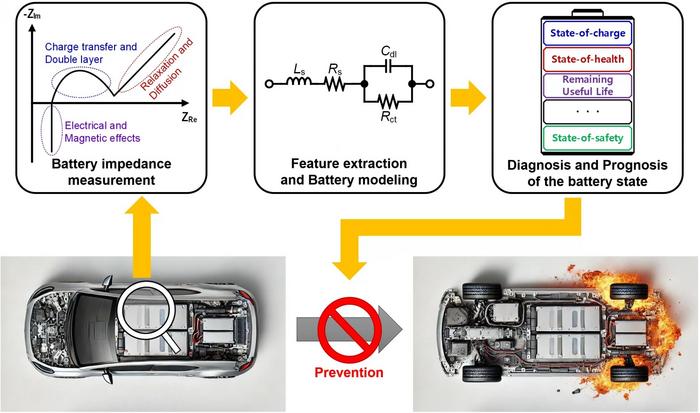
    Figure 1. Flow chart for diagnosis and prevention of unexpected combustion via the use of the electrochemical impedance spectroscopy (EIS) for the batteries for electric vehicles.
    Figure 1. Flow chart for diagnosis and prevention of unexpected combustion via the use of the electrochemical impedance spectroscopy (EIS) for the batteries for electric vehicles. Credit: The Kwon Research Group at KAIST

    Professor Kwon added: “This system can be easily integrated into the battery management system (BMS) of electric vehicles and has demonstrated high measurement accuracy while significantly reducing the cost and complexity compared to traditional high-current EIS methods.

    “It can contribute to battery diagnosis and performance improvements not only for electric vehicles but also for energy storage systems (ESS).”

    The future of EV battery management

    This development by KAIST represents a major advancement in EV technology. By utilising low-current electrochemical impedance spectroscopy, the research team has created a solution that not only improves battery diagnostics but also ensures greater safety and longevity of EV batteries.

    [ad_2]

    Source link

  • Major breakthrough in all-solid-state lithium batteries for EVs

    Major breakthrough in all-solid-state lithium batteries for EVs

    [ad_1]

    Researchers at McGill University have achieved a major breakthrough in the development of all-solid-state lithium batteries, potentially revolutionising electric vehicle (EV) battery technology.

    By solving a critical issue that has hindered the performance of all-solid-state lithium batteries, this innovation could help create safer, longer-lasting EVs, paving the way for a greener future.

    Tackling a long-standing challenge

    The core problem researchers face with all-solid-state lithium batteries is the resistance that forms at the interface where the ceramic electrolyte meets the electrodes.

    This resistance reduces battery efficiency and limits the amount of energy the battery can deliver, ultimately diminishing performance. The team at McGill has addressed this issue with a creative new approach.

    Led by Professor George Demopoulos from the Department of Materials Engineering, the research group discovered that using a porous ceramic membrane filled with a small amount of polymer could allow lithium ions to move more freely within the battery.

    This eliminates the interfacial resistance between the solid electrolyte and the electrodes, significantly boosting battery performance.

    “By using a polymer-filled porous membrane, we can allow lithium ions to move freely and eliminate the interfacial resistance between the solid electrolyte and the electrodes,” said Professor Demopoulos.

    “This not only improves the battery’s performance but also creates a stable interface for high-voltage operation, which is one of the industry’s key goals.”

    The importance of EV battery safety and performance

    Electric vehicles are central to reducing global carbon emissions, and the evolution of EV batteries is a crucial part of making widespread EV adoption a reality.

    The current standard, lithium-ion batteries, relies on liquid electrolytes, which pose a safety risk due to their flammability.

    Additionally, these batteries degrade over time, leading to reduced range and performance. As the demand for EVs continues to grow, so does the need for safer, more reliable battery technology.

    All-solid-state lithium batteries, which replace the liquid components of traditional batteries with solid materials, offer a promising solution.

    Not only do they have the potential to significantly increase the energy density of batteries, allowing EVs to travel farther on a single charge, but they also improve safety by reducing the risk of overheating and fire.

    McGill’s latest innovation is a crucial step toward overcoming one of the key technical barriers to commercialising all-solid-state lithium batteries.

    By ensuring stable, high-voltage operation and enhancing battery efficiency, this technology can lead to EVs that are not only safer but also capable of delivering greater performance for longer periods of time.

    A game-changer for the future of EVs

    The impact of this breakthrough extends far beyond just improving the range and lifespan of electric vehicles.

    As all-solid-state lithium batteries become a viable option, they could accelerate the global shift toward electric mobility, helping to lower greenhouse gas emissions and reduce dependency on fossil fuels.

    “This discovery brings us closer to building the next generation of safer and more efficient batteries for electric vehicles,” said Senhao Wang, a PhD graduate in the Department of Materials Engineering and first author of the study.

    While there is still work to be done before this technology is ready for mass production, this significant advancement brings all-solid-state batteries one step closer to transforming the EV industry.

    With further development and scaling, this innovation could help solve some of the biggest challenges facing electric vehicles today—namely, battery safety, longevity, and performance.

    [ad_2]

    Source link

  • Secure your tickets for The Business Booster 2024

    Secure your tickets for The Business Booster 2024

    [ad_1]

    Innovation News Network is delighted to announce that we are a media partner for The Business Booster.

    The Business Booster, hosted by EIT InnoEnergy, is where transactions in sustainable energy happen! The two-day event is your unique opportunity to meet over 150 technologies spanning the entire energy value chain, including the industrial scale-ups driving Europe’s energy transition.

    InnoEnergy has been recognised as the most active global energy investor for the third consecutive year. Its portfolio companies have collectively secured over €25bn in investments and are projected to save 2.1 gigatons of CO2e annually by 2030, and now is your chance to meet them!

    Taking place in Barcelona on 16 and 17 October, The Business Booster will bring together 1,500+ attendees from over 40 countries, consisting of start-ups, industry representatives, investors, policymakers and regulators.

    Attendees will take part in B2B meetings, hear from world‐class speakers, witness live panel debates, hear start‐ups pitch and discover innovations at the exhibition and product display area. Running for over a decade, The Business Booster boasts over 3,200 B2B meetings.

    Under the theme ‘Economic growth, geopolitical resilience, clean energy transition – trilemma or opportunity?’  The Business Booster 2024 will focus on sustainable energy innovation, with a particular focus on green industrial policies, industrial unicorns Made in Europe, the reshoring of the photovoltaic industry, the battery value chain, the impact of AI on energy consumption, and the green hydrogen value chain.

    We are a proud partner of The Business Booster 2024! As a valued member of our community, secure an exclusive 15% discount on your tickets using the code ([email protected]) when you register: https://tbb.innoenergy.com

    [ad_2]

    Source link

  • Altilium to produce EV battery cells from recycled materials

    Altilium to produce EV battery cells from recycled materials

    [ad_1]

    Altilium has unveiled an innovative project aimed at producing EV battery cells using materials recovered from end-of-life EV batteries.

    This project marks a significant milestone in sustainable EV battery production and is the first of its kind in the UK.

    A first for the UK: EV battery cells from recycled materials

    In a pioneering move, Altilium will demonstrate EV battery cells produced from recovered cathode active materials (CAM).

    These recycled materials will be validated for use in vehicles by a leading automotive original equipment manufacturer (OEM).

    The project, which underscores the potential of battery recycling, is made possible through support from the Advanced Propulsion Centre UK under the Advanced Route to Market Demonstrator (ARMD) competition.

    Collaboration with JLR and EcoCathode™ process

    Altilium’s groundbreaking project involves a strategic partnership with Jaguar Land Rover (JLR), a globally recognised luxury automotive manufacturer.

    The collaboration aims to validate and test EV battery cells produced with recycled materials through Altilium’s proprietary EcoCathode™ process.

    This innovative recycling process recovers critical materials such as lithium, cobalt, and nickel from old batteries, significantly reducing the need for newly mined resources.

    The result is a 60% reduction in carbon emissions when compared to traditional mining and battery production methods.

    By addressing the environmental impact of sourcing raw materials for batteries, Altilium’s EcoCathode™ process represents a substantial step towards achieving net-zero emissions in the automotive industry.

    Dr Christian Marston, Altilium COO, commented: “We are proud to lead this pioneering project with JLR that brings us one step closer to a circular economy for battery materials in the UK.

    “By demonstrating that EV battery cells made from recovered materials can meet the rigorous standards of the automotive industry, we’re not only reducing the environmental impact of battery production but also supporting the UK’s efforts to build a more sustainable and resilient EV supply chain.

    “This project is a vital milestone in our mission to decarbonise the battery value chain and support automotive OEMs in achieving their regulatory and sustainability goals.”

    Battery testing and production at UKBIC

    The EV battery cells produced from recovered materials will undergo rigorous validation at JLR’s state-of-the-art testing facilities.

    Production of these EV battery cells will take place at the UK Battery Industrialisation Centre (UKBIC), a national-scale facility dedicated to advancing battery manufacturing in the UK.

    This production will utilise recycled materials processed by Altilium at its new ACT2 facility in Devon, as well as its ACT1 pilot plant.

    This project builds on a previous collaboration between Altilium and UKBIC, supported by Innovate UK’s Faraday Battery Challenge.

    The combined efforts are critical in accelerating the prototyping and production of EV battery cells using recycled CAM, paving the way for scaling up Altilium’s battery recycling operations.

    Strengthening the UK’s EV supply chain

    As the UK transitions towards greater electrification in transport, there is growing pressure to secure a sustainable supply of critical raw materials like lithium, cobalt, and nickel for EV battery production.

    A recent report by the Faraday Institution forecasts that the UK will need nearly 110 GWh of annual EV battery manufacturing capacity by 2030 to meet demand.

    Altilium’s project is poised to play a vital role in helping the UK develop a domestic supply chain for these crucial materials, reducing reliance on overseas resources.

    Teesside Hub: A key player in UK battery recycling

    Altilium’s vision extends beyond this current project, with plans to establish the UK’s largest integrated battery recycling facility in Teesside.

    Capable of processing 150,000 EV batteries annually, the Teesside hub will supply approximately 30,000 tonnes per annum (tpa) of recycled CAM back into the UK’s rapidly expanding gigafactory network.

    This facility will play a crucial role in supporting the country’s growing EV battery manufacturing needs while contributing to environmental sustainability.

    Altilium’s innovative approach to producing EV battery cells from recycled materials highlights the potential of battery recycling in reducing the environmental impact of the automotive industry.

    With strong collaborations and cutting-edge technology, the project is set to strengthen the UK’s position in the global EV supply chain while advancing toward the goal of net-zero emissions.

    [ad_2]

    Source link

  • Cirba Solutions’ lithium-ion battery recycling facility selected for $200m DOE funding

    Cirba Solutions’ lithium-ion battery recycling facility selected for $200m DOE funding

    [ad_1]

    Cirba Solutions, a leader in battery recycling and materials management, is set to negotiate an award of up to $200m from the U.S. Department of Energy (DOE).

    This funding, part of the Bipartisan Infrastructure Law, will support the development of a cutting-edge lithium-ion battery recycling facility in Columbia, South Carolina.

    The announcement comes from the DOE’s Office of Manufacturing and Energy Supply Chains (MESC) and marks a significant step toward establishing a domestic closed-loop supply chain for electric vehicle (EV) batteries.

    Lithium-ion battery recycling facility overview

    The new facility will focus on recycling lithium-ion batteries sourced from end-of-life EVs, energy storage systems, and manufacturing scrap.

    Once fully operational, the lithium-ion battery recycling plant will have the capacity to process more than 60,000 tonnes of batteries annually, producing battery-grade salts for up to 500,000 EVs per year.

    This will play a crucial role in addressing the increasing demand for EV batteries while promoting sustainability through battery recycling.

    Beyond the environmental benefits, the 200-acre lithium-ion battery recycling facility is expected to generate over 300 full-time jobs in Columbia, along with 650 construction positions, providing a significant economic boost to the region.

    Strengthening US battery supply chains

    The Columbia plant is part of a broader national effort to enhance domestic lithium-ion battery recycling capabilities and reduce dependence on foreign supply chains.

    Cirba Solutions’ CEO, David Klanecky, emphasised the importance of the project: “This project advances the growth trajectory Cirba Solutions is on, working to expand lithium-ion battery recycling capacity in order to achieve a closed-loop domestic supply chain.

    “The funding from the Bipartisan Infrastructure Law provides us with a vital opportunity to increase capacity through the sourcing and processing of these critical materials in a responsible and sustainable way.

    “It will help strengthen our nation’s supply chains, accelerate accessibility to critical battery-grade metals for new battery production and help to establish our country as a true competitor in the global battery industry, all while enhancing energy independence and national security.”

    Commitment to community engagement

    In addition to its focus on lithium-ion recycling, Cirba Solutions is committed to supporting the Columbia community. The company plans to partner with local schools, host recycling events, and increase access to information about battery recycling.

    This South Carolina facility will be Cirba Solutions’ seventh operational site, adding to its extensive North American footprint. With over 30 years of industry experience, the company continues to lead the charge in sustainable battery recycling solutions.

    [ad_2]

    Source link

  • US battery manufacturing boosted with $3bn DOE funding

    US battery manufacturing boosted with $3bn DOE funding

    [ad_1]

    The U.S. Department of Energy (DOE) has announced a significant $3bn investment in battery manufacturing and materials production to bolster the domestic supply chain.

    Spanning across 14 states, the 25 projects selected under this initiative aim to create thousands of jobs while positioning the US as a global leader in clean energy and battery technology.

    $3bn for US battery manufacturing growth

    The DOE’s multi-billion dollar investment package will be allocated to expand the domestic production of advanced batteries and battery materials, supporting over 8,000 construction jobs and more than 4,000 permanent positions.

    These projects will focus on enhancing US battery manufacturing capacity, refining critical minerals, and recycling existing battery components, ensuring a more sustainable and resilient supply chain.

    The portfolio of projects will be managed by the DOE’s Office of Manufacturing and Energy Supply Chains (MESC).

    Their objective is to upgrade existing facilities and build new ones for battery-grade minerals, components, and recycling, which are crucial to supporting America’s energy independence and security.

    Strengthening energy independence and competitiveness

    Batteries are a cornerstone of the US energy grid and are critical for powering homes, businesses, and electric vehicles (EVs).

    The US has prioritised the development of a robust domestic supply chain to ensure that the nation is less reliant on foreign imports.

    This effort is part of a broader clean energy strategy aimed at making the nation more competitive in global markets while supporting a transition to cleaner energy.

    “By positioning the US at the forefront of advanced battery manufacturing, we are creating high-paying jobs and strengthening our global economic leadership and domestic energy security, all while supporting the clean energy transition,” said US Secretary of Energy Jennifer Granholm.

    Driving investment in EV supply chains

    The US Government has encouraged over $120bn in private sector investments in the EV supply chain.

    The DOE’s battery manufacturing initiative is a critical component of this effort, helping the US onshore and ‘friend-shore’ key technologies with the help of international allies and partners.

    Comprehensive projects across the battery supply chain

    The 25 selected projects cover all aspects of the battery supply chain, from raw material extraction to manufacturing and recycling.

    This initiative aims to build and expand facilities to process critical minerals such as lithium, graphite, and manganese, all of which are essential components in battery production.

    The projects will also explore next-generation battery technologies, ensuring the US stays ahead in the global market.

    The investments aim to foster a diversified battery portfolio, enhancing the nation’s ability to process and manufacture various battery chemistries.

    This diversity ensures the US has a reliable and adaptable energy supply chain capable of meeting future demand for batteries across a range of industries.

    Employment opportunities and economic benefits

    In addition to advancing battery technology, this investment will have a substantial impact on the US workforce.

    More than half of the selected projects have signed Project Labor Agreements, ensuring that the jobs created are well-paying, union positions.

    Partnerships with labour organisations, such as the North America’s Building Trades Unions (NABTU) and the International Brotherhood of Electrical Workers (IBEW), underscore the US’ commitment to improving job quality and providing strong economic support to local communities.

    By driving the growth of US battery manufacturing, these projects will not only bolster the clean energy sector but also provide long-term economic benefits by fostering innovation and job creation across the nation.

    [ad_2]

    Source link