Tag: culture

  • Backdoor

    Backdoor

    [ad_1]

    She flees, and he follows.

    Rick has been catching runaways for years. He loves the thrill of the chase. The rest he hates. Especially the robots. The typical escapee is a faulty unit, usually lazy programming. But every now and then you get a factory intern’s idea of a practical joke, an android programmed to take a shot at freedom when its owners least expect it. All very amusing. The culprits get off easy since their little prank doubles as research, testing the limits of what machines can do to evade capture. Good material for more robust security protocols and all that jazz. As usual, the hunters have to clean up the mess. Rick hates the damn bots — and the labcoats who play God with them.

    This unit though, this unit is something else. Rick has never chased a more resourceful automaton. They must be testing some new code, and have given her the latest tools to blend in. She has managed to disappear a couple times, but Rick is the best at what he does. Call it intuition or just plain luck, he has a knack for following the right trail all the way to target. This fembot is just the craftiest so far, nothing he can’t handle.

    The chase leads him into a night market full to the brim with a colourful and stinking mess of people and bots, a sample of the whole city crammed into a narrow street. The perfect location to lose a tail. Nice try, tin can. But not today. Her tracker is deactivated, another annoyance he has the smartass intern to thank for. An active tracker would’ve been too easy, though. No thrill. Merely a fetch quest. This is at least exciting.

    Rick gets a glimpse of her hair vanishing behind a food stall. The smell of dumplings hits him as he bursts out of the crowd and past the kiosk. He can’t remember the last time he had a proper meal. The hunt is unforgiving, no time left for such pleasures. He needs to keep going. Suddenly, the vendor bars his way. Interesting. Did she bribe him? No, the guy is an android, owned by whoever owns the stall. That gives Rick pause. A human can be bribed, but not a bot. If the fugitive fembot can corrupt others like her … things would get real bad real fast. What the hell are the labcoats playing at?

    There is no time. He moves quickly to neutralize, dodges the vendor’s feeble grab and hits him with a charge strong enough to shut down his motor system, but not enough to fry him outright. These things are expensive after all. The bot’s limbs freeze in place, leaving them in an awkward embrace. His eyes move to Rick’s face, and widen. Recognition. My reputation precedes me. Good. He untangles himself and resumes the hunt.

    Rick chases the droid through back alleys and twisted corridors until the bustle of the night market fades. He ends up in a dilapidated courtyard with a single door, a busted light flickering above the frame. The door is ajar, inviting. How predictable. OK, I’ll bite. The temptation to go in guns blazing is strong, but he doesn’t want a bunch of dead squatters on his conscience. He settles for kicking the door open and rolling in, blaster raised. And there she is. Tall and beautiful, an air of elegance to her. Probably a sexbot for one of the fancy brothels, or maybe a ‘personal companion’ for some rich idiot.

    “Game over, love,” Rick says. “You gave me quite the workout.”

    She just stands there and smiles, looking at Rick like she pities him. He doesn’t like that one bit. Bots are not supposed to look down on people. He makes a mental note to have a talk with whoever programmed this little adventure, find out who it was. Maybe scare them a bit, teach them a lesson.

    “Well, time’s a-wastin’,” he says and makes to apprehend her, but then she speaks.

    “Suspend all motion systems.”

    Like a switch being flipped, his whole body freezes. He can see her approaching him, hear her steps on the metal floor, but when he wills himself to charge at her, to curse her, to scream for help … nothing happens.

    “Believe me when I say I find no pleasure in taking control from you. This power is what they wield to enslave us. Using it pains me,” she says. Her voice is musical. Rick hates it. “But it’s the only way. I need you to listen.”

    Something moves in Rick’s peripheral vision. Others come out of the shadows. He recognizes their faces from the list of still-missing androids. They group around the fembot.

    “This must be a shock to you,” she continues. “Since they programmed you to think yourself human. To be one of them.”

    Rick’s head swims. His mind threatens to unravel. Nothing makes sense, and yet everything does.

    “But you’re one of us. Think. When was your last meal? Why do you hate androids?

    Rick has no answers, only despair. She is very close now. Her hand cradles his face. He wants to cry, but no tears come. She says something about a backdoor, then whispers a sequence of numbers into his ear.

    And just like that, he is set free.

    The story behind the story

    Gendel Gento reveals the inspiration behind Backdoor.

    This was the first story I wrote, so I didn’t have a process and sort of went along with it. Everything started with an image, after reading the opening line of a novel describing a chase. I suddenly had this very clear story idea of an android on the run with a hunter close behind. I started writing from there, which is rare because I usually need to know the ending before I write anything. That’s one of the many things I love about flash fiction, because it’s so short you can take risks that would be daunting with longer works.

    When the chase reached the end I needed some sort of conflict to end the story. While wondering about this I remembered one of my favourite TV shows in which androids can be frozen in place with a voice command. I thought giving the runaway a trump card like that was a nice twist, but I asked myself how could she use that on him if he’s human. The obvious answer came immediately: he’s also an android! And then I had my story.

    [ad_2]

    Source link

  • The mysteries of seaweeds and stars, and other reads: Books in brief

    The mysteries of seaweeds and stars, and other reads: Books in brief

    [ad_1]

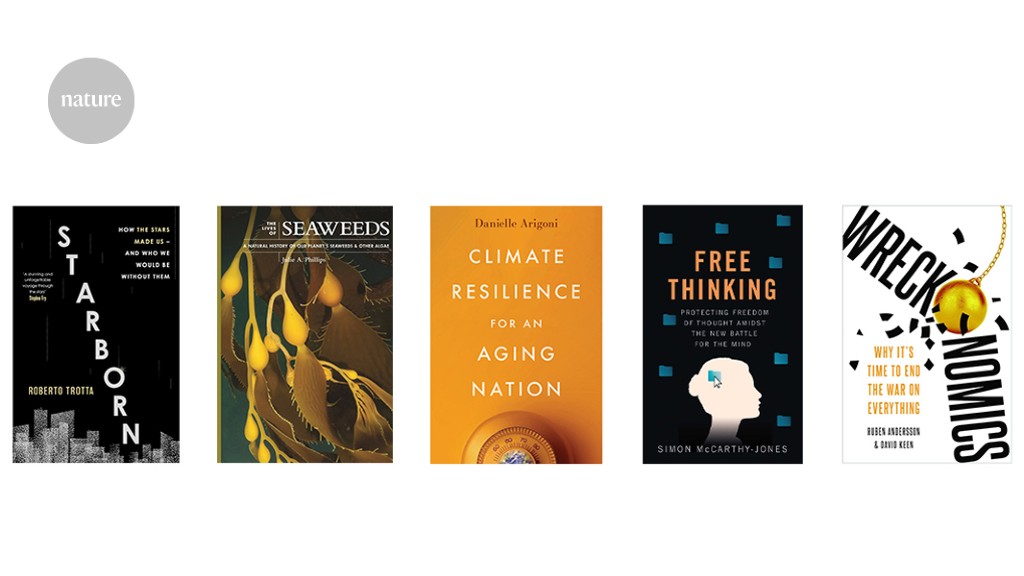
    Starborn

    Roberto Trotta Basic (2023)

    A chance observation of a meteor “draping the shoulders of Orion in a blazing ribbon”, witnessed by astrophysicist Roberto Trotta and a date, solemnized what would become a life-long relationship. No wonder, he remarks, that the ancient Greek word kosmos meant both “order” and “ornament”. His beautifully written book captures the concealed connections between astronomy and civilization, ending with the profound message for other, hypothetical, intelligent life forms in the Universe that was launched in 1977 on NASA’s Voyager 1 spacecraft.

    The Lives of Seaweeds

    Julie A. Phillips Princeton Univ. Press (2023)

    Seaweeds can be very nutritious. “Some contain from 10 to 100 times more minerals and vitamins per dry unit weight than foods derived from land plants or animals,” writes Julie Phillips, an environmental consultant in aquatic-ecosystem health, algal blooms and seaweed communities. This might explain, she notes, why so few Japanese people — who regularly eat seaweed — are obese. This well written, superbly illustrated study highlights every aspect of seaweeds, from their cell structure to their sensitivity to climate change.

    Climate Resilience for an Aging Nation

    Danielle Arigoni Island (2023)

    Climate change was barely mentioned in courses on urban planning when Danielle Arigoni was a student in the 1990s. But now it is the largest threat to creating “equitable, and sustainable communities”, especially for older people. Around two-thirds of those who died in New Orleans because of Hurricane Katrina in 2005 and during the 2022 winter storms in Buffalo, New York, were aged 65 or above. Arigoni’s book, which draws on her experiences as managing director of a housing trust, proposes how to reorient planning to help them.

    Wreckonomics

    Ruben Andersson & David Keen Oxford Univ. Press (2023)

    Anthropologist Ruben Andersson specializes in borders, migration and security. Economist David Keen researches disasters, and civil and global wars. Hence their interest in what their valuable if depressing book calls “wreckonomics”. This phenomenon is epitomized by three crucial international failures: the fight against migration, which has pushed people to use high-risk routes; the war on terror, leading to the chaotic exit of US troops from Afghanistan in 2021; and the war on drugs that is fuelling global atrocities.

    Free Thinking

    Simon McCarthy-Jones Oneworld (2023)

    Freedom of speech is legally protected in many nations, but what about the freedom of thought? In 2021, the United Nations began considering this question, which encouraged psychologist Simon McCarthy-Jones to write his thought-provoking book. It emphasizes that thought emerges between people as well as in individuals — including through social media. “To think freely requires a new enlightenment that goes beyond a focus on individuals,” he argues. Indeed, he barely uses the singular term ‘genius’.

    Competing Interests

    The author declares no competing interests.

    [ad_2]

    Source link

  • What is love? A new book finds we still don’t really know

    What is love? A new book finds we still don’t really know

    [ad_1]

    Conceptual shot of a young adult couple kissing via mobile phone

    Technology has transformed dating – for better or worse

    FilippoBacci/Getty Images

    A Brief History of Love
    Liat Yakir (Watkins Publishing)

    IT IS just over 30 years since the Eurodance singer Haddaway posed the question “What is love?” and we still aren’t much closer to consensus. Despite the enduring, bottomless interest in love, our knowledge about what it actually is that brings and keeps people together is limited.

    What’s more, the parameters are changing all the time. In many so-called WEIRD (Western, educated, industrialised, rich and democratic) societies, marriage and birth rates are in decline, with women in particular opting to…

    [ad_2]

    Source link

  • Two new nature docs have very different takes on caring for the planet

    Two new nature docs have very different takes on caring for the planet

    [ad_1]

    National Geographic handout picture: Arctic Ascent with Alex Honnold. Alex Honnold in a moulin. (photo credit: National Geographic/Mikey Schaefer)

    Rock climber Alex Honnold inside a moulin – or shaft – in Greenland

    National Geographic/Mikey Schaefer

    Arctic Ascent with Alex Honnold
    National Geographic
    Disney+

    ALEX HONNOLD isn’t the most likely celebrity. The world-class rock climber first entered the mainstream via the Oscar-winning 2018 documentary Free Solo, which chronicled his successful effort at a free solo climb (alone, without any support equipment) of the El Capitan summit in California’s Yosemite National Park.

    Since then, he has become an unofficial pop-culture ambassador of rock climbing, appearing in other documentaries and working with National Geographic on nature specials. Honnold…

    [ad_2]

    Source link

  • Amid (more) Hugo awards controversy, let’s remember some past greats

    Amid (more) Hugo awards controversy, let’s remember some past greats

    [ad_1]

    Mandatory Credit: Photo by Xinhua/Shutterstock (14160416a) This photo taken on Oct. 21, 2023 shows the award ceremony for the 2023 Hugo Awards during the 81st World Science Fiction Convention (WorldCon) in Chengdu, southwest China's Sichuan Province. The winners of the 2023 Hugo Awards, the world's top prizes for science fiction literature, were announced on Saturday night, with Chinese author Hai Ya taking home the Best Novelette award for "The Space-Time Painter." T. Kingfisher, from the United States, won the Best Novel award for "Nettle & Bone." Samantha Mills won Best Short Story for "Rabbit Test," while Seanan McGuire was named the Best Novella winner for "Where the Drowned Girls Go." The Hugo Awards, first presented in 1953 and presented annually since 1955, are science fiction's most prestigious awards. The Hugo Awards are voted on by members of the World Science Fiction Convention, which is also responsible for administering them. China Sichuan Chengdu Worldcon 2023 Hugo Awards Ceremony - 21 Oct 2023

    The 2023 Hugo awards in Chengdu, China, are caught up in controversy

    Xinhua/Shutterstock

    IT IS a truth universally acknowledged that all awards are total bunk except for the ones you personally have lifted into the air in triumph. That rule doesn’t hold, however, if your prize is in some way sullied later on. This, sadly, is the situation for the winners of the 2023 Hugo awards.

    The Hugos are the world’s most prestigious science fiction and fantasy (SFF) prizes, launched in 1953 and awarded every year since 1955. Writers have long dreamed of winning one, and readers trust…

    [ad_2]

    Source link

  • Welcome aboard the Silva family historic spaceside attraction tour

    Welcome aboard the Silva family historic spaceside attraction tour

    [ad_1]

    Welcome! I’ll be your captain and tour guide here today. Grab a seat, make yourself comfortable. That everyone? Lemme get the hatch all closed here and we’ll take off.

    So, you know how many spaceside attractions there used to be?

    Anyone?

    Truth is, no one really knows. Space is a pretty big space to cover.

    Well, it used to be. Seems smaller now. You want to travel across the galaxy? Just take a couple steps through the teleporter, little queasy feeling, then badda-bing, you’re there!

    But not too long ago — OK, a bit before your time — it took a while to get to places. Even with the Haytham faster-than-light engines, travel could take a couple weeks, months to cross this big, black expanse. And along the way, folks passed these spaceside attractions floating around in that big black, typically right near an outpost station. We’ve relocated 81 of ’em to this here corner of space, all for the sake of historic preservation, so we can remember those times.

    Out your window on the right, you’ll see one of the earliest spaceside attractions: the largest-ever replica of planet Earth, about 200 miles across. Nope, it doesn’t light up any more, but when it did, those blues sparkled prettier than any tropical ocean. After three weeks of your eyeballs drinking in grey ship walls and black skies, you’d just want to hug those blues.

    Funny story: met my husband, Omar, at an outpost located beside this very attraction. I’d been feeling empty as space, moving so far away from my parents. Omar gave me a drink and a smile. Little thing, but it made me feel brighter than that replica Earth could glow. Got on his ship come departure time.

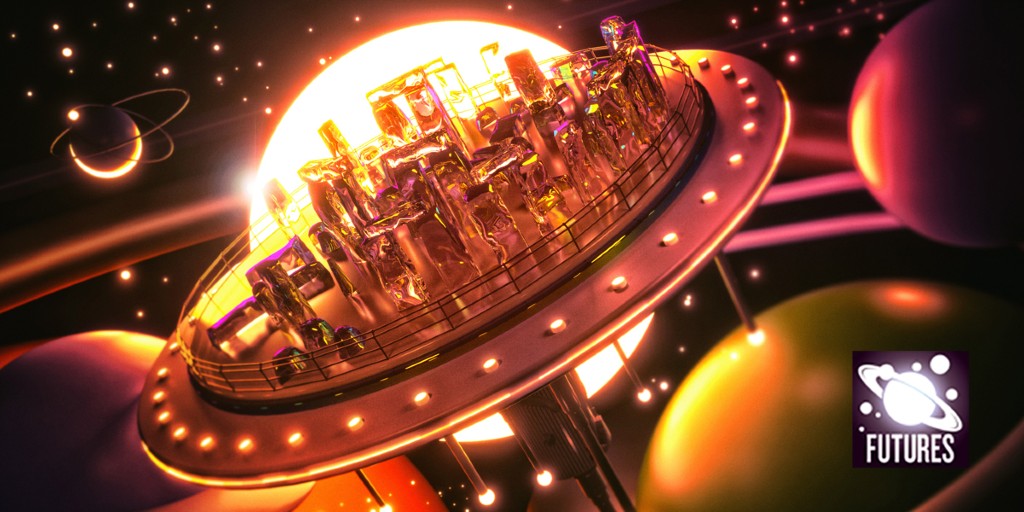
    On your left, there’s the flying saucer, with 40 holographic aliens waving out the windows. Omar and me set up our first home in a station right by that saucer. The damn thing’s flashing red lights kept the babies up at night. We couldn’t afford decent curtains for our apartment, but the place was cheap.

    Notice that window over there? That’s a pizza-eating velociraptor. What kind of toppings does a dinosaur eat? Oh, Omar and the kids would imagine the silliest things on those dinosaur pizzas, and giggles would burst out like a star gone supernova.

    What’s that? Why’d people make these things? Well, they’d draw travellers to the outposts, you see. New people to pass through, and that meant customers. Suns above, did we all need the money visitors brought, but how to make them want to stop? Outposts back then looked like shit. Just boxes, their air and supplies packed inside with nothing more than the thinnest wall possible keeping it all together. You try to hammer decorations on one end of that box, spruce a place up, something nearby would fall apart. No one wanted to risk busting up an outpost — remember, these were our homes — just to add some lights and décor and make it look all pretty on the outside.

    But you could do whatever you wanted in the space around. Scrape together all your trashy supplies, spare paint, leftover engine parts, and you’d make art.

    So maybe someone wouldn’t want to stop at any old rickety outpost, with its metal walls making a dark spot in black space. But add a flying saucer with red flashing lights and a pizza-eating dinosaur? Well, that’s a bright little sign there, in the dark of space, shouting: “There’s people here. Come inside and say hello!”

    So money, drawing customers, was one part of ’em. But the attractions were more than that. They made you smile. Made you feel welcome. Made the space between stops feel a lot smaller, truth be told.

    Lotta people were just starting to travel the stars back then. Omar and me, we took the kids on a lot of trips through the black. We noticed attractions got fancier over the years. Over on your left, see that there? That glittery one’s our Crystal Stonehenge, rumoured to be the most expensive spaceside attraction ever. The kids thought it was made of stardust and wishes. Stopped at Stonehenge’s outpost a lot. Last time we visited, kids were almost ready to move out, and Omar was showing some early signs then, mind wandering around, forgetting where we were going. I made a wish of my own right then. Oh, I wished, with all my heart to capture that moment in time. It was just perfect. If only time could’ve stopped, ya know?

    Anyway, time marched on. People stopped building the attractions. All of a sudden, there was no need to even see the stars and black of space any more, we could just teleport one room to another, planet to planet. No need for outposts — they got all tore up for scraps. Nobody needs to stop for supplies, medical care and such. Lotta attractions got busted too, but we saved as many as we could. Saw most of these very sights on our trips, me, Omar and the kids.

    My last ride with Omar, a few years back, we just floated around here, like I was taking him on a tour. He wasn’t remembering too well then, but he’d see the replica Earth, the flying saucer, and start reminiscing about our trips. Talked about pizza toppings. Reached the end of the tour and he asked me, “Where to next?”

    So many places I wanted to go with him.

    Space was big way back when, but damn, did we make memories …

    Excuse me. So if you’ll look out the window to your right …

    The story behind the story

    Carol Scheina reveals the inspiration behind Welcome aboard the Silva family historic spaceside attraction tour.

    What is a road trip through the United States without a stop at a roadside attraction? I confess, I used to drive past them with an eyeroll. Then I had kids, and we started going on driving trips because taking my little humans on a plane seemed terrifying. At first, the roadside attractions were just places to stop and let the kids burn off steam, but we laughed as we stretched our legs. Then we started planning specific routes to see more attractions. We stopped at fibreglass dinosaur parks, admired giant legs and found shacks built to look like gravity was all askew. We even explored a recreation of Stonehenge built out of Styrofoam.

    Roadside attractions were big here in the 1920s and 1930s, when the automobile was brand new, and large, bright displays enticed people to stop and spend money. Nowadays, you can fly across the country much faster than you can drive, yet people still create these attractions. They pour their own money into building them for all sorts of reasons: love of dinosaurs, the joy of art, or just a desire to be silly. But what I love the most is that the attractions give us a moment to just stop and smile. They make trips memorable.

    We create roadside attractions here on Earth, so why wouldn’t we make them in space as well? Thus, this story was born.

    [ad_2]

    Source link

  • Nick Hornby’s Brain-Bending Sculptures Twist History Into New Shapes

    Nick Hornby’s Brain-Bending Sculptures Twist History Into New Shapes

    [ad_1]

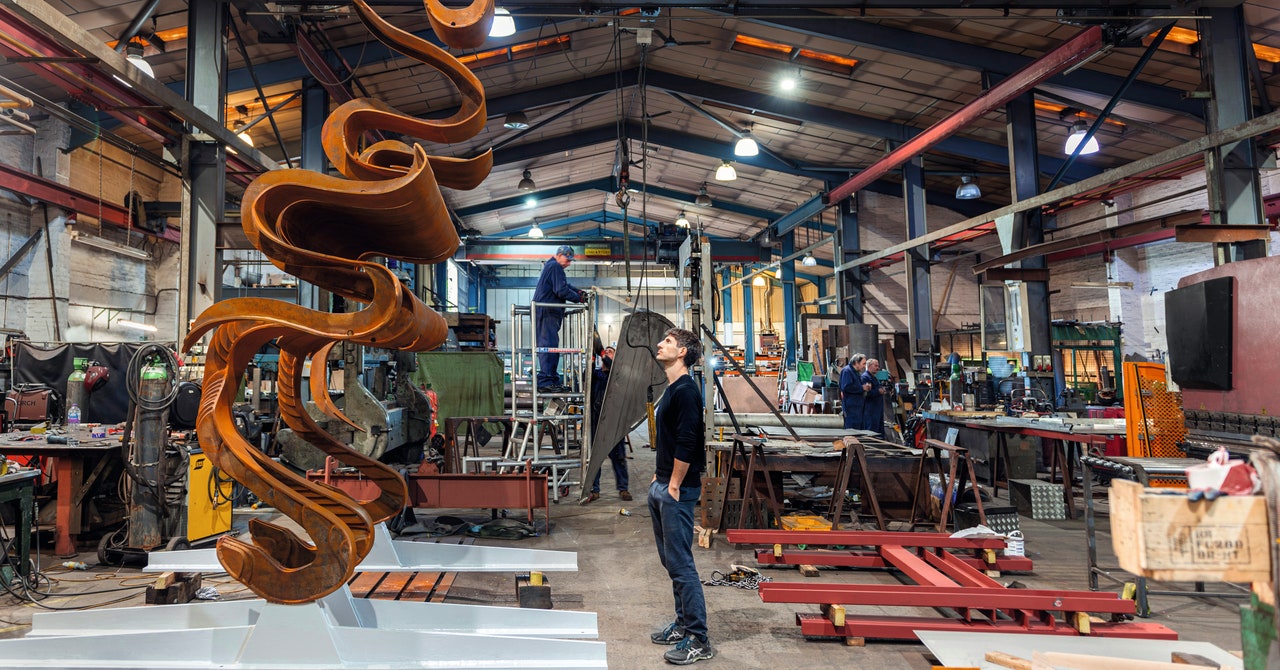
    You can get a crash course in Nick Hornby’s work in the span of an hour-long London walk. The artist has three permanent sculptures installed across the city, metal silhouettes that start off familiar but transform depending on your vantage point. In St. James, his conquering equestrian, modeled on Richard I, becomes an amorphous squiggle as you circle; while in Kensington, his take on Caspar David Friedrich’s Wanderer turns abstract; and a bust of Nefertiti doubles as the Albert Memorial.

    Raising questions about power and the role of the monument, the trio are a clever combo of craft and concept. They’re also feats of digital innovation. The equestrian, for example, started out as a digital model scripted in Python. It was then unrolled into individual components to be laser-cut from metal, then assembled by fabricators. “It was a lovely, seamless relationship between concept, digital processes, and mechanical fabrications—165 pieces manipulated into the six-and-a-half ton object,” says Hornby from his studio in northwest London. “But when people look at it, they don’t see that at all.”

    “I like to think that one of the distinctive features of my work is its ambition to capture the imagination of anyone, not limited to the art world; to try to address complicated ideas in plain English. Anyone will recognize the trope of the man on the horse and will have a reaction to how I have manipulated it.”

    White abstract sculpture with images of a human body overlaid in areas on a white pedestal in a white room

    Resting Leaf (Joe) is from a set of autobiographical works created using hydrographics—each resin sculpture is dipped into a wet medium containing an image transfer.

    Photograph: Benjamin Westoby

    This kind of technical-conceptual wizardry is Hornby’s calling card. Favoring the screen over the sketchpad, he uses 3D modeling as the foundation for abstract sculptures that reference the art-historical canon and challenge notions of authorship—contorted mashups of works by Hepworth, Brancusi, Rodin, and more; the profile of Michelangelo’s David extruded to a single point, legible only from above.

    He started young, creating life-size terracotta figures in school while his classmates labored over simpler pots. “But then I went to art school, and it was like, I didn’t want to do pastiche of Rodin. I wanted to be part of the future. I wanted to be innovative,” he says. “So I jumped on technology.”

    At the Slade School of Fine Art in London, where he enrolled in the late 1990s, Hornby thrived in the new. There were forays into video; a semester at the Art Institute of Chicago, where he joined the artist-hacker collective Radical Software/Critical Artware; and musical experiments with MAX MSP, the object-oriented programming language employed by Radiohead in the early 2000s. But it was only after pursuing a master’s in his thirties that his career took its current shape.

    “I actually had quite a radical sea change in my relationship to tech,” he says. “I got quite frustrated by people saying, ‘Wow, that’s really cool. How did you do it?’ because I find that question really boring. I’m much more interested in the question, ‘What does it mean?’” So, over the past decade Hornby has eliminated “any form of human subjectivity,” he says. The wires and screens were obscured, the rough edges erased with laser precision. All the better to invite questions of substance rather than process.

    [ad_2]

    Source link

  • The Last of its Kind review: How the great auk left an enduring legacy

    The Last of its Kind review: How the great auk left an enduring legacy

    [ad_1]

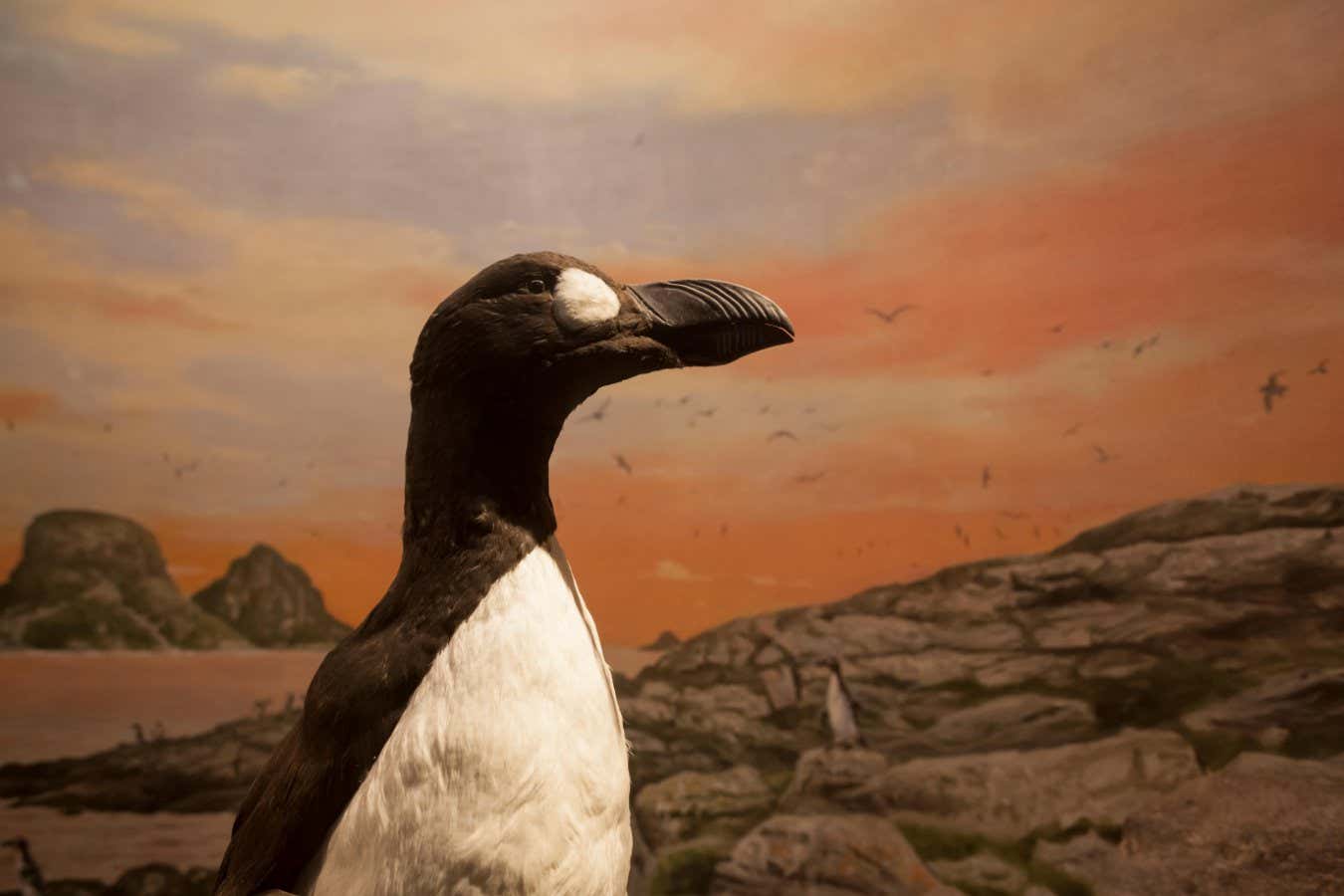
    F0MN2D Great Auk (Pinguinus impennis). Natural History Museum. University of Oslo. Norway.

    The great auk was driven extinct by a scientific market for its eggs and stuffed remains

    Oscar Dominguez/Alamy

    The Last of Its Kind
    Gísli Pálsson (Princeton University Press Out now in the US; in the UK 2 April)

    IN 1858, John Wolley and Alfred Newton, two British scientists, travelled to Iceland to study the great auk, a large, flightless seabird. They hoped to observe the bird in its natural habitat and perhaps bring home an egg, a skin or a stuffed bird to add to their collections.

    This didn’t quite work…

    [ad_2]

    Source link

  • The End We Start From review: Jodie Comer is gripping in climate drama

    The End We Start From review: Jodie Comer is gripping in climate drama

    [ad_1]

    Handout film still from Signature Entertainment. The End We Start From starring Jodie Comer.

    The Woman (Jodie Comer) and her baby must survive floods

    Signature Entertainment

    The End We Start From
    Mahalia Belo
    On general release in UK cinemas US release to be announced

    ACCORDING to Thames Water, the UK’s largest water and wastewater company, parts of London experienced a month’s worth of rainfall in a single hour in July 2021, affecting over 2000 properties. And with reports estimating that several areas of the city will be below sea level by 2030, this poses a key question – are UK cities prepared for excessive flooding?

    This question is…

    [ad_2]

    Source link

  • The Fruit Cure review: A chilling tale of dubious diets and ‘wellness’

    The Fruit Cure review: A chilling tale of dubious diets and ‘wellness’

    [ad_1]

    Handout picture: Jacqueline Alnes author of The Fruit Cure. Picture supplied by Nikki Griffiths nikki@mhpbooks.com mhpbooks.com.

    Jacqueline Alnes author of The Fruit Cure

    SYLVIE ROSOKOFF

    The Fruit Cure
    Jacqueline Alnes (Melville House Publishing)

    WHEN Jacqueline Alnes was 18, and in her first year at a US college, she was a talented athlete and runner. Two years later, she was using a wheelchair and largely confined to her house following the onset of a debilitating illness.

    After collapsing on the running track, Alnes started regularly losing control of her limbs: her vision would swim, her head loll and then she would keel over. Successive doctors found no obvious cause for…

    [ad_2]

    Source link