“The answer ended up being, yes, in all US states, on average heat pumps will reduce greenhouse gas emissions,” says Eric Wilson, a senior research engineer at the National Renewable Energy Laboratory and the lead author of the new paper. “Even if it’s a relatively low-efficiency heat pump that relies on electric resistance heating during the coldest times, and even if it’s the most pessimistic grid scenario that has prices for wind and solar being higher than their current trajectory has been.”
Because a heat pump can be reversed to provide cooling, getting more of the devices into homes could also improve public health during the summer, the study notes. That is, with a heat pump, a home that has never had AC now has a way to ensure comfortable indoor temperatures. That’ll be all the more critical as outdoor temperatures march relentlessly upward, especially in cities, where the built environment absorbs and slowly releases the sun’s energy. The tricky bit is that even though a heat pump can be more efficient at cooling than a traditional AC unit, its operating cost during the summer may surprise a household that has never had AC before.
It’s important to note that a household will get the most out of a heat pump if it also opts for better insulation. If you have double-paned windows, for instance, less of that indoor heating or cooling will escape in the winter or summer. That sort of insulation comes with its own upfront cost, sure, but reduces the upfront cost of the heat pump by thousands of dollars, the new study finds: If your home is sealed nice and tight, you’ll require a smaller, less expensive device to provide proper warming. “I worry a little bit about people putting in heat pumps in very poorly insulated homes, and just not being comfortable,” says Wilson. (To that end, the Inflation Reduction Act provides 30 percent off the cost of insulation. The legislation also offers thousands of bucks to upgrade your home’s electrical system, which may be required to accommodate a new heat pump.)
The study further notes that if deploying lowest-efficiency heat pumps, energy bills could increase in 39 percent of households, but that drops to 19 percent if they also reinsulate. (This is based on state-average energy prices from the winter of 2021-2022.) When using higher-efficiency heat pumps, only 5 percent of households could see an increase in their energy bills. The upfront cost of this insulation or higher-efficiency heat pumps could be offset by financial incentives, the study says, like those provided by the IRA.
This modeling isn’t predicting the future, but calculating scenarios for how the adoption of heat pumps could unfold in the US. In the coming years, the heat pump industry could well generate surprises—the good kind—especially as the US invests hundreds of millions of dollars into domestic production. “What are the efficiency improvements, the surprising innovations, the leaps here that one can only get when you in fact start deploying these at scale?” asks climate economist Gernot Wagner of the Columbia Business School, who wasn’t involved in the paper.
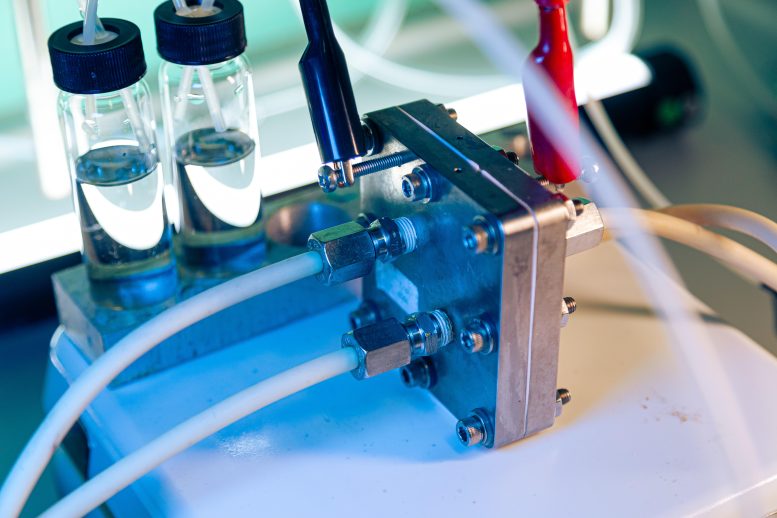
Electrochemical reduction of carbon dioxide holds promise for converting CO2 into valuable products but is hampered by stability issues and wasted carbon. A proton-exchange membrane that uses lead as a catalyst demonstrates the feasibility of durable and efficient CO2 reduction.
About 3 per cent of all carbon emissions are due to the shipping industry
GreenOak/Shutterstock
A 240-metre-long container ship called the Sounion Trader recently completed a test of an onboard carbon capture system as it cruised around the Persian Gulf. It is one of a small but growing number of ships trying to reduce their climate footprint by capturing and storing their carbon dioxide emissions onboard – but finding space for tonnes of CO2 is a challenge.
“You’re miniaturising a system that was designed for huge power plants,” says Roujia Wen at Seabound, the UK-based start-up behind the Sounion Trader’s test run.
Shipping is responsible for around 3 per cent of global CO2 emissions. To reduce that, shippers are using cleaner fuels, lubricating hulls with bubbles to improve fuel efficiency and even turning back to sails. But near-term options to reach the industry’s pledge of net-zero emissions by 2050 are limited .
Another possibility is capturing ships’ emissions and storing them onboard, but it faces major obstacles. One is supplying the energy to recharge the chemical sorbents used to absorb CO2. Tristan Smith at University College London says some existing systems increase fuel use by a third just to catch half of CO2 emissions.
The systems, and the carbon they capture, also take up room on board that would normally be used for valuable cargo. “Space is an issue,” says Jasper Ros at TNO, a research organisation in the Netherlands. “Especially when you’re talking about long voyages.” Each tonne of combusted fuel forms around 3 tonnes of CO2, says George Mallouppas at the Cyprus Marine & Maritime Institute. When it is captured and stored, the added mass can affect a ship’s stability and reduce its fuel efficiency.
Wen says Seabound’s small-scale tests captured around a tonne of CO2 per day. That is a small fraction of the ship’s overall emissions, but she says the full-scale system will be able to capture as much as 95 per cent of a ship’s CO2.
To save energy, Seabound moves part of its process onshore. On the ship, exhaust is looped through a calcium oxide sorbent, which reacts with CO2 to form solid calcium carbonate pebbles. The company then waits to recharge the sorbents until the pebbles are offloaded at port for permanent storage. The trade-off is space. Seabound’s approach means a ship must carry tanks of sorbent along with every tonne of captured CO2. Still, Wen says the company aims to retrofit 1000 ships for carbon capture by 2030.
A Dutch company called Value Maritime is taking a similar approach, using a liquid amine sorbent to capture CO2 and then recharging it offshore. Yvette van der Sommen at Value Maritime says 26 ships are now using its system alongside existing sulphur pollution-scrubbers to capture up to 40 per cent of CO2 in exhaust, although the process hasn’t yet been certified by a third party. She says the company has sold some captured CO2 to greenhouses to fertilise plants, but much of it remains stored in tanks at ports.
Such systems could appear attractive to cut emissions now, says Smith. But the rapid scale-up of cleaner shipping fuels may soon make them obsolete – unless they can achieve very high rates of capture at a low enough cost. “Shipping faces a very short time to decarbonise, because it has started so late,” he says.
Founded at the Massachusetts Institute of Technology in 1899, MIT Technology Review is a world-renowned, independent media company whose insight, analysis, reviews, interviews and live events explain the newest technologies and their commercial, social and political impact.
IIT and BeDimensional’s researchers used nanoparticles of ruthenium, a noble metal that is similar to platinum in its chemical behavior but far cheaper, to serve as the active phase of the electrolyser’s cathode, leading to an increased efficiency of the overall electrolyzer. Credit: IIT-Istituto Italiano di Tecnologia
A collaborative research effort between IIT and its spin-off BeDimensional has discovered a method utilizing ruthenium particles in conjunction with a solar-powered electrolysis system.
What does it take to produce green hydrogen more efficiently and cheaply? Apparently, small ruthenium particles and a solar-powered system for water electrolysis. This is the solution identified by a joint team involving the Istituto Italiano di Tecnologia (Italian Institute of Technology, IIT) of Genoa, and BeDimensional S.p.A. (an IIT spin-off).
The technology, developed in the context of the Joint-lab’s activities and recently published in two high-impact factor journals (Nature Communicationsand the Journal of the American Chemical Society) is based on a new family of electrocatalysts that could reduce the costs of green hydrogen production on an industrial scale.
Hydrogen is considered as a sustainable energy vector, an alternative to fossil fuels. But not all hydrogen is the same when it comes to environmental impact. Indeed, the main way hydrogen is produced nowadays is through the methane steam reforming, a fossil fuel-based process that releases carbon dioxide (CO2) as a by-product.
The hydrogen produced by this process is classified as “grey” (when CO2 is released into the atmosphere) or “blue” (when CO2 undergoes capture and geological storage). To significantly reduce emissions to zero by 2050 these processes must be replaced with more environmentally sustainable ones that deliver “green” (i.e. net-zero emissions) hydrogen. The cost of “green” hydrogen critically depends on the energy efficiency of the setup (the electrolyzer) that splits water molecules into hydrogen and oxygen.
Technological Innovations in Hydrogen Production
The researchers from the joint team of this discovery have developed a new method that guarantees greater efficiency than currently known methods in the conversion of electrical energy (the energy bias exploited to split water molecules) into the chemical energy stored in the hydrogen molecules that are produced. The team has developed a concept of catalyst and have used renewable energy sources, such as the electrical energy produced by a solar panel.
The new solution has been identified by a joint team involving the Istituto Italiano di Tecnologia (Italian Institute of Technology, IIT) of Genoa, and BeDimensional S.p.A. (an IIT spin-off). In the picture: Liberato Manna (IIT), Francesco Bonaccorso (BeDimensional), Yong Zuo (IIT), Sebastiano Bellani (BeDimensional), Marilena Zappia (BeDimensional), Michele Ferri (IIT). Credit: IIT-Istituto Italiano di Tecnologia
“In our study, we have shown how it is possible to maximise the efficiency of a robust, well-developed technology, despite an initial investment that is slightly greater than what would be needed for a standard electrolyzer. This is because we are using a precious metal such as ruthenium”, commented Yong Zuo and Michele Ferri from the Nanochemistry Group at IIT in Genoa.
The researchers used nanoparticles of ruthenium, a noble metal that is similar to platinum in its chemical behavior but far cheaper. Ruthenium nanoparticles serve as the active phase of the electrolyzer’s cathode, leading to an increased efficiency of the overall electrolyzer.
“We have run electro-chemical analyses and tests under industrially-significant conditions that have enabled us to assess the catalytic activity of our materials. Additionally, theoretical simulations allowed us to understand the catalytic behavior of ruthenium nanoparticles at the molecular level; in other words, the mechanism of water splitting on their surfaces,” explained Sebastiano Bellani and Marilena Zappia from BeDimensional, who were involved in the discovery. “Combining the data from our experiments with additional process parameters, we have carried out a techno-economic analysis that demonstrated the competitiveness of this technology, when compared to state-of-the-art electrolyzers.”
Cost-Effectiveness of the New Technology
Ruthenium is a precious metal that is obtained in small quantities as a by-product of platinum extraction (30 tonnes per year, as compared to the annual production of 200 tonnes of platinum) but at a lower cost (18.5 dollars per gram as opposed to 30 dollars for platinum). The new technology involves the use of just 40 mg of ruthenium per kilowatt, in stark contrast with the extensive use of platinum (up to 1 gram per kilowatt) and iridium (between 1 and 2.5 grams per kilowatt, with iridium price being around 150 dollars per gram) that characterize proton-exchange membrane electrolyzers.
By using ruthenium, the researchers at IIT and BeDimensional have improved the efficiency of alkaline electrolyzers, a technology that has been used for decades due to its robustness and durability. For example, this technology was on board of the Apollo 11 capsule that brought humanity to the moon in 1969. The new family of ruthenium-based cathodes for alkaline electrolyzers that has been developed is very efficient and has a long operating life, being therefore capable of reducing the production costs of green hydrogen.
“In the future, we plan to apply this and other technologies, such as nanostructured catalysts based on sustainable two-dimensional materials, in up-scaled electrolyzers powered by electrical energy from renewable sources, including electricity produced by photovoltaic panels,” concluded the researchers.
Reference: “Ru–Cu Nanoheterostructures for Efficient Hydrogen Evolution Reaction in Alkaline Water Electrolyzers” by Yong Zuo, Sebastiano Bellani, Gabriele Saleh, Michele Ferri, Dipak V. Shinde, Marilena Isabella Zappia, Joka Buha, Rosaria Brescia, Mirko Prato, Roberta Pascazio, Abinaya Annamalai, Danilo Oliveira de Souza, Luca De Trizio, Ivan Infante, Francesco Bonaccorso and Liberato Manna, 25 September 2023, Journal of the American Chemical Society. DOI: 10.1021/jacs.3c06726
“High-performance alkaline water electrolyzers based on Ru-perturbed Cu nanoplatelets cathode” by Yong Zuo, Sebastiano Bellani, Michele Ferri, Gabriele Saleh, Dipak V. Shinde, Marilena Isabella Zappia, Rosaria Brescia, Mirko Prato, Luca De Trizio, Ivan Infante, Francesco Bonaccorso and Liberato Manna, 4 August 2023, Nature Communications. DOI: 10.1038/s41467-023-40319-5
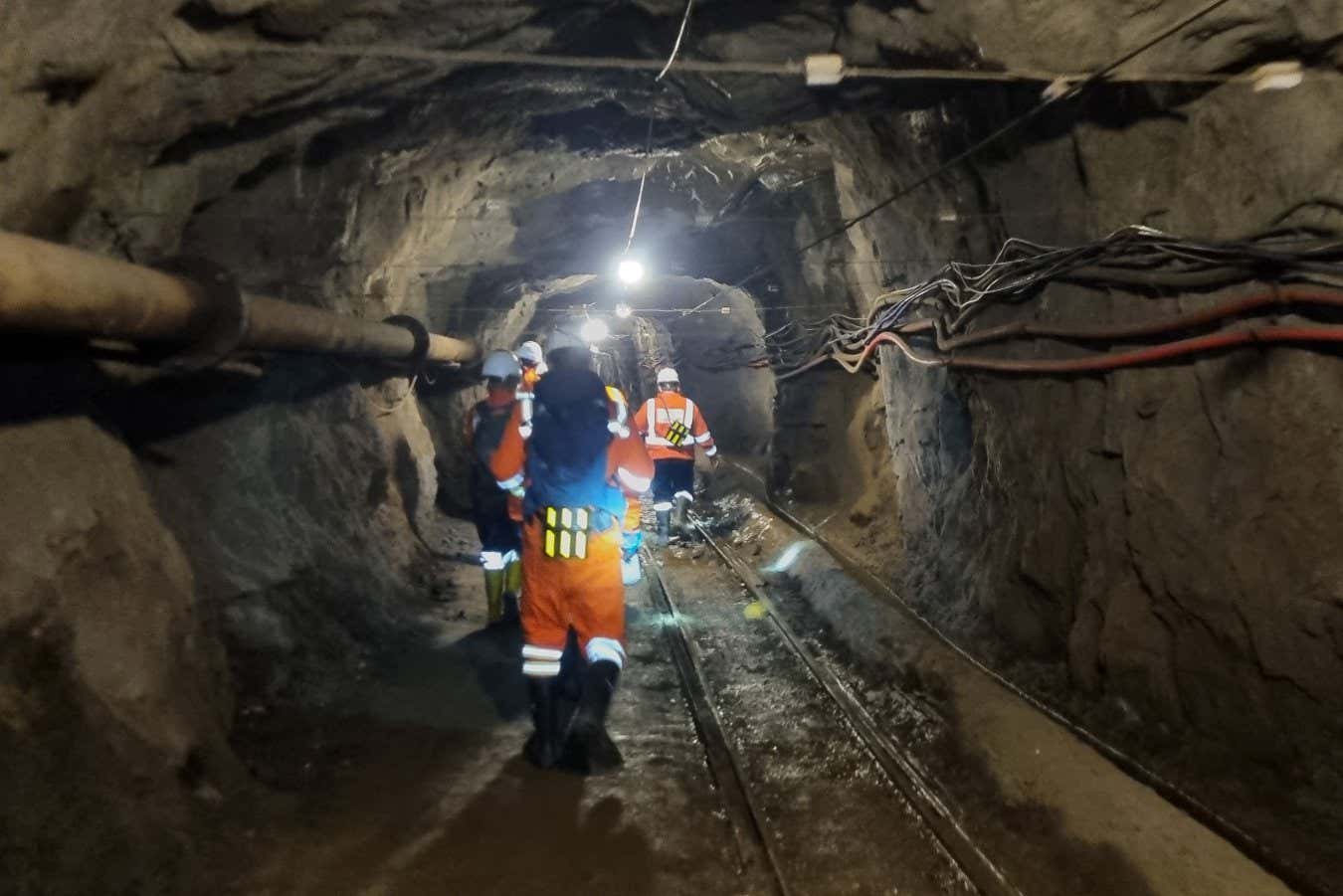
An Albanian mine where hydrogen naturally seeps up through the rock
F-V. Donzé
The largest flow of natural hydrogen gas ever recorded has been measured deep in an Albanian mine. The find could help us work out where to locate underground deposits of this clean fuel.
“The bubbling is really, really intense,” says Laurent Truche at the University of Grenoble Alpes in France, who measured the gas in a pool of water nearly a kilometre underground. “It’s like a Jacuzzi.”
Companies are now searching for deposits of natural hydrogen all over the world as a source of clean fuel, but evidence for large accumulations of this “gold hydrogen” is sparse. Most claims about vast hydrogen deposits beneath the surface rely on extrapolation, rather than direct measurements.
In search of more substantial proof, Truche and his colleagues descended into the Bulqizë chromite mine in Albania, where hydrogen gas seeping out of the rocks has caused several explosions. The mine is also located within an exposure of iron-rich rock, known as an ophiolite. Water is known to react with such rock to generate hydrogen in other places, such as Oman.
The researchers found that the gas bubbling from the pool was more than 80 per cent hydrogen, with methane and a small amount of nitrogen mixed in. It was flowing at a rate of 11 tonnes per year, almost an order of magnitude greater than any other flows of hydrogen gas measured from single-point sources elsewhere on Earth’s surface.
To determine the source of the gas, the researchers also modelled different geological scenarios that could produce such a flow. They found the most likely scenario was that the gas was coming from a deeper reservoir of hydrogen accumulated in a fault beneath the mine. Based on the geometry of the fault, they estimate this reservoir contains at least 5000 to 50,000 tonnes of hydrogen.
“It’s one of the largest volumes of natural hydrogen that has ever been measured,” says Eric Gaucher, an independent geochemist focused on natural hydrogen.
But it still isn’t a huge amount, says Geoffrey Ellis at the US Geological Survey. However, evidence for a stable accumulation of hydrogen supports the notion that much more is stored underground, he says. “We really should be looking deeper.”
The UK’s 40-year-old fusion reactor achieved a world record for energy output in its final runs before being shut down for good, scientists have announced.
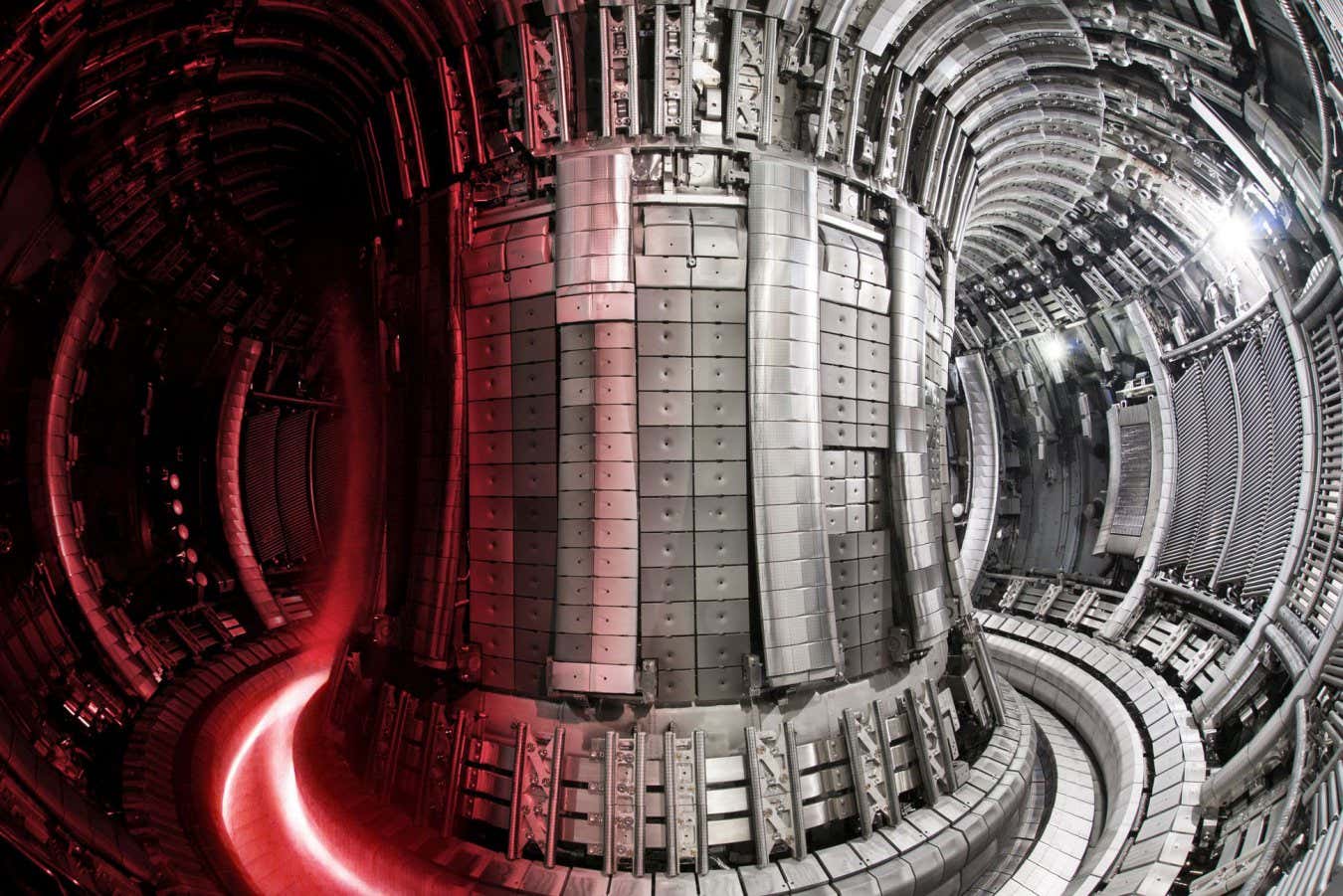
The Joint European Torus (JET) in Oxfordshire began operating in 1983. When running, it was temporarily the hottest point in the solar system, reaching 150 million°C.
The reactor’s previous record was a reaction lasting for 5 seconds in 2021, producing 59 megajoules of heat energy. But in its final tests in late 2023, it surpassed this by sustaining a reaction for 5.2 seconds while also reaching 69 megajoules of output, using just 0.2 milligrams of fuel.
Inside the JET fusion reactor
EUROfusion
This equates to a power output of 12.5 megawatts – enough to power 12,000 homes, said Mikhail Maslov of the UK Atomic Energy Authority at a press conference on 8 February.
Today’s nuclear power plants rely on fission reactions, where atoms are smashed apart to release energy and smaller particles. Fusion works in reverse, squeezing smaller particles together into larger atoms.
Fusion can create more energy with none of the resulting radioactive waste created by fission, but we don’t yet have a practical way to harness this process in a power plant.
JET forged together atoms of deuterium and tritium – two stable isotopes of hydrogen – in plasma to create helium, while also releasing a vast amount of energy. This is the same reaction that powers our sun. It was a type of fusion reactor known as a tokamak, which contains plasma in a donut shape using rings of electromagnets.
Scientists ran the last experiments with deuterium-tritium fuel at JET in October last year and other experiments continued until December. But the machine has now been shut down for good and it is being decommissioned over the next 16 years.
Juan Matthews at the University of Manchester, UK, says JET will reveal many secrets as it is dismantled, such as how the lining of the reactor deteriorated through contact with plasma and where valuable tritium – worth around £30,000 a gram – has embedded in the machinery and can be recovered. This will be vital information for future research and commercial reactors.
“It’s great that it’s gone out with a little flourish,” says Matthews. “It’s got a noble history. It’s served its time and they’re going to squeeze a bit more information out of it during its decommissioning period as well. So it’s not something to be sad about; it’s something to be celebrated.”
A larger and more modern replacement for JET, the International Thermonuclear Experimental Reactor (ITER) in France, is nearing completion and its first experiments are due to start in 2025.
Tim Luce, deputy head of the ITER construction project, told the press conference that ITER will scale up the energy output to 500 megawatts, or possibly even 700.
“These are what I usually call power plant scale,” he said. “They’re at the lower end of what you would need for an electricity generating facility. In addition, we need to extend the timescale to at least 300 seconds for the high fusion power and gain but perhaps as long as an hour in terms of energy production. So what JET has done is exactly a scale model of what we have to do in the ITER project.”
Another reactor using the same design, the Korea Superconducting Tokamak Advanced Research (KSTAR) device, recently managed to sustain a reaction for 30 seconds at temperatures in excess of 100 million°C.
There are other approaches to creating a working fusion reactor being pursued around the world as well, such as the National Ignition Facility at the Lawrence Livermore National Laboratory in California. This bombards capsules of fuel with immensely powerful lasers, a process called inertial confinement fusion, and has managed to unleash almost twice the energy that was put into it.
Blades that will form part of the world’s largest onshore wind turbines
SANY Renewable Energy
The world’s largest-ever onshore wind turbine blades have been manufactured in China. At 131 metres in length, each foil would dwarf Big Ben or the Statue of Liberty.
Once installed in central China in the coming months, each of the structures, including a 15-megawatt turbine and three blades, will have a diameter of over 260 metres.
The SY1310A onshore wind turbine blade was made by SANY Renewable Energy at its factory in Bayannur in northern China.
The company said in a statement that the increased blade length meant greater demands for stiffness and strength as well as the need for protection from extreme weather events such as lightning.
“The blade has applied multiple advanced technological innovations including a high-performance airfoil with a thick blunt trailing edge, optimized airfoil layout, and overall increased thickness,” it said.
Peter Majewski at the University of South Australia says the advantage of such large wind turbines is that the bigger they are, the fewer are needed. “But the bigger they are, the more visible they are and so there has to be social acceptance for such large structures to be built,” he says.
“These are huge structures and putting them up is expensive and taking them down is just as expensive.”
While wind turbine blades can continue to get larger, the logistics of transporting such massive blades make their use challenging, says Majewski. He also says that manufacturers and society must consider what will be done with these structures as they age.
Majewski has studied the issue of recycling wind turbine blades. In a 2022 study, he and his colleagues predicted that, by 2050, when existing turbines reach the end of their 20 to 30-year lifespan, there will be tens of thousands of tonnes of wind farm blades that may need to go to landfill.
However, he welcomed the use of recycled polyurethane as part of the construction of these newly unveiled blades.
There’s a revolution brewing in batteries for electric cars. Japanese car maker Toyota said last year that it aims to release a car in 2027–28 that could travel 1,000 kilometres and recharge in just 10 minutes, using a battery type that swaps liquid components for solids. Chinese manufacturers have announced budget cars for 2024 featuring batteries based not on the lithium that powers today’s best electric vehicles (EVs), but on cheap sodium — one of the most abundant elements in Earth’s crust. And a US laboratory has surprised the world with a dream cell that runs in part on air1 and could pack enough energy to power aeroplanes.
These and other announcements rely on alternative designs to the conventional lithium-ion batteries that have dominated EVs for decades. Although lithium-ion is hard to beat, researchers think that a range of options will soon fill different niches of the market: some very cheap, others providing much more power. “We’re going to see the market diversify,” says Gerbrand Ceder, a materials scientist at the University of California, Berkeley.
The pursuit of better car batteries is fierce, in large part because the market is skyrocketing. More than a dozen nations have declared that all new cars must be electric by 2035 or earlier. The International Energy Agency forecasts that the global stock of EVs on the road will rise from 16.5 million in 2021 to nearly 350 million by 2030 (see go.nature.com/42mpkqy), and that demand for energy from EV batteries will reach 14 terawatt hours (TWh) by 2050, which is 90 times more than in 20202.
Car batteries have a stiff list of requirements. They need to pack a lot of energy into as little material and weight as possible so that cars can go farther on a single charge. They need to provide enough power for acceleration, recharge fast, have a long lifespan (the common standard is to withstand 1,000 full recharging cycles, which should last a consumer 10–20 years), work well across wide temperature ranges and be safe and affordable. “It’s very hard to optimize all these things at once,” says Linda Nazar, a battery researcher at the University of Waterloo, Canada.
So researchers are pursuing a plethora of options, with different targets in mind. The US Department of Energy’s (DoE’s) Battery500 programme, launched in 2017, is aiming for a cell energy density of 500 watt-hours per kilogram (Wh kg–1), a 65% boost compared with today’s best products. The PROPEL-1K programme, launched last year by the US Advanced Research Projects Agency–Energy, is ambitiously aiming for a longer-term goal of 1,000 Wh kg–1. As for cost, the DoE’s Vehicle Technologies Office is aiming to hit US$60 per kilowatt hour by 2030, about half today’s prices, which it reckons will mean that the price of electric cars will break even with the cost of those powered by gas guzzling petrol engines (see ‘Powering up’).
Source: Ref. 3
It’s hard to pin down where things stand. Commercial announcements about yet-to-be-released batteries or cars sometimes emphasize one metric over others, and proprietary claims can be impossible to check until batteries have been tested for years in real-world cars. But it’s clear that decades of work on variants such as solid-state and sodium batteries are finally coming to fruition, says Nazar. As for the far future, plenty of battery chemistries remain tantalizing possibilities. “Now everyone has accepted battery development is really important, everyone is tripping over themselves to do it,” she says.
Electrode evolution
Batteries are effectively chemical sandwiches, which work by shuttling charged ions from one side (the anode) to the other (the cathode) through some intermediate material (the electrolyte) while electrons flow in an outside circuit. Recharging the battery means shunting the ions back to the anode (see ‘How a battery works’).
Source: Adapted from G. Harper et al. Nature575, 75–86 (2019) and G. Offer et al. Nature582, 485–487 (2020)
Today, most electric cars run on some variant of a lithium-ion battery. Lithium is the third-lightest element in the periodic table and has a reactive outer electron, making its ions great energy carriers. The lithium ions travel between an anode usually made from graphite and a cathode made from a metal oxide, both of which host lithium ions between atomic layers. The electrolyte is typically an organic liquid.
Lithium-ion batteries have improved a lot since the first commercial product in 1991: cell energy densities have nearly tripled, while prices have dropped by an order of magnitude3. “Lithium-ion is a formidable competitor,” says Ceder. And with further scope for improvement, some say lithium-ion will be king for a long time. “I think lithium ion will for decades be the technology which powers electric cars, because it’s good enough,” says Winfried Wilcke, a recently retired scientist in Los Altos, California, who headed an IBM Research battery project from 2009 to 2015.
Most of the improvement in lithium-ion thus far has come from changes to the material of the cathode, resulting in multiple commercial cell types. One, popular in laptops, uses lithium cobalt oxide, which produces relatively light but expensive batteries. Others, popular in many cars, use a mix of nickel and cobalt with aluminium or manganese as a stabilizer (NCA and NCM). Then there’s lithium iron phosphate (LFP), which does without expensive cobalt and nickel but so far has relatively poor energy densities (see ‘Lithium-ion battery types’). LFP’s price has made it attractive and plenty of researchers and companies are working to improve it; US EV manufacturer Tesla notably decided in 2021 to swap to LFP batteries in its mid-range cars.
Sources: IEA and Y. Miao et al. Energies12, 1074 (2019)
There is scope for more tweaks to the cathode. In NCM batteries, researchers have been paring back more-expensive cobalt in favour of nickel, which also provides a higher energy density. That path has led to commercial NCM811 battery cathodes with 80% nickel, and researchers are now working on NCM955, with 90% nickel.
Meanwhile, at the anode, one common option is to swap graphite for silicon, a material that can store ten times more lithium atoms per weight. The challenge is that silicon expands and contracts by around 300% during charge–discharge cycles, putting a lot of structural strain on the battery and limiting its lifetime.
Even better than a silicon anode is simply lithium itself. “You don’t have any wasted material,” says chemical engineer Brian Cunningham at the DoE’s Vehicle Technologies Office in Arlington, Virginia. In addition to cutting down on weight, this can speed up charging, because there is no waiting for lithium ions to slot in between any layers (this change, technically, makes the design a lithium-metal rather than a lithium-ion battery). But a big problem with this strategy is that during recharging, lithium tends to redeposit on the anode unevenly, with hotspots that form tendrils called dendrites, which can reach out through the electrolyte and short-circuit the battery.
Lithium-based batteries with better electrodes can, in theory, achieve huge energy densities, but often have trade-offs in terms of cell lifetimes or safety. Last year, one group of researchers in China reported a cell with a lithium-metal anode (and a type of lithium-rich cathode) that hit higher than 700 Wh kg–1 in the lab4. The group’s start-up firm, WeLion New Energy in Beijing, is aiming to develop and commercialize this battery, along with other options. Another aspirational idea offering high energy densities is a lithium sulfur (LiS) battery, with a lithium-metal anode and a sulfur cathode. But sulfur reacts with lithium to make soluble products that can deposit on the anode and kill the battery. LiS “has been tried for 30 years and it still has major challenges”, says Ceder.
With such troubles plaguing batteries with better electrodes, many say the most enticing solution is to replace the liquid electrolyte with a solid.
Solid idea
The idea of solid-state batteries is to use a ceramic or solid polymer as the electrolyte, which hosts the passage of lithium ions but helps to stem dendrite formation. Not only does this make it easier to use an all-lithium anode — with the attendant energy-density advantage — but getting rid of the flammable organic liquid also means removing a hazard that can cause fires. The cell architecture of solid-state batteries is simpler than that of liquid-based cells, says Nazar. And the solid batteries, in theory, work better both at low temperatures (because there’s no liquid to get more viscous when it’s cold) and at high temperatures (because the interfaces with the electrodes don’t suffer so much when it’s hot).
Could grinding up lithium batteries help to recycle them?
But there are challenges: in particular, how to manufacture a smooth, flawless interface between the layers. Also, the transport of ions through a solid tends to be slower than through a liquid, limiting power. And solid-state batteries require an entirely new manufacturing process. “From all we see, they will be more expensive,” says Ceder.
“Solid state has a big future. No question. But it’s bloody difficult to make it happen,” says Wilcke.
Some battery companies are moving forward with solid state. Colorado-based Solid Power in Louisville (partnered with car makers BMW and Ford), for example, has begun pilot-scale production of a solid-state cell with a silicon-based anode that they say hits 390 Wh kg–1, and California-based QuantumScape (which has signed deals with manufacturers including Volkswagen) has a solid-state battery that gets the advantages of a lithium anode with an even lower-weight, anode-less design. Lithium metal gathers at the anode side, but there is no need for a lithium plate there to start with. Some of these battery details are proprietary. QuantumScape has released some prototype performance data, but won’t say what its electrolyte is made from or what the energy density is of its intended first commercial product. In general, the touted higher energy densities for solid-state batteries are “unproven today at any sort of commercial scale”, says Ceder.
Actual cars powered by solid-state batteries seem to be perpetually on the horizon: Toyota’s original target date for commercializing them in the early 2020s has now slipped to the late 2020s, for example. When it comes to batteries, “Toyota has said a lot of things in the last ten years, none of which have come through,” cautions Ceder. But Nazar thinks the time frame in general is realistic. “I believe that in 2025, we’re probably going to see some market intrusion of some of these cells,” she says, especially given that there are some ambitious Chinese companies on the case. That includes the world’s largest battery manufacturer, Contemporary Amperex Technology (CATL), headquartered in Ningde.
Meanwhile, plenty of researchers are pursuing ways to improve solid state. Chemist Jennifer Rupp at the Technical University of Munich in Germany has founded a company, QKera, also in Munich, that manufactures ceramic electrolytes at half the usual 1,000 °C temperature. That both helps to limit carbon dioxide emissions from the furnaces used in the manufacturing process and helps to resolve some issues over binding the electrolyte to the cathode. Another promising angle, says Nazar, is a new class of oxyhalide electrolytes for solid-state batteries. Some of these are ‘gooey’ and so more flexible, which should ease manufacturing and make them less vulnerable to cracking5. And some have extremely high conductivity, letting lithium ions zoom through as if through a liquid rather than a solid, with associated power benefits6. Other firms are working on a solid-state version of LiS, says Cunningham.
The ‘pot of gold’ battery at the end of this solid-state rainbow, many say, would be a lithium–air design. This kind of battery uses a lithium-metal anode, and the cathode is based on lithium binding to oxygen that is pulled from the air and released again when the battery recharges. In part because a key cathode ingredient isn’t stored in the battery, this design can hold much more energy per kilogram. But the idea has long seemed speculative. “Some of my colleagues call it fairy-tale chemistry,” says Nazar.
Materials scientist Larry Curtiss at Argonne National Laboratory in Lemont, Illinois, and his colleagues hit the headlines in 2023 with a surprising paper showing a solid-state, experimental lithium–air battery tested over 1,000 cycles in the lab1. The team says its coin-sized test cell runs at about 685 Wh kg–1 and should be able to reach 1,200 Wh kg–1, four times what’s achievable with lithium-ion now and roughly comparable with the energy density of petrol in cars. The experimental system works using a new chemistry that surprised even the team studying it. Previous lithium–air battery projects, typically using liquid electrolytes, made lithium superoxide (LiO2) or lithium peroxide (Li2O2) at the cathode, which store one or two electrons per oxygen molecule. The new cell instead makes lithium oxide (Li2O), which can hold four. Those extra electrons translate to a higher energy density, and the system seems a lot more stable than previous efforts, which should lead to longer battery life.
An employee works on an electric-vehicle battery system at a workshop in Nanjing, China.Credit: Xu Congjun/VCG/Getty
“It’s unbelievable what they did,” says Wilcke. “They can use ordinary dirty air with moisture and carbon dioxide and all the other crap that you find in unfiltered air. Not a problem,” says Wilcke. But many say they would like to see the effort replicated before getting too excited. And although it’s a great energy storage system, it’s unclear how it would work in practice — how you could get the air in and out, for example, and whether it can be built bigger and made to work with higher currents. “It’s definitely a much longer time horizon then than even lithium sulfur,” says Cunningham.
Curtiss says the team is thinking about aviation as the best application for the technology, given that it’s so energy dense. Wilcke agrees. Energy density is a “huge, huge factor in aircraft”, says Wilcke, who is bullish in particular on electric vertical take-off and landing craft, expected to be used as ‘flying taxis’. If that sounds like science fiction, an electric air taxi was licensed to fly in China — even without a pilot — in October 2023, and several companies make craft that can go a couple of hundred kilometres on lithium-ion batteries. Air taxis that can skip the traffic taking you from the airport to your hotel, Wilcke says, are an emergent industry that’s about to take off.
Price drop
As the quest continues for miracle batteries that pack in ever more energy, some scientists argue that the most pressing concern is the need to pick a battery chemistry that will be cheap and sustainable in the long run.
“The biggest challenges are resource-related,” says Ceder, who calculates that the projected 14 TWh needed for cars by 2050 will require 14 million tonnes of total metal. That’s a lot; for comparison, today’s global mining of lithium is about 130,000 tonnes per year, whereas cobalt is nearly 200,000 tonnes and nickel 3.3 million tonnes — that’s for all purposes, including non-EV batteries and, for nickel, stainless steel. The quantity needed makes it important to choose metals that are not scarce or expensive and do not cause excessive environmental damage when they are mined.
Electric cars and batteries: how will the world produce enough?
Plenty of researchers and companies are trying to make batteries that don’t use nickel, cobalt or other expensive metals. QuantumScape, for example, says its batteries have this advantage, as do lithium–air concepts, LiS (if it can be made to work), other experimental materials7 and the already commercial LFP cathodes (although LFP might put a strain on phosphorus resources if that technology scales up a lot). Ceder is looking at alternative cathodes called disordered rocksalts (DRX)8. These rely on the idea that lithium ions can just meander through a crystalline cathode rather than taking an ordered path through layers, and thus the cathode can be made with almost any transition metals. Ceder’s team favours manganese and titanium. He expects the first batteries with DRX cathodes to be cheaper than current lithium-ion cells and to achieve comparable energy densities.
Perhaps the ultimate goal is to get rid of the lithium itself — a metal that has seen wild price swings thanks to booming demand and supply pinchpoints. In 2022–23, for example, battery-grade lithium carbonate prices briefly spiked at six times higher than usual.
Researchers have toyed with replacing lithium with plenty of other charge carriers, including magnesium, calcium, aluminium and zinc, but work on sodium is the most advanced. Sodium lies directly beneath lithium in the periodic table, making its atoms heavier and bigger, but with similar chemical properties. This means a lot of the lessons from lithium battery development and manufacturing can be copied over to sodium. And sodium is much easier to source: it’s about 1,000 times more plentiful in Earth’s crust than is lithium. “Sodium is just unbelievably abundant,” says Ceder, who thinks sodium batteries could end up costing around $50 per kilowatt hour.
Sodium batteries are already in production (see go.nature.com/3tnwdgt). Chinese conglomerate BYD — which in early 2024 replaced Tesla as the world’s largest EV manufacturer — has broken ground on its first sodium-ion battery plant. And Chinese car makers Chery, JMEV and JAC have all announced budget cars powered by sodium-ion batteries in their line-up for China this year. List prices for these small cars are expected to be around $10,000.
On the plus side, sodium’s larger atomic size opens up more options for the metals that can be used in the layered metal oxides at the cathode, says Ceder: “There’s a lot more chemical flexibility.” And researchers could make an anode-less solid-state battery with sodium, too — an enticing possibility, says Nazar.
Lithium-ion batteries need to be greener and more ethical
But the heavier weight of sodium compared to lithium makes it fundamentally harder to get to high energy densities. There also hasn’t been as much time to develop the best electrodes and electrolytes — sodium-ion battery energy density now roughly matches that of the best lithium-ion batteries from a decade ago. CATL has a sodium battery that hit an advertised energy density of 160 Wh kg–1 in 2021 at a reported price of $77 per kilowatt hour; the company says that will ramp up to 200 Wh kg–1 in its next model. These lower energy densities mean that range is limited.The ultra-compact cars expected to run on sodium batteries have advertised ranges of around 250–300 km, compared with nearly 600 km for a lithium-powered Tesla Model S.
“It’s going to need chemistry advances in order to get to the level that is necessary for the automotive market in the United States,” says Cunningham, where consumers are used to longer drives and bigger cars.
Some companies, including UK-based Faradion and Swedish Northvolt, are promoting their sodium batteries (also both advertised at 160 Wh kg–1) to store excess renewable energy for electricity grids, where sodium’s weight problem is less of an issue.
Guess and test
Battery development is onerous, because the behaviours of materials are not always predictable. Rupp says, for instance, that it currently takes researchers 8–15 years to come up with new solid-state electrolyte designs and optimize the specifications, including which additives to use and how to pack in high densities of lithium. “This gives me as a material scientist two-and-a-half more materials to work on” before retirement, says Rupp. “That’s too slow”.
Assistance is coming from artificial intelligence (AI) and automated synthesis, which can help to explore more options more quickly. For example, the DoE’s Pacific Northwest National Laboratory in Richland, Washington, is working with Microsoft to rapidly come up with new battery materials; a lithium–sodium solid electrolyte found this way is now in initial tests.
But these AI strategies are limited by the information that chemists have to feed into them, says Nazar. There are still plenty of unknowns, she says, about what’s actually going on at the atomic level at the interface of electrode and electrolyte materials.
In the end, experts say we’re likely to see a range of batteries for our future cars — in much the same way that we have 2-, 4- and 6-cylinder engines today. We might see sodium batteries or LFP for lower-range cars, forklifts or specialist vehicles, for example. Then there might be improved lithium-ion batteries, maybe using silicon anodes or rocksalt cathodes, for mid-range vehicles, or perhaps solid-state lithium batteries will take over that class. Then there might be LiS or even lithium–air cells for high-end cars — or flying taxis. But there’s a lot of work yet to be done. “All of the different chemistries that aren’t commercialized today have their pros and cons,” says Cunningham. “Our job is to remove all those cons.”
Hou, S. et al. Solvation sheath reorganization enables divalent metal batteries with fast interfacial charge transfer kinetics. Science374, 172–178 (2021).
Arroyo-de Dompablo, M. E., Ponrouch, A., Johansson, P. & Palacin, M. R. Achievements, challenges, and prospects of calcium batteries. Chem. Rev.120, 6331–6357 (2020).
Wang, M. et al. Reversible calcium alloying enables a practical room-temperature rechargeable calcium-ion battery with a high discharge voltage. Nat. Chem.10, 667–672 (2018).
Forero-Saboya, J. et al. Understanding the nature of the passivation layer enabling reversible calcium plating. Energy Environ. Sci.13, 3423–3431 (2020).
Zhao-Karger, Z. et al. Calcium-tin alloys as anodes for rechargeable non-aqueous calcium-ion batteries at room temperature. Nat. Commun.13, 3849 (2022).
Gao, X. et al. Alkoxy-functionalized ionic liquid electrolytes: understanding ionic coordination of calcium ion speciation for the rational design of calcium electrolytes. Energy Environ. Sci.13, 2559–2569 (2020).
Aurbach, D., McCloskey, B. D., Nazar, L. F. & Bruce, P. G. Advances in understanding mechanisms underpinning lithium–air batteries. Nat. Energy1, 16128 (2016).
Shiga, T., Kato, Y. & Hase, Y. Coupling of nitroxyl radical as an electrochemical charging catalyst and ionic liquid for calcium plating/stripping toward a rechargeable calcium-oxygen battery. J. Mater. Chem. A5, 13212–13219 (2017).
Li, Z., Fuhr, O., Fichtner, M. & Zhao-Karger, Z. Towards stable and efficient electrolytes for room-temperature rechargeable calcium batteries. Energy Environ. Sci.12, 3496–3501 (2019).
Ye, L. et al. Stabilizing lithium into cross-stacked nanotube sheets with an ultra-high specific capacity for lithium oxygen batteries. Angew. Chem. Int. Ed.58, 2437–2442 (2019).
Nishioka, K. et al. Isotopic depth profiling of discharge products identifies reactive interfaces in an aprotic Li–O2 battery with a redox mediator. J. Am. Chem. Soc.143, 7394–7401 (2021).
Shyamsunder, A., Blanc, L. E., Assoud, A. & Nazar, L. F. Reversible calcium plating and stripping at room temperature using a borate salt. ACS Energy Lett.4, 2271–2276 (2019).
Ko, S., Yamada, Y. & Yamada, A. An overlooked issue for high-voltage Li-ion batteries: suppressing the intercalation of anions into conductive carbon. Joule5, 998–1009 (2021).
Yu, Y. et al. A renaissance of N,N-dimethylacetamide-based electrolytes to promote the cycling stability of Li–O2 batteries. Energy & Environ. Sci.13, 3075–3081 (2020).
Kresse, G. & Furthmuller, J. Efficient iterative schemes for ab initio total-energy calculations using a plane-wave basis set. Phys. Rev. B54, 11169–11186 (1996).