Tag: Energy

  • Electrocatalyst Breakthrough for Efficient H2O2 Production and Biomass Upgrading

    Electrocatalyst Breakthrough for Efficient H2O2 Production and Biomass Upgrading

    [ad_1]

    By

    New Approach Developed for Electrocatalytic H2O2 Production and Biomass Upgrading

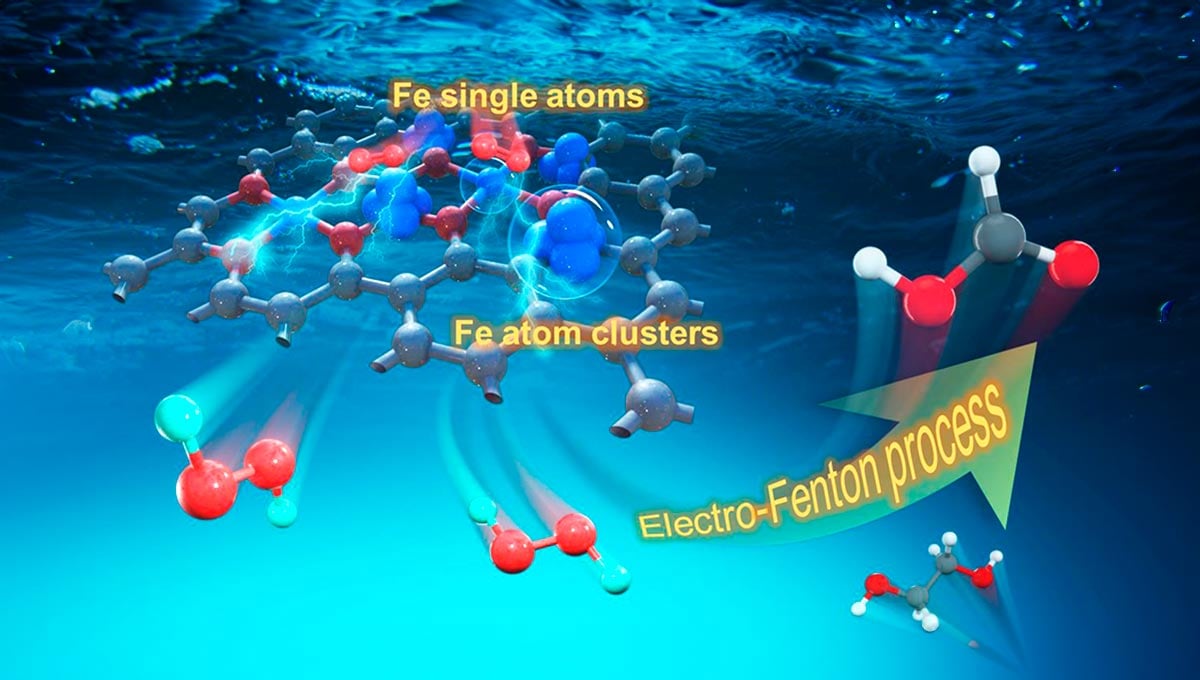
    New Approach Developed for Electrocatalytic H2O2 Production and Biomass Upgrading. Credit: Hui Xu

    Chinese scientists have created a new electrocatalyst with oxygen-coordinated Fe atoms, significantly improving H2O2 production and biomass upgrading. This catalyst marks a significant step in sustainable chemical synthesis.

    Scientists from Hefei Institutes of Physical Science (HFIPS) of Chinese Academy of Sciences (CAS) have synthesized an oxygen-coordinated Fe single atoms and atom clusters catalyst, manifesting superior electrocatalytic performance toward H2O2 production and biomass upgrading.

    The Significance of H2O2 and Electrocatalysis

    Hydrogen peroxide (H2O2) is a widely used chemical with applications in diverse fields such as environment, energy, and healthcare. While traditionally manufactured through energy-intensive processes, electrocatalytic synthesis offers a greener and more efficient method using water and oxygen. However, this approach requires advanced electrocatalysts for high yield and selective H2O2 production, and further attention is needed for utilizing the generated H2O2, particularly in electrochemical organic oxidation processes. This presents significant potential for value-added applications beyond environmental remediation.
    New Approach Developed for Electrocatalytic H2O2 Production and Biomass Upgrading

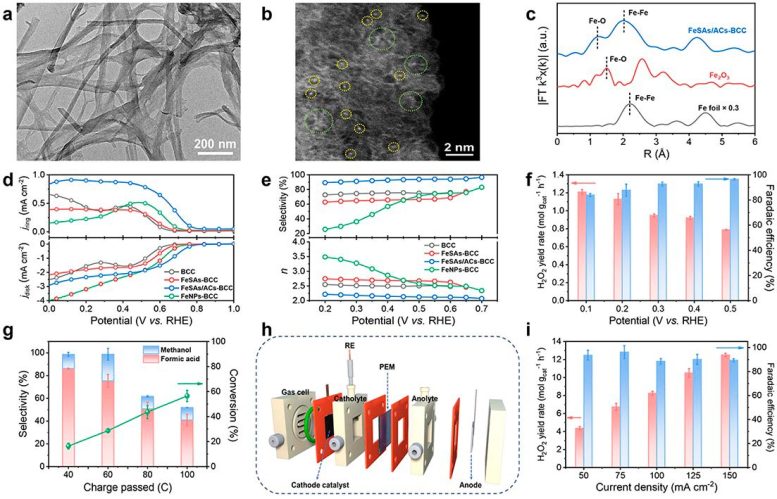
    Characterizations, electrochemical H2O2 synthesis performance and coupled electro-Fenton process of FeSAs/ACs-BCC. Credit: Hui Xu

    Innovative Catalyst Development Process

    In this study, the scientists utilized bacterial cellulose as the adsorption regulator and carbon source in combination with a multi-step approach involving wet-chemistry impregnation, pyrolysis, and acid-etching processes to create a catalyst termed FeSAs/ACs-BCC, consisting of oxygen-coordinated Fe single atoms and atom clusters. The presence of both Fe single atoms and clusters was confirmed using advanced imaging techniques such as aberration-corrected scanning transmission electron microscopy. Also, the atomic structure of Fe was determined using X-ray fine structure absorption spectroscopy and X-ray photoelectron spectroscopy.

    Exceptional Performance in Electrocatalysis

    This catalyst demonstrated outstanding electrocatalytic performance and selectivity for the 2-electron oxygen reduction reaction (2e ORR) under alkaline conditions. Further H-cell experiments confirmed the accumulation of H2O2 in the electrolyte.

    Innovations in Biomass Upgrading

    Researchers successfully coupled the in situ generated H2O2 with the electro-Fenton process using ethylene glycol as the reactant and acidified 0.1M Na2SO4 as the electrolyte. This led to a high rate of ethylene glycol conversion and high selectivity for formic acid, showing that the electro-Fenton process has the potential to improve biomass-derived feedstocks through oxidative upgrading.

    Aside from that, they developed a three-phase flow cell based on the gas diffusion electrode to further enhance the H2O2 yield.

    Insights from Density Functional Theory

    Density functional theory analyses indicated that the actual catalytically active sites in the 2e ORR process were the Fe clusters, and the electronic interaction between Fe single atoms and Fe clusters could significantly enhance the electrocatalytic performance toward 2e ORR.

    Implications for Future Catalyst Design

    This study is instrumental in the design and development of atomic-level electrocatalysts. These catalysts are essential for high-efficiency 2e ORR to H2O2 and biomass upgrading.

    Reference: “Atomically Dispersed Iron Regulating Electronic Structure of Iron Atom Clusters for Electrocatalytic H2O2 Production and Biomass Upgrading” by Hui Xu, Shengbo Zhang, Xinyuan Zhang, Min Xu, Miaomiao Han, Li Rong Zheng, Yunxia Zhang, Guozhong Wang, Haimin Zhang and Huijun Zhao, 09 November 2023, Angewandte Chemie International Edition.
    DOI: 10.1002/anie.202314414


    [ad_2]

    Source link
  • MoS2 Reimagined: Scientists Unveil Electronic Secrets

    MoS2 Reimagined: Scientists Unveil Electronic Secrets

    [ad_1]

    MoS2 Lattice Structure

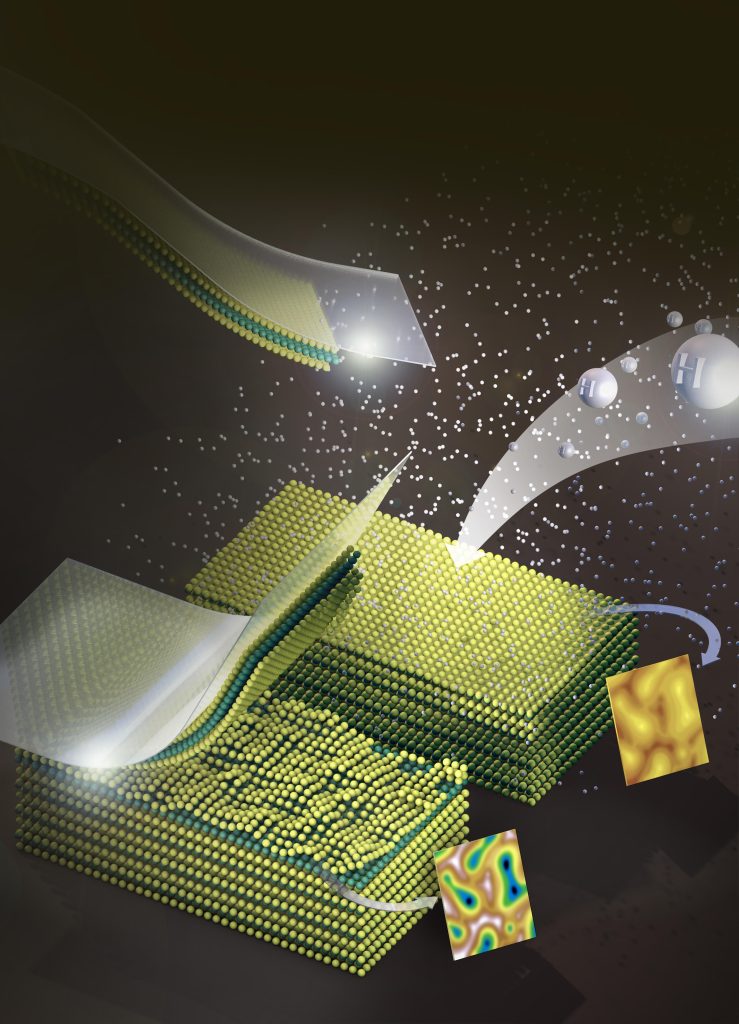
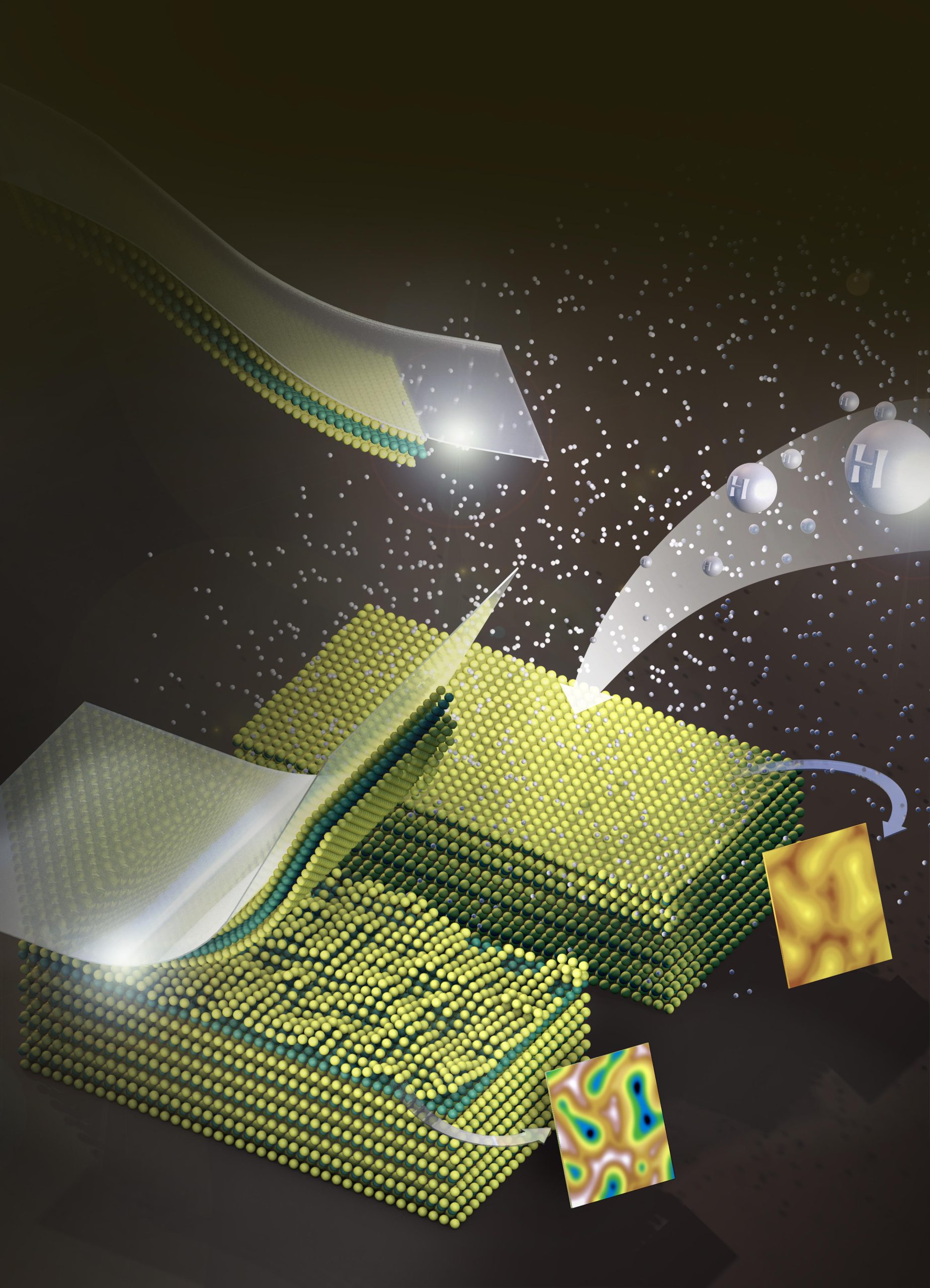
    The illustration shows the MoS2 lattice structure (green: Mo, yellow: S). The material after cleaving is shown in the forefront, the surface is jagged, and the measured surface electronic structure is inhomogeneous (coloured map). In the back is the cleaved material after exposure to atomic hydrogen (represented by the white balls). The measured surface electronic structure, shown in the map, is more homogenous. Credit: Martin Künsting / HZB

    Molybdenum disulfide (MoS₂) is an extremely adaptable substance with applications ranging from gas sensing to serving as a photocatalyst in the production of green hydrogen. Typically, the study of a material begins with its bulk crystalline form. However, in the case of MoS₂, the focus has been more on exploring its mono and few-layer nanosheets.

    The few studies conducted thus far show diverse and irreproducible results for the electronic properties of cleaved bulk MoS₂ surfaces, highlighting the need for a more systematic study, which has been done now at the light source BESSY II.

    Systematic Study at BESSY II

    Dr. Erika Giangrisostomi and her team at HZB carried such a systematic study at the LowDosePES end-station of the BESSY II light source. They utilized X-ray photoelectron spectroscopy technique to map the core-level electron energies across extensive surface areas of MoS2 samples.

    Using this method, they were able to monitor the changes in the surface electronic properties after in-situ ultra-high-vacuum cleaving, annealing, and exposure to atomic and molecular hydrogen.

    Key Findings and Implications

    The results from this study point to two main findings. Firstly, the study unambiguously reveals sizeable variations and instabilities in electron energies for the freshly cleaved surfaces, demonstrating how easy it is to come to diverse and irreproducible outcomes.

    Secondly, the study shows that room-temperature atomic hydrogen treatment is remarkably effective in neutralizing the surface electronic inhomogeneity and instability. This is rationalized by the ability of hydrogen atoms to either accept or give away an electron and calls for further characterizations of the functional properties of the hydrogenated material.

    “We hypothesize that atomic hydrogen helps to rearrange sulfur vacancies and excess of sulfur atoms yielding a more ordered structure”. Erika Giangrisostomi says.

    This study marks a fundamental step in the investigation of MoS2. Due to the extensive use of MoS2 in all kinds of applications, the findings of this research have the potential to reach a wide audience in the fields of electronics, photonics, sensors, and catalysis.

    Reference: “Inhomogeneity of Cleaved Bulk MoS2 and Compensation of Its Charge Imbalances by Room-Temperature Hydrogen Treatment” by Erika Giangrisostomi, Ruslan Ovsyannikov, Robert Haverkamp, Nomi L. A. N. Sorgenfrei, Stefan Neppl, Hikmet Sezen, Fredrik O. L. Johansson, Svante Svensson and Alexander Föhlisch, 31 August 2023, Advanced Materials Interfaces.
    DOI: 10.1002/admi.202300392


    [ad_2]

    Source link

  • How Electrochemistry Is Winning the Green Game

    How Electrochemistry Is Winning the Green Game

    [ad_1]

    Electrochemical Reactions Advancing Green Transition

    Advanced research in electrochemistry at the University of Jyväskylä has revealed how various factors, especially electrolyte ions, impact electrochemical reactions. This work, combining theoretical and experimental approaches, contributes to the development of efficient fuel cells and carbon-neutral energy solutions.

    New research on electrochemical reactions highlights the critical role of electrolyte ions, aiding in the advancement of sustainable energy technologies.

    Electrochemical reactions are central to the green transition. These reactions use the electric current and potential difference to carry out chemical reactions, which enables binding and realizing electric energy from chemical bonds. This chemistry is the basis for several applications, such as hydrogen technology, batteries, and various aspects of circular economy.

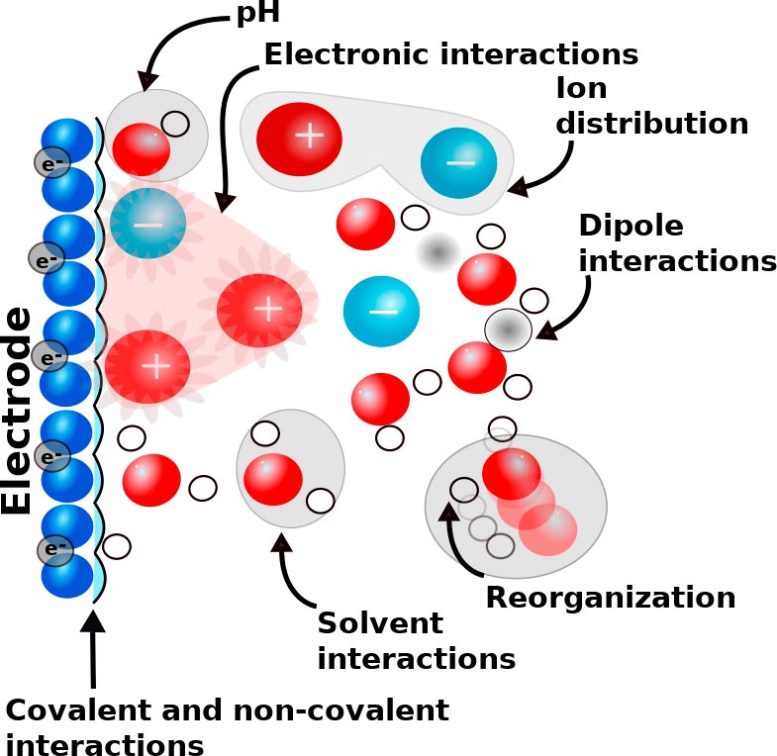
    Developments and improvement in these technologies require detailed insight into the electrochemical reactions and different factors impacting them. Recent studies have shown that besides the electrode material also the used solvent, its acidity, and the used electrolyte ions crucially impact the efficiency of electrochemical reactions. Therefore, recent focus has shifted to studying how the electrochemical interfaces, i.e. the reaction environment at the electrode and the electrolyte interface shown in Figure 1, impact the outcome of electrochemical reactions.

    Electrochemical Interface Reaction Environment

    Figure 1. The electrochemical interface is a very complex reaction environment where several interactions and processes contribute to a chemical reaction. Credit: Marko Melander

    Converting Carbon Dioxide

    However, understanding the interfacial chemistry using only experimental methods is extremely difficult since they are very thin, only a fraction of a nanometer. Computational and theoretical are therefore crucial as they provide an accurate way to study the electrochemical interfaces at the atomic level and as a function of time. The long-term method and theory development at the Department of Chemistry of the University of Jyväskylä (Finland) has provided new understanding on the chemistry of electrochemical interfaces, in particular on the electrolyte ion effects.

    “Our two recent research articles have focused on the electrolyte ion effects in the oxygen and carbon dioxide reduction reactions, which determine the efficiency of fuel cells, hydrogen peroxide synthesis, and conversion of carbon dioxide to carbon-neutral chemical and fuels,” tells the Academy of Finland Research Fellow Marko Melander from Department of Chemistry of the University of Jyväskylä.

    Combining Experimental and Computational Results

    Researchers at University of Jyväskylä have been collaborating with both experimental and computational groups to understand the electrolyte effects. The work has been recently published in renowned journals, Nature Communications and Angewandte Chemie International Edition.

    Platinum Water Interface

    Figure 2. An oxygen molecule (pink) binds to a potassium ion (green) at the platinum-water interface. Credit: Marko Melander

    “In both studies we have focused on the fundamental properties and research, which has necessitated use of highly accurate and demanding experimental, and their combination with the latest simulation methods. For instance, we were able, for the first time, to combine experiments and simulations of quantum mechanical kinetic isotope effects of hydrogen to understand the oxygen reduction reaction. We also developed and applied advanced computational methods to simulate the reorganization of the aqueous electrolyte solutions to reach detailed insight on their joint effect on the reaction mechanism,” elucidates Melander.

    Advancing Knowledge in Electrochemical Science

    This research provides an atomistic picture on how electrolytes impact electrochemical reactions. One of the identified mechanisms is the bond formation between an ion and the reacting molecule, as shown in Figure 2.

    “We were able to show that both the ions control the structure and dynamics of both the electrode surface and the interfacial water through non-covalent interactions. These rather weak interactions then determine the reaction pathway, rate, and selectivity, and hence control the activity and outcome of electrochemical reactions,” explains Melander.

    Implications for Renewable Energy Development

    While this research focused on the fundamental aspects of electrochemical systems, it can enhance the development of improved electrochemical technologies.

    “Utilizing ion and solvent effects may provide a way to tailor the reactivity and selectivity of electrochemical reactions. For instance, the electrolyte can be used to direct the oxygen reduction reaction either towards fuel cell or hydrogen peroxide synthesis applications. The electrolyte chemistry is also an effective way to steer the carbon dioxide reduction towards the wanted, valuable products,” says Melander.

    References:

    “Cation-induced changes in the inner- and outer-sphere mechanisms of electrocatalytic CO2 reduction” by Xueping Qin, Heine A. Hansen, Karoliina Honkala and Marko M. Melander, 22 November 2023, Nature Communications.
    DOI: 10.1038/s41467-023-43300-4

    “Cations Determine the Mechanism and Selectivity of Alkaline Oxygen Reduction Reaction on Pt(111)** ” by Tomoaki Kumeda, Laura Laverdure, Karoliina Honkala, Marko M. Melander and Ken Sakaushi, 20 November 2023, Angewandte Chemie International Edition.
    DOI: 10.1002/anie.202312841


    [ad_2]

    Source link