Tag: Exercise

  • Study reports rising rates of craniofacial injuries related to exercise and weightlifting

    Study reports rising rates of craniofacial injuries related to exercise and weightlifting

    [ad_1]

    Numbers of craniofacial injuries related to exercise and weightlifting have increased sharply over the past decade, reports a study in The Journal of Craniofacial Surgery. The journal is published in the Lippincott portfolio by Wolters Kluwer. 

    Incidence of craniofacial injury significantly increased between 2013 and 2022, illuminating the need for better education and risk mitigation strategies,” according to the new research by Rohan Mangal, MSc, and colleagues of University of Miami. Rates of exercise-related head and facial injuries appear higher for men than women, and for adolescents and young adults compared to older age groups. 

    Increasing incidence of exercise-related head and face injuries 

    Using the Consumer Product Safety Commission’s National Electronic Injury Surveillance System, the researchers identified US emergency department visits for craniofacial injuries related to “exercise and equipment.” The data included a total of 582,972 such injuries occurring between 2013 and 2022. 

    Over this ten-year period, the annual incidence rate of exercise- and weightlifting-related head and facial injuries increased by 32.7%. While most injuries occurred in men (55.7%), the increase in incidence was nearly twice as high in women (44.5% versus 24.2%). 

    On analysis by age, adolescents aged 15 to 19 had the highest rate of craniofacial injuries: 9.9%. This figure decreased gradually until age 40 to 44 years, then increased again up to age 65 to 69 years. Head injuries were the most common type of exercise- and weightlifting-related injuries (45%), followed by injuries to the face (26%) and neck (21%). Other injury categories included mouth, eye, and ear injuries (less than 5% each). 

    Increased craniofacial injuries may reflect rise in gym membership 

    Internal injuries (25.2%) and lacerations (24.8%) were the most common types of injuries. Other diagnoses included contusions or abrasions (12.9%) and strains or sprains (11.9%). Only 8.5% of patients were hospitalized, mainly due to internal organ injuries or fractures. For patients with internal injuries to the head, hospital admission rates were higher (15% to 20%). 

    Studies of injuries related to exercise and weightlifting have focused on other areas such as the limbs and lower back, while craniofacial injuries have been “insufficiently characterized,” according to the authors. Citing a recent report that 22% of people in the United States have a fitness club membership, the researchers estimate that such injuries occur in about 1 out of every 1,264 gym-goers per year. 

    The higher rate of exercise- and weightlifting-related craniofacial injuries in men may reflect social pressures to exercise or lift weights beyond their capacity – sometimes called “ego lifting.” A similar inclination to exercise at high intensity may contribute to the higher injury rates in adolescents and young adults. 

    The researchers note some key limitations of their study – including a lack of specific information on how the injuries occurred. Since the analysis included only injuries leading to emergency department visits, the total number of injuries is “likely underreported.” 

    The authors discuss “safe exercise practices” that may help to reduce the rates of exercise-related craniofacial injuries, including training in proper technique, certain types of external safeguards at health clubs, and exercise supervision by gym staff. Mr. Mangal and coauthors conclude: “While exercise and weightlifting-related craniofacial injuries are impossible to avoid altogether, knowledge of their current trends allows for targeted prevention strategies for vulnerable subgroups.” 

    The Journal of Craniofacial Surgery, under the editorship of Mutaz B. Habal MD, FRCSC, FICS, FACS, is rated 23 out of 600 surgical journals worldwide. Dr. Habal works with an outstanding editorial board and top global medical organizations to prepare a premiere scholarly journal for the global community. 

    Source:

    Journal reference:

    Mangal, R., et al. (2024). Epidemiology of Craniofacial Injuries from Exercise and Weightlifting: A 10-Year Analysis. Journal of Craniofacial Surgery. doi.org/10.1097/SCS.0000000000009975.

    [ad_2]

    Source link

  • Metformin boosts appetite-suppressing metabolite, new study finds

    Metformin boosts appetite-suppressing metabolite, new study finds

    [ad_1]

    A recent study published in the journal Nature Metabolism showed that metformin treatment significantly increases blood levels of N-lactoyl phenylalanine (Lac-Phe), an appetite-suppressing metabolite.

    Metformin, used for type 2 diabetes (T2D) treatment, reduces blood glucose and suppresses appetite. It is prescribed to more than 150 million individuals worldwide. However, the mechanisms of its therapeutic effects are not fully understood. It inhibits complex 1 of the electron transport chain at higher levels. Nevertheless, it is uncertain whether physiological levels of metformin are sufficient for complex 1 inhibition.

    Lac-Phe is a metabolite produced by carnosine dipeptidase 2 and has been reported as an appetite suppressant in obese mice. Lac-Phe correlates with weight loss in humans with regular exercise. It also increases in mitochondrial disease and phenylketonuria. Nonetheless, whether Lac-Phe has a role in the appetite-suppressing activity of metformin has not been explored.

    Study: Metformin and feeding increase levels of the appetite-suppressing metabolite Lac-Phe in humans. Image Credit: LuchschenF / ShutterstockStudy: Metformin and feeding increase levels of the appetite-suppressing metabolite Lac-Phe in humans. Image Credit: LuchschenF / Shutterstock

    The study and findings

    In the present study, researchers reported significant increases in Lac-Phe levels following metformin treatment. The study was conducted between August and December 2019 at Brigham and Women’s Hospital. Thirty-three volunteers who were 1) lean without T2D, 2) lean and prediabetic, 3) obese and prediabetic, 4) obese without T2D, or 5) obese with T2D were recruited.

    Diabetes was primarily managed with metformin, albeit some participants also received insulin. The team collected sera from participants and performed untargeted metabolomic profiling. This showed notable increases in all N-lactoyl amino acids in the obese T2D group relative to obese participants without T2D. These elevations were not related to body mass index (BMI) but to T2D.

    Moreover, Lac-Phe levels were 5.7 times higher in obese T2D subjects than in obese non-T2D volunteers. In addition, these increases were also significant compared to prediabetic individuals. Notably, Lac-Phe levels correlated with the concentrations of other N-lactoyl amino acids. Next, the team analyzed the metabolomic data from the TwinsUK cohort.

    Lac-Phe levels in this cohort were elevated in individuals with T2D. Further, there was a robust correlation between metformin and Lac-Phe levels among T2D patients in the Brigham cohort. Notably, while metformin use was a criterion for inclusion, one volunteer lacked detectable metformin levels and had the lowest Lac-Phe levels; the volunteer discontinued metformin.

    As such, the team speculated that metformin may elevate serum levels of Lac-Phe in individuals with T2D rather than T2D. This hypothesis was tested using the TwinsUK dataset; each participant had three samples collected during 1997-2012, a period when the role of metformin in T2D was growing considerably.

    This enabled analyses of the Lac-Phe trajectories in participants whose metformin and T2D status changed with time. The researchers noted that metformin treatment significantly increased Lac-Phe levels in individuals newly diagnosed with T2D. By contrast, for newly diagnosed diabetic individuals without metformin therapy, there were no significant changes in Lac-Phe levels.

    In participants who consistently had diabetes over successive sampling, metformin use caused substantial increases in Lac-Phe levels. On the other hand, those who did not receive metformin lacked significant changes in Lac-Phe levels. Further, the team analyzed two interventional studies from Denmark and Jordan to establish a causal link between metformin use and increases in Lac-Phe levels.

    In the Danish study, significant increases in N-lactoyl amino acids were evident following a 12-week metformin intervention in non-T2D and T2D groups. The Jordanian study reported rapid increases in Lac-Phe levels over 36 hours after a single metformin dose, and the peak Lac-Phe concentration corresponded to the maximum metformin concentration.

    Within the TwinsUK dataset, Lac-Phe levels correlated highly with the non-fasted state. As such, the researchers speculated whether metformin-related increases in Lac-Phe were influenced by feeding or fasting state. They observed a trend of higher Lac-Phe levels in the fed state. Moreover, while individuals not receiving metformin had lower Lac-Phe levels, Lac-Phe was significantly increased in fed subjects.

    Conclusions

    Taken together, the study highlighted that metformin elevates Lac-Phe levels. These increases were specific to metformin rather than T2D status and were evident in T2D subjects and healthy individuals. Further, Lac-Phe levels increase postprandially, paralleling other appetite suppressants’ patterns. Thus, pharmacological targeting of Lac-Phe could result in a more robust appetite-suppressing effect, leading to a new class of drugs for obesity.

    [ad_2]

    Source link

  • Common cranberry can help improve performance of competitive athletes

    Common cranberry can help improve performance of competitive athletes

    [ad_1]

    Competitive athletes are always looking for an extra edge that can help them improve performance. According to a new study by Concordia researchers published in the journal Physical Activity and Nutrition, they can find one in the common cranberry.

    In a series of trials involving trained distance runners, the researchers found that ingesting a cranberry supplement for 28 consecutive days led to noticeable improvements in both performance and muscle fatigue following 1,500-metre time trials. Reoxygenation rates were faster and running speeds improved by 1.5 per cent.

    When it comes to elite athletes, any advantage can make the difference between finishing fifth or on the podium.”


    Andreas Bergdahl, Associate Professor in the Department of Health, Kinesiology and Applied Physiology and the paper’s senior author

    Effects of different energy systems

    The researchers recruited 14 high-level runners from Concordia’s varsity track and field team and from two Montreal running clubs, who are performing at least five hours of endurance training a week.

    The athletes ran two time trials over three separate visits, one a 1,500-metre, the other a 400-metre. The first visit was used as a baseline. At the second, they were given a single large dose of cranberry extract two hours before running. The athletes were then instructed to consume a small dose of cranberry extract daily for 28 days, after which they repeated the runs for a third time.

    “We selected these distances to test the effects the cranberry extract had on different energy systems,” says Francis Parenteau, a PhD candidate and the paper’s lead author. “The 400-metre is shorter and of higher intensity and involves the anaerobic system. The 1,500-metre uses the aerobic system but is shorter than what the athletes usually run. Since they do not train to run that distance, we were able to isolate training effects as a variable.”

    Besides their running time, the researchers measured their post-exercise blood lactate, a marker for potential muscle fatigue and lack of oxygen. They also attached a portable near-infrared spectroscopy device to the runners to measure muscle oxygenation levels before, during and after their runs.

    Following data analysis, the researchers found that 28 days of cranberry extract consumption demonstrated a trend toward increased speed in the 1,500-metre time trial but not in the 400-metre. However, they did notice that lactate buildup was reduced following the 400-metre but not the 1,500-metre compared to baseline.

    The data also indicated that the cranberry extract promoted better oxygen extraction by the muscle, improved lactate clearance and slower muscle deoxygenation.

    A runner’s best friend, made in Quebec

    Cranberries are extraordinarily rich in polyphenols, a natural compound with antioxidant properties. These characteristics help protect the body from the harmful effects of free radical molecules produced by strenuous exercise.

    Cranberries are also indigenous to and a major industrial crop for Quebec. The province produces roughly 60 per cent of Canada’s cranberry yield, according to Statistics Canada.

    “The beauty of this is that it is all natural,” says Bergdahl. “It is an ergogenic aid, meaning that it is performance-enhancing, but it is not an anabolic steroid. Athletes can get this important boost in their performance just by consuming more cranberries.”

    Source:

    Journal reference:

    Parenteau, F., et al. (2023). Cranberry supplementation improves physiological markers of performance in trained runners. Physical Activity and Nutrition. doi.org/10.20463/pan.2023.0032.

    [ad_2]

    Source link

  • Review suggests the middle-aged brain could provide a window into future cognitive health

    Review suggests the middle-aged brain could provide a window into future cognitive health

    [ad_1]

    The middle-aged brain could provide a window into future cognitive health, researchers write in a review publishing March 19 in the journal Trends in Neurosciences. The team reviewed evidence from human and animal studies suggesting that middle age-;commonly considered as the period between 40 and 60 or 65 years of age-;marks a shift in brain aging. They argue that more research should be dedicated to middle age, a period of life that is historically understudied.

    Middle age is associated with specific and modifiable risk factors for future dementia risk,” write the authors, who include neuroscientist Yvonne Nolan (@yvonnemnolan) of APC Microbiome Ireland at University College Cork. “We encourage giving this previously understudied period of life renewed consideration.”

    Most studies of brain health and cognitive decline focus on older age groups, but by this time, interventions may have limited efficacy. Screening for risk of future cognitive decline could help by allowing treatment to begin earlier when it might be more effective. A better understanding of brain shifts during middle age might also help identify novel targets for therapy, the researchers say.

    During middle age, the brain undergoes significant molecular, cellular, and structural changes, and many of these changes have been linked to cognitive decline, which has also been shown to accelerate during middle age.

    There is good evidence to suggest that the human brain undergoes non-linear structural and functional changes during middle age that have implications for cognitive functioning, and variation in these processes could account for individual trajectories in cognitive aging,” the authors write.

    Structurally, middle age is associated with changes in the volume of several brain structures, shrinking of the hippocampus (a brain structure involved in memory and learning), and decreased connectivity between different parts of the brain.

    The fourth and fifth decades of life may be a turning point in the organization of brain networks, characterized by optimal efficiency, system segregation, and modularity, followed by accelerated decay of these properties,” the authors write.

    Middle age is also associated with changes in gene expression, both within the brain and in other parts of the body. In the human brain, studies show increased expression of immune-related genes and decreased expression of synaptic genes. The authors also point to evidence suggesting that changes in other parts of the body may predict brain health and function.

    “Factors in systemic circulation-;mainly proteins secreted by various organs-;are understood to mediate brain aging in terms of cognition, plasticity, adult neurogenesis, and neuroinflammation,” the authors write. “Some of the largest peaks of change across the entire adult lifespan occur during middle age, as measured in plasma, peripheral blood monocytes, and muscle.

    There is some evidence that exercise might aid healthy cognitive aging, but more research is needed. “Studying the intersection of aging- and exercise-related molecular processes could unveil new therapeutic targets,” the authors write.

    Further research is also needed to investigate observed sex differences in brain aging, as evident in the higher rate of dementia in women, the researchers say. They also note that it will be important for future studies to differentiate processes that cause declining brain health from biomarkers that reflect compensatory mechanisms.

    Ultimately, scientists will want to find novel therapeutic targets to mitigate unhealthy cognitive aging,” the authors write. “We argue that applying recent trends in aging research to this period of life could reveal novel biomarkers and possible interventions to combat cognitive decline in an increasingly older global population.”

    This research was supported by the Science Foundation Ireland, the Irish Health Research Board, and Alzheimer Nederland.

    Source:

    Journal reference:

    Dohm-Hansen, S., et al. (2024) The ‘middle-aging’ brain. Trends in Neurosciences. doi.org/10.1016/j.tins.2024.02.001.

    [ad_2]

    Source link

  • A call for targeted research and therapies

    A call for targeted research and therapies

    [ad_1]

    In a recent review published in the journal Cell Metabolism, researchers elucidated mechanisms and evaluated therapies for impaired skeletal muscle regeneration in diabetes, identifying research gaps and future directions.

    Study: Impaired skeletal muscle regeneration in diabetes: From cellular and molecular mechanisms to novel treatments. Image Credit: Crevis / ShutterstockStudy: Impaired skeletal muscle regeneration in diabetes: From cellular and molecular mechanisms to novel treatments. Image Credit: Crevis / Shutterstock

    Background 

    Diabetes, a growing public health issue, continues to surge despite extensive research and healthcare efforts. It leads to various forms of diabetic myopathy, irrespective of its type, causing a decline in skeletal muscle mass and function. This decline not only worsens obesity and hyperglycemia but also affects locomotion, energy metabolism, and glucose regulation, further deteriorating muscle structure and function. Additionally, diabetes impairs muscle regeneration, potentially worsening conditions like ischemia and foot ulcers by promoting fibrosis and hindering myofiber recovery. Further research is needed to better understand and develop targeted interventions for the complex mechanisms underlying impaired muscle regeneration in diabetes.

    Skeletal muscle abnormalities in diabetes

    Diabetes, alongside its comorbidities like obesity, hypertension, and dyslipidemia, significantly affects skeletal muscle structure, function, and metabolism. The complex nature of diabetes complicates the identification of effective therapeutic targets. Other contributing factors include aging, inactivity, and poor nutrition. Key observed abnormalities in diabetic patients include reduced muscle mass and strength, abnormal lipid deposition, fiber atrophy, and altered myokine secretion, contributing to decreased functional capacity and quality of life.

    Diabetes not only leads to muscle degeneration but also impairs the muscle’s ability to regenerate, complicating injuries such as ischemia and foot ulcers. The regeneration process, involving both muscle stem cells (MuSCs) and non-MuSCs, is hampered, as indicated by excessive fibrosis and delayed myofiber maturation.

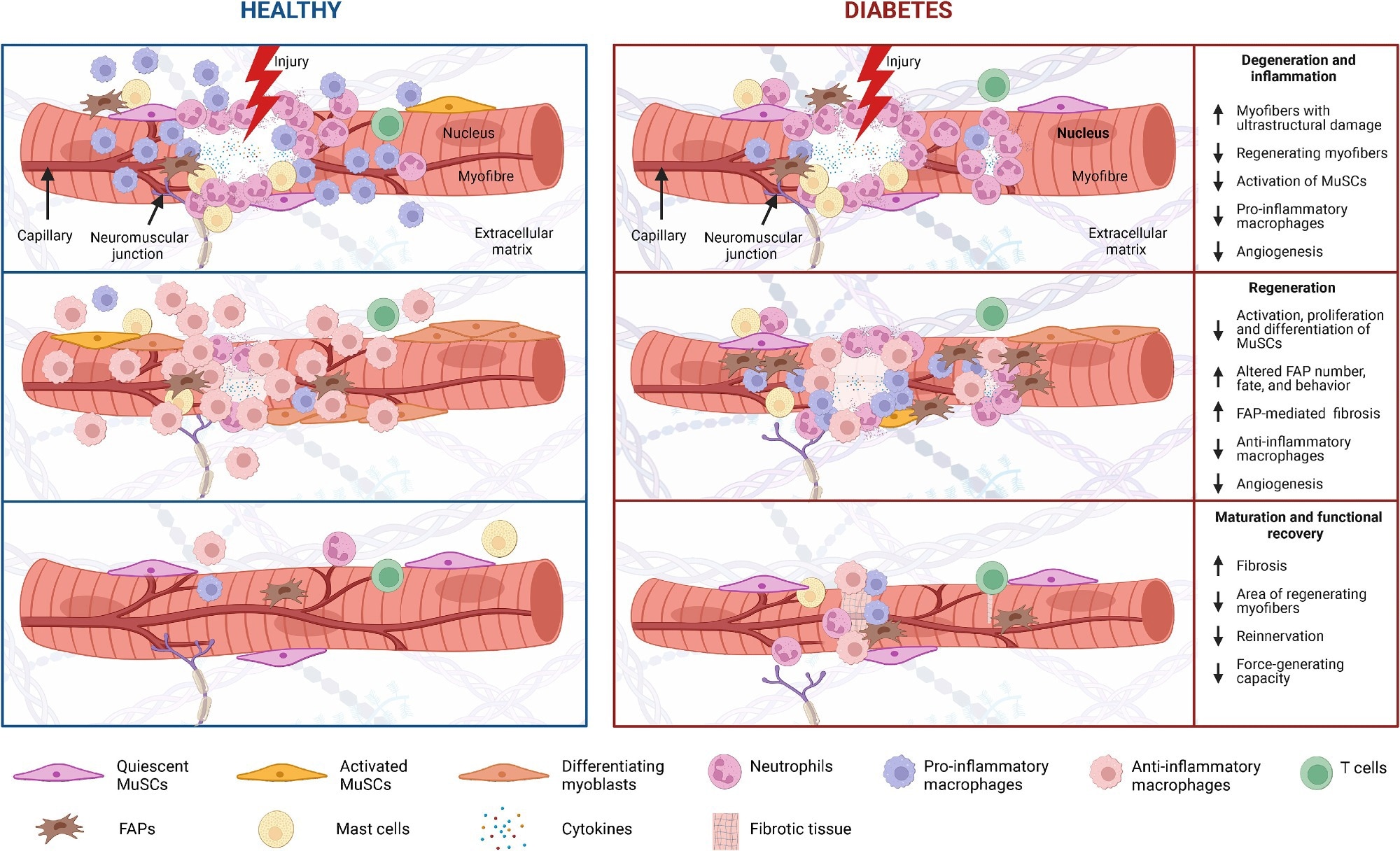
    Skeletal muscle regeneration in diabetes Diabetes and its associated complications, including obesity and hyperglycemia, impact multiple cell populations (MuSCs, neutrophils, macrophages, T cells, FAPs, and mast cells) that play a vital role in the process of muscle regeneration (i.e., degeneration and inflammation, regeneration, and maturation and functional recovery).

    Skeletal muscle regeneration in diabetes Diabetes and its associated complications, including obesity and hyperglycemia, impact multiple cell populations (MuSCs, neutrophils, macrophages, T cells, FAPs, and mast cells) that play a vital role in the process of muscle regeneration (i.e., degeneration and inflammation, regeneration, and maturation and functional recovery).

    Degeneration and inflammation

    Muscle injuries trigger necrosis and inflammation, marked by fiber breakdown and protein leakage into the serum. The process, essential for tissue repair, draws in immune cells like neutrophils and macrophages. Diabetes compounds this degeneration, amplifying damage, and hampering regeneration, highlighting the metabolic impact on muscle recovery.

    Regeneration process

    Diabetes negatively impacts the muscle regeneration process, notably affecting the activation, proliferation, and differentiation of MuSCs and the roles of fibro-adipogenic progenitors (FAPs). Treatments like metformin offer some hope by potentially modifying FAP activity. However, delayed regeneration in diabetic models underlines the urgent need for deeper insights into how diabetes disrupts muscle repair mechanisms.

    Challenges in muscle recovery

    Efficient muscle regeneration requires not only the formation of new myofibers but also the reconstitution of the extracellular matrix, vascular network, and innervation. Diabetes and obesity complicate this process, showing delayed functional recovery, increased collagen accumulation, and impaired neuromuscular junction adaptations.

    Diabetic impacts on muscle fiber and insulin signaling

    Diabetes shifts muscle fiber composition towards type II fibers, which are more prone to damage and impair regeneration. Insulin resistance disrupts muscle cell growth pathways, while hyperinsulinemia and lipotoxicity inhibit crucial recovery processes like autophagy and protein metabolism. These changes suggest that targeting fiber-type transitions and improving insulin signaling could enhance muscle regeneration in diabetes.

    Diabetic challenges in muscle regeneration signaling

    Diabetes triggers elevated pro-inflammatory cytokines and oxidative stress, disrupting muscle repair by inhibiting growth pathways and promoting protein breakdown. Concurrently, increased myostatin levels and NOTCH and WNT signaling alterations impair muscle cell proliferation and differentiation. Moreover, the compromised Adenosine Monophosphate-Activated Protein Kinase (AMPK) signaling pathway further hinders MuSC function and regeneration, highlighting complex challenges in diabetic muscle repair.

    Disentangling diabetes and comorbidity effects on muscle regeneration

    Diabetes significantly impairs muscle regeneration, but pinpointing whether diabetes itself or related comorbidities such as obesity and sarcopenia are responsible remains challenging. Muscle health is influenced by a number of factors, including genetics, diet, and physical activity, complicating the isolation of diabetes’ direct effects. Studies often struggle to establish control groups that adequately account for these variables, leading to ambiguity about the specific impacts of diabetes versus other conditions. For instance, research using obese diabetic mice versus lean controls has difficulty distinguishing whether observed effects are due to obesity or diabetes itself. 

    Challenges in research models and therapeutic approaches

    There is no definitive animal model for studying diabetes’ impact on muscle regeneration, complicating the translation of findings to humans. Treatments for muscle regeneration in diabetes are varied, spanning from exercise and dietary supplements to advanced cell therapies, yet their effectiveness often falls short in addressing muscle fibrosis. Despite the promise shown by certain therapies in improving muscle health in diabetes, rigorous clinical trials are needed to assess their true efficacy in muscle regeneration, specifically within diabetic populations.

    Future directions in muscle regeneration research

    Addressing these gaps requires a multifaceted approach. Research must refine its models and control groups to isolate the effects of diabetes from those of comorbidities and lifestyle factors. Advanced genetic and omics technologies offer new avenues to uncover the intricate mechanisms at play in diabetic muscle regeneration. Furthermore, integrating therapies such as exercise, dietary interventions, and possibly cell therapies may hold the key to enhancing muscle repair in diabetic patients. However, more research is essential to navigate the complexities of muscle regeneration in diabetes and develop effective treatments.

    [ad_2]

    Source link

  • The efficacy of the Mediterranean diet on health outcomes in adults with cancer

    The efficacy of the Mediterranean diet on health outcomes in adults with cancer

    [ad_1]

    Cancer treatment is often associated with undue weight gain, mostly due to fat deposition. The Mediterranean diet (MED diet) may help support such patients during this period. A new study published in the European Journal of Clinical Nutrition explores the safety and benefits of this diet in adults with cancer, in addition to its feasibility in this population.

    Study: Mediterranean-style dietary interventions in adults with cancer: a systematic review of the methodological approaches, feasibility, and preliminary efficacy. Image Credit: Marian Weyo/Shutterstock.com
    Study: Mediterranean-style dietary interventions in adults with cancer: a systematic review of the methodological approaches, feasibility, and preliminary efficacy. Image Credit: Marian Weyo/Shutterstock.com

    Background

    Almost 20 million people today have received a cancer diagnosis, making it the leading cause of illness and death globally. The treatment of cancer is also associated with multiple adverse effects that cause rapid aging, trigger chronic metabolic aberrations, and reduce the quality of life.

    These side effects include early menopause, cognitive impairment, and cardiomyopathy, with persistent fatigue and weight loss. Such long-term ill effects could be mitigated by nutrition and exercise. Yet, there is little evidence to support the right nutritional pattern for such issues arising during or after cancer treatment.

    About the Mediterranean diet

    The MED diet has been long recognized as among the healthiest eating patterns. Compliance with this diet has been associated with reduced risk of many chronic illnesses, including type 2 diabetes and cardiovascular harm.

    This dietary pattern is characterized by a high consumption of fish, vegetables, legumes, nuts, fruits, and extra virgin olive oil, a moderate intake of dairy and red wine, with little added sugar, processed foods, and red meat. The antioxidant and anti-inflammatory profile of this diet have been thought to mediate its beneficial effects on cardiac and metabolic health.

    Previous evidence indicates that those on a MED diet have 22% and 13% lower odds of dying from prostate and breast cancer, respectively. This is very significant since the hormone treatment typically used in these cancers adversely affects the metabolic and body composition profile, increasing the risk of cardiometabolic disease.

    This group of patients has been shown to benefit from nutritional manipulation with exercise by reducing body fat and body weight. Yet, there is little systematic evidence to support the recommendation of a MED diet for adults with cancer. This prompted the current study.

    About the study

    A systematic review was undertaken, including 15 articles covering the MED diet intervention among this group of patients. Of these, ten included breast cancer patients, all women, and one mostly female breast cancer patients. The remaining included prostate cancer, acute myeloid leukemia, and lung cancer.

    In five of the studies, patients were being actively treated, while five were post-treatment studies. Three included patients who either had been or were being treated, with one starting within five years from the diagnosis.

    In most studies, the aim was to lose weight, but a few were aimed at lessening fatigue, reducing inflammatory mediator levels, enhancing the diet, or maintaining a stable weight. Energy restrictions at varying levels were applied for those who were obese or overweight. Others used strategies such as reduced portion size or consuming more satiating foods.

    What changes were observed?

    Most participants adhered closely to the MED diet compared to controls, at 64% to 96% completion rates. In six studies, the body weight of the MED diet participants decreased compared to that of the control group. In seven studies, the body mass index (BMI) decreased in the intervention group vs controls.

    A similar favorable change was reported in the body fat mass, though three also reported loss of lean mass.

    Multiple metabolic biomarkers and inflammatory markers were favorably affected, including decreased glucose markers, reduced cardiovascular markers including triglycerides and total cholesterol, increased high-density lipoprotein (HDL, ‘good cholesterol’), higher albumin levels, and reduced interleukin-8 (IL-8).

    The intervention was also associated with a higher quality of life and reduction in fatigue, as well as better emotional, physical, and cognitive health.

    What are the conclusions?

    The studies included in this review had widely varying study designs and MED diet content, making it difficult to provide a definitive recommendation to achieve these favorable outcomes. However, the safety and feasibility, as well as acceptability, of the MED diet as a nutritional intervention is established.

    The positive role of nutritionists in this type of intervention, with accompanying advice on nutritional value, cooking demos, and recipes tailored to individual clients, appears from the significantly higher adherence seen in such studies.

    Body weight reduction is particularly well supported by this diet with energy restriction, with overweight or obese subjects on hormone therapy or post-treatment for prostate or breast cancer losing up to 4 kg. Currently, evidence of the benefit of the MED diet is available only for women who have completed breast cancer treatment.

    Further studies need to be done to confirm that the MED diet will help prevent and manage chronic disease in this population of cancer survivors who are at high risk for such conditions. Approaches that protect or increase muscle mass but are compatible with this dietary pattern need to be explored.

    Confounding factors that may have mediated the improvement in cardiometabolic status and quality of life include frequent interactions with healthcare providers and other dietary components like green tea that have anti-inflammatory and antioxidant activity themselves. Careful documentation of the diet, adherence, and outcomes is necessary to rule out the role of such factors in preventing or managing chronic disease in future studies.

    Future longer term RCTs should focus on reducing the risk of, or managing, cardiovascular or metabolic disease after cancer treatment to improve the potential clinical implications of the MED-diet.”

    [ad_2]

    Source link

  • High-intensity exercise increases adiponectin concentrations in human breast milk

    High-intensity exercise increases adiponectin concentrations in human breast milk

    [ad_1]

    Although women have breastfed since the beginning of time, there is very little scientific research on how exercise affects breast milk.

    Online forums for pregnant women and new mothers are full of questions about this exact issue:

    Can exercise cause breast milk to go sour? What happens to breast milk if you do high-intensity interval training? Will strenuous exercise affect your milk supply?

    There are so many myths about exercise and breast milk. We simply need more knowledge.”


    Trine Moholdt, Researcher, Norwegian University of Science and Technology (NTNU)

    She heads several international research projects on how exercise can prevent and treat lifestyle diseases.

    Limiting overweight in children

    Last year, Moholdt received NOK 23.5 million from the EU and NTNU to find out if breast milk is extra healthy for babies if mothers exercise.

    “The primary aim of our research is to find out if we can limit the development of overweight in children,” says Moholdt.

    In 2020, the World Health Organization estimated that 39 million children under the age of five were overweight or obese. They also found that the incidence of overweight and obesity among children and adolescents aged 5–19 rose from four per cent in 1975 to 18 per cent in 2018.

    Research shows that one possible contributing factor in the rapid rise in obesity in children is that nutrition during the early phase of life partially determines your health later in life.

    “In fact, the period from conception to two years of age is considered the most critical period for possible development of obesity later in life,” says Moholdt.

    Important hormone

    Twenty new mothers have given 240 samples of breast milk. The samples were taken before and at specific times after two exercise sessions, and then compared with the corresponding times after the participants had been more sedentary.

    The first piece of the puzzle has been identified, and it concerns a hormone called adiponectin.

    This hormone regulates the body’s metabolism to ensure a supply of energy and substances that the body needs to function.

    It is probable that this hormone is absorbed through the intestines of breastfeeding babies, thus changing how their metabolism functions.

    Having low levels of this hormone is associated with insulin resistance and type 2 diabetes.

    Good for the child

    Moholdt’s study shows that mothers who did high-intensity interval training had higher levels of this hormone in their breast milk after their exercise session.

    It is the first time that someone has investigated the effect exercise has on this hormone in breast milk.

    “The hormone is secreted from fatty tissue and enters the bloodstream, and much of what is in the blood goes into the milk. We were not that surprised by the findings, but now we know for certain,” says Moholdt.

    Intense exercise gives the best effect

    The study shows that moderately intense exercise did not have the same effect on this particular hormone.

    “Intense exercise led to a higher response. In my opinion, new mothers don’t have to worry about lactic acid in their breast milk. There is no research suggesting that this is unfortunate, and lactic acid is energy-rich,” says Moholdt.

    One of the reasons why the WHO recommends breastfeeding during the first six months of life is that breast-fed children are less likely to be overweight and obese than formula-fed children. However, new research shows that the composition of breast milk varies between mothers who have high and low body mass indexes, and that differences in breast milk composition can play a role in the transfer of obesity from mother to child.

    “We now have the first result of all the work we are doing, and many more results are on the way. It will be very exciting going forward,” says Moholdt.

    Source:

    Journal reference:

    Holmen, M., et al. (2023). High-intensity exercise increases breast milk adiponectin concentrations: a randomised cross-over study. Frontiers in Nutrition. doi.org/10.3389/fnut.2023.1275508.

    [ad_2]

    Source link

  • New analysis sheds light on cancer incidence and mortality trends in the UK

    New analysis sheds light on cancer incidence and mortality trends in the UK

    [ad_1]

    In a recent study published in BMJ, researchers investigated trends in cancer incidence and deaths in the United Kingdom (UK) among individuals aged between 35 and 69 years.

    Study: 25 year trends in cancer incidence and mortality among adults aged 35-69 years in the UK, 1993-2018: retrospective secondary analysis. Image Credit: Image Point Fr/Shutterstock.comStudy: 25 year trends in cancer incidence and mortality among adults aged 35-69 years in the UK, 1993-2018: retrospective secondary analysis. Image Credit: Image Point Fr/Shutterstock.com

    Background

    Over the last 25 years, the UK has seen remarkable improvements in cancer risk factors, including a decline in smoking prevalence as a result of tariff rises, advertising restrictions, and smoke-free laws. Diet and exercise are leading to an increase in the number of overweight or obese individuals.

    Between 1993 and 2018, three screening programs for cervical, breast, and bowel cancer were implemented, with the ability to detect non-harmful cases. However, there is limited recent research on cancer incidences and deaths among those aged 35 to 69.

    About the study

    In the present study, researchers examined changes in cancer incidences and deaths in the United Kingdom between 1993 and 2018 for individuals aged 35 to 69 years.

    The researchers examined cancer registration, deaths, and nationwide population-level data from the Public Health Wales, Office for National Statistics (ONS), North Ireland Cancer Registry, Public Health Scotland, the General Register Office for North Ireland, and National Health Service (NHS) England.

    They investigated 23 cancer locations in the United Kingdom to determine cancer incidence and deaths among individuals aged 35 to 69 who received cancer diagnoses or died from cancers between 1993 and 2018.

    The team used the International Classification of Diseases, Tenth Revision (ICD-10) codes to diagnose cancers. The primary outcomes were changes in cancer incidences and deaths based on age across time.

    Sex-specific cancer groups were evaluated without breast and prostate cancers to examine general trends in the absence of the most prevalent cancer site for each gender.

    Mesothelioma was a new particular code released in ICD-10, and there were no credible mortality statistics available for this site before 2001; hence, the researchers did not include this kind of malignancy.

    They included non-malignant brain and spinal cord tumor codes, despite their benign character, because their presence in the cranial cavity can lead to death.

    The researchers omitted non-melanoma skin cancer from the incidence statistics due to incomplete documentation of these tumors, making the data unreliable. To account for yearly volatility in low-case sites, the researchers estimated three-year rolling average age-standardized rates per 100,000 population. They used generalized linear modeling for analysis.

    Results

    Cancer incidence among individuals aged 35 to 69 years increased by 57% (86,297 from 55,014) for males and 48% (88,970 from 60,187) for women, with an average yearly growth of 0.80% for both genders.

    Between 2003 and 2013, prostate and breast cancers grew in both sexes, with the male age-standardized incidence rate falling before 2000 and rising among women. Less frequent malignancies, such as melanoma, skin, liver, mouth, and kidney, have also shown alarming rises.

    For males aged 35 to 69 years, the highest mean yearly percentage elevations were for malignancies of hepatic tissues (4.70%), prostate (4.20%), and skin melanomas (4.20%). The highest yearly declines were for stomach (4.2%), bladder (4.10%), and lung (2.10%) cancers.

    For females, the highest average yearly percentage increases were for the liver (3.90%), skin melanomas (3.50%), and mouth (3.30%) cancers, whereas the highest annual declines were for bladder (3.60%) and stomach (3.10%).

    Over the past 25 years, cancer fatalities were reduced by 20% (26,322 from 32,878) in men and 17% (23,719 from 28,516) in women. Age-standardized mortality rates for all malignancies were decreased by 37% (2.0% each year) in men and 33% (1.6% per year) in women.

    The study discovered that after omitting prostate cancer from mortality trends, men’s death rates fell considerably, whereas women’s mortality decreased by 1.3% each year. The highest decline in mortality happened before 2000, with 14% in males and 11% in females.

    The most significant declines were shown in bladder, mesothelioma, and stomach malignancies in males, as well as stomach, cervical, and non-Hodgkin lymphoma in women.

    For males, the cancers with mean yearly percentage decreases in death rates of ≥1.0% per year were stomach (5.10%), mesothelioma (4.20%), bladder (3.20%), lung (3.10%), non-Hodgkin lymphoma (2.90%), testis (2.80%), Hodgkin lymphoma (2.60%), larynx (2.50%), bowel (2.50%), prostate (1.80%), myeloma (1.70%), and leukemia (1.60%).

    For females, the cancers with mean yearly reductions in death rates of ≥1.0% were of the stomach (4.20%), cervix (3.60%), non-Hodgkin lymphomas (3.20%), ovaries (2.80%), breast (2.80%), myeloma (2.30%), bowel (2.20%), mesothelioma (2.0%), laryngeal tissues (2.0%), leukemia (2.0%), bladder (1.60%), esophagus (1.20%), and kidneys (1.00%).

    In both sexes, liver (2.70%) and mouth (1.20%) malignancies had mean yearly mortality increases of ≥1.0%.

    Conclusion

    The study findings showed that cancer mortality in males and females aged 35 to 69 years decreased significantly over the last 25 years, primarily due to cancer prevention, early diagnosis, improved diagnostic testing, and successful treatment.

    However, an increase in nonsmoking risk factors may result in a rise in some malignancies. The research provides a baseline for the coming years, assessing the influence of coronavirus disease 2019 (COVID-19) on cancer incidences and outcomes.

    There are increased concerns regarding specific cancer sites, with the highest concern being the need to expedite the decline in female lung cancer.

    [ad_2]

    Source link

  • The impact on cognitive and physical performances

    The impact on cognitive and physical performances

    [ad_1]

    In a recent study published in Nutrients, researchers examined the individual and combined effects of caffeine and creatine nitrate on cognitive and exercise performance by resistance-trained athletes.

    Study: The Effect of Creatine Nitrate and Caffeine Individually or Combined on Exercise Performance and Cognitive Function: A Randomized, Crossover, Double-Blind, Placebo-Controlled Trial. Image Credit: Ground Picture/Shutterstock.comStudy: The Effect of Creatine Nitrate and Caffeine Individually or Combined on Exercise Performance and Cognitive Function: A Randomized, Crossover, Double-Blind, Placebo-Controlled Trial. Image Credit: Ground Picture/Shutterstock.com

    Background

    Caffeine and creatine are dietary supplements that have demonstrated the ability to enhance training and exercise performance. Caffeine improves strength, muscular endurance, and anaerobic performance via binding to adenosine receptors, namely the A2A subtype.

    It also lowers pain and increases neuronal excitability. Creatine replaces adenosine triphosphate (ATP) during anaerobic exercise, thus increasing short-term power output and training volume. However, the interactions between caffeine and creatine are unclear.

    About the study

    In the present double-blinded, randomized, crossover, placebo-controlled trial, researchers at Jacksonville State University investigated the effects of seven-day high-dose caffeine, creatine nitrate, and their combination on severe intermittent exercise performance and mental attention in resistance-trained athletes.

    The team included 18–40-year-olds with ≥2.0 years of experience in multi-joint resistance exercise, no history of metabolic diseases (e.g., cardiovascular disease, diabetes, thyroid conditions, arrhythmia), and no prescription drug use.

    They excluded underweight or obese individuals (body mass index below 18.5 or above 24.9), smokers, those who consumed more than 12 alcoholic beverages per week, and those who were allergic to natural stimulants like caffeine.

    The researchers conducted the study in controlled settings, which included a 12-hour fast and a 48-hour break from exercise, caffeine, and certain drugs and supplements.

    They provided 12 resistance-trained male athletes with creatine nitrate [CN: (4 g creatine; 1 g nitrate), 5.0 g/d plus 0.7 g/d maltodextrin], caffeine (CAF: 400 mg/d + 5 g/d maltodextrin), or a mixture of the two.

    The subjects completed standardized resistance exercises (bench and leg press at 70% 1RM) and a Wingate anaerobic power test. The researchers assessed their cognitive performance and cardiovascular responses 45 minutes following the test.

    Following the cognitive function test, they measured participants’ performance preparedness using the Visual Analog Scale (VAS). The participants also completed detailed questionnaires to assess their sleep quality, coffee use, and any adverse effects they may have encountered.

    The athletes provided blood samples for safety examination, which included creatine kinase (CK), lactate dehydrogenase (LDH), alkaline phosphatase (ALP), aspartate aminotransferase (AST), and alanine aminotransferase (ALT).

    The researchers performed a thorough lipid profile to assess total cholesterol (TC), high-density lipoproteins (HDL), low-density lipoproteins (LDL), very-low-density lipoproteins (VLDL), and triglycerides (TG).

    Participants completed four sets of three-day food diaries to evaluate their dietary consumption. The Stroop Word-Color Test was used to assess the effects of nutritional supplements on attention, processing speed, and cognitive flexibility.

    Results

    Creatine nitrate and caffeine combination treatment considerably improved cognitive function, notably in cognitive interference tests, while having little effect on short-term exercise performance.

    The Stroop Word-Color Interference test revealed a significant interaction effect between the two supplements, with the CO treatment producing a higher mean score than the CN treatment. The findings indicate that combination supplementation significantly affects cognitive processing.

    However, no supplement type showed unambiguous performance improvement across all or most outcomes, indicating a complicated interaction between caffeine and creatine.

    The observed gains from baseline in the Stroop Color and Word-Color interference tests following CO supplementation are consistent with previous research confirming creatine’s cognitive advantages.

    The improved cognitive performance in the CO group may indicate a synergistic impact of creatine when paired with CAF, perhaps increasing cognitive advantages through higher prefrontal cortex activation.

    The researchers also found that creatine supplementation had varying effects across different exercise modalities, particularly endurance sports, and in situations where extra body mass might impair performance.

    The Wingate test findings demonstrated consistent performance across markers such as peak power, mean power, minimum power, total work, and fatigue index, indicating that caffeine’s effects on anaerobic performance are less robust than previously assumed.

    The study supports a cautious approach to announcing the efficacy of CN and CAF as performance enhancers, bolstering the necessity for more research to untangle the numerous relationships impacting exercise results.

    The absence of significant changes in heart rate and blood pressure before and after exercise supports these supplements’ short-term cardiovascular safety.

    Conclusion

    The study found that consuming creatine nitrate and caffeine together enhances cognition in resistance-trained athletes for up to seven days without causing adverse effects. However, these supplements did not significantly improve exercise performance.

    The study validates the short-term safety of these supplements and recommends further investigation into their influences on cognitive and athletic performance over long periods and among varied demographics.

    Longitudinal research might provide insight into how these supplements affect muscle growth, intramuscular signaling networks, hormone responses, neuromuscular efficiency, and force generation. Future research should include female athletes to broaden the findings to gender-diverse groups.

    [ad_2]

    Source link

  • Do you wear makeup while you exercise? New research reveals the effects on skin and pores

    Do you wear makeup while you exercise? New research reveals the effects on skin and pores

    [ad_1]

    Regular moderate physical exercise is recommended as part of a healthy lifestyle. However, there is no clarity on whether it is wise to wear makeup while exercising, even though more people appear to be making up their faces before exercise. A new study in the Journal of Cosmetic Dermatology reports the results of an intervention study on skin changes following the use of makeup while exercising on a treadmill.

    Study: Influence of cosmetic foundation cream on skin condition during treadmill exercise. Image Credit: Andrew Angelov/Shutterstock.com
    Study: Influence of cosmetic foundation cream on skin condition during treadmill exercise. Image Credit: Andrew Angelov/Shutterstock.com

    Background

    The skin forms the largest organ in the human body. It has barrier and protective functions, which are best performed when the skin is healthy. Healthy skin has specific attributes such as moisture, oil level, elasticity, the number of pores, and the area of sebum production. Unhealthy skin may cause lesions such as pimples, whiteheads and blackheads, papules, and nodules to appear.

    Apart from local care, it is important to eat a healthy diet, sleep 7-9 hours, and exercise regularly. A healthy gut microbiome also plays a key role.

    Skin changes with exercise

    Exercise causes changes in healing production, boosts metabolism, and indirectly alters the condition of the skin. For instance, each increase by 0.2 degrees in the internal temperature associated with exercise causes more blood to flow to the skin as a compensatory regulatory measure, along with the expansion of skin pores to discharge more waste products and sebum, which have to be cleaned before they accumulate and potentially damage the skin. 

    A recent study reported the use of face makeup by up to 60% of people at the gym. How would this practice affect skin health? The researchers sought to find out, focusing on the use of just one component, a cosmetic foundation cream.

    About the study

    This pilot study obtained data from a group of 43 college students without a history of chronic illness. All were 23-26 years old. None of them reported previous allergies to cosmetic ingredients.

    Each participant had two face areas on the same side cleansed before cosmetic foundation cream was applied – the MT and MU areas. Two corresponding areas on the other side of the face – the T and U areas – were left untreated to serve as controls.

    All the participants exercised on the treadmill for 20 minutes after the cream was applied, and the skin condition was assessed according to the protocol.

    What did the study show?

    Moisture levels in T and MT went up, from 25 to 39 and from 19 to 40, respectively, but not in either U or MU. Elasticity was boosted in T and MT after exercise, from 26 to 42 and from 21 to 42, respectively, but not, again, in the U or MU zones.

    Pore enlargement was observed in the T group after exercise but not in the MT, U, or MU groups. Sebum was also higher post-exercise in T and MT, as well as U and MU.

    The levels of oil rose in the T and U areas, where makeup was not applied, after exercise. In the T areas, it rose from 6 to 12, and in U from 7 to 12. Interestingly, oil levels fell after exercise in both makeup areas. It declined from 13 to 7 in the MT and from 22 to 3 in the MU areas.

    Skin changes with makeup during exercise

    The study shows an increase in skin moisture irrespective of makeup application, but more in the areas that were made up. This may be because the foundation is locked in the moisture, preventing evaporation. The mean moisture was 60.

    Exercising with makeup on could adversely impact skin health, but in this study, skin elasticity improved both in makeup and non-makeup zones. However, the increase in the former was greater, perhaps because the elasticity and moisture of the skin depend on each other. This could be an area of future research.

    While pore size and number went up somewhat following the exercise, it was not significant. This could be due to pore blockage by makeup. This could force sebum and skin waste to build up on the skin and trigger skin conditions.

    Sebum levels rose in the MT and U areas but not in the no-makeup areas. This could demonstrate the way in which makeup blocks the pores, causing the sebum score to decrease.

    Again, post-exercise oil levels went down in the makeup areas, while they increased in the no-makeup areas. This may indicate that wearing makeup during exercise could cause skin dryness. Overall, the oil score was 60, a favorable score.

    Implications of the study

    Remarkably, these results were demonstrated with the use of foundation. This is often cited as a moisturizing cream and is said to be safe for extended periods of use. In this study, a water-based non-oily foundation was used. Further research should explore how other kinds of foundation creams act on the skin during exercise.

    The possibility that the use of makeup during exercise may dry out the skin and perhaps block the skin pores while increasing sebum production, means that people with dry skin, at least, should not, perhaps, use makeup when they exercise. “This research offers important insights to the public, encouraging them to consider the possible consequences of using makeup while exercising.”

    [ad_2]

    Source link