Quantum computing has reached a pivotal milestone thanks to Equal1, a leader in silicon-powered quantum technology.
The company has announced remarkable advancements in both quantum controller chips and silicon qubit performance, laying a strong foundation for scalable, practical quantum systems.
These breakthroughs underscore the potential of silicon to drive the next generation of quantum innovation.
Understanding the quantum controller chip
A quantum controller chip is a critical component in quantum computing systems. Unlike traditional chips, these devices are designed to operate in extreme environments, such as cryogenic temperatures, to ensure the delicate quantum states of qubits are maintained.
They handle the complex tasks of initialising, manipulating, and reading out qubits with the precision and speed required for high-performance quantum computations.
This technology is essential for scaling quantum computers, as it enables the coordination of vast networks of qubits needed for solving complex problems.
Equal1’s latest quantum controller chip not only manages these operations but also integrates advanced features, such as adaptive error correction, to optimise system reliability and performance.
Record-breaking performance in silicon qubits
Equal1’s silicon qubit array has achieved industry-leading performance, marking a significant step toward scalable quantum systems.
Nodar Samkharadze, Equal1’s Chief Quantum Architect, said: “This result demonstrates the massive benefit of silicon qubits – the ability to achieve the performance required for scaling in two key areas – fidelity and speed of quantum gates.”
These achievements were realised using a six-qubit array fabricated on a silicon-germanium (SiGe) platform compatible with CMOS manufacturing processes.
This compatibility with existing silicon infrastructure underscores a key advantage of Equal1’s approach: the ability to manufacture high-performance quantum processors using well-established and cost-effective technologies.
The fidelity and speed of these operations highlight the suitability of silicon as a foundation for quantum computing.
With these metrics, Equal1 has addressed critical challenges in quantum computing, including reliability and the rapid execution of quantum gates, bringing the technology closer to practical real-world applications.
Innovation in cryogenic quantum control
Adding to its list of breakthroughs, Equal1 has unveiled the first multi-tile quantum controller chip integrated into its UnityQ Quantum-System-on-Chip platform.
This chip operates at cryogenic temperatures of 300 millikelvins, a necessity for maintaining qubit coherence. It is powered by Arm Cortex cores, which provide the computational capability to manage complex operations at unprecedented scales.
This controller chip represents a significant leap in scalability. Its multi-tile architecture enables the coordination of millions of qubits on a single chip, paving the way for quantum systems capable of tackling highly complex computations.
Another key innovation is the inclusion of patented AI-enabled Qubit Adaptive Error Correction technology. This system dynamically adjusts error correction parameters for each tile, optimising performance in real-time and supporting advanced error correction algorithms as they evolve.
Silicon’s role in scalable quantum computing
Equal1’s silicon-based approach stands out for its practicality and potential. By leveraging the global silicon semiconductor infrastructure, the company ensures its solutions are both scalable and cost-effective.
This approach avoids the need for specialised fabrication facilities, reducing costs and accelerating the path to large-scale quantum computing.
The company’s all-to-all connectivity model further enhances its architecture, enabling efficient operations across the quantum system.
This connectivity, combined with the high fidelity and speed of the gates, ensures the system can handle next-generation quantum algorithms required for real-world applications.
Towards practical applications of quantum technology
Equal1’s advancements are not just technical achievements – they have significant implications for industries and research fields worldwide.
Quantum computing has the potential to revolutionise areas such as cryptography, material science, and artificial intelligence by solving problems that are currently intractable for classical computers.
With its record-breaking silicon qubit performance and innovative quantum controller chip, Equal1 is accelerating the transition of quantum computing from experimental labs to practical, scalable systems.
By harnessing silicon’s potential, the company is creating a future where quantum technology is accessible, efficient, and impactful.
A research team at the Center for Quantum Technology at the Korea Institute of Science and Technology (KIST) has implemented a quantum computing algorithm to estimate interatomic bond distances and ground state energies.
The new quantum algorithm can perform chemical accuracy using fewer resources than conventional methods.
It has succeeded in performing accurate calculations without the need for additional quantum error mitigation techniques.
Reoccurring quantum errors
Quantum computers have the disadvantage of rapidly increasing errors as the computational space grows at the current level.
To overcome this, the Variational Quantum Eigensolver (VQE) method, which combines the advantages of classical and quantum computers, has emerged.
VQE is a hybrid quantum algorithm that uses a quantum processing unit (QPU) and a classical processing unit (CPU) to perform faster computations.
Global research teams, including IBM and Google, are investigating it in a variety of quantum systems, including superconducting and trapped-ion systems.
However, qubit-based VQE is currently only implemented in up to 2 qubits in photonic systems and 12 qubits in superconducting systems. It is challenged by error issues that make it difficult to scale when more qubits and complex computations are required.
A quantum algorithm with higher dimensions
Instead of qubits, the team utilised a higher-dimensional form of quantum algorithm called a qudit.
A qudit is a quantum unit with multiple states, including 0, 1, and 2, in addition to the 0 and 1 that a traditional qubit can represent, which is advantageous for complex quantum computations.
This allowed for high-dimensional calculations without complex quantum gates, reducing errors.
Commercialising the algorithm
While conventional VQEs from IBM, Google, and others require quantum error mitigation techniques for chemical accuracy, the KIST team’s VQE quantum algorithm achieved chemical accuracy without any error mitigation techniques.
This demonstrates how high accuracy can be achieved with fewer resources, and it shows the potential for widespread application in industries where molecular properties are important.
It is also expected to be useful in solving complex problems such as climate modelling.
“By securing qudit-based quantum algorithm technology that can achieve chemical accuracy with fewer resources, we expect it to be used in various practical fields, such as developing new drugs and improving battery performance,” concluded Dr Hyang-Tag Lim from KIST.
A research team led by DGIST Institute of Science and Technology has introduced a novel quantum state and a pioneering mechanism for extracting and controlling quantum information using exciton and Floquet states.
The study captures quantum information in real-time as it unfolds through entanglement, offering valuable insights into the exciton formation process in these materials and thereby advancing quantum information technology.
The role of two-dimensional semiconductors in developing quantum information
Unlike traditional three-dimensional solids, where quantum coherence is challenging to maintain owing to thermal influences, two-dimensional semiconductors feature energy levels for excitons and conduction bands that remain distinct owing to weaker screening effects.
This preserves coherence over extended periods.
This distinction makes two-dimensional semiconductors promising for developing quantum information devices.
However, until now, the coherence and decoherence mechanisms of electrons during exciton formation have been poorly understood.
Through theoretical calculations using time-resolved angular-resolved photoelectron spectroscopy on two-dimensional semiconductor materials, Professor Lee’s team confirmed that exciton formation coincides with creating a Floquet state, producing a combined new quantum state.
Additionally, they identified the mechanism by which quantum entanglement occurs within this state and proposed a real-time method to extract, unfold, and control quantum information.
Driving forward new quantum innovations
Professor Jaedong Lee of DGIST’s Department of Chemical Physics commented: “We have discovered a new quantum state, known as the exciton-Floquet synthesis state, and proposed a novel mechanism for quantum entanglement and quantum information extraction.
“This is anticipated to drive forward quantum information technology research in two-dimensional semiconductors.”
UNIST’s Professor Noejung Park added: “This research sets a new paradigm for quantum information technology, including quantum computers, marking an important milestone for its realisation.”
The research received funding from the Korea Research Foundation’s Mid-Career Researcher Support Program and DGIST’s International Joint Research Project.
Researchers at the University of Sydney, Dominic Williamson and Nouédyn Baspin, have developed an innovative new framework for managing quantum errors that could reshape the field of quantum computing.
Their theoretical model not only enhances the reliability of storing quantum information but also dramatically reduces the physical resources needed for generating ‘logical qubits,’ the computational units that drive quantum systems.
This advancement opens doors to a more compact and efficient form of quantum memory, or ‘quantum hard drive,’ with potential applications across various computing domains.
Overcoming quantum error correction barriers
In quantum computing, error correction is a major challenge due to the extreme sensitivity of quantum systems to external disturbances, which causes errors that can disrupt calculations.
Conventional quantum error correction methods require a large number of qubits (quantum bits) solely for error management, using up much of a quantum computer’s processing power to maintain stability and reduce the chances of data loss or corruption. This excessive use of qubits limits the resources available for actual computing tasks.
Dr Dominic Williamson, the lead researcher on the study and part of the University of Sydney’s Nano Institute and School of Physics, explained that the new architecture requires significantly fewer qubits for error suppression.
The result is a system that can allocate a greater portion of its qubits to computation rather than error control. With this efficiency, Williamson and Baspin’s model moves quantum computing closer to practical applications and strengthens its potential for high-performance calculations.
Unlike previous systems that correct errors in only one dimension within a 3D grid of qubits, this model enables error correction across two dimensions using the same 3D space.
This design shift means the new model can correct more errors with fewer qubits, representing a leap forward in the scalability of quantum systems.
Traditional 3D quantum error correction methods can only handle errors in a linear pattern, making them less efficient.
However, Williamson and Baspin’s architecture takes advantage of a unique qubit lattice arrangement that scales error correction capacity quadratically rather than linearly with the system’s dimensions.
This approach allows for a far greater number of errors to be addressed within the same physical space, representing a significant enhancement over previous error correction codes.
Toward scalable quantum computing with reduced physical qubits
As the field of quantum computing pushes toward practical, large-scale systems, the need for scalable quantum error correction methods becomes critical.
Current models often struggle with resource efficiency, as they require extensive qubit overhead that increases exponentially with system size.
Williamson and Baspin’s architecture presents a solution to this scaling issue by minimising the number of qubits necessary for error correction.
Their model’s compact design enables the construction of a quantum hard drive that could store substantial amounts of quantum data with greater reliability and efficiency.
Baspin, a PhD student and co-author of the study, highlighted the discovery of new quantum states within their three-dimensional structure, which exhibit properties not seen in previous quantum materials.
These states are integral to the functionality of the quantum error correction model and may have broader applications in quantum technology.
Implications for the future of quantum error correction and computing
Quantum computers have the potential to revolutionise problem-solving in fields such as cryptography, complex data analysis, and molecular simulation—areas that are beyond the reach of traditional computing methods.
However, reliable error correction is essential for achieving practical quantum computing. Williamson and Baspin’s research could help address this critical challenge, bringing scalable, resource-efficient quantum computing closer to reality.
Professor Stephen Bartlett, Director of the University of Sydney Nano Institute, sees this new approach as a transformative development that could make quantum computing accessible for real-world applications.
By making error correction more resource-efficient, this architecture paves the way for a new generation of quantum systems, offering benefits across fields that depend on high-speed, secure computing.
The newly opened National Quantum Computing Centre (NQCC) in the UK will house new quantum computers designed to push the boundaries of the technology’s possibilities.
It will house a wide range of quantum computing platforms, uniquely offering open access to industry, academia, and other sectors across the UK.
More than 70 staff will be based there, and the Centre will also host an array of opportunities for students – including the world’s first dedicated quantum apprenticeship programme, 30 PhD studentships, summer placements, and crash courses for those in industry.
Unlike many global counterparts, the NQCC’s systems are not restricted to government ownership or use, enabling anyone with a valid use case to harness its cutting-edge capabilities.
By fostering collaboration and innovation, the NQCC is set to become a key driver of quantum breakthroughs, delivering transformative benefits for both the public and private sectors.
Quantum computing set to revolutionise key industries
Quantum technologies like quantum computers and quantum sensors have the potential to revolutionise many industries, from healthcare to energy.
For example, at UKRI’s Quantum Hubs, researchers are already using quantum computers to build ‘neural networks’ that could be used to detect fraud and are building the foundations of a ‘quantum internet’ that will pool the colossal power of quantum computers from across the globe.
The UK’s quantum technology sector is a global leader, with a thriving ecosystem of companies, research institutions, and talent. The UK is home to the second-largest quantum sector globally, backed by substantial private investment.
Quantum technology will not only help drive the government’s mission to kickstart economic growth by creating cutting-edge innovations that can be commercialised and exported, boosting the UK’s GDP, but it will also play a key role in supporting broader efforts to rebuild Britain.
By advancing science and technology, quantum computing will help create a more efficient, future-ready NHS and enhance cybersecurity, ensuring safer streets and a stronger digital infrastructure for the future.
The NQCC will solve real-world problems
The NQCC is set to harness the power of quantum computing to solve real-world problems affecting individuals and industries.
The Centre will focus on key areas where quantum computing can offer impactful solutions, including:
Energy grid optimisation: Quantum computers can analyse vast amounts of data in real time to identify the most efficient ways to balance energy supply and demand, preventing power outages and minimising energy losses.
Faster drug discovery: By speeding up the analysis of molecular structures, quantum computing could dramatically accelerate the development of new medicines, offering faster treatments for life-threatening conditions.
Climate prediction: By processing vast amounts of data, quantum technology can enhance climate modelling, allowing for more accurate predictions and improved responses to global environmental challenges.
Advances in AI: Quantum computing can supercharge artificial intelligence, enhancing areas such as medical diagnostics and fraud detection, leading to better healthcare outcomes and more secure financial systems.
A vital step forward in the UK quantum sector
Science Minister Lord Vallance said: “ By making its facilities available to users from across industry and academia and focusing on making quantum computers practically usable at scale, this Centre will help us solve some of the biggest challenges we face.
“This includes delivering advances in healthcare, enhancing energy efficiency, tackling climate change, or inventing new materials.”
He added: “The innovations that will emerge from the work the NQCC will do will ultimately improve lives across the country and ensure the UK seizes the economic benefits of its leadership in quantum technologies.”
The NQCC will foster pioneering research and act as a hub for collaboration, bringing together businesses, academics, and government to unlock quantum computing’s full potential.
It will also champion the safe and ethical use of quantum computing, as set out in its responsible innovation strategy, which was published earlier this summer.
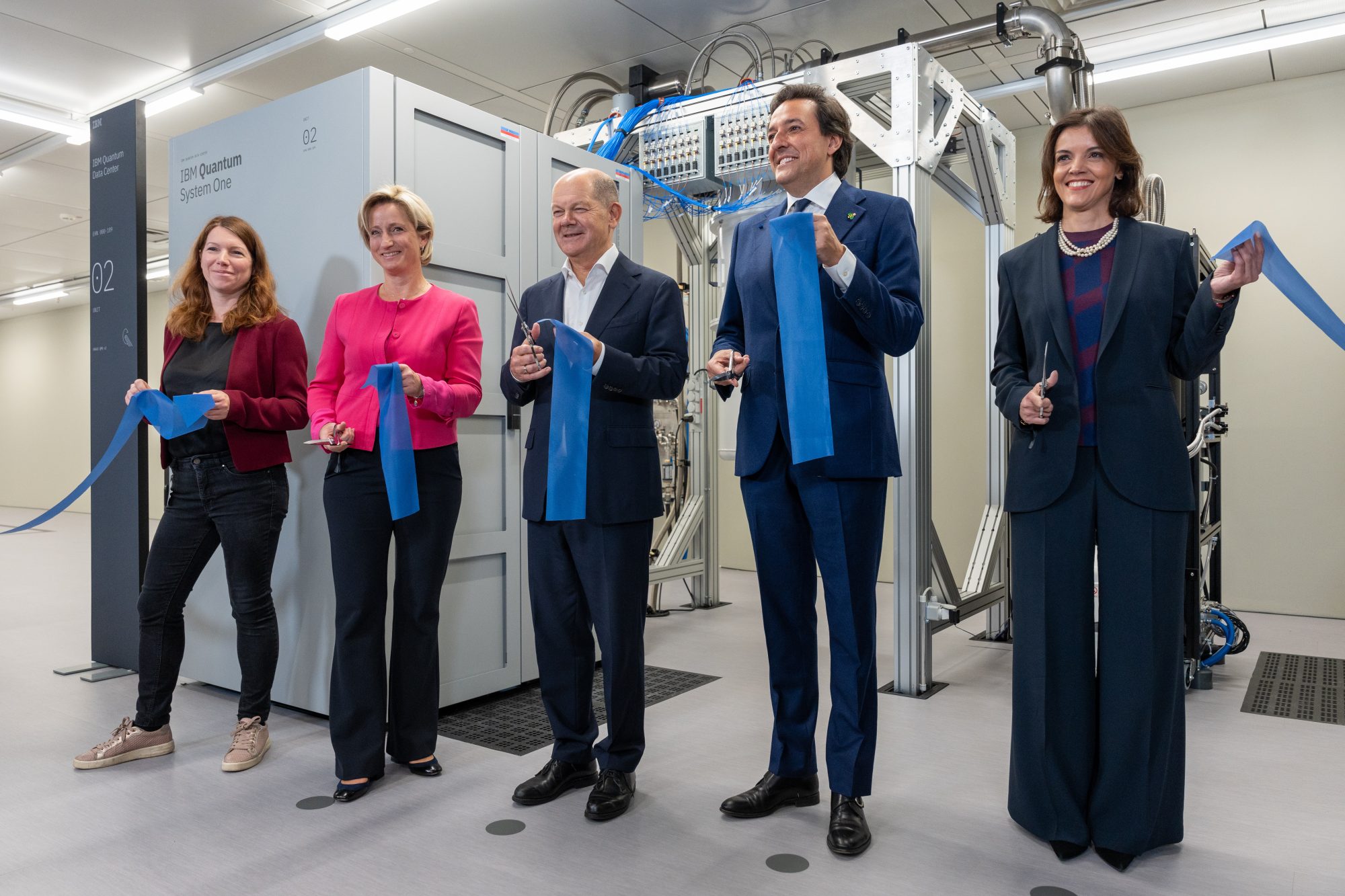
In a groundbreaking move for quantum technology, IBM has launched its first quantum data centre in Europe, marking a significant milestone for the continent’s role in advancing quantum computing.
Located in Ehningen, Germany, this new IBM quantum data centre is the first of its kind outside the United States and the second in the world. This development signifies a strategic expansion of IBM’s cutting-edge quantum computing systems, accessible to users worldwide via the cloud.
Olaf Scholz, Chancellor of the Federal Republic of Germany, commented on the landmark development: “The opening of the IBM quantum data centre in Ehningen is good news for Germany.
“It will serve as a location for innovation and business growth and is an expression of investors’ confidence in the German market. IBM enriches the German quantum computing landscape with this new data centre.
“The German government is providing targeted support for the development of quantum technologies. It is thereby driving forward the development of competencies and capacities in quantum computing in order to promote a robust ecosystem around the development of quantum computers.”
Europe’s first quantum data centre
IBM’s new quantum data centre houses two advanced quantum systems based on the IBM Quantum Eagle chip, with a third, Heron-based system, to be added soon.
These state-of-the-art quantum systems surpass the computational limits of classical computers, offering businesses, researchers, and institutions unprecedented computing power to tackle complex challenges.
The Heron chip, introduced in late 2023, is IBM’s most advanced quantum processor to date. It supports more intricate algorithms and promises a performance boost of up to 16 times and a 25-fold increase in speed over older systems.
Credit: IBM
Once the Heron system goes live, it will be the third of its kind across IBM’s global quantum fleet, enhancing Europe’s access to the largest network of quantum computers in the world.
This expansion is crucial for advancing research and commercial applications of quantum computing, especially as organisations push toward achieving quantum advantage—the point where quantum computers outperform classical ones in solving practical problems.
Strengthening Europe’s quantum ecosystem
The opening of the IBM Quantum Data Center in Germany is not only a technical achievement but also a strategic decision that underscores Europe’s growing leadership in quantum technology.
IBM’s new quantum data centre opens the door to more than 80 European organisations, including universities, research institutions, and large enterprises, all of which are part of the IBM Quantum Network.
Research institutions like Ikerbasque in Spain and Fraunhofer-Gesellschaft in Germany are already exploring quantum solutions to complex industry challenges, further solidifying Europe’s role in this next technological frontier.
With the IBM Quantum Platform, users across Europe can tap into this vast quantum infrastructure, advancing the discovery of new algorithms and applications.
The platform is designed to support organisations as they push forward with real-world quantum use cases, moving closer to quantum utility—the era when quantum computing becomes indispensable for solving key problems across multiple industries.
Ana Paula Assis, General Manager and Chairman of IBM Europe, Middle East and Africa, added: “The opening of our first IBM quantum data centre in Europe marks a pivotal moment for the region’s technological development, demonstrates our commitment to Europe, and underscores the key role of collaboration with industry, academia and policymakers for a pan-European quantum ecosystem.
“This state-of-the-art facility will foster innovation around quantum computing, creating new opportunities for talent attraction and ensuring that Europe remains at the forefront of global technological advancements.”
A quantum leap toward the future
As IBM continues to expand its quantum offerings globally, Europe is now positioned at the forefront of quantum innovation.
The quantum data centre in Germany is a pivotal step in enabling global access to quantum technologies and fostering collaboration among researchers, industries, and governments to explore the full potential of quantum computing.
By enhancing accessibility to advanced quantum systems and tools, IBM is empowering organisations to innovate, accelerate discoveries, and bring quantum advantage closer to reality.
As Europe deepens its involvement in the quantum computing landscape, the continent is poised to become a key player in solving some of the most complex computational problems of the future.
This collaboration, originally established between Columbia University, the Flatiron Institute, and two Max Planck Institutes in Germany, will now include Cornell University. The centre’s expansion aims to deepen research into the unique properties of quantum materials, which hold significant potential for advancements in technologies such as quantum computing, sensors, and networks.
Pushing the boundaries of quantum materials
At the heart of the centre’s work is the exploration of non-equilibrium quantum phenomena, which occur when materials are pushed beyond their normal, stable states.
These phenomena can lead to the emergence of entirely new properties, such as unique forms of superconductivity and magnetism.
By understanding and controlling these properties, researchers hope to unlock innovative applications for quantum technologies.
“This renewal will allow our team to continue our innovative work combining modern experimental physics methods with breakthroughs in materials synthesis, nonlinear optical and electronic spectroscopies, and cutting-edge theoretical, computational, and data science methods to provide an unprecedented understanding of quantum matter at the shortest lengths and time scales,” said Andrew Millis, Director of the Center and professor of physics at Columbia University.
“The collaborations enabled by the centre will solidify the positions of the participating institutions as world leaders in one of the most vibrant and exciting areas of current research in the physical sciences.”
New capabilities and directions for quantum research
The inclusion of Cornell University adds new capabilities to the centre’s research portfolio, particularly in the areas of material synthesis and quantum measurement.
Additionally, the Max Planck Institute’s new Microstructured Quantum Matter Department will contribute to the design and creation of novel quantum materials.
This enhanced expertise will allow the centre to push research into innovative areas, such as using light to manipulate material properties and bridging the gap between atomic, molecular, and optical physics with quantum materials.
Groundbreaking achievements and future goals
The centre has already achieved pioneering work, including the development of ultrafast optical scanning tools and the discovery of new physical properties in quantum materials.
Looking ahead, researchers aim to further their understanding of light-matter interactions and design materials with dynamic control capabilities.
The renewed collaboration promises exciting new advances in quantum materials, driving innovation and discovery in one of the most promising fields of modern science.
The European Commission has revealed a major investment of €65m to drive innovation in quantum chips in the EU.
Managed by the Chips Joint Undertaking (Chips JU), a European partnership established to reinforce the EU’s semiconductor sector, the funding aims to support the development of quantum chips for computing and sensors.
Chips JU has now opened calls to accelerate semiconductor research and innovation, with the funding representing the first call in quantum technologies.
Quantum chips explained
Quantum chips, or quantum processors, are specialised computing devices that harness the principles of quantum mechanics to process information.
Unlike classical computers, which use bits (0s and 1s) as their basic unit of data, quantum chips use quantum bits or qubits.
These qubits can exist in multiple states simultaneously, thanks to quantum phenomena like superposition and entanglement.
This allows quantum computers to perform many calculations in parallel, making them exceptionally powerful for certain types of problems.
The importance of quantum chips lies in their potential to revolutionise fields like cryptography, optimisation, drug discovery, and materials science.
In cryptography, these chips could break currently unbreakable encryption by solving complex mathematical problems at unprecedented speeds.
In materials science and pharmaceuticals, quantum computers could simulate molecular interactions more accurately, speeding up the development of new drugs and materials.
The importance of quantum chips in driving innovation across an array of sectors cannot be understated, with the EU’s latest investment signalling Europe’s intent to become a leader in the field.
Europe’s quantum investment
The €65m funding is expected to be matched by states participating in Chips JU and is part of a wider €200m investment in quantum chips over the next three years.
The call will select projects for the development and manufacturing of quantum technologies that increase European innovation to establish a robust manufacturing supply chain for quantum chips.
Quantum mechanics explores the fundamental nature of matter and energy at the smallest scales. Key concepts include quantised particles and probabilistic wave functions, as governed by the Schrödinger equation.
Notable principles of quantum mechanics, such as wave-particle duality and the uncertainty principle, challenge classical physics. Quantum phenomena like tunnelling and entanglement enable groundbreaking technologies, including quantum computing and cryptography.
The origins of quantum theory can be traced back to pivotal contributions by Max Planck, Albert Einstein, and others.
By understanding these critical theories, we can gain insight into the perplexing yet fascinating domain of quantum mechanics and its vast potential in our future.
Quantum physics fundamentals
Quantum physics, the branch of science that investigates the behaviour of matter and energy at the smallest scales, introduces a groundbreaking framework where classical mechanics no longer apply.
At the core of this field lies the concept of quantisation, where particles such as electrons are described by discrete packets referred to as quanta. These quantum objects are governed by probabilistic wave functions and the Schrödinger equation, allowing them to exist in multiple states simultaneously—an idea recognised as superposition.
One of the intriguing phenomena in quantum physics is quantum tunnelling, where particles pass through potential barriers that would be insurmountable in classical physics. This effect is fundamental to technologies like the scanning tunnelling microscope, which allows for imaging surfaces at the atomic level.
Quantum decoherence describes the process by which a quantum system loses its superposition state due to interaction with its environment, shifting it to a classical state. This phenomenon is a significant challenge in the development of quantum computing, where maintaining coherence is essential for performing calculations that far exceed the capabilities of classical computers.
Quantum teleportation, another fascinating concept, involves the transfer of quantum information between particles over distance, leveraging the phenomenon of entanglement. This principle has profound implications for the future of secure communication.
Quantum cryptography capitalises on the principles of quantum mechanics to develop secure communication methods that are theoretically immune to eavesdropping. This field promises to revolutionise data security.
The origins of quantum mechanics
At the dawn of the 20th century, classical physics’ inadequacies in explaining certain phenomena led to the birth of quantum theory. This revolutionary framework emerged from a series of historical breakthroughs and early experiments that challenged the prevailing notions of classical mechanics.
One of the pivotal moments was Max Planck’s introduction of quantised energy levels in 1900, laying the cornerstone for quantum theory. Planck’s work addressed the black-body radiation problem that classical physics could not resolve, marking the first significant conceptual shift towards quantum mechanics.
Albert Einstein further advanced this nascent field in 1905 through his explanation of the photoelectric effect, which demonstrated that light could be understood as discrete packets of energy called quanta or photons. This revelation underscored the inadequacy of the wave theory of light and reinforced the need for a new theoretical framework.
Niels Bohr’s 1913 model of the atom, which introduced quantised orbits for electrons, was another foundational principle that provided deeper insights into atomic structure and stability.
Subsequently, Erwin Schrödinger’s wave function formalism, published in 1926, offered a robust mathematical description of quantum systems and their evolution, leading to significant theoretical advancements.
These collective efforts culminated in the formulation of quantum mechanics, a probabilistic framework that profoundly altered our understanding of particle behaviour and interactions at the microscopic level.
Wave-particle duality
One of the most intriguing aspects of quantum mechanics is wave-particle duality, which posits that particles such as electrons exhibit both wave-like and particle-like properties. This concept challenges the classical physics paradigm by demonstrating that particles can exhibit wave characteristics, such as interference patterns, a phenomenon traditionally attributed solely to waves.
The cornerstone of wave-particle duality is the double-slit experiment, which provides compelling experimental evidence. When electrons are fired through two closely spaced slits, they create an interference pattern on a detection screen, a clear indication of their wave-like behaviour.
Conversely, when observed, these same electrons appear to act as discrete particles, showcasing their dualistic nature.
This dualistic nature underscores the complexity of quantum mechanics and highlights the need to rethink conventional concepts of particles and waves.
Through these insights, wave-particle duality forms a critical pillar in the broader understanding of quantum physics.
Superposition and entanglement
Superposition and entanglement are cornerstones of quantum mechanics. They present phenomena that defy classical intuition and underpin the field’s most revolutionary advancements.
In quantum physics, superposition refers to the ability of quantum particles to exist in multiple states simultaneously. This property is pivotal in quantum computing, where quantum bits, or qubits, harness superposition to perform complex computations in parallel, leading to exponential speedups in solving certain problems compared to classical computers.
Quantum entanglement, another fundamental concept, occurs when particles become interconnected in such a way that the state of one particle instantly influences the state of another, regardless of the distance separating them. This phenomenon, known as quantum entanglement, is instrumental in the development of quantum communication and quantum information processing.
Entangled particles share correlated properties, enabling secure communication methods such as quantum key distribution, which can detect eavesdropping attempts due to the disturbance it would cause in the entangled states.
Quantum algorithms exploit both superposition and entanglement to enhance computational efficiency. For instance, Shor’s algorithm for factoring large numbers and Grover’s algorithm for database searching demonstrate how quantum systems can outperform classical counterparts.
Superposition allows these algorithms to evaluate many possibilities simultaneously while guaranteeing the coherence and interdependence of qubits, maintaining the integrity of quantum information throughout the computation process.
The Schrödinger Equation
The Schrödinger Equation stands as a cornerstone in quantum mechanics, offering a profound mathematical framework for understanding the dynamic behaviour of quantum systems.
Formulated by Erwin Schrödinger in 1925, this pivotal equation encapsulates the essence of quantum evolution, describing how a quantum system evolves over time. It is instrumental in predicting the behaviour of particles at the microscopic level, revealing the intricate dance of wave functions and probability amplitudes.
At the heart of the Schrödinger Equation is the concept of the wave function. This mathematical entity encodes the probability amplitude of finding a particle in a particular state or position. This wave function is central to determining the likelihood of various outcomes in quantum experiments and forms the bedrock of quantum predictions.
The Schrödinger Equation can be expressed in both time-dependent and time-independent forms, each serving distinct purposes in the analysis of quantum systems. The time-dependent Schrödinger Equation describes how the wave function evolves with time, while the time-independent form is often used to solve for the system’s stationary states.
The Uncertainty Principle
The Uncertainty Principle, a cornerstone of quantum mechanics formulated by Werner Heisenberg, delineates the fundamental limitations in simultaneously measuring certain pairs of complementary properties, such as a particle’s position and momentum, with arbitrary precision.
This principle underscores the quantum uncertainty inherent in particle dynamics, challenging the classical physics notion that such properties can be measured with exactitude.
Heisenberg’s principle asserts that the more precisely one knows a particle’s position, the less precisely one can know its momentum, and vice versa. This position momentum dilemma arises from the wave-like nature of quantum objects, where particles are described not by definite positions and velocities but by wave functions that encapsulate probabilities.
Consequently, any attempt to measure one property with high precision inevitably disturbs the other, introducing an intrinsic quantum uncertainty.
At its core, the Uncertainty Principle fundamentally alters our understanding of predictability and measurability at the quantum level. It implies that there is a limit to the precision with which we can simultaneously know a particle’s position and momentum. This limit is not due to experimental imperfections but a fundamental property of nature itself, rooted in the principles of quantum mechanics.
The double-slit experiment
Amid the foundational experiments that reveal the enigmatic nature of quantum mechanics, the double-slit experiment stands as a pivotal demonstration of wave-particle duality.
Originally conceived by Thomas Young in the early 19th century to study light, it has since become a cornerstone in quantum physics, elucidating the dual nature of quantum particles such as electrons and photons.
In the double-slit experiment, particles are emitted towards a barrier with two slits. When both slits are open, and no observation mechanism is in place, the particles create an interference pattern on the detection screen, characteristic of wave behaviour. This pattern is akin to ripples overlapping on a water surface, with alternating bands of high and low intensity, indicating the superposition of quantum states.
However, the quantum mysteries deepen when an observation mechanism is introduced to determine through which slit the particle passes. The act of observing collapses the interference pattern, resulting in two distinct clusters on the screen, indicative of particle behaviour. This phenomenon, known as observation collapse, highlights the profound impact of measurement on quantum systems.
Quantum technologies and applications
Quantum technologies, rooted in the principles of quantum mechanics, are revolutionising various sectors by offering unprecedented computational power, enhanced security, and precision measurement capabilities. These technologies harness quantum phenomena such as superposition and entanglement to develop groundbreaking applications across multiple fields.
Quantum computing advancements are at the forefront of this revolution. Unlike classical computers, which use bits as the smallest unit of data, quantum computers employ qubits. Qubits can exist in multiple states simultaneously, enabling them to solve complex problems at an exponential speed. This dramatic increase in computational power holds the potential for solving currently intractable problems in cryptography, optimisation, and materials science.
Quantum cryptography developments leverage the principles of quantum mechanics to ensure secure communication. Quantum Key Distribution (QKD) uses entangled particles to detect eavesdropping, making it theoretically impossible for an interceptor to access the communication without being detected. This guarantees unparalleled quantum communication security.
Quantum sensor innovations exploit quantum phenomena to achieve high-precision measurements. These sensors can enhance imaging technologies, improve navigation systems, and enable more accurate detection of environmental changes. The precision offered by quantum sensors is transforming fields such as medicine, where they can be used for early disease detection, and geology, where they can predict seismic activities with greater accuracy.
These quantum technology applications are not confined to theoretical research – they are already impacting practical fields and propelling industries towards unprecedented advancements.
The future of quantum advancements
Quantum physics fundamentally challenges classical conceptions of reality by introducing phenomena such as superposition, wave-particle duality, and probabilistic behaviour.
Governed by the Schrödinger equation and demonstrated through experiments like the double-slit experiment, quantum systems reveal the profound impact of observation on outcomes.
These principles not only illuminate the microscopic domain but also propel advancements in quantum technologies, redefining the understanding of the universe’s underlying principles and opening new frontiers in scientific exploration.
Quantum computing is poised to transform technology by harnessing the principles of quantum mechanics to solve complex problems at unprecedented speeds.
Utilising qubits, superposition, and entanglement, quantum computers are set to transform industries like finance, healthcare, and materials science through groundbreaking solutions and optimisation capabilities.
Tech giants, including IBM, Google, and Microsoft, are leading the charge, demonstrating significant advancements such as Google’s quantum supremacy.
While challenges like qubit stability and error correction remain, ongoing research and investment are making remarkable strides. To comprehend the future potential of this transformative technology, an appreciation of its unique properties and developing applications is essential.
How quantum computing works
The intricacies of quantum computing lie in its ability to leverage the bizarre principles of quantum mechanics to process information with unparalleled efficiency.
Central to this are qubits, the quantum analogues of classical bits. Unlike classical bits, which can be either 0 or 1, qubits can exist in a state of superposition, where they can be both 0 and 1 simultaneously.
This property facilitates parallel computation, allowing quantum computers to process a vast number of possibilities at once, significantly enhancing computational speed and capability.
A fundamental aspect of quantum computing is the qubit manipulation through quantum gates. These gates function similarly to classical logic gates but operate on qubits, enabling complex operations to be performed at quantum speeds.
Quantum gates manipulate qubits by exploiting their superposition and entanglement properties. Entanglement is a phenomenon where qubits become interconnected such that the state of one qubit directly affects the state of another, irrespective of the distance between them.
This interconnectedness is pivotal in maintaining the integrity of information and facilitating rapid data transfer within quantum systems.
Quantum algorithms are designed to capitalise on these unique quantum properties to solve problems more efficiently than their classical counterparts.
Notable examples include Shor’s algorithm for integer factorisation and Grover’s algorithm for database searching, both of which demonstrate the potential of quantum computing to outperform classical methods in certain tasks.
By harnessing superposition and entanglement, quantum algorithms can explore multiple solutions simultaneously, offering solutions to complex problems that would be impractical for traditional computers.
In essence, quantum computing represents a paradigm shift in how we approach computational challenges, promising advancements that could redefine the technological landscape.
Key benefits and applications
Quantum computing presents numerous benefits that promise to revolutionise various industries through its extraordinary computational capabilities.
By leveraging the principles of quantum mechanics, quantum computers can solve complex optimisation problems exponentially faster than classical computers.
This remarkable computational power is poised to drive significant industry impact, particularly in fields like finance, healthcare, and materials science.
In finance, quantum computing can optimise trading strategies, risk management, and fraud detection, thereby unleashing substantial economic potential.
The healthcare sector stands to benefit from accelerated drug discovery processes, enabling the rapid development of personalised medicine and treatments.
Similarly, in materials science, quantum simulations can lead to scientific breakthroughs by precisely modelling atomic interactions, ultimately resulting in the creation of new materials with enhanced properties.
Quantum algorithms also enhance machine learning efficiency and accuracy. This advancement allows for the processing of vast datasets at unprecedented speeds, which is crucial for applications ranging from climate modelling to supply chain optimisation.
Therefore, quantum computing can address some of the most pressing global challenges, offering innovative solutions that were previously unattainable with classical computing methods.
Security measures are another critical area where quantum computing will have a profound impact. Traditional cryptographic methods are vulnerable to quantum algorithms such as Shor’s, which can factorise large numbers exponentially faster than classical algorithms.
Consequently, the development of quantum-resistant cryptography is crucial to guarantee data security in the quantum era.
Current state and advances
Major technology corporations are leading the way in quantum computing research and development, driving notable progress in the field.
These industry leaders are investing heavily to overcome the technical challenges that have historically hindered the practical application of quantum computing.
One of the landmark achievements in this domain is Google’s demonstration of quantum supremacy, where their Sycamore processor performed a specific calculation markedly faster than the most advanced classical computers.
This milestone has energised the pursuit of more robust quantum systems. A critical aspect of these systems is qubit coherence, which refers to the maintenance of quantum states over time.
Enhancing qubit coherence remains a primary focus, as it directly impacts the reliability and scalability of quantum computers.
Equally important is error correction. Quantum bits, or qubits, are notoriously susceptible to errors due to environmental interference.
Advanced error correction techniques are essential for ensuring the accuracy of quantum computations. Researchers are making strides in this area by developing more sophisticated error correction codes and hardware improvements.
The development of advanced algorithms tailored for quantum computers is another pivotal area of progress. These algorithms can potentially solve complex problems in fields such as cryptography, materials science, and optimisation much more efficiently than classical algorithms.
To democratise access to quantum computing, IBM Quantum offers cloud services, allowing researchers, developers, and businesses to experiment with quantum algorithms on real quantum hardware.
Similarly, Microsoft Quantum is not only advancing quantum research but also building a wide-ranging ecosystem that includes cloud-based quantum computing platforms.
These advances collectively push the boundaries of what is achievable with quantum technology, setting the stage for unparalleled computational capabilities.
Future prospects and challenges
As quantum computing continues to mature, its future prospects are both exciting and challenging. The promise of quantum supremacy—where quantum computers outperform classical counterparts in specific tasks—ushers in a new era of problem-solving potential.
However, the path to realising these prospects is filled with challenges. Qubit stability remains a significant obstacle, as quantum bits are notoriously susceptible to decoherence and errors.
Developing robust error correction techniques is essential to guarantee reliable computations. Scalability is another challenging task; constructing a quantum computer with millions of stable qubits is still a distant goal. Despite these hurdles, ongoing research and investment are steadily advancing the field.
The future of quantum technology extends beyond computing. The emergence of the quantum internet promises ultra-secure communication channels, leveraging the principles of quantum encryption to safeguard data against eavesdropping.
Quantum sensors, with their heightened sensitivity, are expected to revolutionise fields such as medical imaging and environmental monitoring.
Furthermore, the rise of quantum computing necessitates advancements in post-quantum encryption to protect classical systems from potential quantum threats. As quantum computers edge closer to practical application, the need for strong security measures becomes essential.
Quantum computing promises to revolutionise data processing and problem-solving across numerous industries.
Despite current challenges, ongoing research and development are expected to drive significant innovation, fundamentally altering traditional computational paradigms and heralding a new era of technological advancement.