Humans setting up home in outer space has long been the preserve of science fiction. Now, thanks to advances in technology and the backing of billionaires, this dream could actually be realised. But is it more likely to be a nightmare?
Kelly and Zach Weinersmith join us to discuss their new book A City on Mars and some of the medical, environmental and legal roadblocks that may prevent humanity from ultimately settling in space.
A City on Mars: Can We Settle Space, Should We Settle Space, and Have We Really Thought This Through? Kelly and Zach Weinersmith Particular Books (2023)
Music supplied by Airae/Epidemic Sound/Getty images.
“It makes your heart want to skip a beat — and you cannot really describe it to someone who hasn’t experienced it in person,” said Lynnice Carter on Monday, after watching the total solar eclipse that crossed North America. Carter, a retired educator from Blue Springs, Mississippi, travelled about 230 miles (370 kilometres) to Heber Springs, Arkansas, to see the much-anticipated celestial event from the ‘path of totality’, the track from Sinaloa, Mexico, to New Brunswick, Canada, where the Moon completely blocked the Sun’s face.
Carter wasn’t alone in making time for the eclipse. Millions viewed the phenomenon from watch sites along the path of totality, where people picnicked, listened to music and donned inexpensive eclipse glasses that helped them to see the main event safely. Some researchers celebrated in their own way — by chasing the eclipse in aeroplanes or with high-resolution cameras on the ground. Although more than a few were disappointed by cloud-filled skies in some locations, others were dazzled by the fiery activity they could see within the Sun’s outer atmosphere, or corona. Here, Nature chats with casual observers and solar researchers alike to hear about what they saw — and what they learnt.
Crowds gathered on the National Mall in Washington DC to watch the eclipse on 8 April.Credit: Kent Nishimura/Getty
Some marveled over the science that they could see by eye:
The last time a total solar eclipse passed over North America was 2017, but it was during a solar minimum — a period of weak activity occurring every 11 years on the Sun when there are fewer sunspots and plasma eruptions. This time around, viewers experienced a solar maximum, when structures in the Sun’s corona are at their most fiery. “This one was just so much brighter, and so much prettier! It was just awesome,” said Alice Beverly, who journeyed from Tulsa, Oklahoma, to Heber Springs to watch.
Astronomers have long observed ‘shadow bands’ during total solar eclipses. These as-yet-unexplained phenomena are alternating segments of light and dark that pass over the ground in the moments just before and after the full eclipse. One hypothesis is that they are caused by turbulence in the atmosphere as the sliver of light from the eclipse passes through. Viewers like Kelley Boyett were particularly excited to see them. “I researched a lot, and brought a white posterboard to see the little crescents and shadow bands. The coolest thing was the shadow banding — it looked like racing water across the posterboard.” Boyett, a postal office worker, travelled from Bronson, Texas, to a watch site in Heber Springs for the festivities.
Others made the most of a cloud-covered sky:
“I was disappointed, not so much for myself — since it was my fourth eclipse — but for my sister and her husband for whom this was going to be the first time,” said Jim Klimchuk, a solar physicist at NASA Goddard Spaceflight Center in Greenbelt, Maryland, who travelled to San Antonio, Texas, to view the eclipse. “During totality, it got dark. [Automatic] streetlights and building lights came on. And then for about five seconds, we could see the corona [amid the clouds]. No details at all, but we could see the brightness around the disk. That was very exciting.”
Marcel Corchado-Albelo, a solar physicist at the University of Colorado Boulder, spent the week leading up to the eclipse in Eagle Pass, Texas, visiting various schools as part of a public-outreach programme. On the morning of the eclipse, the approximately 400 people that gathered to watch at a student activity centre were “very nervous”, Corchado-Albelo said. Clouds loomed. The sun would peek from behind the clouds occasionally, and every time, “people were screaming”, he added. In the end, though, their fortune turned — the clouds parted as totality approached. And everyone screamed again.
Bright red spots called prominences appeared along the solar disk during the total eclipse.Credit: Sumeet Kulkarni/Nature
Researchers grabbed data that they can’t wait to analyse:
One thing many observers were mesmerized by during the eclipse was the appearance of bright red spots protruding from the solar disk. These are called prominences — worm-like filaments of plasma. One in particular, along the southern edge of the Sun, “looked like it was potentially lifting off”, said Amir Caspi, a solar physicist at the Southwest Research Institute in Boulder, Colorado, who travelled to Dallas, Texas, to watch the eclipse with his family.
Total solar eclipse 2024: how it will help scientists to study the Sun
Caspi leads 35 teams of citizen scientists that captured images of the eclipse from stations distributed along the path of totality. By recording images using identical telescopes and cameras, the project — called Citizen Continental-America Telescopic Eclipse, or Citizen CATE — aims to observe how structures within the corona evolve over time.
“A majority of our teams were able to get great data. But there were a few that got clouded out completely,” Caspi said. The citizen scientists are currently uploading their data — as much as tens of gigabytes per site — onto servers where it will be analysed to make an hour-long ‘film’ of the corona. Caspi expects the consolidated results to be available within the next month.
Another scientist closely watching structures in the corona was Cooper Downs, an astrophysicist at research and product-development firm Predictive Science in San Diego, California. He is part of a team that has spent the past few weeks predicting where in the corona features such as streamers will appear, with the idea of honing the firm’s solar model. Streamers are densely packed spikes of plasma pointing away from the solar core. “My initial impressions were pretty positive,” Downs said. “I saw these two streamers, one was really bright on the top left and another to the south.” Downs is now comparing the simulations generated before and during the eclipse with images taken by astrophotographers. “When you do the detailed comparison, you start seeing some discrepancies”, which should motivate revisions to the model, he told Nature.
Researchers in North America are gearing up for their chance to observe the Sun’s corona — its wispy outer atmosphere — like never before. Normally hidden to the naked eye by the Sun’s glare, the corona will be visible to millions from Sinaloa, Mexico, to Newfoundland, Canada, when the Moon blocks the solar disk during the total eclipse on 8 April. Importantly, the event coincides with the solar maximum — a period of extreme activity that occurs every 11 years. During this time, the Sun’s magnetic fields intensify, creating sunspots, fiery loops of plasma and exciting structures in the corona.
The Sun’s outer atmosphere, named for its crown-like appearance, is one of astronomy’s biggest unsolved mysteries, says James Klimchuk, a solar physicist at the NASA Goddard Spaceflight Center in Greenbelt, Maryland. For decades, scientists have been scratching their heads about why the corona, a hot plasma that extends millions of kilometres from the core, is so much hotter than the solar surface. “It’s like if you walk away from a campfire,” Klimchuk says, but instead of cooling down, you get warmer. “Why would that be?” They also have puzzled over what gives the corona its intricate structure (see ‘Crown jewels’).
Source: Nature adaptation from image provided by Nicolas Lefaudeux
Earth experiences total eclipses roughly once every 18 months. But their paths often cross remote areas, where few people can view them. The last time a total eclipse passed over North America was in 2017. Viewers along that eclipse’s ‘path of totality’ — in which the Moon completely blocks the solar disk — “wouldn’t have seen the same Sun as we’re seeing” during this one, says Marcel Corchado-Albelo, a solar physicist at the University of Colorado Boulder, who will participate in a public-outreach programme on 8 April aimed at marginalized communities in Texas. During the previous eclipse, the Sun was closer to its solar minimum.
The corona will “look much more complex” this time, Klimchuk says.
Simulating the Sun
A preview of how it might appear during the eclipse was released last month by Predictive Science, a research and product-development firm in San Diego, California. Staff members, including astrophysicist Cooper Downs, used real-time satellite data of the Sun’s surface magnetic fields and intensive supercomputer simulations to make the prediction. “The Sun is quite chaotic,” Downs says. So forecasting the corona’s appearance is as difficult as predicting cloud movement — the mention of which is a source of anxiety for eclipse chasers. Clouds could obscure the eclipse from the view of many on 8 April.
Staring at the Sun — close-up images from space rewrite solar science
The firm’s prediction shows a corona composed of several spiky, spade-like structures called streamers, in which coronal plasma is tightly confined by magnetic field lines that leave the Sun’s surface but loop back into it. Streamers glow brighter than other parts of the corona because electrons in the denser plasma scatter sunlight. The prediction also shows coronal holes, darker regions between the streamers where magnetic field lines don’t loop back into the Sun but extend into interplanetary space. The holes can create strong gusts of solar wind — charged particles accelerated by magnetic fields — that cause geomagnetic storms threatening Earth-orbiting satellites.
By comparing the locations of streamers and holes in the actual eclipse and the simulation, the firm’s scientists will be able to validate and improve their model for future applications, including space-weather forecasting, Downs says.
Photo op
Because the Moon perfectly blocks the solar disk during an eclipse — owing to the cosmic coincidence that the Sun and Moon have similar sizes when viewed from Earth — solar physicists on the ground, including Shadia Habbal at the University of Hawaii in Honolulu, will be able to study the Sun’s chromosphere next week. This thin layer of plasma just above the solar surface is home to prominences, worm-like filaments of plasma protruding into the corona. “You see them very clearly during an eclipse,” Habbal says.
Sometimes, these prominences can snap explosively to form a coronal mass ejection. During one of these events, billions of tonnes of relatively cool (about 10,000 °C) solar plasma are expelled from the solar surface and are enveloped by the corona, whose temperature can exceed 1,000,000 °C. Habbal says that because of the solar maximum, viewers have a good chance of seeing a coronal mass ejection. Eclipses provide “the best opportunity to figure out how these plasmas co-exist and interact”, she adds.
To do this, Habbal is leading a team of 40 researchers armed with high-speed cameras and high-resolution sensors to capture tiny changes in the corona during the eclipse’s minutes of darkness. The scientists will be spread across three sites in Texas and Arkansas, to maximize the chance of a cloudless observation.
Flying high
One group that is not worried about clouds is the Airborne Coronal Emission Surveyor (ACES) team. These scientists will fly in a Gulfstream V jet above the clouds, at an altitude exceeding 13 kilometres. This will put them over a layer of water vapour in Earth’s atmosphere that absorbs infrared light and would interfere with their measurements of the corona. Chad Madsen, an astrophysicist at the Harvard–Smithsonian Center for Astrophysics in Cambridge, Massachusetts, and an ACES participant, says the team is interested in studying one particularly long streamer in the Predictive Science forecast.
What powers the Sun’s mysterious wind? A daring spacecraft has some answers
The team will measure infrared light emitted by the streamer to determine the strength of the magnetic fields in the part of the corona where it appears and the makeup of ions along various segments of the streamer, Madsen says. (Magnetic fields in the corona directly affect the infrared light emitted by plasma.)
Their flight will chase the Moon’s shadow along the path of totality through Texas, adding 90 more seconds of observation time to the maximum of 4 minutes and 30 seconds that viewers on the ground will get.
For many corona scientists, this eclipse isn’t their first, and probably won’t be their last. But each one offers a few minutes of magic. “There’s always an anticipation — you don’t know what it’s going to look like,” says Habbal, who will count this as her twentieth total eclipse. “Every time, it’s different.”
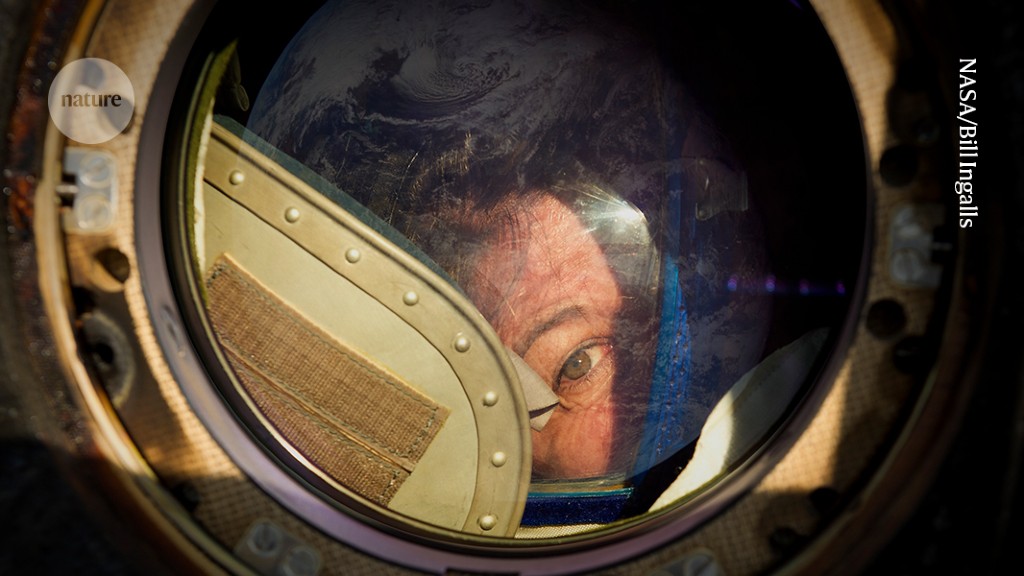
In 2010, astronaut Cady Coleman left her husband and young son to go into space.Credit: NASA/Bill Ingalls
Space: The Longest GoodbyeGreenwich Entertainment Directed by Ido Mizrahy
Neither NASA nor the Chinese space agency are probably consulting screenwriters as they develop their plans to send humans to the Moon and Mars. But they need to take the problem of astronaut isolation seriously, as director Ido Mizrahy sets out in his heartfelt documentary Space: The Longest Goodbye. Released in cinemas and online this week, this thoughtful film shares first-hand accounts of how leaving family behind can wreak havoc on an astronaut’s well-being.
Any crewed trip to Mars, for example, will involve up to three years of spaceflight — a sea change in what humans have experienced so far. Russian cosmonaut Valery Polyakov holds the record for the longest-duration spaceflight: 437 consecutive days aboard the Mir space station from January 1994 to March 1995. He and other cosmonauts pioneered the study of how the human body responds to microgravity over time, from bone deterioration to muscle loss and vision changes.
Yet the psychological impacts of spaceflight are equally important, argues Al Holland, an operational psychologist at the NASA Johnson Space Center in Houston, Texas, who drives much of the narrative for The Longest Goodbye. He and his colleagues studied NASA astronauts who flew on Mir, and used the lessons to try to improve astronauts’ mental health and well-being on board the International Space Station (ISS) during the 1990s. For example, carrying mechanical spare parts on board, which weren’t always stowed on Mir, reduced stress levels because astronauts knew that they had backups in case of an emergency.
Easing mental strain
Holland’s team developed ways to lessen the psychological strain of separation, such as by providing twice-weekly audio- or videoconferences between astronauts aboard the ISS and their families, and phone calls home whenever needed. The Longest Goodbye explores these long-distance conversations poignantly, through video recordings shared by Cady Coleman, a NASA astronaut who spent 159 days aboard the ISS in 2010–11.
As Coleman speaks with her husband and ten-year-old son from orbit, they mimic her, drifting across the screen as they pretend to float in microgravity. In another call, Coleman and her son play a flute duet. But after being separated from his mum for so long, he begins to act up. As she reads a story to him, he gets off the couch and makes faces at the camera. He is often like this just before joining calls with Coleman, her husband tells her. From her screen, Coleman can’t do much more than raise her eyebrows sternly.
Coleman had frequent videoconferences with her son, but her absence was still hard on both of them.Credit: Cady Coleman
The video connection breaks up -repeatedly. Coleman cries on camera — a lot. In recent interviews for the film, her son talks about how he didn’t understand why she had to be gone for so long. It is a heartbreaking glimpse into the personal challenges of one of NASA’s most accomplished astronauts, and a warning for anyone thinking about taking a three-year trip to Mars. Being separated from your family for a long journey on Earth is challenging enough; being apart while enduring the unique stresses and dangers of spaceflight is much harder.
The film illuminates this while following the story of Kayla Barron, a NASA astronaut who flew aboard the ISS from November 2021 to May 2022. Barron is a former submariner who has experienced stressful military deployments, but says that going to space is very different. Just getting to orbit in the first place involves putting yourself atop a flaming rocket, she notes. “It’s the most dangerous thing you’ve ever done, and then you invite all of your family and friends to come watch it.” “My spouse is on top of this ball of fire,” her husband thinks.
The couple confronts the existential -question of whether, if she dies, she is doing what she wanted to be doing. In one scene, she rushes to shelter in a protected part of the ISS as an errant piece of space debris threatens to hit the station. Her husband sits helplessly at home, frantically trying to get updates.
Might spacefarers find other ways to -recreate human bonds? European Space Agency astronaut Matthias Maurer, who was on the ISS at the same time as Barron, is shown interacting with an artificial-intelligence assistant. It looks like a floating football and has a screen with a creepily simplified human face. Viewers are likely to be relieved when Maurer packs it away in its storage case.
Lessons on Earth
The film also recaps the rescue of 33 -Chilean miners in 2010, who had been trapped during a mine collapse and spent 69 days underground. Holland and other NASA employees advised the Chilean government on how to sustain the miners’ physical and psychological well-being during their extended isolation. They were told to eat and sleep on a strict schedule, and set up an illuminated area so they could transition between ‘day’ and ‘night’ while they awaited rescue. Lessons from space thus helped the miners to survive underground.
The Longest Goodbye doesn’t describe what might work best for astronauts on their way to Mars. But it does offer a poignant look at the isolation and loss of connection that so many astronauts feel in space, and that many of the rest of us might recognize a little from our own experiences during the COVID-19 pandemic.
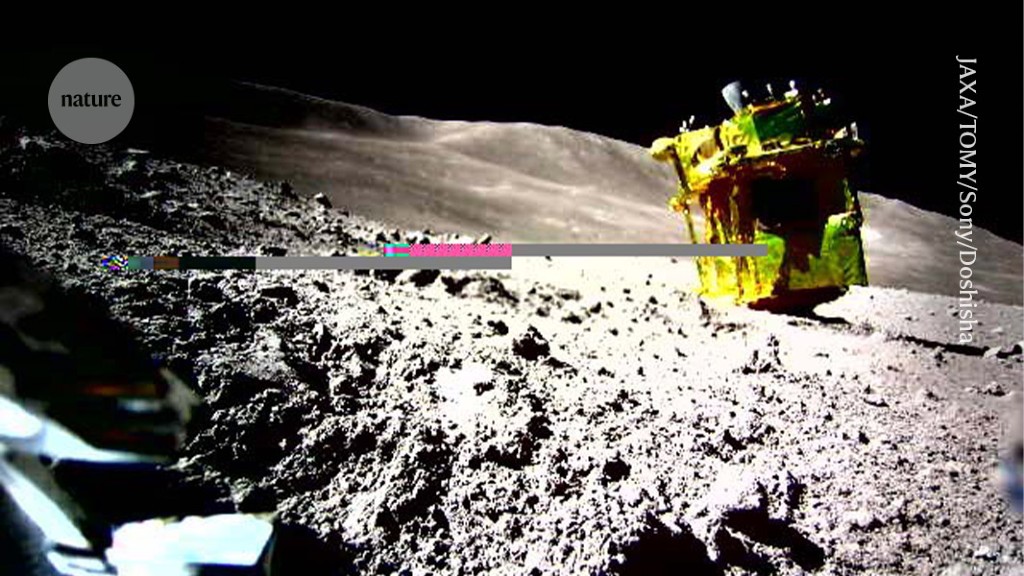
The lander was photographed upside down on the lunar surface. Credit: JAXA/TOMY Company/Sony Group Corporation/Doshisha
Defying expectations, Japan’s spacecraft, which touched down with unprecedented precision near the Moon’s equator last month, has survived the harsh lunar night and started communicating with Earth again. On Sunday, a command was sent to the Smart Lander for Investigating Moon, or SLIM, and a response was received, according to the Japanese Space Agency (JAXA).
SLIM was not designed to survive the deep cold night on the lunar surface, where temperatures drop below minus 130 degrees Celsius. JAXA’s engineers had remained hopeful that it would make it through the night, says SLIM project manager Shinichiro Sakai, but its message home was “a nice surprise”. “We knew that some of NASA’s Surveyors survived, so we felt we should also have some chance,” he says.
He believes the lander’s communications system, onboard computer and solar panels are working. JAXA announced later on social media that it was attempting to take new images with a multiband spectroscopic camera used to study the composition of rocks.
It’s been a rollercoaster ride for SLIM. Despite a successful on-target landing, JAXA lost contact with SLIM for some days when it rolled upside down. With its solar panels oriented the wrong way, it had only a trickle of energy with which to snap a photo and send it home before lunar night fell. The next lunar sunset for SLIM will take place on Thursday.
During the lunar day, extreme heat also becomes a problem for SLIM. With the Sun high, its radio electronics overheat very quickly and Sakai says the team will need to wait for the temperature to cool later in the week before they restart scientific investigation.
Electronic circuit boards can fail when they get too warm or cold, because they are built with different materials and the materials have different contraction rates, says Simeon Barber, a planetary scientist from Open University in Milton Keynes, UK. “It can generate significant twisting and stretching forces, and cause components or joints to crack or be pulled apart,” he says.
First private Moon lander touches down on lunar surface to make history
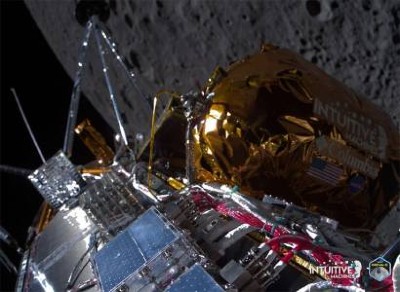
Both SLIM and the US spacecraft Odysseus, which made history last week by becoming the first privately built Moon-lander to complete a soft touchdown, experienced issues with landing positions. “Landing on the Moon is as difficult as it has always been,” says Barber.
The two recent spacecraft were built within many constraints, in particular cost, which places limits on their size and technology. “The two landers got almost everything right, but went awry at the last moments,” he says.
However the teams have obtained lots of data that will inform future attempts. “The best way to land successfully is to keep trying and to learn from previous attempts,” says Barber.