Tag: Tumor

  • Non-invasive detection and treatment of ovarian cancer with new radiotheranostic system

    Non-invasive detection and treatment of ovarian cancer with new radiotheranostic system

    [ad_1]

    A new radiotheranostic system has the ability to detect and treat ovarian cancer noninvasively, according to new research published in the April issue of The Journal of Nuclear Medicine. Combining the highly specific huAR9.6 antibody with PET and therapeutic radionuclides, this theranostic platform may provide more personalized treatment to improve health outcomes for ovarian cancer patients.

    Ovarian cancer causes more deaths than any other gynecologic malignancy, with a five-year survival rate below 30 percent for patients diagnosed at advanced stages. The current standard of care for ovarian cancer consists of surgery followed by platinum-based chemotherapy; however, these methods have failed to increase overall survival rates in patients because of tumor recurrence and chemoresistance.

    Current serum-based biomarkers do not sufficiently detect all occurrences of early-stage ovarian cancer. Therefore, there is a critical need for both additional detection methods and new targeted therapies that can improve patient survival.”


    Jason Lewis, PhD, Chief Attending of Radiochemistry and Emily Tow Chair at Memorial Sloan Kettering Cancer (MSK) in New York, New York

    Studies have shown that the MUC16 protein is overexpressed in ovarian cancer patients, with elevated levels correlating with disease stage and tumor volume. The antibody huAR9.6 binds to a unique epitope that is influenced by truncated carbohydrate residues on MUC16. Thus, the authors noted, MUC16 could be a potential target for tumor detection via immuno-PET imaging and treatment with radioimmunotherapy.

    In the study, the diagnostic radiotracer 89Zr-DFO-huAR9.6 was investigated in vitro and in vivo via binding experiments, immuno-PET imaging, and biodistribution studies on ovarian cancer mouse models. In addition, ovarian xenografts were used to determine the safety and efficacy of the therapeutic radionuclide, 177Lu-CHX-A″-DTPA-huAR9.6.

    MUC16 proteins were successfully detected via immuno-PET imaging with 89Zr-DFO-huAR9.6. In vivo studies showed that 89Zr-DFO-huAR9.6 could effectively specify varying levels of MUC16 expression in ovarian cancer mouse models. Radioimmunotherapy studies with 177Lu-CHX-A″-DTPA-huAR9.6 demonstrated improved overall survival and strong antitumor responses in highly MUC16-expressing models. Hematologic toxicity was also determined to be transient in mice treated with 177Lu-CHX-A″-DTPA-huAR9.6.

    “Immuno-PET imaging of MUC16 with this radiotheranostic pair may allow for noninvasive diagnosis and treatment monitoring of ovarian cancer lesions in patients,” said Kyeara Mack, PhD, postdoctoral fellow in the Lewis Lab at MSK. “This theranostic platform may be used to stratify and select patients who would benefit from the targeted radioimmunotherapy. In addition, it could also play a significant role in early ovarian cancer detection.”

    This study was made available online in March 2024.

    Source:

    Journal reference:

    Mack, K. N., et al. (2024). Interrogating the Theranostic Capacity of a MUC16-Targeted Antibody for Ovarian Cancer. Journal of Nuclear Medicine. doi.org/10.2967/jnumed.123.266524.

    [ad_2]

    Source link

  • Researchers unlock the potential of whey-derived proteins for cancer prevention

    Researchers unlock the potential of whey-derived proteins for cancer prevention

    [ad_1]

    In a recent review article published in Food and Humanity, researchers summarized the current evidence regarding the significance of whey protein for cancer prevention and treatment.

    Their conclusions highlighted the emerging role of whey protein supplements as a cost-effective, practicable, and viable strategy for cancer treatment and prevention.

    Study: Emerging potential of whey proteins in prevention of cancer. Image Credit: Dan_photography/Shutterstock.comStudy: Emerging potential of whey proteins in prevention of cancer. Image Credit: Dan_photography/Shutterstock.com

    Background

    Cancer is a leading cause of mortality globally, and its prevalence has increased significantly, prompting research to guide the development of effective strategies for treatment and prevention.

    Whey protein, known for its nutritional value and popularity in fitness, has recently garnered attention for its potential anticancer properties.

    Studies suggest whey protein contains bioactive compounds, such as lactoferrin, which demonstrate anticancer effects by inhibiting cancer cell growth and boosting the immune system.

    Whey protein also appears to modulate signaling pathways involved in cancer development, potentially slowing its progression. Additionally, it may enhance the efficacy and reduce the side effects of conventional cancer treatments like chemotherapy and radiation therapy.

    While more research is needed to understand the mechanisms underlying the anticancer effects of whey protein, initial findings offer promising avenues for cancer prevention and treatment.

    Whey protein and its benefits

    Whey protein, formed during milk processing as a by-product, can be sweet or acid. Sweet whey is used widely in supplements, with about 50% of the nutrients found in milk constituting approximately 20% of the protein content of milk.

    Whey contains various nutrients, including bioactive peptides, minerals, B-complex vitamins, and growth factors. These bioactive components, such as lactoperoxidase, beta-lactoglobulin, and lactoferrin, demonstrate diverse bioactivities and functionalities.

    Whey protein is highly regarded for its role in providing essential amino acids and promoting quick absorption, making it ideal for people with cancer and individuals seeking protein-rich diets.

    Commercially, whey protein is available in different forms like whey protein isolates (WPI), whey protein hydrolysates (WPH), and whey protein concentrates (WPC), each with varying protein concentrations.

    Whey protein concentrates generally contain between 25% and 89% protein, while isolates contain between 90% and 95%.

    Whey protein offers numerous health benefits, including weight loss support, muscle preservation, digestive health promotion, hypertension regulation, and anti-carcinogenic effects.

    It has probiotic properties and is a precursor for bioactive compounds like lactulose and lactobionic acid, and exhibits a low glycemic index and cariogenicity compared to other protein sources.

    The therapeutic properties of whey protein are attributed to its antioxidant activity, glutathione enhancement, apoptosis induction, iron-binding capacity, cell proliferation regulation, and potential in treating cancer cachexia-anorexia syndrome.

    It stimulates glutathione synthesis, promotes apoptosis in cancer cells, and regulates cell growth and division through insulin-like growth factor 1 pathways.

    Further research into whey protein and its bioactive components holds promise for enhancing human health and well-being.

    In vivo and clinical cancer studies

    Animal studies demonstrate that whey protein shows promise against oxidative stress-induced tissue injuries and cancers. Its potential anticancer and antioxidant properties may be associated with its ability to increase glutathione levels.

    WPC exhibits advantages over soy, casein, and other proteins in reducing colorectal cancer incidence via glutathione elevation.

    Whey protein diets have also shown promise in managing mucositis for individuals undergoing chemotherapy while improving nutritional outcomes.

    Subfractions of whey protein, particularly bovine lactoferrin and alpha-lactalbumin, exhibit antitumor effects inhibiting tumor development. Researchers are exploring novel nanocarriers incorporating components of whey protein to prevent tumors without side effects.

    Some clinical trials with human participants have shown positive outcomes, which are consistent with the evidence from in vitro studies of whey protein’s antioxidant and anti-cancer.

    Regarding nutritional and performance parameters, interventions that combined supplementation with dietary assistance and exercise improved nutritional parameters and handgrip strength; WPI supplementation also showed promise for protein status strengthening, boosting immunity during chemotherapy, and raising glutathione levels.

    Studies also indicate both positive and complex effects of whey protein concentrate and lactoferrin supplementation on the health of cancer patients.

    While these results are promising, robust multicentric trials must be conducted across various forms of cancer to confirm the pervasive efficacy of whey protein supplementation as an adjuvant therapy.

    Conclusions

    The narrative review discussed the role of whey protein in cancer prevention and treatment based on both animal and clinical studies, highlighting the potential benefits of whey protein, including its antioxidant and anticancer properties, its ability to increase glutathione levels, and its effectiveness in managing mucositis during chemotherapy.

    Various subfractions of whey protein, such as alpha-lactalbumin and lactoferrin, show promising antitumor effects. Additionally, novel approaches like utilizing nanocarriers incorporating whey protein components are being explored for tumor prevention.

    Clinical trials suggest positive outcomes of whey protein supplementation, including improved nutritional and performance parameters, raised glutathione levels and strengthened immunity in cancer patients.

    However, robust multicentric trials across different cancer types are needed to confirm the widespread efficacy of whey protein supplementation as an adjuvant therapy.

    [ad_2]

    Source link

  • The impact of AI on oncology care efficiency and mortality rates

    The impact of AI on oncology care efficiency and mortality rates

    [ad_1]

    In a recent review published in the journal Cancer, research review publications investigating the benefits and limitations of AI precision medicine techniques in oncology research and treatment.

    Study: Uses and limitations of artificial intelligence for oncology. Image Credit: metamorworks/Shutterstock.comStudy: Uses and limitations of artificial intelligence for oncology. Image Credit: metamorworks/Shutterstock.com

    Background

    The study focussed on the diagnostic and prognostic utility of artificial intelligence (AI) algorithms and discussed the impacts of AI-based chatbots (generative AI) in promoting anti-cancer outcomes in the last few decades.

    Finally, they touch upon the current challenges to widespread AI deployment and suggest regulatory implementations that may bolster the performance of these algorithms in the coming years.

    Precision medicine and its application in clinical anti-cancer applications

    More commonly known as ‘personalized medicine’, precision medicine is the therapeutic approach that considers a patient’s specific genetic makeup, environmental exposure, and health behaviors (lifestyle and associated behaviors).

    In contrast to traditional medical approaches, which primarily subscribe to the ‘one size fits all’ ideology, precision medicine presents numerous benefits, especially in the case of fields such as oncology, wherein patient-specific details (such as tumor information) can substantially improve clinical outcomes over general chemotherapy.

    Innovations in oncology are of particular scientific interest, with reports revealing that cancer mortality rates have declined by more than 33% in the last 32 years alone.

    Unfortunately, increased environmental pollution and suboptimal lifestyle choices have concurrently hampered progress in the field due to the increasing variability of carcinogens that trigger the condition.

    Precision medical approaches, especially those that employ artificial intelligence (AI) algorithms, have the potential to overcome this limitation of conventional generalized medicine by allowing researchers and clinicians to identify better previously unknown patterns in patients’ radiological scans revealed by machine learning (ML) and deep learning (DL) technologies.

    “AI algorithms are grouped into two categories: predictive AI and generative AI. Predictive AI tools learn patterns from training data to forecast outcomes in new scenarios. For example, an image-based classification tool used to diagnose breast cancer from mammogram scans is a predictive tool. Generative AI creates novel outputs that were not explicitly in the training data. AI chatbots that interact with patients in conversation are a form of generative AI.”

    Unfortunately, despite developing and testing several AI algorithms for cancer care management, implementations of these technologies in mainstream medicine remain rare.

    Notable roadblocks in incorporating AI models in the research included their relatively high upfront implementation costs, human noninterpretability of the algorithm outcomes, and limited human monitoring and validation of algorithms post-deployment.

    Furthermore, research efforts in various aspects (and during different phases) of cancer care are not uniform, with substantially greater literature available on cancer diagnosis (>80%) compared to treatment and post-chemotherapy care.

    Challenges notwithstanding, AI’s implementation in oncology has rapidly progressed the field, allowing for novel diagnostic, prognostic, and chat-based information access for both clinicians and their patients.

    The present review discusses this progress and highlights the pros and cons of current AI implementations. It further discusses conventional and future challenges in widespread AI adoption.

    It suggests policy changes that may further reduce the global burden of cancer, one of the most deadly and debilitating chronic diseases in the world.

    About the review

    The present review aims to provide context for three common use cases of precision medicine (particularly AI implementations) in cancer care – 1. Cancer classification and diagnosis, 2. Cancer prognostication, and 3.

    Utility of AI chatbots and other large language model (LLM) technologies in optimizing clinical workflows.

    It discusses the outcomes of more than 40 bodies of research (primary studies) to elucidate policy and implementation improvements that could further bolster cancer mortality rate reductions in the coming years.

    Diagnosis

    Cancer diagnosis, especially in early-stage cancers and cancers that have relapsed following previous treatment, given that most patients at these stages appear clinically healthy to human observers.

    AI algorithms, especially ML ones, trained on millions of cancer diagnostic images (radiology scans, pathology images, and even patient-provided smartphone photographs) are efficient in identifying, classifying, and diagnosing these cancers, especially in cases where image data features are too subtle to be perceived by the human eye.

    Even in cases where a diagnosis is a human preview, AI technologies, including computer-aided detection (CAD) algorithms (variants of DL frameworks), can highlight regions of interest (suspicious pixels in cancer diagnostic images) to aid clinicians in their diagnosis evaluations.

    Surprisingly, AI algorithms have, in some cases, displayed better diagnostic accuracy and efficiency than their human counterparts.

    “Commonly used AI algorithms for image classification are convolutional neural networks (CNN), deep learning architectures that extract identifying features for each group and use the resulting schema for a new classification task. The algorithm assigns a probability for each output class, and the image is classified into the group assigned the highest probability. The accuracy of the AI tool is measured by comparing the algorithm classifications with clinician classifications, referred to as “ground truth”.”

    The major pro of AI implementation in diagnosis is melanoma and breast cancer screening, where early detection is the most important variable in favorable mortality and morbidity outcomes. Unfortunately, AI suffers from severe training-associated biases, significantly hampering its implementation in the field.

    Underreporting of training data, alongside inconsistent representation and data heterogeneity (image acquisition and processing), makes most AI models non-generalizable, preventing their incorporation into global oncology protocols.

    “Modifications along the algorithm development pipeline can help mitigate these concerns. Training data can be expanded to include representative images from all demographics (e.g. skin color, ages, and body types). Training sets with image data should include samples taken from different angles, lighting, and equipment; and AI technologies should accommodate changes in image acquisition technology by retraining the model with new images.”

    Prognostication

    Forecasting patient outcomes is one of the most essential early-stage clinical intervention steps carried out by medical practitioners, as it allows clinical interventions to be tailored to improve or avoid the most adverse clinical outcomes.

    Unfortunately, human-conducted prognostication is historically susceptible to significant error, with reports estimating that 63% of prognoses are overestimations of outcomes, while 17% underestimate patient survival.

    “The consequences of inaccurate predictions in oncology include increased emotional burden on patients and their caregivers, inappropriate allocation of resources, decreased trust in the patient–physician relationship, and delay in crucial therapeutic or end-of-life interventions. AI-based risk prediction models that generate individualized estimates on prognosis have augmented clinician assessments of risk and aided personalized care decisions in oncology.”

    Electronic health records (EHR)-based ML models have shown great promise in this field. They have been proven to predict cancer outcomes months or even years in advance, thereby allowing clinicians the information they need to best prepare for the oncological eventuality.

    Moreover, these models can evaluate the most efficient and cost-effective clinical intervention route, thereby saving extensive (clinical) human resources and (patients’) financial investment, reducing the overall disease and socioeconomic burden of the disease.

    Unfortunately, most of these models are deterministic in nature and are thus susceptible to changes in model results on the inclusion of novel, yet computationally unaccounted for, data generation approaches.

    ‘Performance drift,’ the gradual decline in model performance over time, can make subsequent model predictions inaccurate and unreliable unless frequent updates to its modeling algorithm and human results validation are routinely carried out.

    In this field, quality of training data, frequent human model validation, and data-sharing across different cancer types may overcome these challenges in the future.

    Chatbots and conclusions

    Modern conversational chatbots, particularly platforms such as ChatGPT, Google Gemini, Microsoft Copilot, and others, are revolutionizing the way both professionals and laypeople acquire and process information from the World Wide Web.

    These generative AI applications are designed to harness the power of LLMs to output novel content in based on the user’s need.

    Unfortunately, research into the applications of chatbots in oncology has revealed that the technology is still in its nascent stages with little to no support, let alone policy-approved implementation in clinical practice.

    “The adoption of chatbots for medicine relies on achieving both understandable language and conveying complex medical topics accurately, which current algorithms cannot do consistently because readability scores vary by the user’s verbiage of the prompt. Although medical knowledge expands each day, algorithms are not continuously updated to accommodate this change. As a result, the chatbots that are not trained on updated information can become unreliable and more inaccurate with time.”

    Together, these individual, field-specific pros and cons paint an interesting picture – while the importance and relevance of AI implementation in oncology research cannot be overstated, these models’ computational and raw data requirements are only recently beginning to be met.

    With the development of improved modeling frameworks, the Availity of larger and higher-resolution datasets, and increased scientific verification of their accuracy and reliability, AI models present a powerful tool in the oncologist’s arsenal against this terrible disease and may one day take a majority of the cancer care burden off human medical practitioners.

    [ad_2]

    Source link

  • the rise of AI in neuro-oncology

    the rise of AI in neuro-oncology

    [ad_1]

    A new review article in npj Precision Oncology summarizes the current state of knowledge about the role of artificial intelligence (AI) in the diagnosis, treatment, and prognosis of brain tumors.

    Study: Artificial intelligence in neuro-oncology: advances and challenges in brain tumor diagnosis, prognosis, and precision treatment. Image Credit: metamorworks/Shutterstock.comStudy: Artificial intelligence in neuro-oncology: advances and challenges in brain tumor diagnosis, prognosis, and precision treatment. Image Credit: metamorworks/Shutterstock.com

    Background

    Brain tumors, although uncommon, pose a significant health challenge globally, with approximately 250,000 new cases each year. In the United States alone, over 96,000 brain tumor cases were reported in 2022, with around 26,600 of these being cancerous.

    Glioblastoma is the most frequently diagnosed type of brain tumor and has a particularly poor prognosis, with only a 7% survival rate five years after diagnosis.

    This highlights the urgent need for improved methods of diagnosing, treating, and forecasting the progression of brain tumors.

    Challenges in managing brain tumors

    Diffuse midline glioma (DMG) in children and glioblastoma in adults are among the toughest brain tumors to treat and are often considered incurable with current medical approaches.

    Tailored treatments stand the best chance of providing a cure with the least possible harm. However, the challenge is that information on diagnosing and treating brain tumors is scattered and hard to come by.

    Only a select number of medical centers have access to the latest treatment techniques. Moreover, much of the available data on these treatments is sourced from just one or a few institutions, limiting the breadth of knowledge and accessibility for many.

    Management approaches and diagnostic criteria based on such data are open to a lack of demographic data and may not be generalizable globally.

    Socioeconomic inequity also contributes to late diagnosis, therapeutic challenges, and reduced survival by restricting access to some key tests and reducing the odds of combination therapies. This includes 06-Methylguanine-DNA-methyltransferase (MGMT) testing for glioblastoma.

    The need for precise diagnosis, staging, and treatment monitoring is difficult to meet in many cases.

    Taking into account the contribution of tumor genotype to the prognosis, limited accessibility for imaging and biopsy, intratumor heterogeneity, and poorly reliable biomarkers to monitor the progress of therapy, there are significant obstacles to the optimal care of these patients.

    The brain tumor paradigm

    In most cases, a suspected brain tumor is diagnosed, beginning with a physical examination and neuroimaging. A biopsy follows this. If possible, the tumor and other biomarkers are removed and subjected to histologic and molecular analysis.

    The choice of therapy depends on available and recommended care practices, clinical trials that are currently going on, the patient’s medical status, and toxicity risks. Magnetic resonance imaging (MRI) is the follow-up modality of choice, sometimes supplemented with cerebrospinal fluid (CSF) or blood tests.

    Decisions regarding brain tumor treatment often involve multidisciplinary meetings between neuro-oncologists, neurosurgeons, neuroradiologists, molecular pathologists, and neuropathologists, underscoring the complexity of these decisions.”

    The advantages of AI

    AI includes machine learning (ML) and deep learning (DL) techniques, computer vision (CV), and the integration of these as Computational Biology. ML excels at pattern recognition and DL in extracting detailed features. CV improves visual interpretation of imaging data to provide medical data.

    Computational biology uses all these methods to parse biological data, helping to understand tumor genetics and molecular biology.

    This study aims to uncover AI-assisted tumor radiology, pathology, and genomics advancements. AI contributes synergistically to all these domains to improve their role as a combined dataset in brain tumor management.

    AI may help clinicians navigate tumor management decisions by improving MRI imaging accuracy and enhancing the speed at which results are available.

    It offers increased sensitivity to anomalies picked up on imaging, detailed image analysis, optimized workflows, comprehensive data analysis from multiple sources, and detecting patterns that could be missed by the human observer.

    AI algorithms help localize tumors more efficiently, avoiding human error. The nnU-Net algorithm excels at tumor segmentation, reducing radiation or surgical harm.

    This enables AI to help diagnose and grade the tumor, determine the prognosis, and plan treatment while setting up a monitoring framework.

    AI may become part of new clinical trials, exploring the feasibility of personalized therapy by leveraging its ability to handle large volumes of data.

    AI uses various data types, including imaging data from MRI and computerized tomography (CT), radiomics, histopathologic data, genomics, molecular biomarkers from tumor cells, and clinical data.

    Neuroimaging often uses pre- and post-contrast T1-weighted, T2-weighted, fluid-attenuated inversion recovery (FLAIR), diffusion-weighted (DWI), and susceptibility-weighted imaging (SWI), as well as, in specialized centers, MR spectroscopy and perfusion imaging.

    Molecular biomarkers include IDH mutations for astrocytomas and oligodendrogliomas, TERT promoter mutations for glioblastomas, EGFR amplification for glioblastomas, gain of chromosome 7 and loss of chromosome 10 for glioblastomas, and MGMT promoter methylation for glioblastomas.

    Non-invasive circulating tumor DNA (ctDNA) analysis is a newer method for diagnosing such tumors.

    AI platforms

    3D U-Net, DeepMedic, and V-Net are AI architectures that help preprocess tumor images, making the analysis more robust and precise. Methylome profiling is useful in classifying brain tumors using AI/MI and systems like DeepGlioma. This uses stimulated Raman histology (SRH) to offer results on GMB molecular diagnosis within 90 seconds.

    Other systems to predict IDH and other mutations based on radiomics data from MRI perfusion scans or 18F-FET PET/CT scans are being explored, such as a deep learning imaging signature (DLIS) and Terahertz spectroscopy.

    ‘Sturgeon’ is another DL method to classify brain tumors intraoperatively using nanopore-sequenced methylation array data. Its 40-minute turnaround time, with >70% accuracy, helps surgical decision-making.

    Prognostic help is being provided from imaging data to predict overall survival and progression-free survival, two key clinical and research metrics.

    Combined with histology and molecular biology, exceptional predictive performance has been demonstrated.

    Integrated approaches

    Multimodal data fusion approaches could help achieve a less invasive and more accurate understanding of brain tumors using multiple data sources. This will eventually help tailor management to the patient.

    The challenge is to extend and diversify the data collection range to other populations and tumor types with standardized features to ensure reproducibility and generalizability.

    The adoption of AI should not worsen healthcare and social inequities, emphasizing the need to remove biases, provide legal support, communicate the scope and benefits with transparency, define responsibilities and keep patients safe.

    Conclusions

    AI has the potential to empower patients by providing personalized information and enabling shared decision-making. However, the equitable access and affordability of AI-driven healthcare need to be addressed to avoid exacerbating existing disparities.”

    [ad_2]

    Source link

  • Researchers identify increased brain tumor risk with specific contraceptive use

    Researchers identify increased brain tumor risk with specific contraceptive use

    [ad_1]

    In a recent study published in BMJ, researchers evaluated the intracranial meningioma risk associated with progestogen use.

    Study: Use of progestogens and the risk of intracranial meningioma: national case-control study. Image Credit: fongbeerredhot/Shutterstock.comStudy: Use of progestogens and the risk of intracranial meningioma: national case-control study. Image Credit: fongbeerredhot/Shutterstock.com

    Background

    Meningiomas are primary central nervous system tumors that can compress nearby brain tissue, necessitating surgical decompression.

    Age, female sex, neurofibromatosis type 2, ionizing radiation exposure, and long-term usage of high-dose progestogens such as nomegestrol, chlormadinone, and cyproterone acetate are all risk factors for intracranial meningioma. Discontinuing these progestogens minimizes meningioma volume, avoiding surgery and its risks.

    However, meningioma risk related to other progestogens is uncertain, and there is no apparent link between exogenous female hormones and meningioma risk for hormonal contraceptives.

    Further, the evidence regarding hormone replacement therapy for menopause is conflicting. Discontinuing these progestogens minimizes meningioma volume, preventing surgery and related risks.

    About the study

    In the present observational and population-based study, researchers investigated whether certain progestogens increased intracranial meningioma risk and related delivery routes.

    The researchers analyzed data from France’s National Health Information System [i.e., Système National des Données de Santé (SNDS)]. Among 108,366 females, 18,061 residing in France and operating for intracranial meningioma from January 2009 to December 2018 were cases.

    The researchers matched each case to five control individuals by birth year and residence area (90,305 controls), excluding women with pregnancies commencing two years before hospitalization for meningioma surgery.

    Progestogens used included hydroxyprogesterone, progesterone, medrogestone, dydrogesterone, promegestone, medroxyprogesterone acetate, levonorgestrel, and dienogest. The administration routes investigated were oral, intramuscular, intravaginal, percutaneous, and intrauterine.

    The team defined progestogen use by one drug dispensation within 12 months before hospitalization (within three and five years for intrauterine levonorgestrel systems in doses of 13.50 mg and 52 mg, respectively).

    The researchers used the World Health Organization’s (WHO) Anatomical, Therapeutic, and Chemical (ATC) classification to define progestogen exposure. They used conditional logistic regressions to determine the odds ratios (OR) for analysis. Study covariates included residence, age, type 2 neurofibromatosis, and, for meningioma cases only, surgery year, tumor site, and grade.

    The team obtained adjuvant radiation data between three months before and six months after hospitalization. They also evaluated the patients for all-cause death two and five years after the hospitalization date and antiepileptic medicine use three years after surgery.

    In addition, they performed sensitivity analyses, stratifying the data by patient age, tumor location, and severity.

    Results

    The mean participant age was 58 years, and the most common tumor site was the skull base (56%). Most cases were benign (92%), with 5.8% atypical and 1.9% malignant tumors. Among the cases, 29% of women consumed antiepileptic medications after three years of surgery.

    Mortality rates were higher among cases than controls, with 2.8% of cases dying within two years and 5.3% within five years. Of 18,061 cases, 1.8% used oral or intravaginal progesterone, and 1.5% used spironolactone.

    0.9% used dydrogesterone, 0.9% used medroxyprogesterone acetate, 0.5% used percutaneous progesterone, 0.2% used medrogestone, 0.1% used dienogest, and 0.5% used promegestone.

    The team noted excess meningioma risk related to medrogestone use [42/18,061 cases (0.20%) vs. 79/90,305 control individuals (0.10%), OR 3.5], promegestone [83/18,061 (0.5%) vs. 225/90,305 (0.2%), OR 2.4], and medroxyprogesterone acetate [injectable route, 9/18,061 (0.05%) vs. 11/90,305 (0.01%), OR 5.6]. The excess meningioma risk was associated with progestogen use for ≥12 months.

    In contrast, there was no excess meningioma risk for dydrogesterone, progesterone, and levonorgestrel intrauterine medications. The team could not conclude hydroxyprogesterone or dienogest use due to the limited sample size of drug recipients.

    They observed a considerably elevated risk of intracranial meningioma for nomegestrol acetate [5.1% (925 cases) vs. 1.2% (1,121 controls), OR 4.9], cyproterone acetate [4.9% (891 cases) vs. 0.3% (256 controls), OR 19.2], and chlormadinone [3.5% (628 cases) vs. 1.0% (946 controls), OR 3.9], which were positive controls.

    The sensitivity analyses showed a high excess meningioma risk for the middle of the skull tumors (OR 8.3), with a slightly higher risk among women aged 45–54 years.

    The excess meningioma risk related to promegestone use was marginally higher among individuals aged above 65 years (OR 3.2) and for tumors in the middle or front of the skull (ORs of 3.0 and 3.2, respectively).

    Conclusions

    The study findings showed prolonged usage of medrogestone (oral, 5.0 mg), medroxyprogesterone acetate (injectable, 150 mg), and promegestone (oral, 0.10/0.50 mg) was associated with increased meningioma risk.

    However, there was no excess meningioma risk related to progesterone (oral, percutaneous, and intravaginal; 25, 100, and 200 mg), dydrogesterone (10 mg, combined with estrogen: 5, 10 mg), spironolactone (25, 50, 75 mg), and levonorgestrel (intrauterine, 13.5 mg and 52 mg) use.

    Future studies should investigate the relationship between progestogen duration and meningioma risk, broaden the topic to include dienogest and hydroxyprogesterone and evaluate meningioma risk with medroxyprogesterone acetate, a second-line injectable contraceptive infrequently used in France.

    Further research from nations with a larger population and vulnerable groups is required to improve understanding of the dose-response relationship of this medication.

    [ad_2]

    Source link

  • UC researchers open Phase 2 clinical trial to test new combination treatment for glioblastomas

    UC researchers open Phase 2 clinical trial to test new combination treatment for glioblastomas

    [ad_1]

    A multidisciplinary team of University of Cincinnati Cancer Center researchers have opened a Phase 2 clinical trial to test a new combination treatment for glioblastomas (GBM), the most deadly form of brain tumors. 

    The team, led by UC’s Pankaj Desai, PhD, and Trisha Wise-Draper, MD, PhD, has been awarded a Catalyst Research Award from the Dr. Ralph and Marian Falk Medical Research Trust to move the trial forward. 

    Study background 

    Difficult to diagnose at early stages, GBMs are aggressive brain tumors that become symptomatic once the tumor is substantial. Current treatments include immediate surgery to safely remove as much tumor as possible, radiation and chemotherapy, but the tumor often recurs or becomes resistant to treatments. The average patient survives no more than 15 months after diagnosis. 

    Drug-based treatments for GBMs face an additional challenge known as the blood-brain barrier, which only allows certain compounds into the brain based on their physical and chemical properties. 

    The research team is focused on the use of a drug called letrozole that has been used for more than 20 years as a treatment for breast cancer. The drug targets an enzyme called aromatase that is present in the breast cancer cells and helps the cells grow. 

    Early research in Desai’s lab found that aromatase was present in brain tumor cells, making letrozole a potential new treatment for GBMs. 

    Phase 0/1 trial results 

    To bring letrozole from Desai’s lab to patients’ bedsides, he collaborated with Wise-Draper and neuro-oncologists and neurosurgeons at UC’s Brain Tumor Center to launch a Phase 0/1 clinical trial. 

    “In the academic setting, we are very good at doing molecular research that enhances our understanding of the mechanism of disease and preclinical characterization of efficacy, safety and other aspects of drug development research,” said Desai, professor and chair of the Pharmaceutical Sciences Division and director of the drug development graduate program in UC’s James L. Winkle College of Pharmacy. “But you can’t translate this into a clinical trial without a Phase 1 clinical trial expert like Dr. Wise-Draper and the experts at the Brain Tumor Center.” 

    The researchers published the results of the Phase 0/1 trial March 26 in Clinical Cancer Research, a journal of the American Association for Cancer Research.

    Letrozole was safe up to the highest dose, and there were no safety concerns in the Phase 0/1 trial. The biggest conclusion is that it was safe and that we could reach what we felt was going to be the effective dose based on Dr. Desai’s preclinical work.” 


    Trisha Wise-Draper, MD, PhD, section head of Medical Oncology and professor in the Division of Hematology/Oncology in UC’s College of Medicine

    The research team collected tumor tissues from patients enrolled in the Phase 0/1 trial and found that letrozole was crossing the blood-brain barrier when they analyzed the samples in Desai’s lab. 

    “We can categorically show that in humans the drug actually crosses and reaches the brain tumor at concentrations that we believe are likely to be most efficacious,” Desai said. 

    Phase 2 trial design 

    Since GBMs are aggressive and complicated tumors, Desai said most likely new effective treatments will be combinations of drugs instead of one single drug. 

    In the Phase 2 trial, patients will be given letrozole in combination with a chemotherapy drug called temozolomide that is already approved as a GBM treatment. Desai said preclinical research in his lab and input from Brain Tumor Center collaborators, including neuro-oncologist and former UC faculty member Soma Sengupta, suggested this combination treatment could be more effective than letrozole alone. 

    A total of 19 patients with recurrent GBM who are no longer eligible for additional surgery will be enrolled in the first stage of the trial. The results from this trial will guide the design of future larger Phase 2 trials.

    The team estimates it will complete enrollment within two years, and two patients have already been enrolled. 

    Collaboration and funding support 

    Wise-Draper and Desai have worked together on various research projects for nearly 15 years and said this project would not be moving forward without the varied expertise each team member brings. 

    “I think collaboration with multidisciplinary teams is critical to be able to have the expertise and all the components you need, including biostatistics, pharmacokinetics, clinical, basic science and neuro-oncology expertise,” Wise-Draper said. “The future of all science is team science. No one really can do everything on their own anymore because we’re all too specialized.” 

    “Only academic centers with integrated scientific and clinical expertise are able to move their molecules from the research bench to clinical trials,” Desai added. “It takes a lot of persistence, ups and downs, highs and lows of funding, but we have been supported by a very strong team of people. It’s a journey that has taken a while and a lot of hard work by a number of people, and we’re in a very exciting stage.”

    Early-stage support for the preclinical and clinical trial studies was provided by the UC Brain Tumor Center, where investigators from UC’s colleges of Medicine, Pharmacy, Engineering and Applied Science and Cincinnati Children’s Hospital collaborate on brain tumor research.

    UC’s Brain Tumor Center provided direct support for the completion of the Phase 0/1 trial and some of the correlative mechanistic studies that will continue during the Phase 2 trials using funds raised in the annual Walk Ahead for a Brain Tumor Discoveries fundraiser. 

    The Falk Catalyst Award provides up to $350,000 in seed funding to support translational research projects, which the researchers said was crucial in opening the new trial. 

    “Oftentimes the funding is somewhat limited for initial clinical trial development compared to many other more early-stage studies that you can do,” Desai said. “So that gap is filled by foundations like the Falk Medical Research Trust, and that really is very helpful and plays a critical role in accelerating clinical development.”

    “It would not be possible if we didn’t have the funding to be able to bring this combination into patients that desperately need new treatment options,” Wise-Draper said. 

    As the clinical trial progresses, the team is also collaborating to find other drugs to combine with letrozole to treat GBMs, funded by a $1.19 million National Institutes of Health/National Institute of Neurological Disorders and Stroke grant. The team is already preparing a proposal for larger confirmatory Phase 2 studies and expanding the opportunities for cutting-edge brain tumor clinical trials in Cincinnati. 

    Desai said the ongoing research includes additional collaboration from experts including David Plas, PhD, Biplab DasGupta, PhD, and Tim Phoenix, PhD (molecular/cancer biology); Gary Gudelsky, PhD (neuro-pharmacology) Rekha Chaudhary, MD, and Lalanthica Yogendran, MD (neuro-oncology); Mario Medvedovic, PhD (bioinformatics and genomics); and Shesh Rai, PhD (biostatistics). Many graduate students, postdoctoral fellows and the clinical trials support staff also provide essential support for the project.

    Source:

    Journal reference:

    Desai, P. B., et al. (2024) A Phase 0/1 Pharmacokinetic and Pharmacodynamics and Safety and Tolerability Study of Letrozole in Combination with Standard Therapy in Recurrent High-Grade Gliomas. Clinical Cancer Research. doi.org/10.1158/1078-0432.CCR-23-3341.

    [ad_2]

    Source link

  • Bio-Rad launches validated antibodies for rare cell and circulating tumor cell enumeration

    Bio-Rad launches validated antibodies for rare cell and circulating tumor cell enumeration

    [ad_1]

    Bio-Rad Laboratories, Inc. (NYSE: BIO and BIO.B), a global leader in life science research and clinical diagnostics products, today announced the launch of validated antibodies for rare cell and circulating tumor cell (CTC) enumeration. Validated for use with Bio-Rad’s Celselect Slides Enumeration Stain Kits, the antibodies are specific to CTC surface markers to enable the sensitive and specific identification of target cell populations, enhancing the study of tumor heterogeneity and disease progression at various stages. 

    Bio-Rad’s Genesis Cell Isolation System is a customizable benchtop solution that uses unbiased size-based cell selection to gently and efficiently capture a wide range of CTCs and other rare cells from liquid biopsy samples. After capture, the enriched cells can be recovered for downstream analysis, or immuno-stained on-slide for immunofluorescence applications such as enumeration and identification of various CTC types. 

    The enumeration of captured CTCs provides valuable insights into the surface markers that indicate cancer type and progression and is critical to understanding the mechanisms of cancer metastasis. For successful enumeration, the antibody reagents require careful selection to ensure not only sensitivity and specificity to the target cell surface marker, but also compatibility with the staining method. Bio-Rad’s new range of validated primary and secondary antibodies enables accurate immunostaining of captured CTCs, supporting cancer researchers working in this field. 

    CTC analysis is a promising tool for the study of tumor heterogeneity and disease progression, offering real-time data and unique insights into cancer metastasis,” said Stephen Kulisch, Vice President of Marketing for Bio-Rad’s Digital Biology Group. “The introduction of validated antibodies for target cell identification reflects Bio-Rad’s growing single-cell oncology product portfolio and is a testament to our commitment to deliver highly efficient rare cell capture, enrichment, enumeration, and recovery for cancer researchers.”  

    To learn more about the new validated antibodies, visit bio-rad-antibodies.com/val-abs

    BIO-RAD and CELSELECT SLIDES are trademarks of Bio-Rad Laboratories, Inc. in certain jurisdictions.  

    [ad_2]

    Source link

  • Vitamin D receptor presence in breast cancer tumors linked to better survival outcomes

    Vitamin D receptor presence in breast cancer tumors linked to better survival outcomes

    [ad_1]

    In a recent study published in the journal Nutrients, researchers explored the role of vitamin D receptors (VDR) as a potential prognostic marker for breast cancer.

    Their results indicate significant associations between VDR, the mode of detection, and the size of invasive tumors, suggesting a promising avenue for further study.

    Study: The Vitamin D Receptor as a Prognostic Marker in Breast Cancer—A Cohort Study. Image Credit: Peddalanka Ramesh Babu / ShutterstockStudy: The Vitamin D Receptor as a Prognostic Marker in Breast Cancer—A Cohort Study. Image Credit: Peddalanka Ramesh Babu / Shutterstock

    Background

    People with breast cancer often show lower serum levels of vitamin D compared to healthy individuals; some studies have also found links between low vitamin D levels and the probability of an adverse prognosis, while others suggest that supplementation could reduce the risk of developing advanced cancer.

    Calcitriol, an active metabolite of vitamin D, binds to the VDR before it translocates into the nucleus, modifying regulatory genes that control cell signaling, apoptosis, and cell growth.

    This could be a mechanism that underlies the association between VDR and favorable breast cancer prognoses, but further research is needed to understand its potential role as a biomarker for the progression of tumors.

    About the study

    In this study, researchers attempted to validate prior work that found positive associations between breast cancer prognoses and nuclear VDR presence. They additionally explored if prognostic information can be refined by VDR subcellular localization.

    The dataset included tumor samples obtained from individuals who received a diagnosis of primary breast cancer between October 2002 and June 2012. The samples were utilized for tissue microarray (TMA) construction after excluding people who had received a prior diagnosis of any cancer in the previous 10 years.

    During preoperative visits, patients were asked to complete questionnaires that included information on reproductive factors, lifestyles, and medication and supplements consumed during the previous week. Vitamin D consumption was calculated from the product information for supplements.

    Nurses measured hip and waist circumference, height, weight, and breast volume. Pathology reports were used to obtain characteristics of tumors, including size, histologic type, grade, involvement of axillary lymph nodes, and status of progesterone receptors (PR) and estrogen receptors (ER).

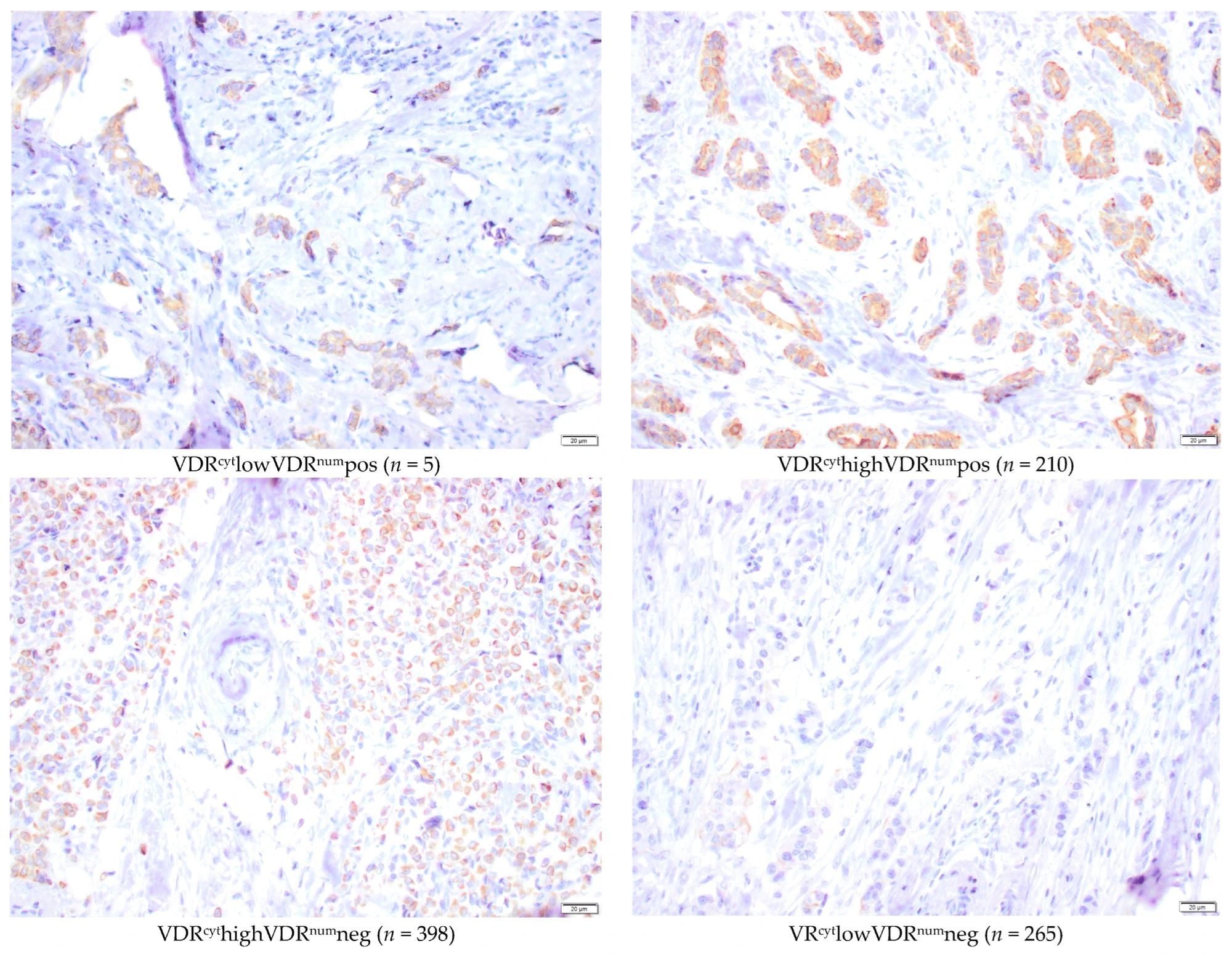
    Pathological assessment of human epidermal growth factor receptor 2 (HER2) status and TMA were assessed jointly using microscopic methods after blinding. In multiple subcellular locations of invasive tumor cells, VDR staining was examined in the nuclear membrane (VDRnum), cytoplasm (VDRcyt), and nucleus (VDRnuc).

    During the final follow-up in 2019, medical records, pathology reports, and national registries for population and tumors were used to calculate the breast cancer-free interval (BCFI) and calculate endpoints (death or last follow-up) for survival analyses.

    Findings

    On average, patients were 61 years old, and VDR was obtained for 878 tumors; cytoplasmic intensity evaluations showed that 7% were VDR-negative, while VDRnum was positive in 25% of patients. Tumors included in the analysis were, on average, large, of a higher grade, and more likely to be lymph node-negative than those that were excluded.

    Microscopic representative images of immunohistochemical staining intensities of nuclear membrane and cytoplasmic VDR (40×) in the TMA. Bar represents 20 µm.Microscopic representative images of immunohistochemical staining intensities of nuclear membrane and cytoplasmic VDR (40×) in the TMA. Bar represents 20 µm.

    Patients with VDRnum-positive tumors had smaller waist circumferences and breast volumes on average and were more likely to have screening-detected tumors. VDRnum-positive tumors were linked with lower tumor grade, positive hormone receptors, and the absence of HER2 amplification.

    After surgery, more VDRnum-negative patients received chemotherapy and trastuzumab, while VDRnum-positive patients received further endocrine therapy. In terms of prognosis, patients with VDRnum-positive tumors had better outcomes in both BCFI and overall survival (OS) in univariable analysis. This effect persisted after adjusting for various factors.

    When VDR localization was considered, VDRnum-positive tumors showed the best prognosis regardless of VDRcyt. Patients with both ER-positive and VDRnum-positive tumors had the best prognosis, while those with ER-negative and VDRnum-negative tumors had the worst. Even among ER-positive tumors, VDRnum-positive tumors were associated with lower tumor grade and longer OS.

    Interaction analyses suggested that VDRnum interacts with the mode of detection and size of tumors in the case of BCFI. Larger VDRnum-positive tumors (>20 mm) were associated with significantly fewer breast cancer events than small ones. Clinically detected VDRnum-positive tumors showed better BCFI than screening-detected ones.

    Conclusions

    This study highlights significant correlations between positive VDR staining in the nuclear membranes of breast cancer cells and favorable characteristics of tumors, OS, and longer BCFI.

    Results indicate that evaluating nuclear membrane VDR levels may be a better prognosis predictor compared to cytoplasmic levels. VDRnum status could refine luminal breast cancer selection with favorable prognoses, especially when considering interactions with tumor size and detection mode.

    VDR expression inversely correlates with aggressiveness, particularly in triple-negative and HER2-amplified cancers, possibly due to mutations in the tumor protein p53. Further research is needed to standardize VDR evaluation methods and explore associations with vitamin D levels.

    The study suggests potential clinical relevance for VDR as a prognostic marker and underscores the need for understanding the interplay between vitamin D, VDR, and breast cancer outcomes. Since most participants in the study were of European descent, heterogeneous populations should be included in future studies to ensure the generalizability of findings.

    Journal reference:

    • The vitamin D receptor as a prognostic marker in breast cancer – a cohort study. Huss, L., Gulz-Haake, I., Nilsson, E., Tryggvadottir, H., Nilsson, L., Nodin, B., Jirström, K., Isaksson, K., Jernström, H. Nutrients (2024). 10.3390/nu16070931, https://www.mdpi.com/2072-6643/16/7/931

    [ad_2]

    Source link

  • MUTYH gene mutation linked to increased risk of various solid tumors

    MUTYH gene mutation linked to increased risk of various solid tumors

    [ad_1]

    A gene associated with colorectal cancer appears to also play a role in the development of other solid tumors, according to a study of over 350,000 patient biopsy samples conducted by researchers at the Johns Hopkins Kimmel Cancer Center, the Johns Hopkins Bloomberg School of Public Health and Foundation Medicine. 

    Since the early 2000s, scientists have known that inheriting two mutated copies of the gene MUTYH leads to a 93-fold increased risk of colorectal cancer and is a major cause of that cancer in individuals younger than 55. The new study, published online Feb. 23 in JCO Precision Oncology, is the largest analysis to date to investigate whether a single mutated copy of MUTYH also affects one’s risk of developing cancer. 

    We know two missing copies of MUTYH greatly increases the risk of colon cancer, and now it appears that having only one missing copy may lead to a small increased risk of other cancer types.”


    Channing Paller, M.D., study’s lead author, director of prostate cancer clinical research and associate professor of oncology at the Johns Hopkins University School of Medicine

    She co-led the work with Emmanuel Antonarakis, M.D., associate director of translational research at the Masonic Cancer Center and Clark Endowed Professor of Medicine at the University of Minnesota Medical School. He was at Johns Hopkins at the time the research was conducted.

    The gene MUTYH encodes a critical enzyme in the base excision repair (BER) pathway, which fixes DNA damage in human cells. When the BER pathway isn’t working, routine DNA damage is not repaired, leading to additional DNA mutations or cell death. 

    Since 2021, Paller has co-led PROMISE, a genetic registry of patients with inherited mutations in prostate cancer. When one of her patients asked whether his MUTYH mutation, for which he had one defective copy rather than two, affected his aggressive prostate cancer, there was not enough data on MUTYH variants to answer the question, says Paller. Past studies reached conflicting results about whether a single, heterozygous mutation of MUTYH might predispose a person to cancer. 

    In pursuit of an answer, Paller reached out to Foundation Medicine, a Massachusetts-based genomic profiling company that maintains one of the world’s largest cancer genomic databases. With researchers at Foundation Medicine; Alexandra Maertens, Ph.D., of the Center for Alternatives to Animal Testing at the Bloomberg School of Public Health; and others, the team applied an advanced algorithm to analyze the genetic data of 354,366 solid tumor biopsies stored in the Foundation database. 

    Within that population of tumor samples, 5,991 had one working version and one mutated version of MUTYH. Of those, 738 (about 12%) had lost their working copy of the gene, leaving them with just the mutated copy. Those with a single, mutated copy of MUTYH showed a genetic signature, like a fingerprint, of additional genetic mutations and a defective BER pathway. Individuals with that genetic signature had a modest increase in susceptibility to a subset of solid tumors, including adrenal gland cancers and pancreatic islet cell tumors. However, they did not have an increased risk for breast or prostate cancer, resolving the original patient’s question. 

    The results suggests that MUTYH variants might be involved in a broader range of cancers than previously known, Paller says. 

    “The next question is whether this finding has therapeutic implications,” she says. “Can we target the BER pathway for possible drug sensitivities?” If so, doctors might be able to add a new therapeutic approach to their arsenal of tools against solid cancers. 

    Other study co-authors were from Cardiff University School of Medicine in the United Kingdom and the University of Minnesota Masonic Cancer Center in Minneapolis. 

    The research was supported in part by Department of Defense funding from the Congressionally Directed Medical Research Programs (grant W81XWH-22-2-0024), the National Institutes of Health (grant P30CA006973) and Advancing Cancer Treatment.Paller is a consultant or adviser for Dendreon, Omnitura, Exelixis and AstraZeneca; receives research funding from Lilly (Inst); and travel, accommodations and expenses from Bayer. Maertens maintains stock and other ownership interests in Pfizer.

    Source:

    Journal reference:

    Paller, C. J., et al. (2024). Pan-Cancer Interrogation of MUTYH Variants Reveals Biallelic Inactivation and Defective Base Excision Repair Across a Spectrum of Solid Tumors. JCO Precision Oncology. doi.org/10.1200/po.23.00251.

    [ad_2]

    Source link

  • Scientists uncover four proteins that govern the identity of anaplastic large cell lymphoma

    Scientists uncover four proteins that govern the identity of anaplastic large cell lymphoma

    [ad_1]

    A collaboration between scientists from St. Jude Children’s Research Hospital and Dana-Farber Cancer Institute uncovered four proteins that govern the identity of anaplastic large cell lymphoma (ALCL), an aggressive form of cancer. These proteins comprise a core regulatory circuit (CRC) that surprisingly incorporates a dysregulated signaling protein. Establishing the CRC for this lymphoma gives researchers insight into potential vulnerabilities that may be future therapeutic targets. The findings were published today in Cell Reports Medicine.

    “Mutations in signaling pathways have long been known to drive oncogenic transformation and tumor progression,” said senior co-corresponding author Mark Zimmerman, PhD, currently of Foghorn Therapeutics, previously of Dana-Farber Cancer Institute and Boston Children’s Hospital. “Our new results show a mechanistic link in this aggressive T-cell lymphoma between aberrant signaling pathway activation and the dysregulated gene expression that is a hallmark of these tumor cells.”

    ALCL patient tumors and models showed significant dysregulation of a protein called signal transducer and activator of transcription 3 (STAT3). STAT3 is a signaling protein that integrates information from other proteins, acting as a transcription factor (a protein involved in regulating the copying of genetic information from DNA into messenger RNA). 

    We have found how dysregulation of the signaling protein STAT3 is central to enforcing ALCL cancer identity. A healthy cell has a ‘Board of Directors’ made up of a few dominant regulators, and STAT3 gets ‘promoted’ from a division chief to a full board member with all the rights and powers that grants.”


    Brian J. Abraham, PhD, co-corresponding author, St. Jude Department of Computational Biology

    Among the genes it controls, STAT3 increases expression of the protein MYC, which is well-known to be associated with cancers. Nearly every ALCL cell line tested showed either a mutation in STAT3 or in a protein that signals to STAT3, causing it always to be always “on” and directing gene expression, promoting perpetual cell growth through its targets.

    The findings have implications for treatment because drugs that target the STAT family of proteins and other proteins that signal through STAT3 already exist.

    Finding a core regulatory circuit for all ALCL subtypes

    “Transcription factors and proteins that regulate the oncogenic gene expression programs are emerging as some of the most direct and effective targets for cancer therapy,” said first author Nicole Prutsch, PhD, Dana-Farber Cancer Institute and Boston Children’s Hospital. “STAT3 was already a recognized transcriptional activator in ALCL, but our research has identified a core transcriptional regulatory circuit hijacked by STAT3 to drive genes essential for ALCL cell growth.”

    STAT3 hijacks three transcription factors that comprise the CRC: BATF3, IRF4 and IKZF1. All were expressed at high levels in ALCL cells, although they lacked any cancer-causing mutations. They were also identified as potential vulnerabilities in the DepMap Consortium gene knockout studies. When the scientists lowered the expression of any of these proteins, it significantly reduced cancer cell growth, demonstrating the centrality of the CRC.

    “This is the first core regulatory circuit, to our knowledge, identified for ALCL,” Abraham said. Of the two major known molecular ALCL subtypes, anaplastic lymphoma kinase (ALK)-positive has an 80% survival rate, while ALK-negative has a 48% survival rate. Contrary to these differences, the researchers found both types relied on the same CRC.

    “ALCL represents a diverse group of T-cell lymphomas with distinct clinical behaviors,” Prutsch said. “While ALK-positive cases respond well to ALK inhibitors, ALK-negative ALCL is highly aggressive and possesses limited targeted therapy options, highlighting the critical need for new treatment strategies.”

    To understand the difference between the subtypes and find potential vulnerabilities, the researchers mapped special complexes of DNA and proteins called super-enhancers. These clusters of transcription-regulating elements are known to influence gene expression tightly. In cancers, super-enhancers can play a role in maintaining the cancer’s identity as a malignancy. 

    The scientists found that super-enhancers that differed among ALCLs converged to highlight the same CRC across ALCL tumors and models.

    “The core regulatory circuit appears to be common across what have historically been treated as distinct diseases,” Abraham said. “Regardless of if an ALCL cell is ALK-positive or ALK-negative, it relies on the expression and the positive feedback provided by this circuit to stay ALCL.”

    Potential vulnerabilities highlight treatment opportunities

    Understanding the central role of the CRC in this cancer has implications for treatment. Drugs that target the STAT family of proteins and other proteins that signal through STAT3 already exist -; but they have seen limited success, particularly in ALK-negative disease. Knowledge of the CRC and its interaction with STAT3 may allow for developing novel therapeutics and combination strategies.

    “Our findings reveal a significant relationship between the core regulatory circuit members and STAT3,” Prutsch said, “This emphasizes the potential for therapies leveraging these connections and offers attractive options for developing new treatments in ALK-negative ALCL.”

    The same methods used in the study may also provide a path to understanding and searching for vulnerabilities in other malignancies without a clear driver mutation.

    “Our discovery indicates that exploiting the interconnectedness between signaling and transcriptional dependencies is a rational approach to developing new treatment strategies across a broad range of cancers,” Zimmerman said.

    Authors and funding

    The study’s other authors are Shuning He, Alla Berezovskaya, and Kimberly Stegmaier, Dana-Farber Cancer Institute and Boston Children’s Hospital; Neekesh Dharia, Genentech; Jamie Matthews, Lucy Hare, and Suzanne Turner, University of Cambridge, Addenbrooke’s Hospital; Lukas Kenner, Masaryk University; Olaf Merkel, Medical University of Vienna; and Adam Durbin, and Kelsey Maher, St. Jude.

    The study was supported by grants from the National Institutes of Health (R35CA210064, R35CA210030 and K08CA245251), Lymphoma Research Foundation, Julia’s Legacy of Hope St. Baldrick’s Foundation Fellowship, National Institute for Cancer Research (Programme EXCELES, ID Project No. LX22NPO5102), European Union – Next Generation, Cancer Research UK Cambridge Centre (CTRQQR-2021\100012), Alex’s Lemonade Stand Foundation, Charles A. King Trust, Claudia Adams Barr Foundation and ALSAC, the fundraising and awareness organization of St. Jude.

    Source:

    Journal reference:

    Prutsch, N., et al. (2024) STAT3 couples activated tyrosine kinase signaling to the oncogenic core transcriptional regulatory circuitry of anaplastic large cell lymphoma. Cell Reports Medicine. doi.org/10.1016/j.xcrm.2024.101472.

    [ad_2]

    Source link