[ad_1]
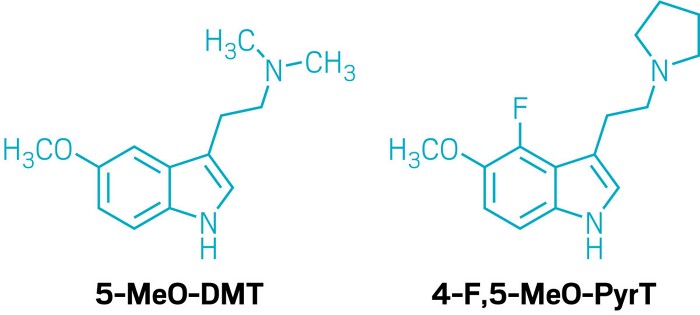
To deter predators, the Colorado river toad (Incilius alvarius) exudes the toxin 5-MeO-DMT from glands within its skin. While the substance puts off predators, people who consume 5-MeO-DMT can have a psychedelic experience. Psychedelic substances have gained attention in recent years as treatments for depression and other central nervous system disorders. Now, researchers have made an analog of 5-MeO-DMT that appears to relieve anxiety and depression in mice without causing hallucinations.
The compound, called 4-F,5-MeO-PyrT, preferentially binds to the serotonin receptor 5-HT1A. That’s by design. Until now, researchers have focused primarily on the 5-HT2Areceptor when studying psychedelic compounds, and the 5-HT1Areceptor has been underappreciated, says Daniel Wacker of the Icahn School of Medicine at Mount Sinai. Wacker led the development of 4-F,5-MeO-PyrT along with Dalibor Sames of Columbia University.
Using cryogenic electron microscopy and medicinal chemistry, Wacker and Sames’s team developed a toolbox of compounds based on the structures of serotonin and 5-MeO-DMT. This series of molecules lets them dial in selectivity for 5-HT1Aversus 5-HT2A (Nature 2024, DOI: 10.1038/s41586-024-07403-2).
For example, where 5-MeO-DMT has a methoxy group, serotonin has only a hydroxy group. This difference changes how the two compounds bind. “We saw from the structure how effectively the methoxy group pushes the molecule further down into the pocket, making very different interactions in 5-HT1A,” Wacker says.
By changing 5-MeO-DMT’s dimethyl amine into a pyrrolidine, the researchers created a molecule that’s selective for 5-HT1A compared with 5-HT2A, “which is exactly what we wanted to do,” Sames says. And adding a fluorine to the indole core changed the molecule’s electronic properties, further boosting its selectivity. It’s surprising that “with such small molecular real estate you can achieve very high affinities” for these receptors, Sames says.
In tests with mice, the chemists’ lead compound, 4-F,5-MeO-PyrT, alleviated anxiety and depression in rodents that were bullied by other mice. 4-F,5-MeO-PyrT did not cause the head twitching in mice that’s associated with hallucinogenic compounds, including 5-MeO-DMT.
David E. Olson, director of the University of California Davis Institute for Psychedelics and Neurotherapeutics, calls the work “a really nice example of how structural biology can shed light on medicinal chemistry results,” adding that the structures of the 5-HT1A receptor are an important addition to the literature.
Olson also says that the new compounds add to the body of evidence “that psychedelic scaffolds are privileged structures” that could lead to new central nervous system drugs. “They already have preoptimized physical properties for getting into the brain at high concentrations,” he says.
Wacker and Sames say that they’re interested in moving some of these compounds into the clinic but are still deciding which is the most promising as a drug candidate.
[ad_2]
Source link
Leave a Reply