


A mouse study probing why psilocybin’s effects may depend on the brain’s starting state also tests a long-running question about whether being awake during the psychedelic experience actually matters.
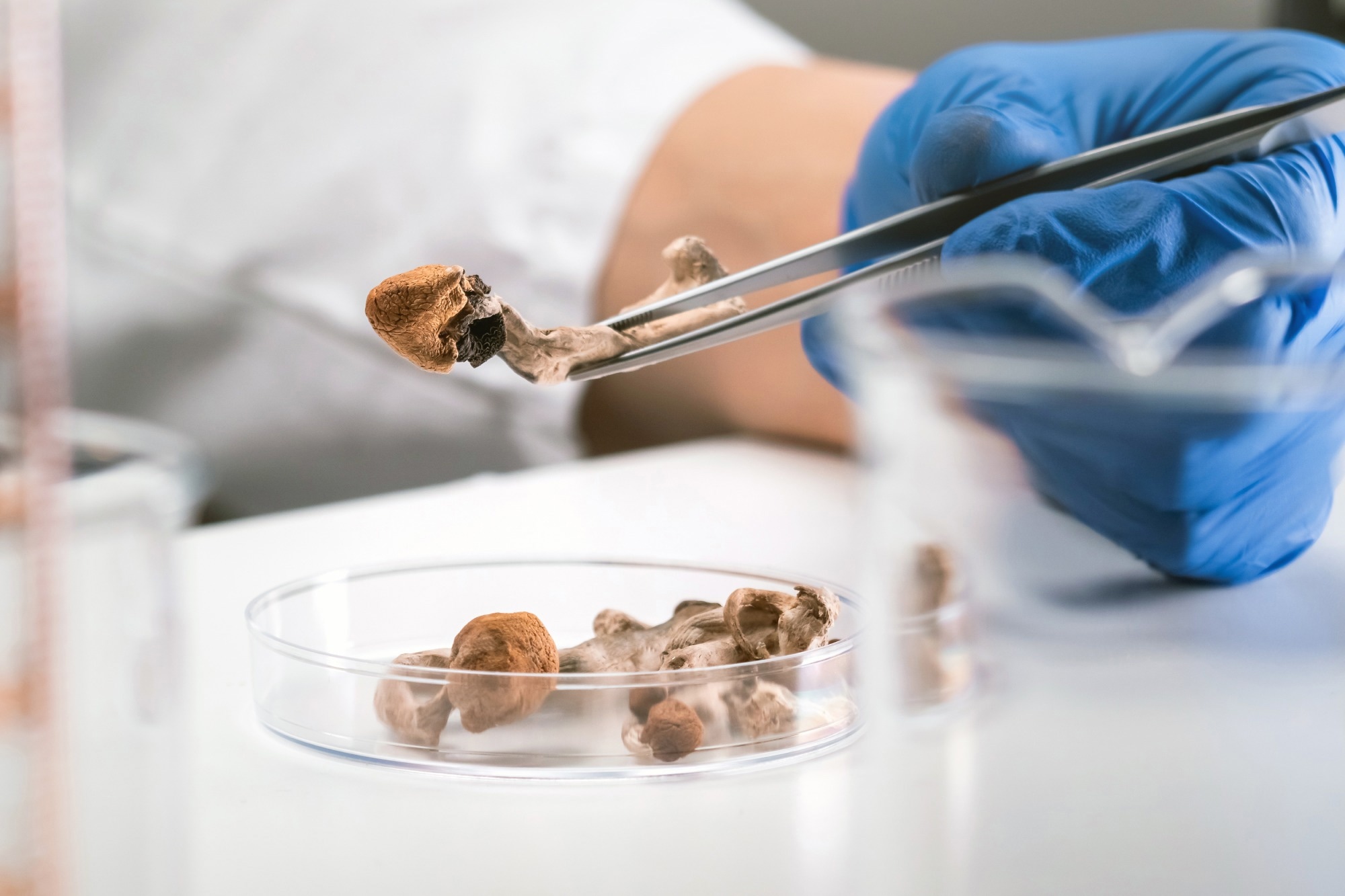
Study: Psilocybin enhances sociability only in altered behavioural state and does not need an awake experience to be effective. Image Credit: 24K-Production / Shutterstock
A new study published in the journal Nature Communications reveals that psilocybin, a psychoactive compound found in certain mushrooms, can increase sociability in a Cntnap2-knockout mouse model with reduced social behavior, but not in mice without baseline social deficits.
Background
Psychoactive compounds, such as psilocybin, can exert long-lasting effects on brain structure and function. Recent evidence highlights the clinical efficacy of psilocybin in treatment-resistant depression, while its potential effects on anxiety, addictive and compulsive behaviors, and reduced social cognition remain under investigation.
Reduced sociability, a form of social cognition and behavioral trait that can reflect altered brain function, is a common symptom in various neuropsychiatric disorders, including autism spectrum disorder (ASD), major depressive disorder, schizophrenia, and dementia.
Several preclinical and clinical studies have shown that a single dose of psilocybin can have a long-lasting impact on brain structure and function. However, a recent multicenter study found no lasting prosocial effects of psilocybin in mice with normal social behavior, suggesting that its lasting effects may depend on baseline behavioral or neural state.
Clinical studies have also raised a concern about the challenges in managing hallucinations or other adverse neuropsychiatric experiences of patients who are undergoing psilocybin treatment. One way to investigate this question experimentally is to suppress wakefulness during the acute effects of psilocybin. However, it remains unclear whether an active, awake psychedelic experience is required for psilocybin’s lasting and potential therapeutic effects.
Given this gap in the literature, an international research team investigated whether a single systemic injection of psilocybin could restore altered social behavior in a well-established mouse model with reduced sociability. The authors used the model to study an altered behavioral state rather than to test psilocybin as a treatment for ASD.
They administered the drug to experimental mice under light anesthesia to explore whether wakefulness during psilocybin’s acute effects is required for the subsequent behavioral response.
Key findings
The researchers used a well-established genetic mouse model carrying a Cntnap2 knockout and showing reduced sociability to examine whether a single systemic injection of psilocybin can induce a long-lasting increase in social behavior.
They used the three-chamber social behavior test to assess the sociability-enhancing effect of psilocybin in experimental mice at 1 day, 1 week, and 2 weeks post-injection. The researchers found a significant improvement in sociability one day after the single-dose psilocybin treatment, which persisted for at least two weeks. An independent group of mice, tested for the first time two weeks after treatment, showed the same effect, supporting its persistence independent of repeated testing.
Notably, the researchers did not find any significant overall enhancement of sociability in psilocybin-treated wild-type (no genetic alteration) mice with normal social behavior. A separate analysis of the one-day time point indicated reduced sociability, although the authors did not conclude that psilocybin had a negative effect in wild-type mice. This finding supports previous reports highlighting psilocybin’s inability to further enhance sociability in animals with normal social behavior.
Regarding two other ASD-related behavioral phenotypes, the results showed that the same single-dose psilocybin treatment had no significant impact on repetitive behaviors and hyperactivity in Cntnap2-knockout mice at the one-day and one-week assessments.
Since psilocybin primarily acts through the activation of serotonin 2A receptors, the researchers suppressed receptor activation by pretreating experimental mice with a specific blocker 15 minutes before psilocybin treatment. The experiment showed that 5-HT2A receptor blockade prevented the sociability-enhancing effect of psilocybin.
To explore whether an awake, active neuropsychiatric experience is required to achieve the lasting behavioral effects of psilocybin, the researchers treated lightly anesthetized mice with the same single-dose psilocybin regimen. They observed a significant increase in sociability across assessments conducted at 1 day, 1 week, and 2 weeks after psilocybin treatment administered under anesthesia.
Study significance
The study highlights the long-lasting behavioral effects of a single dose of psilocybin in enhancing sociability in Cntnap2-knockout mice with reduced social behavior. Notably, the findings reveal that psilocybin did not enhance social behavior in mice without baseline social deficits and that its sociability-enhancing effect did not require the mice to remain awake during the acute period of drug action.
These findings provide experimental evidence relevant to the ongoing debate regarding whether an awake psychedelic state is required for some of psilocybin’s lasting effects.
Existing evidence on the mode of action of psilocybin in mice suggests drug-induced activation of brain circuits in the prefrontal cortex, where 5-HT2A receptors are prominently expressed. A single-dose psilocybin injection can stimulate these circuits for a short period, which the authors suggest may be comparable to other non-invasive stimulation techniques such as transcranial current stimulation, magnetic stimulation, and ultrasound stimulation.
These techniques have been found to induce long-lasting changes in both animal and human brain functions. The current findings suggest that psilocybin may produce more specific circuit activation than these broader stimulation techniques by acting through a defined serotonin receptor subtype.
The observed preservation of psilocybin’s behavioral effect under anesthesia has potential translational significance because it suggests that an awake psychedelic-like state during drug exposure may not be necessary for this particular lasting effect in mice. However, subjective psychedelic experiences cannot be directly assessed in mice, and the authors note that anesthesia itself may influence the cellular mechanisms underlying psilocybin’s effects.
Furthermore, the absence of sociability enhancement in mice without behavioral deficits suggests that the drug is not a general sociability enhancer and that the authors’ proposed model of different behavioral and neural-circuit setpoints for normal versus deficit states warrants further investigation.
The authors caution that this was a fundamental study in mice and cannot establish whether psilocybin would have similar effects in humans or provide therapeutic benefit for people with ASD. They also note limitations of the three-chamber sociability test and emphasize that the Cntnap2-knockout mice were used specifically as a model of altered sociability rather than to establish a treatment for autism.
Journal reference:
- Song, C., Chang, T., Buchborn, T., & Knöpfel, T. (2026). Psilocybin enhances sociability only in altered behavioural state and does not need an awake experience to be effective. Nature Communications. DOI: 10.1038/s41467-026-77238-0. https://www.nature.com/articles/s41467-026-77238-0