

A cooling station in Cologne, Germany, offered relief during a June heat wave exacerbated by climate change. Credit: Ina Fassbender/AFP/Getty
The goal of limiting global warming to 1.5 ºC to avoid the most dangerous consequences of climate change is officially dead. According to a report released today by the United Nations Environment Programme (UNEP), the best the planet can hope for on its current emissions trajectory is warming of about 1.8 ºC above pre-industrial levels this century.
“Obviously, yes, we have climate procrastinated,” Inger Anderson, UNEP’s executive director, said during a briefing on 1 September. “And obviously yes, when we started UNFCCC [the United Nations Framework Convention on Climate Change] we knew what action had to be taken. And we have not taken it at the speed that we could have.”
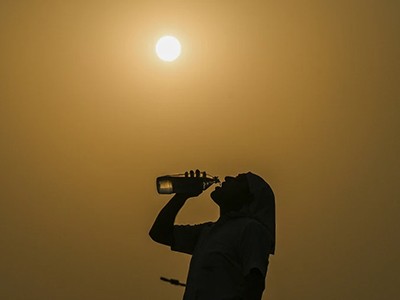
Climate change is speeding up — the pace nearly doubled in ten years
The nearly 200 countries that signed the Paris climate accord in 2015 agreed to cut greenhouse gas emissions fast enough to keep the rise in global average temperatures “well below” 2 ºC relative to the pre-industrial average, with a stretch goal of limiting the rise to 1.5 ºC. Beyond that 1.5 ºC threshold, the risks of triggering dangerous tipping points in the climate system grow more acute1, and rise with every tenth of a degree of warming beyond that point, according to the UN’s Intergovernmental Panel on Climate Change (IPCC).
The 1.5 ºC target remained a prominent goalpost of UN climate negotiations even as countries failed to make the steep cuts that would have been needed to achieve that goal. The theme of the UN climate summit in Glasgow, Scotland in 2021 was “keep 1.5 ºC alive,” and the UN climate meeting last year in Brazil ended with a resolution “to keep 1.5 ºC in reach,” even as researchers pointed out that global average temperatures in 2024 had surpassed 1.5 ̊C above preindustrial levels for the first time. The long-term average used to define the target is now expected to breach 1.5 ºC by the end of the decade.