




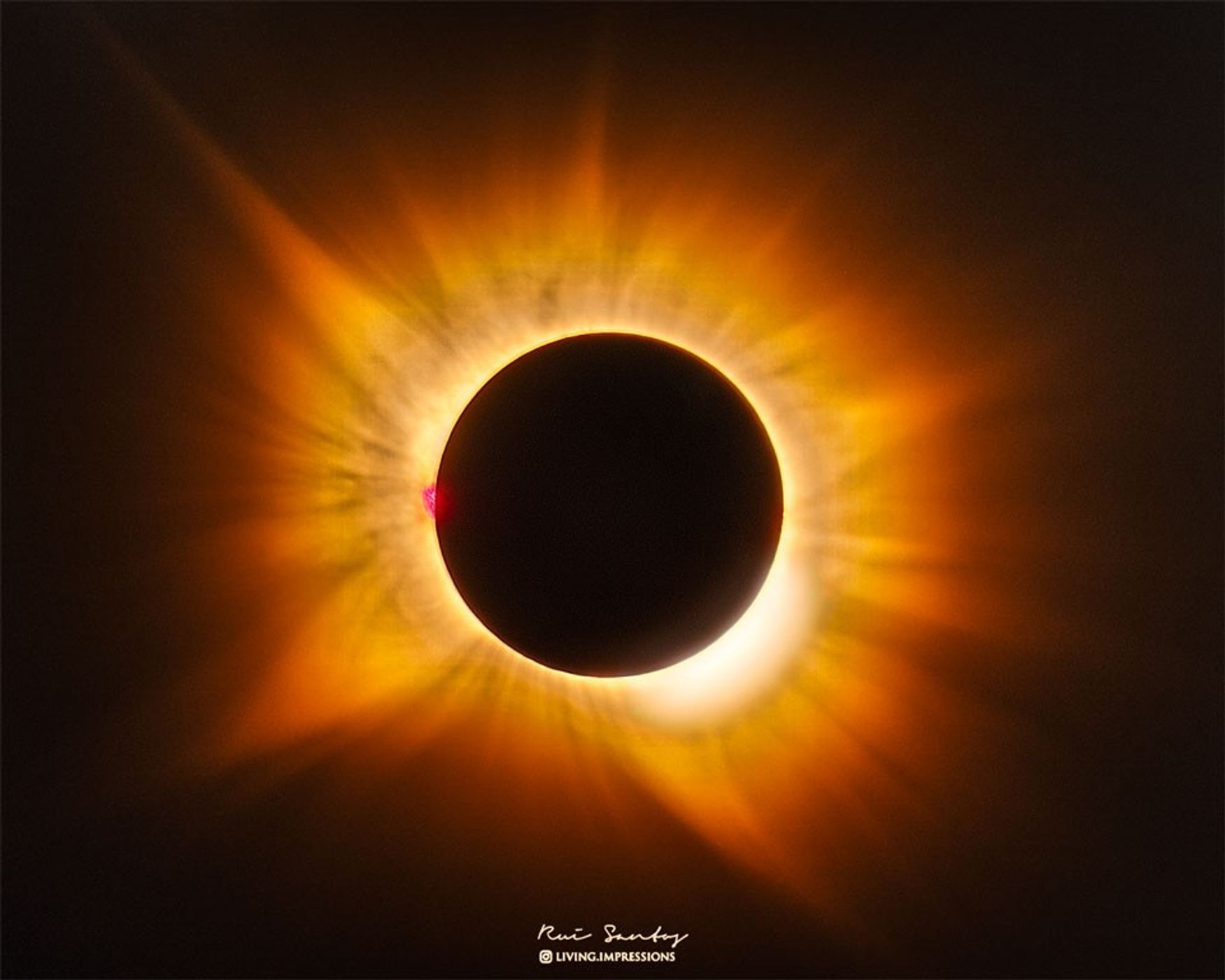
If, in perusing photos of the 2026 solar eclipse, you noted that the corona around the blotted-out sun looked particularly luminous: Congratulations, you have a great eye.
Usually, the corona, or the outermost part of the sun’s atmosphere, appears bright white during a solar eclipse, as it remains visible outside of the moon’s silhouette. However, in parts of Spain, the corona appeared to be more of a golden hue.
Read more: “Awe-Inspiring Images from This Year’s Solar Eclipse”
Here’s why: It was later in the evening in Spain when totality occurred, which meant the sun was low near the horizon, and at that angle, the sunlight has a lot more atmosphere to travel through to reach observers on the ground. The atmosphere scatters blue wavelength light in particular, as nitrogen and oxygen molecules disrupt its travel, leaving behind a golden glow.
The other factor at play was the wildfires across Spain, exacerbated by the heat waves that baked Europe this summer. Smoke acts as its own solar filter, scattering wavelengths that aren’t red and orange, once again leaving a golden color in its wake.
The header image for this post, taken by nature photographer Rui Santos in the town of Benavente, has one additional abnormality as well—a solar prominence erupting from the left of the moon’s silhouette. It’s a plume of electrically charged plasma that appears pink because of the high concentration of hydrogen in it.
If you’re looking to capture something like this yourself in the future, the next total eclipse will be visible from parts of Spain, Africa, Saudi Arabia, and Yemen on August 2, 2027. After that, you’re looking at July 22, 2028, though you’ll have to be in Australia to see the full effect of that one.
That said, it’s definitely worth multiple trips, as between atmospheric conditions and the distance from the horizon, no two eclipses are the same.
Enjoying Nautilus? Subscribe to our free newsletter.
Lead Image: Rui Santos via NASA