


This week, we discuss a study showing promise in applying CAR-T immunotherapy in bladder cancer tumours and breakdown how scientists have uncovered spectral signatures previously misassigned in carbon materials – with Frankie Macpherson and Mason Wakley.
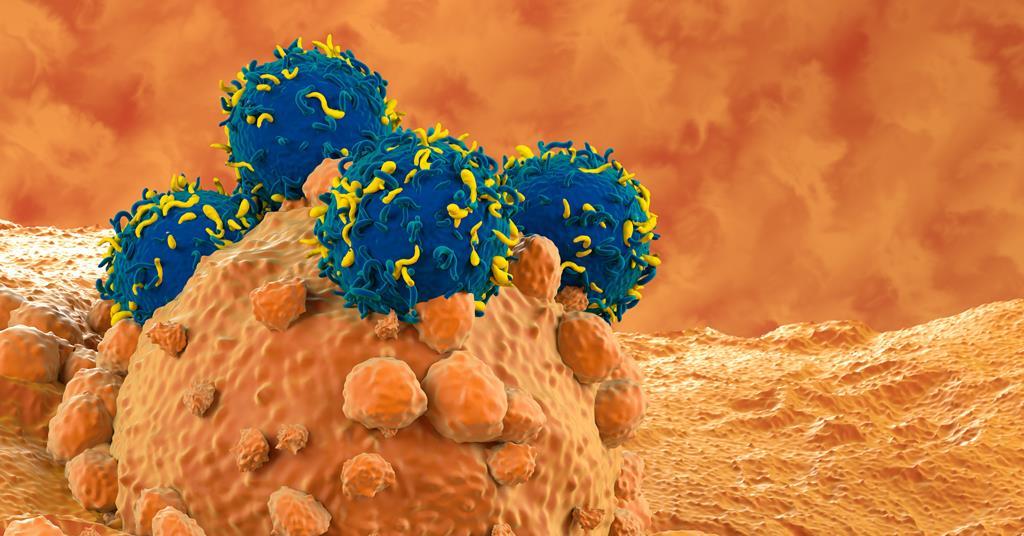
Researchers have developed a new immunotherapy for bladder cancer that has shown promise in mice, using genetically engineered human T-cells to target and destroy bladder cancer cells. The development comes as part of wider progress in chimeric antigen receptor T cells, also known as CAR-T therapy, for solid tumours. CAR-T has been around for a while, mainly as a treatment for blood cancers, but recent research advances mark a significant step forward in applying it to solid tumours, which make up the majority of adult cancers. As this field continues to develop, what barriers does CAR-T therapy face in moving beyond its current applications and reaching more patients?
And, from lightweight aircraft components to batteries and fuel cells, carbon materials underpin many of the technologies we rely on every day. Many of their most valuable properties are shaped by their structure. In particular, tiny imperfections known as defects can make a big difference in the material’s behaviour.
Scientists identify and study defects in carbon materials using spectroscopic techniques. But new research suggests we may not always be interpreting those measurements correctly. By modelling various defects and comparing spectra with carbon materials, researchers found that defects present in these materials have been misidentified. If that’s the case, what does it mean for our understanding of carbon materials, and could some long-held assumptions in the field need revisiting?
We would love to hear your feedback on this podcast, so if you have any questions or comments please get in touch.
Introduction and Weekly News
Mariana Kneppers
CAR-T therapy has been a game-changer for blood cancers, yet solid tumours have been largely resistant to this treatment. We discuss a new study that shows promise in applying this immunotherapy in bladder cancer tumours.
And scientists may have been misinterpreting some of the atomic fingerprints used to identify defects in carbon materials. What does this mean for the technologies that rely on them, and do we need to rethink some long-held assumptions?
I’m Mariana Kneppers, Chemistry World’s science media producer, and this is the Chemical Breakdown.
We’ll be diving deeper into these stories shortly, but first let’s take a look at this week’s news from the Chemistry World website.
Researchers in China have successfully made the longest chains of single metal atoms ever. The scientists believe these carbon sheathed wires could have wide-ranging applications, although questions remain about their scalability.
A graduate student at Hokkaido University in Japan has died following an accident involving hydrofluoric acid. Two other students were harmed during the incident, but are currently in stable condition, according to a statement from the university.
Adding manganese oxide, nickel and a small amount of scandium can significantly improve both the durability and performance of sodium ion batteries. The early stage finding shows that the battery’s lifespan and charging performance can increase more than three times when scandium is used as a coating or structural additive.
And a new study has shown that the bright and saturated colours produced by some dye molecules can fall outside of the 8-bit sRGB colour space used by digital cameras. The researchers warn this could potentially lead to misinterpretations in automated analyses.
You can find these stories and more online. Just visit chemistryworld.com for more of the latest news in the chemical sciences.
CAR-T Therapy for Bladder Cancer
Mariana Kneppers
Researchers have developed a new immunotherapy for bladder cancer that has shown promise in mice using genetically engineered human T cells to target and destroy bladder cancer cells.
The development comes as part of wider progress in chimeric antigen receptor T cells, also known as CAR-T therapy, for solid tumours.
CAR-T therapy has been around for a while, mainly as a treatment for blood cancers, but this study marks a significant step in applying it to solid tumour cancers.
As this field continues to develop, what barriers does CAR-T therapy face in moving beyond its current applications?
Here to discuss today’s stories are digital content assistant Frankie Macpherson And science correspondent Mason Wakley. Hello to you both. Hi there. Hi guys, thanks for being here.
So Frankie, for those of us who don’t know, what is CAR T cell therapy? How does it work? Can you give us a bit of background on that?
Frankie Macpherson
Yeah, so like you said, it’s a type of immunotherapy, but it’s really quite tailored to patients.
You mentioned the acronym there briefly. The CAR is chimeric antigen receptor, and it’s actually made-up of three different components to make sure that it can not only target and bind to them, but can destroy cancer cells.
And everyone’s maybe heard of T cells before. You can think of your T cells as like your killer or fighter cells. They fight off infection, sometimes viruses.
And so CAR T cells are basically genetically modified T cells from the patients.
Essentially by isolating these T cells, researchers are then able to introduce a CAR, which they’ve got three different sort of antigens or proteins that target specific proteins that are known to be on the surface of cancer cells.
And so they create this in the lab and then they insert it into people’s own T cells so that it’s not rejected by the body and then they infuse that back in.
So that’s the usual process is they infuse it back into people’s bloods because CAR T cells has been quite revolutionary for blood cancers where patients are resistant to other treatments and in some patients they’ve even seen like really long term impact so they don’t have recurrence at the same rate as previously.
But one of the biggest challenges for researchers and clinicians has been adapting this to solid tumours.
So obviously you can identify different antigens for solid tumours, but how do we make sure that it reaches the tumour?
Solid tumours often are surrounded by like an actual physical barrier as well. And yeah, so that’s part of the challenge.
Mariana Kneppers
I see. So I guess before, you know, when it was used in blood cancers, I guess blood cancers, they’re a bit more widespread.
So you can kind of do something intravenously, whereas solid tumours, you’re going to have to target a specific system.
And now it sounds like the way that CAR T therapy works is quite targeted anyway, right?
Like it’s targeting a specific, I guess if you want to call it a label that’s on these cancer cells.
But in this study, they also delivered it by catheter. Is that, did that help with the targeting itself?
Frankie Macpherson
Definitely. So you can call it different things.
And this, it was sort of catheter intravesical delivery because it was going into the bladder directly.
But different researchers looking at other solid tumours have found different ways to deliver direct to tumours elsewhere in the body.
Catheter was really beneficial for this because loads of other bladder treatments already use catheters into the bladder and so it was like an established treatment pathway that they were able to take advantage of.
As well as the challenges of trying to improve CAR T cell therapy for solid tumours, there are benefits in terms of it not circulating the blood and potentially having like on target binding to healthy cells that have these similar sort of labels like you said or proteins and then activating in that way and sort of damaging healthy tissues, which has been a real challenging thing that clinicians and people involved in the treatment of the blood cancers have to monitor in patients that receive the already approved CAR T-cell therapies.
Mariana Kneppers
Yeah, of course. And it’s something that I think, you know, Unfortunately, a lot of people know someone or maybe even themselves have been through cancer treatments and chemotherapy is obviously a very well known thing.
And people often talk about the side effects of chemotherapy, the classic being losing your hair, kind of attacking the fastest growing cells in your body.
Is this treatment a way that, I mean, will it also reduce side effects because it is so targeted?
Frankie Macpherson
So it can reduce side effects. So for solid tumours, I should say that it is for patients that are resistant to other forms. of treatment, but it can reduce side effects.
Sometimes patients will still get chemotherapy as well, but one of the researchers I spoke to said because this isn’t circulating in the blood and potentially, in this particular study, obviously it was done in mice, so it’s early days before it can reach clinical trials, but it showed real success and they had a low level of what’s called leakage, which means it wasn’t reaching any tissues outside of the tumour or hardly any.
And that does mean that there’s not things like that we call it cytokine storm when all these other tissues are being attacked as well and your body is just like feels like it’s shutting down in a way.
So that does lower it.
And one of the researchers I spoke to said it opens up the potential for repeat dosing in a way that you maybe wouldn’t consider with these more intense is still intense, but with these therapies that have a long list of side effects and are really exhausting and waiting on the body.
And so that was something that they were sort of keeping an eye on for when this does reach the clinical trial stage.
And they’re keen to see how it progresses in that way.
Mariana Kneppers
Yeah, absolutely. And why specifically bladder cancer? I mean, did they choose particularly bladder cancer as like a model cancer to kind of translate CAR-T cell therapy into solid tumours?
Was there a specific reason they started with bladder cancer or has this been going on with other kinds of solid tumour cancer already?
Frankie Macpherson
It’s a good question. There’s lots of research in other solid tumours as well.
So 2 of the independent researchers I spoke to have investigated CAR therapy for One of them, I believe it was gynecological cancers and head and neck cancers as well.
And so it definitely is being investigated in other areas.
For these researchers, I guess there was the attraction in terms of having that catheter delivery already being established.
Bladder cancer treatment also can typically involve sort of surgical tumour removal, which is then followed by chemotherapy.
But sometimes patients that are resistant to chemo then end up having their whole bladder removed.
And so it is like quite a significant life-changing treatment.
And as one of the world’s like most common cancers, bladder cancer, is something that researchers have been anyway searching for sort of bladder sparing cancer therapies.
And so this is like an opportunity to address that challenge and to take advantage of the benefits that come with the treatment pathways we already have for bladder treatment.
Mason Wakley
Yeah, absolutely. Are there any disadvantages with this type of therapy?
You know, in my head, this seems like this could be a lot more difficult to carry out within a clinical setting or the cost of these therapies could hinder their application.
And I didn’t know whether you had any insight into that?
Frankie Macpherson
Yeah, definitely. So cost and resources is a huge issue for like translating these therapies even from the lab to patients.
And so because it’s tailored and you have to go through these processes to gather the sort of harvesting the T cells from patient’s blood and then genetically modifying and all of these steps.
There are a couple of CAR T cell therapies approved for blood cancers and lymphomas and things like that, but it is quite expensive.
And so that is a huge barrier.
One of the researchers I spoke to mentioned in vivo CAR T therapy that he was saying is the hot topic now because it is a promising lower cost route that a lot of researchers are looking into.
It’s still new, but there seems to be like a lot of excitement around it because it reduces cost.
It involves like the intravenous administration of the CAR vector.
So like I mentioned like a system with three components, each having a slightly different job.
One is tailored to recognise this other protein. One is to signal that it’s like others like activate the cell destruction.
So it’s this in vivo CAR therapy as a real opportunity to reduce that big barrier, which has the cost by basically intravenously administering this CAR vector and then like inside like a nanoparticle or something that can sort of be accepted in the body and then generate the CAR T cells in the patient’s own blood circulation.
So I assume, because I haven’t looked loads into this area, I assume there is an additional component bound to the CAR that is for finding the T cells in that way, which is quite interesting.
When you’re reading around CAR therapy, a lot of the really interesting stuff is how tailored it can be.
Like you can have armoured CAR-T cells that can target two things at once or they can hopefully prevent some of the side effects or sometimes a challenge with solid tumours has been, like I said, reaching the tumour.
But it’s also in the process of getting there, can be other things that go on in the body that can almost like turn the car to sleep.
And so researchers can armour cars with extra components to avoid this.
Mariana Kneppers
So interesting. It does sound like very modular in nature, right?
So it sounds like a literal like car.
That’s you’re adding all these different components onto and like the idea of an armoured car going in to like fight cancer in your body is like, it’s quite an image, right?
I mean, because that is kind of what you’re doing. You’re battling cancer in your body.
Mason Wakley
How does that kind of modular component building, as you phrase it, Mariana, how does that then influence the practicalities of it in the sense of, you know, does this vary by patient or are there signals on certain tumour cells, for example, that are widespread amongst like a general population?
And how do they actually find out what signals or like antigens on surface cells that they need to bind to create this therapy in the 1st place?
Frankie Macpherson
Great question. And There’s a couple components in there.
One is that, yes, generally it is really tailored and specific. And so some patients might not respond in the same way.
But the second part of like, how do they find the cancers? Most of the approved CAR therapies are targeting a protein called CD19 and that is found on lymphomas and it’s like sort of a B cell antigen protein.
As a result, though, because we have loads of healthy B cell tissues, they express this.
That is why I was saying earlier, you sometimes have to be really watchful and ensure that you’re supporting against any binding that is of healthy tissues.
But for other cancers, so one of the researchers I spoke to, like I said, is investigating, I think it was ovarian cancers, and because research and Harvard was targeting a similar overall marker called MUC16 that this bladder cancer research targeted.
But this research took a really systematic approach and they tried to generate their CAR to bind to this target in the same way as others have for other cancers because there’s some generally identified ones from research of old MUC16 as like a already known target for certain cancers, but it didn’t bind in that same way.
So then they had to use a mesothelin component, like a different sort of cell protein, and that was their binding element.
And so even between different cancers expressing the same target, you have to find a slightly different approach to actually bind and have successful therapy.
And so all of the researchers I spoke to spoke about how more and more you’re seeing like the need for cancer specific tailored treatment.
Interestingly, this in vivo car therapy would still need to be targeted to the cancer, of course, but like it could open up the opportunity for almost like off the shelf or like mass producing these cars because you don’t have to like take the patient’s blood and isolate the T cells and all of those things.
So it seems like a more generalised approach and it could be, but it would still need to be tailored to different specific cancer targets.
And that’s a huge part of generating those like modular components is finding not just the target, but how you can bind to it with that specific cancer.
Mariana Kneppers
Yeah. Gosh, it sounds like there are so many options for this treatment.
I mean, the field’s kind of wide open, isn’t it?
But that being said, how long, I mean, it’s a bit of crystal ball gazing, but did you get a sense from any of the researchers you spoke to on how long it might be before it becomes available?
What kind of obstacles remain for that?
Frankie Macpherson
So I spoke to the lead researcher or one of the co-leads in this study and I spoke to some independent researchers and they all sort of identified cost and resources as a huge barrier to transitioning to clinical trials.
The lead researcher was also, when they reached clinical trial, keen to really do a thorough exploration and encounter and preempt any issues so that they can have as thorough a study as possible.
One of the researchers, John Mayer from King’s College London, said that while it has been transformative in blood cancers, it really is very different for solid tumours to translate it.
And sometimes you can have really great preclinical data and it can look different in patients because patients are different to mice.
And so, yeah, he was saying it could take decades, it could be very different.
The other researcher I spoke to, Dr. Yuku from America was saying that he thinks the preclinical data is so strong that once they are getting to that clinical studies trial stage, he’s quite hopeful to see how it then is translated.
But then after the clinical study, that can take years and then even longer to receive approval.
You can be like, oh, I’ve got this hope when you read about the research and then it can be like a long wait sometimes to see that come to fruition.
Obviously, sometimes patients can get access to trials as part of that.
But yes, it’s still a long process to get things approved.
The first ever CAR T therapy for solid tumours was approved just like a month or two ago.
We received approval in China for advanced gastric and gastroesophageal cancers.
And that is again for patients that are resistant to normal treatment, but that’s the first in the field for solid cancers.
So that is, yeah, giving people that hope as well to see that there are some already coming through.
Mariana Kneppers
Yeah. Some positive news, there are, the wheels are moving on the car if you want to keep that metaphor moving.
But yeah, we’ll see.
I mean, fingers crossed, that we see more developments as this goes on, but it’s a promising start and sounds like we’re moving in the right direction.
So yeah, thanks so much.
Carbon Materials and Spectroscopy
Mariana Kneppers
Carbon materials underpin many of the technologies we rely on every day, from lightweight aircraft components to batteries and fuel cells. Many of their most valuable properties are shaped by. tiny imperfections in their structure, known as defects, which scientists identify and study using spectroscopic techniques. But new research suggests we may not always be interpreting these measurements correctly, potentially leading us to misidentify the defects present in these materials. If that’s the case, what does it mean for our understanding of carbon materials, and could some long-held assumptions in the field need revisiting?
Mason, can you give us a bit of context here for those of us who are unfamiliar with materials in general? How and why are scientists using spectroscopy here? I mean, what is the context for all of it?
Mason Wakley
Spectroscopy is one of those techniques that chemists and material scientists use just to simply study their materials. If they’re making something new that they haven’t made before, you want to fully characterise it. And spectroscopy allows you to figure out what the material looks like, what’s it made of, what elements are there. And in the case of these carbon materials, such as carbon fibre, graphene, carbon nanotubes, spectroscopic techniques like Raman spectroscopy and X-ray photoelectron spectroscopy are much better than say, powder X-ray diffraction or NMR, but simply just based on the kind of the amount of sample that you need, the resolution that they can get to, and other practicalities when you’re trying to figure out what these materials are made of and what they look like.
Mariana Kneppers
So these defects, I feel like defects is a bit of a misnomer because if I’m understanding correctly, sometimes you actually want these defects within the material, right?
Can you give us a bit of a background of what exactly these defects are, what they might be?
Mason Wakley
In essence, it can be a whole wide range of things.
These carbon materials might have other elements other than carbon.
You know, when they’re being formed, they’re often in high temperature reactions. So they might react with oxygen or nitrogen, and then those atoms then get incorporated into the rings of the material.
Or there might be rings that are non-hexagonal, which is what most of these materials are made from.
They’re mostly based on the archetypal structure of graphene, where all the carbons are sp2 hybridised.
There might just be giant gaps in the material where there are no rings in general, vacancy defects.
And then these defects, depending on, say, the position of them, how frequent they are, how regularly they are in the material, they can then influence the thermal properties of the material the electronic properties, their melting points, those kind of things.
So actually, if you were able to, or chemists were able to introduce these defects with a bit of precision, then they might be able to create materials with very specific properties, essentially.
Mariana Kneppers
I see, okay.
Yeah, because I think I read somewhere that some of the… like you mentioned, sometimes the gaps within, these structures are quite useful in batteries, for example.
I don’t know if it’s the electrolyte or what it is, but for some reason, like having those gaps in there is quite useful for batteries.
So it looks like in the actual study, we’re looking at the peaks in these spectroscopy readouts.
And Basically, we’ve been interpreting them in one way, but in reality, those peaks could mean something completely different, right?
Can you kind of go into a bit more depth for that?
Mason Wakley
Yeah, of course. So essentially, like with some of these techniques, there can be a lot of overlapping signals. So in the case of the X-ray photoelectron spectra, there’s a peak around 285 electron volts, which is normally assigned to sort of having the origin of a transition as a result of a 1s electron in a carbon atom that’s sp3 hybridised.
So most people assume if you’ve got these carbon-based materials that have a structure based on graphene, there shouldn’t be any sp3 carbons. So that likely comes from sort of advantageous carbon that can be a contaminant within the sample.And so researchers largely, not all, but largely ignore this peak. And what these researchers have now is found that actually when they simulate different structures and a different amount of defects, doing this with computational analysis, they found that other defects can cause the same peak and overlap with one another. So this could be that you’ve got sp2 carbons that are nearby to 7 member or 8 membered ring or have those vacancy defects that I was talking about. And then what else they do in the study is they also look at the Raman spectra.
So there’s a fingerprint region and they can often be quite hard to interpret, but in the sort of 1500 to 1550 wave numbers, there are numerous peaks and they found that if some of the bonds had oxygen incorporated, so you sort of formed these cyclic ethers or you had non-hexagonal rings of various sizes, that they actually generated the peaks. So in the first case, it’s a case of misassigning and saying, actually, this relatively broad peak could be coming from more than one thing. And in the second case, applying it to a different spectra is actually giving a bit more clarity on where some of these peaks are coming from.
Mariana Kneppers
And so what are the implications of maybe misreading these peaks then? Like you say, some of them look like they could be related to like an sp2 orbital peak.
I don’t know if I’m saying that correctly, but could you give us an example like what might that mean if in reality it’s actually a completely different structure, a completely different characteristic?
Mason Wakley
I guess it’s kind of a case-by-case example, but one of the researchers that I spoke to who wasn’t involved in the work kind of said that researchers might have to go back and kind of revisit and reinterpret some of their previous findings.
And say, okay, is it actually this advantageous carbon or something that we can ignore more generally?
Or are there defects in our material that we might not have considered?
And is that potentially the cause of a material’s properties?
Does it have any influence?
Things just weigh up slightly.
I’m not sure exactly how much of an impact this will actually have because not all carbon materials will have defects or that might not be something the researchers kind of looking into these materials are actually interested in.
But the bigger implication, I guess, is to almost revisit the assumptions that we might have about certain things.
That might not hold true for every assumption, obviously, but just kind of being quite critical about what do the results and what does the data that we… we have actually tell us and not have a long-standing belief that you just don’t challenge.
Mariana Kneppers
Kind of checking and rechecking.
Mason Wakley
Yeah, exactly.
Again, it’s also a case-by-case basis and whether the time that you have to invest to do that extra checking is worth what the information might give you about these defects.
Frankie Macpherson
You obviously mentioned that one of the researchers, independent of this, was saying like it might mean that for a lot of published research people have to go back and really check what they had previously assigned as correct or if there’s something that they were missing.
Is this researcher and are the researchers who sort of led this study recommending that we use these sort of advanced spectroscopic techniques moving forward just as like a new baseline almost?
Mason Wakley
I think that’s a good point. I think that’s something I probably should have clarified is that many researchers are already using these spectroscopic techniques as a way of analysing these materials.
So they’re not necessarily saying these are better techniques than ones people are using previously. It’s not saying that they’ve barely found this out because it’s, for example, high resolution or anything. They’re using very similar techniques that those in the field are using. It’s just about, okay, the data that you get out of it, how are we using that data and how are we interpreting it?
Frankie Macpherson
Is it then that it’s not that they’re using a more advanced technique but because they’ve just spent more time unpacking things or is it by using this like modeled simulated version, they were able to have a proper comparison and tease out the differences.
Mason Wakley
Yeah, I think it’s more the latter in the sense that they were then able to simulate these defects within various materials and then look at the spectra that they were getting from experimental evidence and say, okay, well, these actually line up and they could basically deconvolute their peaks that they were getting into then several other peaks.
And I think in one case, they were able to break it down into as many as 17 different peaks.
So obviously each defect can contribute.
If it’s only there in a minimal amount, it will have then a minimal impact on the actual signal or peak that you’re getting.
So that’s why if all of these peaks are very, very similar in energy, as many of these bond energies can be similar and vibrate at similar frequencies, for example, or interact with X-rays in a similar way, then it can be hard to break this down, essentially.
Mariana Kneppers
So there are ways of increasing that kind of data resolution then, like where you can zoom into a peak more or less using other methodology to inspect what’s within that peak.
Mason Wakley
I would presume so. I’m not entirely sure what that would look like, I have to say. I’m not a materials expert.
Frankie Macpherson
But it sounds a little bit more like they’re sort of, please correct me if I’m wrong, but like by using these modelling techniques, and revisiting them, they were almost able to sort of overlay things and be like, okay, within this, rather than sort of like digging deeper into the first spectra, they were able to say like, we’ve now modeled or simulated the spectra for these specific different defects.
And then that’s how we tease out, okay, this isn’t actually that particular bond, but it’s coming from a defect or it’s coming from a hole or anything like that.
Mason Wakley
Yeah, exactly. And I think the researchers who led the work say, I think this may have been part of your earlier question, Mariana, of like part of this is just an academic pursuit of like how well do we actually understand these materials? And I guess it kind of a bit of a curiosity, but I think it goes back to, well, there’s also the application that this could help chemists design better materials, you know, in their own work, they’re looking at controlling the amount and position of where nitrogen atoms are doped within these types of materials, which according to them helps increase the selectivity for carbon dioxide capture, for example.
You know, these nitrogen atoms are probably going to be interact more strongly than carbon, I would imagine. And so they can then actually apply some of this knowledge to say, okay, well, where are our defects? Can we quantify them? Can we qualify them?
So it’s not necessarily just some researchers wanting to think about this from a purely theoretical point of view.
Mariana Kneppers
Yeah, there’s some real world implications. That kind of made me think of a different question: Is this ambiguity unique to carbon materials or do similar challenges exist throughout material sciences?
Mason Wakley
I don’t think it’s necessarily limited to carbon materials.
I think other materials and even just other branches of science are going to have their own difficulties with whatever techniques that they’re using.
Mariana Kneppers
I guess we don’t have the luxury of always having very clear, easy to read results.
Sometimes things are, sometimes there’s a bit more noise, sometimes things are a bit muddier and there is a level of interpretation involved.
Is that fair to say?
Mason Wakley
Yeah, exactly.
I guess it’s, I mean, even if using computers, but like as humans, there’s a level of error, there’s a level of you don’t know exactly what you put into your reaction.
You make every effort to keep things as clean as possible when you’re synthesising something.
But yeah, no, I don’t necessarily think it is limited to just carbon fibres and carbon-based materials, but other materials will have problems with different techniques to analyse them in whatever way is best for that.
Mariana Kneppers
Yeah, so it’s more so a larger commentary on questioning our assumptions.It’s healthy to sometimes maybe have a second look, reevaluate, and just make sure that the assumption you’re holding is still true, because yeah, you never know, it could not be the case.
As a final thought, I mean, where do we go from here then? How do we move forward from this?
Mason Wakley
I think that’s a very good question.
I mean, as we’ve touched on, some researchers are saying that we might have to go back and revisit things and reinterpret some of the spectra to fully understand all the materials that people have kind of published and talked about.
But I think moving forward, it’s like you say, of just like questioning your assumptions, not necessarily just taking things for granted, and just taking a moment to pause and think, okay, could this be as a result of something else?
Like coming at things from a different angle I mean, that’s not always possible.
There might not always be a need for it, but maybe taking an extra pause in time to really think about your material and what the data that you’re getting from these sorts of techniques is giving you.
Mariana Kneppers
I think some of the most exciting things in science is where the materials or the assumptions that we did hold at one point actually are a bit different than what we imagined. So it’ll be interesting to see how this study affects things moving forward in material science which is a good lesson for all of us, I think.
Well, thanks so much, guys. Appreciate it.
Mariana Kneppers
And finally, this week in chemistry history, on the 5th of September 1874, Jacobus van’t Hoff proposed the tetrahedral arrangement of carbon, an idea that would lay the foundation for the field of stereochemistry.
Van’t Hoff was born in Rotterdam, the third of seven children.
From an early age, he was fascinated by science and, despite his father’s wishes, pursued chemistry as a career.
He completed his studies in chemical technology in just two years, graduating a year ahead of his classmates.
He later moved to Bonn, Germany, to study under August Kukule, one of Europe’s most influential chemists.
It was there that van’t Hoff encountered a problem that had puzzled chemists for years.
Scientists already knew that carbon was tetravalent, meaning it could form 4 bonds.
But what remained unclear was how these bonds were arranged in space.
At the time, molecules were generally imagined as flat, two-dimensional structures.
However, experiments carried out by Louis Pasteur in 1848 suggested otherwise.
Pasteur had shown that crystals of sodium ammonium tartrate existed in two forms that were mirror images of one another.
Such behaviour hinted that molecules cannot always be explained by flat structures alone.
Building on ideas he encountered during his time with Kukule, van’t Hoff began to explore a new possibility.
By comparing chemical formulas with experimental observations, including those conducted by Pasteur, he concluded that carbon’s 4 bonds must point towards the corners of a tetrahedron.
This simple but powerful insight provided a way to explain why certain molecules could exist as non-superimposable mirror images, marking a crucial step towards the birth of stereochemistry.
Van’t Hoff published his ideas in a pamphlet just 12 pages long.
He was only 22 years old at the time.
But like many revolutionary scientific ideas, the proposal was not warmly received by the scientific community.
Critics dismissed his ideas as fantastic foolishness and shallow speculation, particularly because of van’t Hoff’s young age.
Yet van’t Hoff remained convinced he was right, even sending paper models of his tetrahedral molecules to leading chemists across Europe in an effort to persuade them.
Van’t Hoff was not the only one reaching these conclusions.
That same year, French chemist Joseph-Achille Le Bel independently arrived at a remarkably similar interpretation of molecular structure.
As evidence accumulated, chemists gradually came to accept the new three-dimensional view of molecules, and the field of stereochemistry was born.
In the end, what some critics had dismissed as fantastic foolishness proved to be one of the most important insights in chemistry.
By giving carbon a third dimension, van’t Hoff and Lebel transformed the way chemists understood molecular structure, laying the foundations of stereochemistry and reshaping the science for generations to come.
Outro
Mariana Kneppers
That’s all for this edition of the podcast.
If you’re interested and want to hear more about any of the items we’ve covered, check out chemistryworld.com for more of the latest stories in the chemical sciences.
You can also sign up for our weekly newsletters like Re:action, giving you a handpicked selection of stories from Chemistry World and beyond from newsletter and research editor Jennifer Newton, or our industry brief containing essential analysis and insight on the industrial side of chemistry from business editor Philip Broadwith.
I’m Mariana Kneppers.
We’ll see you next time.
SEO Keywords
CAR-T therapy, bladder cancer, cancer immunotherapy, solid tumours, chimeric antigen receptor T cells, carbon materials, graphene defects, Raman spectroscopy, X-ray photoelectron spectroscopy, materials science, spectroscopy, stereochemistry, Jacobus van’t Hoff, chemistry podcast, Chemistry World, cancer research, carbon nanotubes, defect engineering, Chemical Breakdown podcast
This transcript was generated by AI and checked by a human editor