

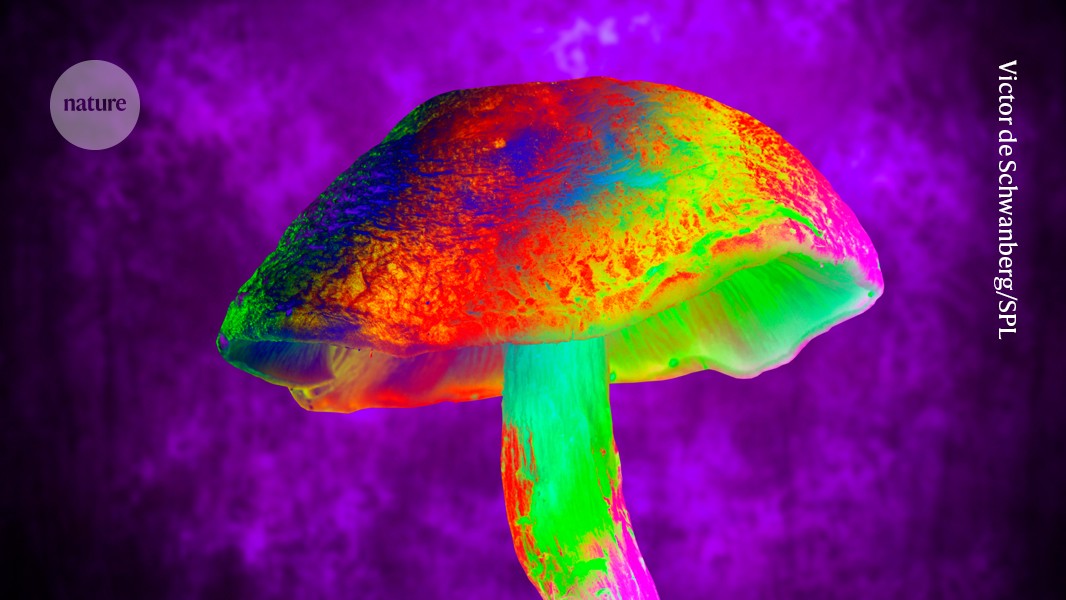
Studies in mice suggest that psilocybin, one of the psychoactive compounds in magic mushrooms, could prevent the chemotherapy side effect called neuropathy.Credit: Victor de Schwanberg/Science Photo Library
For many cancer survivors, the triumph of remission is undercut by a debilitating side effect: hands and feet that feel as though they are constantly burning, prickling with needles or encased in ice. Now, researchers studying this condition, called neuropathy, in mice have identified an unexpected defence against it: psilocybin, the psychoactive compound found in magic mushrooms.
Just two doses of psilocybin administered before chemotherapy completely prevented mice from developing neuropathy. The condition affects as many as 60% of people treated with platinum-based cancer drugs, which are widely used to treat tumours of the ovary and lung, for example. The results, published today in Science, offer evidence that psilocybin could help to protect nerve fibres before chemotherapy causes lasting injury1 — which current approaches can’t effectively prevent or treat.
“This study pushes the needle beyond the canonical indications of psychedelics like depression, addiction, anxiety, PTSD [post-traumatic stress disorder],” says study co-author Moran Amit, a surgical oncologist at the MD Anderson Cancer Center in Houston, Texas. “For the first time, we’re looking at pain,” he says. “And we’re actually showing a really significant efficacy not in treating that, but in preventing that.”
Neuron starvation
Platinum-based cancer drugs and other chemotherapies cause neuropathy by damaging some of the information-gathering ‘sensory’ neurons that extend into the skin’s outer layers. Energy-producing organelles called mitochondria travel long distances through these neurons to the cells’ tips in the skin, but some chemotherapies can disrupt that process. Depleted of energy, the neurons’ tips degenerate, dulling tactile sensation and sparking chronic pain.
Faulty mitochondria cause deadly diseases: fixing them is about to get a lot easier
To test whether psilocybin could ward off that breakdown, the researchers gave mice two doses of the compound before the animals received each of six rounds of chemotherapy over eight months.
In untreated animals, chemotherapy caused pain hypersensitivity, dulled their ability to feel sensations in their paws and led sensory-nerve fibres in the skin to wither. But psilocybin pre-treatment preserved normal paw sensation and nerve endings without diminishing the chemotherapy’s ability to shrink tumours, the authors found.
The authors’ strategy of administering psilocybin to prevent neuropathy, rather than trying to undo damage, is a “clever treatment approach”, says Joe Cichon, a neuroanaesthesiologist at the University of Pennsylvania in Philadelphia.
No trip needed
The authors found that psilocybin stops nerve decay by activating specific receptors on sensory nerve fibres across the animals’ skin. Turning on these receptors triggers a series of reactions that eventually enlist motor proteins to keep mitochondria moving along the neurons. “That’s quite surprising — I wouldn’t have expected psilocybin to regulate mitochondrial movement,” Cichon says.
These neuroprotective effects do not require a psychedelic trip: when the researchers tested tabernanthalog, a non-hallucinogenic compound that activates the same receptors, the animals received similar protection against sensory-nerve loss and pain hypersensitivity.