


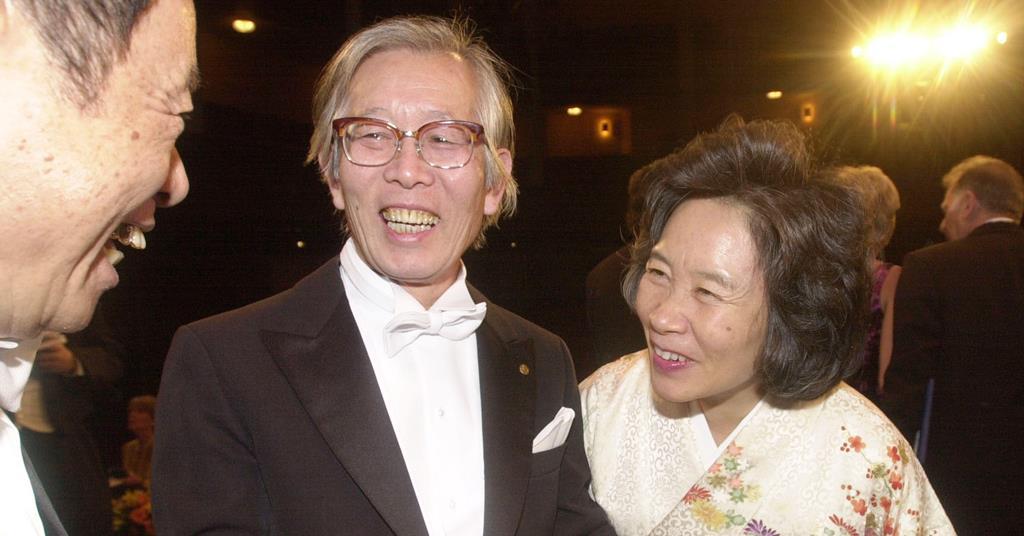
Chemist and materials scientist Hideki Shirakawa, who shared the chemistry Nobel prize for the discovery and development of conductive polymers in 2000, has died at the age of 90. Shirakawa, a pioneer whose work challenged the prevailing view that polymers do not conduct electricity and led to the discovery and development of conductive polymers, died on 24 August.
Shirakawa accumulated over 16,000 citations across his research in the area of conductive polymers, including the landmark paper on halogen derivatives of polyacetylene that he coauthored in 1977 with Alan MacDiarmid and Alan Heeger – co-recipients of the 2000 Nobel award. The work spawned the creation of polymer electronics and revolutionised the design of circuits.
Born in Tokyo in August 1936 to a medical doctor and the daughter of a chief priest of a Buddhist temple, Shirakawa’s family moved several times during his childhood. In 1944, they finally settled in the small city of Takayama.
Takayama, sits in a basin surrounded by mountains with a river flowing through it, and as a child Shirakawa collected insects and plants, and made radios. ‘My affinity for science was awakened and grew during these 10 years,’ Shirakawa recalled in a Nobel prize biography.
Writing about his career dreams as a teenager he talked about his ‘wish to be a scientist in the future and to conduct research on plastics useful for ordinary people’.
A childhood premonition resurfaces
After believing this essay lost, Shirakawa was surprised and delighted when many Japanese newspapers printed it the day after his Nobel prize was announced in 2000.
Shirakawa’s journey to a Nobel prize began with an undergraduate degree in polymer chemistry in 1961 at the Tokyo Institute of Technology – now known as the Institute of Science Tokyo – after considering horticulture and electronics. Shirakawa continued his studies at the university, earning an engineering PhD in 1966. That same year, he married his wife, Chiyoko Shibuya, and became a research associate at the institute. Initially, he worked to understand the polymerisation mechanism of polyacetylene using Ziegler–Natta catalysts.
But then in 1974 a visiting scientist in Shirakawa’s lab added too much Ziegler–Natta catalyst to acetylene, and ragged pieces of a mystery silvery polyacetylene film were produced instead of the expected black powder.
Meanwhile, at the University of Pennsylvania, MacDiarmid and Heeger were both intrigued by recent reports of polymeric sulfur nitride that exhibited electrical properties. They decided to work together to understand this unusual polymer.
Fortuitously, MacDiarmid delivered a lecture at the Tokyo Institute of Technology on polymeric sulfur nitride in 1974. Afterwards, he talked to Shirakawa about their mutual interest in conductive materials over tea.
A promising partnership in Pennsylvania
Shirakawa showed him a sample of the silvery aluminium foil-like film created in his lab, and MacDiarmid invited him to come to the University of Pennsylvania to pursue research into conductive polymers with Heeger and himself. Shirakawa accepted the offer and moved to Pennsylvania in 1976 and spent a year there. Together, the trio showed that it was possible to produce conductive polymers consisting of a carbon chain with alternating single and triple bonds, which were then doped with a halogen.
Shirakawa shared vivid recollections of how he and C K Chiang, a postdoctoral fellow in Heeger’s lab, were measuring the electrical conductivity of polyacetylene in 1976. ‘At exactly the moment we added bromine, the conductivity jumped so rapidly that he couldn’t switch the range of the electrometers,’ he recounted. Conductivity of the polyacetylene jumped 10 million times following doping with bromine.
Following the publication of Shirakawa’s Nobel-prize winning paper with Heeger and MacDiarmid in 1977, he moved to the University of Tsukuba in 1979, where he spent the rest of his career.
MacDiarmid passed away in early 2007 while Heeger, who is 90 years old, is a professor emeritus at the University of California, Santa Barbara and remains active in research.
Nurturing future generations
Upon learning of Shirakawa’s passing, Yujiro Tanaka, president and chief academic officer at of the Institute of Science Tokyo, underscored not only his scientific achievements but also his role as a mentor. ‘Once a year, the professor took time to give a one-hour lecture followed by a thirty-minute question-and-answer session with students,’ Tanaka stated. ‘The auditorium was always packed, and those who could not find a seat would stand along the walls.’
Naoto Ohtake, president and chief executive officer at the Institute of Science Tokyo, also emphasised that he was deeply committed to nurturing future generations. ‘I will never forget how he patiently answered questions from students after his lectures, and strove to improve the course content every year.’
‘Today, with the advent of AI, all forms of knowledge are suddenly at our fingertips, and the very purpose of universities is being called into question,’ Tanaka added. ‘He, however, quietly demonstrated the core values of the institute by encouraging people to gather in the same place, exchange questions and then delve into the accumulated body of knowledge.’
After retiring from the University of Tsukuba at the end of March 2000, Shirakawa withdrew from scientific research and teaching.