


We hate to be the ones to break it to you, but your cat may have some complaints about the service you’re delivering.
Those yowls and yells, and howls and mewls, could be your cat’s way, not just of voicing dissatisfaction with the world, but deliberately trying to get your attention so you can fix it.
It’s OK if you’ve missed it. Humans are, after all, notoriously bad at understanding what our feline friends are trying to say.
But a new study has shown that you, officially, may be the fix-it department in your cat’s life.
Animal behaviorists at the University of São Paulo in Brazil introduced a problem into the lives of 38 pet cats – and observed what happened when their humans were or were not around to fix it.
And the cats were four times more shouty when their favorite lackeys were around.
“These results are consistent with meowing playing a communicative role in cat-human interactions,” the researchers write in a paper published in Animal Behaviour.
Cats have a diverse and often very subtle repertoire of communication skills at their disposal, but one in particular seems like it might have been honed for dealing with rather less subtle human butlers – the meow.
We’ve known for decades that cats meow frequently and sometimes loudly in the presence of humans, but relatively rarely in the presence of their own kind.
In addition, feral cats meow far less frequently than their pet counterparts, suggesting that something about the behavior has to do with proximity to humans.
Scientists have suspected that something has to do with getting humans to do things, even down to different types of meows for food, for pets, or for access through closed doors.
But there’s a difference between yowling out of sheer annoyance and shouting at Jeeves to come and make the thing happen.
And this is where Naila Fukimoto of the University of São Paulo and her colleagues come in with their snacks.
The researchers recruited 38 pet cats whose humans reported quite a lot of meowing if food was involved.
Each cat was then given a life-or-death problem they could not solve alone: a favorite food treat in a small plastic box with holes in it. The cat could smell the treat. They knew it was in there. But they could not get it with their own resources.
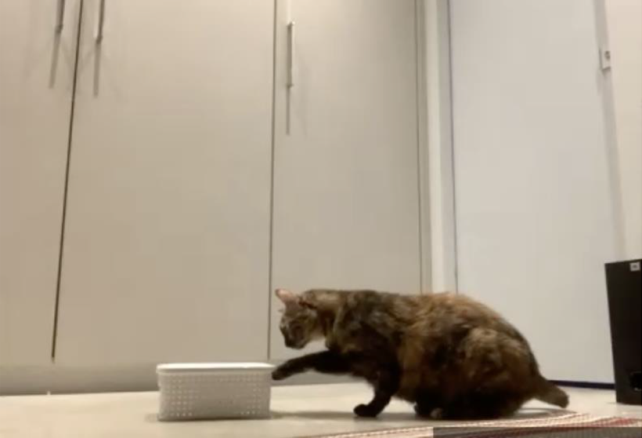
They needed a tool that only a human could provide: opposable thumbs.
The researchers then observed what happened over one minute under two different conditions: with a human present and paying attention, or with no human in the room.
If there was a human with whom to register a complaint, those cats got noisy.
The researchers recorded a total of 86 meows when a human was present, compared to a measly 20 meows if the cat was all alone. A statistical analysis revealed that the odds of meowing were more than 16 times higher when a human was in the room.
And they were, indeed, yowling about their problems.
The researchers also recorded what the cats did when they were meowing.
They often directed their limpid gazes toward the human, sometimes alternating between their would-be savior and the snack box – what certainly looked like a plea to do something about the current unacceptable situation.
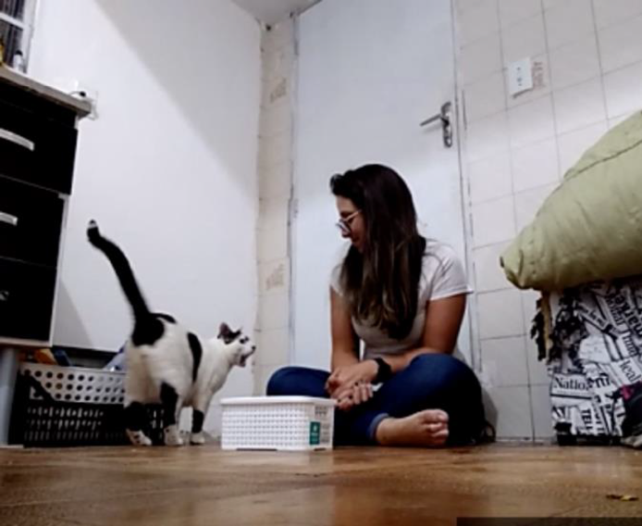
In addition, if the human was not present, the cat spent more time standing still and looking at the door.
This suggests that the cats were not just yelling about the unfair state of the world, but adjusting their behavior depending on who might be available to fix it.
That doesn’t necessarily mean the cats consciously understood that their humans could solve the problem, or that every meow was a deliberate request. But it does suggest that meowing is more than just an involuntary expression of feline feelings.
“The recipient-directed nature of the majority of meows recorded in our study indicates that cats were not simply vocalizing into the environment but targeting a specific audience, consistent with recipient-specific signaling,” the researchers write in their paper.
There are some caveats. The study was relatively small, and the researchers deliberately recruited cats already known to be vocal about food. The results may not apply quite so neatly to cats who prefer to suffer their indignities in silence.
Future studies may also involve profiling the actual meows and comparing them to meows in other situations, to see if the cats use different vocalizations for different requests.
But for anyone who has lived with one of these fuzzy little divas, the results may not come as a surprise.
After all, we all know this street only goes one way. And it’s totally worth it.
The research has been published in Animal Behaviour.
This article was fact-checked by Fiona MacDonald and edited by Fiona MacDonald. While we pride ourselves on our process, we are only human. If you spot a mistake, please let us know.


