


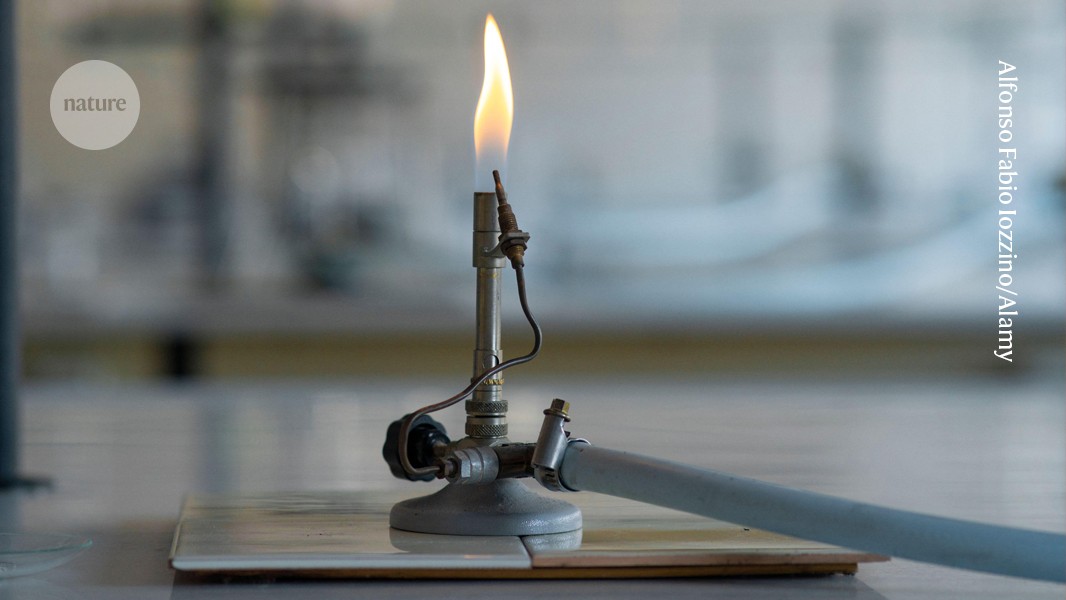
The Bunsen burner’s future in modern microbiology labs is flickering, some scientists say. Credit: Alfonso Fabio Iozzino/Alamy
The Bunsen burner, a workhorse of biology and chemistry labs around the world for decades, might have been getting more credit than it deserves.
Many scientists have long relied on Bunsen burners to decontaminate airspace and surfaces in labs. The burners’ flames were thought to create convection currents that carry microbe-containing particles away from the lab bench. Now, a study has found not only that the devices are ineffective at cleansing workspaces of bacteria-laden particles, but that they can even make contamination worse.
The work was published in August in Microbiology Spectrum1.
Even before the study came out, biologists had divided opinions about Bunsen burners, says Hannah Gavin, a microbiologist at Providence College in Rhode Island and a co-author of the paper. Some researchers swore by the burners’ ability to sterilize research spaces, but others had doubts. The study could fuel debate about whether this low-tech device still has a place in the modern laboratory. It could even be the “nail in the coffin” for the burners’ use in biology labs, says Amir Mitchell, a systems biologist at the University of Massachusetts Chan Medical School in Worcester.
Tradition debunked
Researchers began using Bunsen burners almost two centuries ago. Despite the apparatus’s long history, Gavin could find no experimental evidence in the scientific literature that Bunsen burners decontaminate their surroundings. That information void “allowed for the propagation of all these hypotheses, theories, lore, mythology around the Bunsen burner”, she says.
To find out once and for all whether the burners can shoo away errant bacteria, Gavin and her colleagues grew a strain of Gordonia rubripertincta, a bright orange bacterium that is easy to spot on Petri dishes and does not commonly contaminate labs. In their experiments, the authors aimed to represent the numerous sources of unwanted bacteria — from vacuum cleaners stirring up bacteria-laden dust to scientists’ sneezes and shed skin cells.
Your lab pollutes: here’s how to stop it
To do so, Gavin and her team ran trials in which they seeded the air above lab benches with bacteria by either spraying liquid containing G. rubripertincta in the air or shaking dry towels laced with the bacteria. Immediately after deliberately contaminating the workspace, the researchers turned on a Bunsen burner and opened a Petri dish next to it; they also opened a dish next to an inactive burner in a paired contaminated workspace, beyond the active flame’s reach. They left the dishes open to give bacteria a chance to settle on the dishes’ surfaces, before closing them again.
The researchers varied the size of the burner, the levels of bacterial contamination and other experimental conditions. They found that in almost every trial, the level of bacteria in the dish next to the active Bunsen burner was equal to or higher than the level in the dish next to the inactive burner. The only experiment in which fewer bacteria settled in the active burner’s dish was one in which the amount of bacteria launched into the air was “orders of magnitude higher”, Gavin says, than would be found in most modern labs.