

Quantum mechanics and Einstein’s general relativity explain how the Universe works at the tiniest and largest scales, respectively.
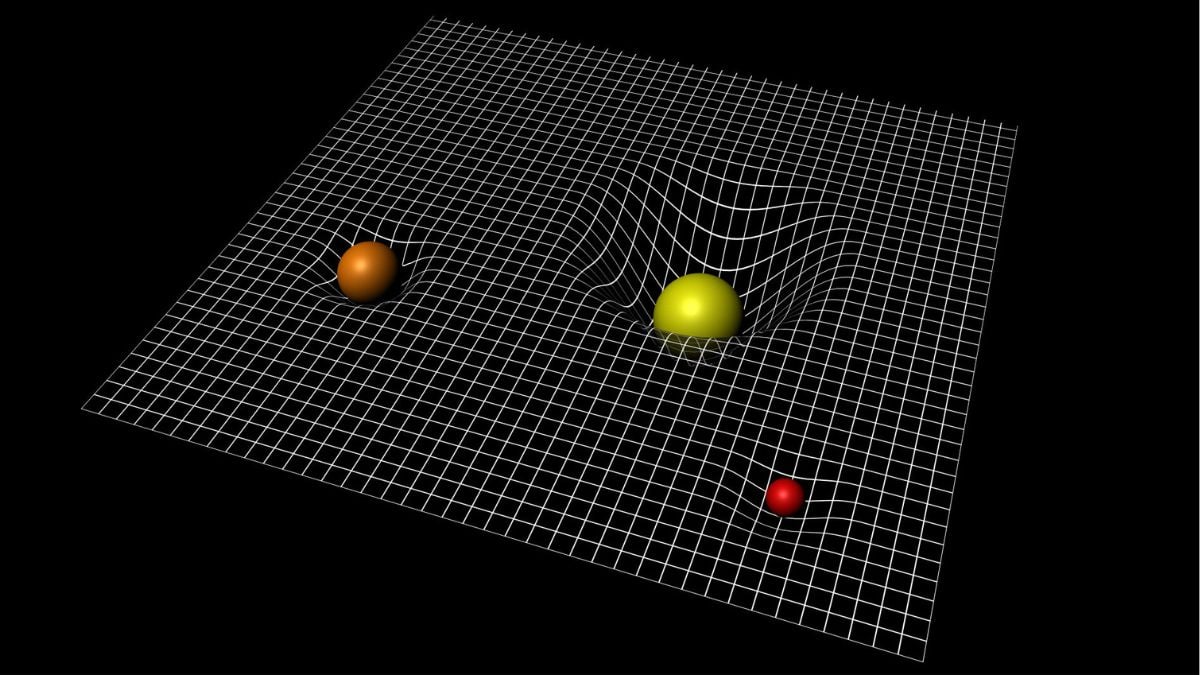
Quantum mechanics has revealed the probabilistic nature of fundamental particles, while Einstein’s general relativity describes how the fabric of spacetime is warped by mass and energy to produce gravity. As a result, we have semiconductors and GPS.
Yet unifying these incredibly successful but separate theories into a single ‘Theory of Everything’ may be modern physics’ greatest challenge (like unifying oil and vinegar into tasty dressing using mustard).
Now, physicists have provided the first direct, experimental evidence that the quantum domain is affected by a cornerstone of the theory of gravity, called the equivalence principle.
“This is a unique paper, in the sense that it combines a hard experiment with a far-reaching theoretical interpretation, about one of the most fundamental questions in physics: How can gravity (described by Einstein’s theory of relativity) and quantum theory, be unified into one understanding of the Universe,” asks lead author of the study Ron Folman, a quantum physicist at Ben-Gurion University of the Negev in Israel.
“These two pillars of modern physics have so far eluded all attempts at a unified theoretical framework, but this complex experiment gives more hints as to how such a unification may be achieved.”
The equivalence principle states that in free fall, gravity should seem to disappear. So someone free-falling in an elevator would experience weightlessness, a principle that NASA relies on to train astronauts aboard its microgravity-simulating, nose-diving ‘vomit comet.’
Though this principle has held with macroscopic entities – including some involuntary cat-stronauts – it was uncertain how quantum objects would react, due to their innate propensity to act as waves and therefore travel along more than one path, rather than just ‘down’.
This first-of-its-kind discovery required a first-of-its-kind experimental apparatus. The researchers have developed a new version of a device called an interferometer, which are commonly used across various sciences to measure how waves interfere with each other – or how their peaks and troughs overlap.
They call theirs the Quantum Galileo Interferometer (QGI).
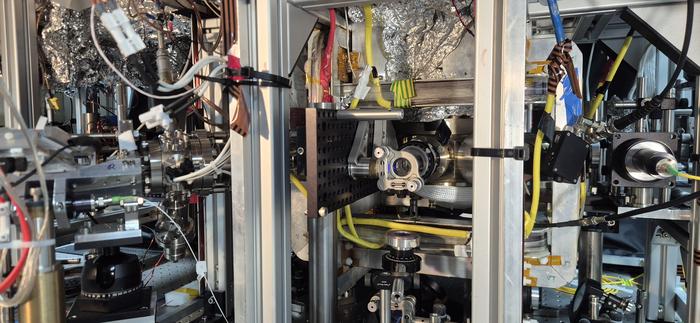
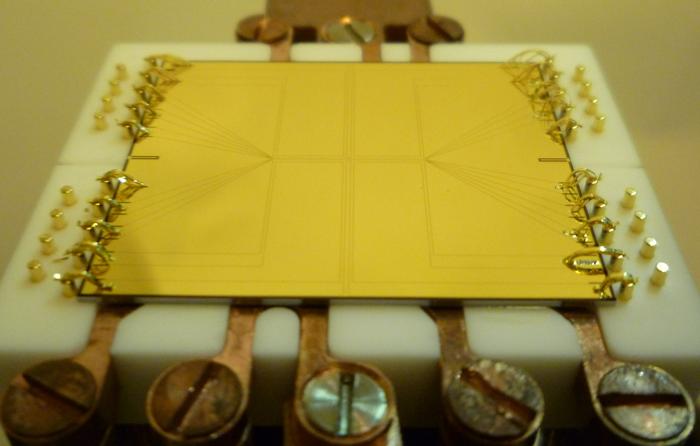
The QGI setup uses an atom chip to generate a magnetic field, allowing researchers to hold and manipulate a chilled cloud of approximately 20,000 rubidium atoms.
By cooling the atoms to nearly absolute zero (-273.15 degrees Celsius, or -459.67 degrees Fahrenheit), the researchers turned the atoms into a Bose-Einstein condensate (BEC), a weird type of matter in which the atoms stop acting like individual atoms and begin acting as a unified particle.
The QGI allowed researchers to do something novel by manipulating a quantum-atomic quirk.
In the quantum domain, atoms and other particles travel like waves, in “wave packets.”
With the QGI, the researchers split the wave packet associated with the BEC so it could take two paths. In one path, the wave packet remained “at rest in the Newtonian frame,” subjected to a magnetic levitating force exactly opposed to gravity, which kept it stationary relative to the laboratory and Earth.
Along the other path, the wave packet was in free fall, or “at rest in the freely falling Einsteinian frame.” This means that the researchers used a magnetic pulse to launch this wave packet upward, then let it fall freely under gravity in a ballistic trajectory, like a quantum vomit comet.
The researchers then utilized an identical magnetic pulse to erase the velocity differences between the two wave packets, allowing them to overlap, or interfere, and therefore show any resultant changes between their two phases, or the lining up of their peaks and troughs.
This produced the desired result: the shift matched predictions, demonstrating that the equivalence principle held true in the quantum realm.
However, the researchers stress that this result does not represent the sought-after unification of quantum mechanics and gravity, nor is it proof that gravity is quantum.

Yet this work paves the way for further exploration.
For example, the higher-mass capabilities of the QGI may lead to testing a wild, just-mentioned hypothesis: that gravity can act as quanta.
Instead of being a smooth, continuous field, or a curve in a fabric, gravity may be distributed in discrete packets of energy called gravitons – in the way that particles of electromagnetic energy (light) travel in quanta called photons.
Related: We May Already Have The First Hints of Quantum Gravity – Hiding in Plain Sight
As Vlatko Vedral, Professor of Quantum Information Science at the University of Oxford and one of the study’s co-authors, concludes:
“This experiment pushes quantum mechanics into one of its most intriguing frontiers, gravity, and shows that, once again, its predictions hold.”
This research was published in Science Advances.
This article was fact-checked by Michael Irving and edited by Michael Irving. While we pride ourselves on our process, we are only human. If you spot a mistake, please let us know.