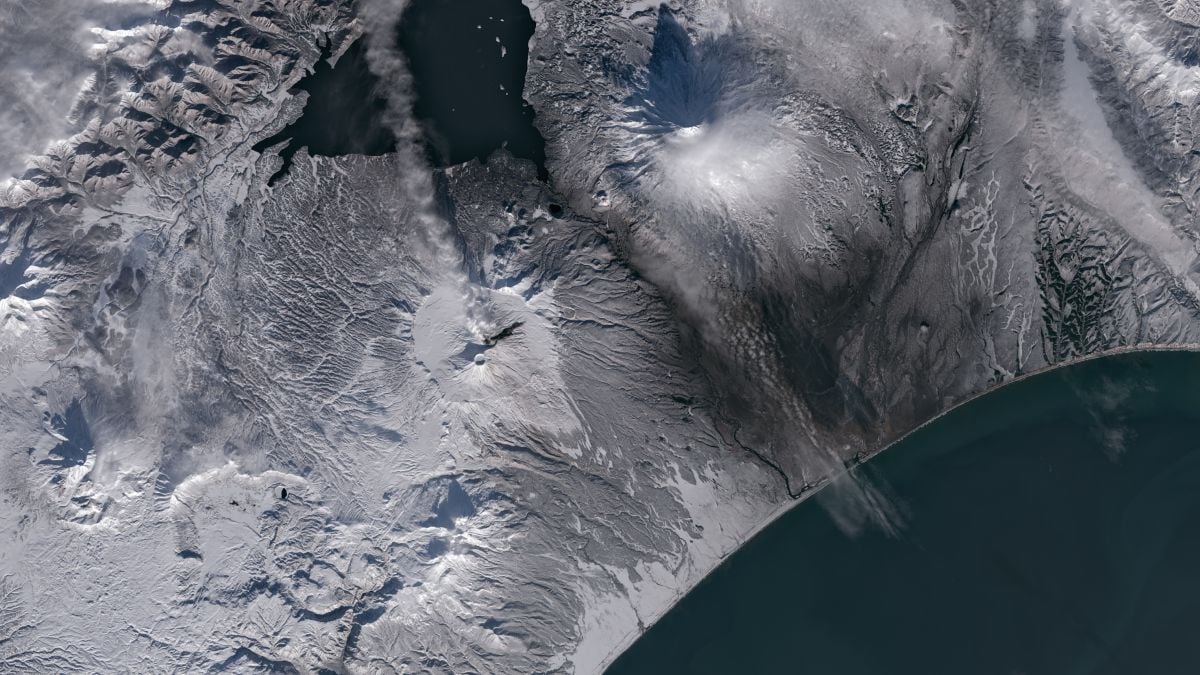


For nearly five centuries, the Krasheninnikov volcano in Russia’s Kamchatka Peninsula had not erupted. Nor did it seem particularly interested in doing so.
Then, just before midday on 30 July 2025 local time, off Kamchatka’s coast, Earth’s crust abruptly tripped over itself.
The megathrust quake was one of the most powerful ever recorded, registering a magnitude of 8.8. Tsunami warnings were issued around the world, and across the peninsula, several volcanoes roared to life, spewing ash and lava in what officials called an “eruption parade“.
Kamchatka is one of the most volcanic places on Earth, home to some 160 volcanoes, 29 of which are classified as active, so geophysical pyrotechnics are not outside the norm.
But one of the volcanoes joining the pandemonium was, in fact, a surprise. Krasheninnikov had not erupted for centuries; yet, several days after the megaquake, it started belching out an enormous plume.
It’s not unreasonable to assume that the two events were connected; but now, a team led by volcanologist James Hickey of the University of Exeter in the UK has studied the eruption and worked out how the Kamchatka megaquake may have rattled Krasheninnikov out of its slumber.
“The prolonged earthquake shaking likely promoted time-dependent volatile exsolution, bubble growth, and eventual reservoir destabilization in a system already mechanically susceptible to failure,” they write in a preprint uploaded to EarthArXiv ahead of peer review.
“We show that apparently quiescent volcanoes may conceal hidden critical states prone to seismic perturbation, particularly in extensional arc settings with volatile-rich magmas exposed to repeated megathrust earthquakes.”
Earthquakes and volcanic outbursts can go hand-in-hand… but getting from one to the other isn’t quite so straightforward, and Kamchatka is the perfect demonstration.
The region sits above a subduction zone, where the Pacific Plate plunges beneath the Okhotsk microplate, generating both its extraordinary volcanism and its powerful earthquakes.
If the equation were as simple as “insert earthquake, get volcano”, the results of the Kamchatka megaquake should have been dramatically more explosive. Dozens of potentially active volcanoes felt the shaking – yet only a handful participated in the eruption parade.
Some of the volcanoes involved should hardly raise an eyebrow; for example, Karymsky has been erupting almost continuously since 1996; it would be stranger if it suddenly piped down.
But why Krasheninnikov? And why, after 475 years of silence, now?
By all outward appearances, there was nothing particularly unusual about Krasheninnikov before the earthquake.
Nine years of satellite radar observations showed no swelling of the ground that would suggest magma was accumulating beneath the volcano. In fact, the surface was slowly sinking, at a rate of around 4 millimeters a year.
Nor could satellites detect any sulfur dioxide escaping from Krasheninnikov before the earthquake, even as they picked up the gas pouring from other volcanoes across Kamchatka.
Then, the megaquake struck.
Roughly two days later, 12 earthquakes of around magnitude 4 rattled the area around Krasheninnikov in the space of just five hours. Satellite observations revealed what was happening underground: Magma was forcing open a near-vertical fracture in the crust.
The resulting dyke intrusion involved an estimated 32 million cubic meters (1.13 billion cubic feet) of magma, fed from a reservoir around 6 kilometers (3.7 miles) beneath the surface.
This is where things get weird.
You’d think that all this ballyhoo would simply shake the volcano hard enough to burst it open – but the permanent stress changes at Krasheninnikov were minuscule – just 0.01 to 0.05 megapascals in Coulomb stress. Magma reservoirs are generally thought to require overpressures around 1 to 10 megapascals to fail.
The transient stress while the quake was physically shaking the ground was larger – around 1.0 ± 0.6 megapascals, potentially just large enough in theory to wake the slumbering volcano. But the researchers don’t think that’s what actually happened.
For one thing, Krasheninnikov didn’t respond immediately. The magma didn’t start forcing its way into the dyke until an estimated 1.5 to 2.5 days after the earthquake.
According to their modeling, the magma in the reservoir had properties consistent with high gas content. And that may be where those 475 years of silence become important.
Over centuries of crystallization, volatile-rich magma may have accumulated bubbles in the reservoir. The prolonged shaking of the earthquake could then have encouraged more gas to diffuse into those bubbles, making them grow, while also helping new bubbles form.
Like your tummy after too much carbonated beverage, all that expanding gas increases the pressure. Eventually, the researchers propose, the reservoir became unstable, magma forced its way into the dyke, and Krasheninnikov erupted.
Earth burped, and a long-dormant volcano was startled awake.

This could help explain why Krasheninnikov, of all Kamchatka’s volcanoes, responded to the earthquake.
Although it appeared quiet at the surface, its volatile-rich magma and the extensional tectonic environment beneath the volcano may have left its reservoir unusually susceptible to disturbance.
Related: First Detailed Look at a Tsunami From Space Reveals Unexpected Feature
The researchers call this a “hidden critical state” – the volcano may have been primed for eruption in ways that weren’t visible in the usual warning signs of seismic activity, ground deformation, or escaping gas.
And that could have implications beyond Kamchatka. A volcano that appears peacefully dormant may not necessarily be as stable underground as it looks – and the right earthquake trigger could provide the disturbance that tips an already vulnerable system over the edge.
“Ultimately, the earthquake likely facilitated the eruption not by directly forcing immediate reservoir failure, but by imposing prolonged dynamic stresses on a volatile-rich and mechanically susceptible magmatic system, prompting delayed volatile exsolution, bubble growth, reservoir destabilization, and later dyke intrusion and eruption,” the researchers write.
The findings can be read on EarthArXiv.
This article was fact-checked by Fiona MacDonald and edited by Fiona MacDonald. While we pride ourselves on our process, we are only human. If you spot a mistake, please let us know.