

Rome wasn’t built in a day, and neither was the Roman Empire. Before it rose to imperial status in 27 BCE, the Roman civilization was a not-so-humble Republic. The last two centuries of that period were marked by wars, conquests, and the consolidation of Roman hegemony over increasingly more distant lands. In other words, it was a pretty exciting time.
Two researchers from the University of São Paulo in Brazil recently published new insights into this thrilling period by focusing on something that may seem relatively dull: old coins.
Read more: “Did a Roman Legionnaire Wear Eyeliner?”
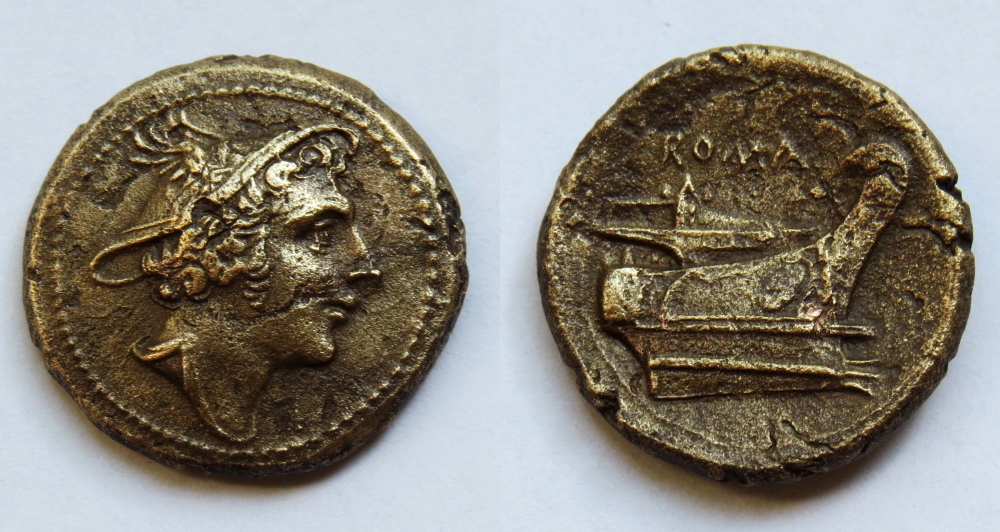
Coins are some of the most commonly found artifacts from ancient Rome, and it turns out they have quite the story to tell. “Each coin preserved by archaeology provides three key pieces of information: where it was minted, when it was produced, and where it was found some 2,000 years later,” study author Eduardo Haddad explained in a statement.
Four million coins from 155 BCE to 2 CE provided the researchers with a wealth of information to investigate. Faced with such a daunting dataset, the two first looked for patterns, and discovered that the coins tended to cluster along the primary Roman trade routes. Then they literally followed the money, retracing the paths of the currency. “After verifying a correlation between the location and concentration of the coins, we began to cross-reference that information with Roman roads,” Haddad said. “And we found something very interesting: a clear spread of coins originating from Rome.” (That is where all roads lead, after all).
Next, the team applied tools used to analyze modern economies to reconstruct the Roman economy. During this period, many trades—espeically in outlying territories—were still conducted by in-kind bartering (for example, grain for cloth), which gradually gave way to currency-based transactions as Roman influence grew. “In the early periods analyzed, coins remained relatively close to the places where they had been minted,” Haddad said. “However, as the Republic expanded its borders, they began to be found at increasingly greater distances.”
So why the change?
The Roman military, which was paid in coin, is traditionally given credit for the spread of currency. The researchers found that while they did kick-start the switch, it was economic ties that perpetuated it. “What we realized was that military expansion introduced monetary circulation, but it only became established once those territories were effectively integrated, creating economic, religious, administrative, and civic structures capable of generating a permanent demand for currency,” Haddad explained.
Basically, when it comes to economics, free trade is stronger than the Roman legions.
Enjoying Nautilus? Subscribe to our free newsletter.
Lead Image: Wikimedia Commons