



Copper is a much sought (and much stolen) metal because it powers the proliferation of data centers, electric vehicles, and energy infrastructure.
Copper also forms interconnects, the wires that transfer electricity between the semiconducting transistors that form the basic building blocks of electronic chips.
Incredibly, a state-of-the-art chip can contain over 100 kilometers (62 miles) in copper interconnects.
But copper may be becoming insufficient.
As copper interconnects continue to shrink, they choke electron flow as these fundamental particles are increasingly scattered by the surfaces of the wires.
This is called the resistivity size effect. It occurs as surface area becomes much larger relative to volume, and the resulting microscopic mosh pit increases resistance and signal delays. Meanwhile, rising current densities can also damage interconnects and reduce their reliability.
But now, physicists have demonstrated the superiority of a counterintuitive copper replacement: a nanoscale material made from cobalt and silicon.
As previously shown, cobalt silicide (CoSi) semimetal materials display an intriguing property.
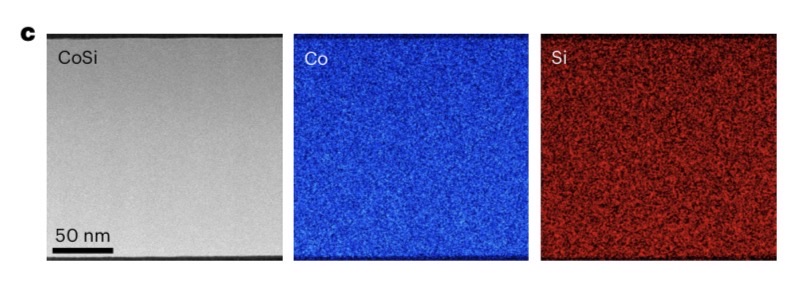
As they get smaller, their electrical resistivity decreases because quantum mechanics creates highly conductive surface paths with reduced electron scattering.
Reporting their findings in Nature Materials, researchers created single-crystal CoSi “nanoflakes” of different sizes and demonstrated their practical potential to supplant copper.
This could help bypass a growing bottleneck, because interconnects make up a substantial volume and cost of integrated circuits.
And even as transistors become faster, their overall performance is limited by the stymied electrical flow through ever-tinier interconnects.
The researchers found that by scaling down the thickness of CoSi components from one micrometer (a millionth of a meter, or 0.00004 of an inch) to around 20 nanometers (20 billionths of a meter), the resistivity of CoSi actually dropped by an order of magnitude.
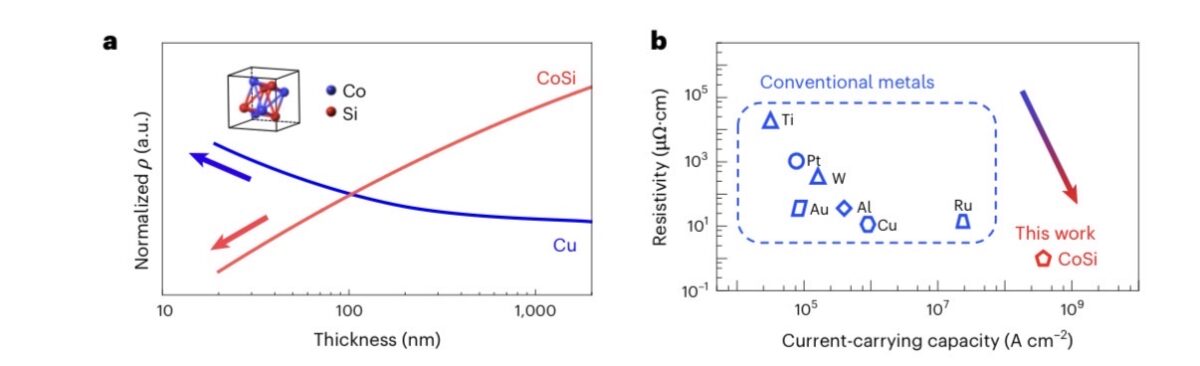
So, a 20-nm-thick CoSi nanoflake is ten times less resistive to electrical flow than a copper interconnect of equal thickness at room temperature.
The current-carrying capacity of CoSi nanoflakes is also 100 times greater than that of copper interconnects, which “substantially surpasses that of conventional metals,” the researchers say.
These properties make CoSi a highly promising alternative to copper. But can it really fill copper’s shiny shoes in interconnect applications?
To find out, the researchers conducted two tests that demonstrated CoSi’s practical value.
First, they used a ground-signal-ground (GSG) configuration to measure how well a CoSi-composed interconnect could transmit signals without lag or energy loss.
This radio-frequency test indicated that CoSi interconnects can transmit signals with little loss up to 40 GHz – frequency bands used by spacecraft communications systems, for example.

The second real-world-style test probed the inherent compatibility of CoSi interconnects with CMOS silicon chip technology, the conventional platform for electronic chips.
The researchers replaced part of the traditional metal interconnects with a CoSi nanoflake in a silicon ring oscillator. This device transfers an electrical signal between an odd number of logic gates in a loop.
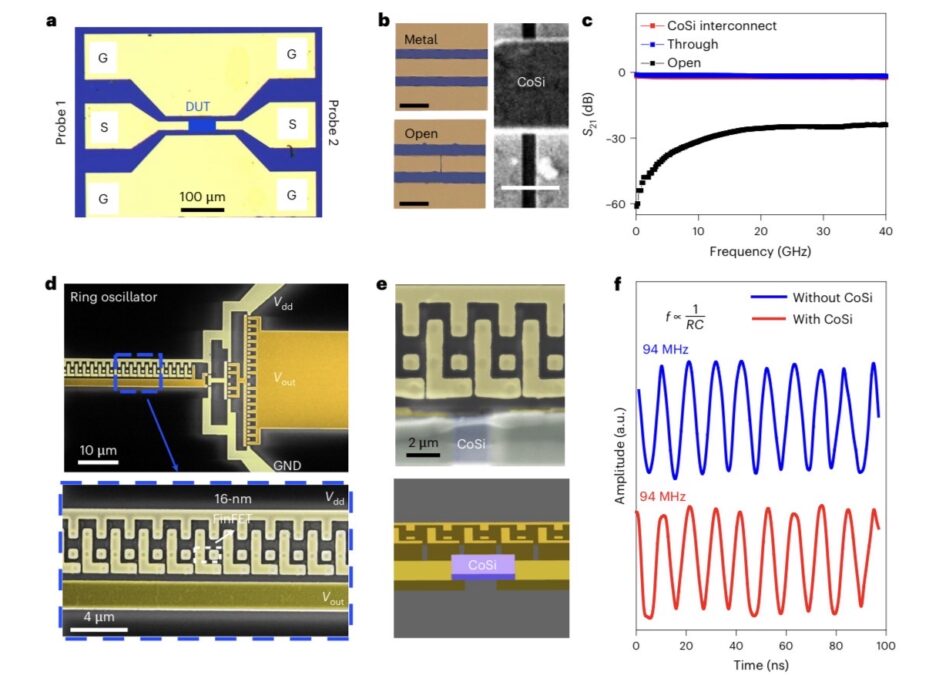
Accordingly, the oscillator was able to operate at the same frequency when using CoSi, yielding “a negligible change in total resistance of the interconnect wire,” the researchers note.
Altogether, the “radio-frequency and on-chip testing unequivocally demonstrate CoSi to be an interconnect material with highly scalable potential,” they add.
It can also take a beating, as other measurements showed that CoSi can remain stable at high current densities and withstand temperatures of 450 degrees Celsius (840 degrees Fahrenheit) for 200 hours.
Related: Engineers Found a Genius Way to Slash Data Center Energy Use
Overall, this material proved itself a promising potential replacement for copper.
“These studies show CoSi to be a superior alternative to copper interconnects, surpassing them in terms of both conductivity and reliability at the nanoscale,” the researchers conclude.
This research was published in Nature Materials.
This article was fact-checked by Peter Dockrill and edited by Peter Dockrill. While we pride ourselves on our process, we are only human. If you spot a mistake, please let us know.