




Jody Mason’s favourite Beatles album is ‘Revolver’. Just as the band’s seventh album marked a radical musical shift, Mason and his colleagues have developed ‘a revolutionary new technique’ to screen and evolve therapeutic peptides to target ‘undruggable’ proteins. This technology is the basis of the University of Bath spin-out co-founded by Mason, Revolver Therapeutics.
Mason is interested in transcription factors – proteins that bind to strands of DNA to switch genes on or off. Problems with transcription factors can lead to over- or under-expression of certain genes, leading to various diseases, including cancer, autoimmune and metabolic diseases. The human genome encodes more than 1600 transcription factors, but many remain challenging drug targets. Mason explains that they often have large, relatively flat interaction surfaces, which makes it difficult for small molecule drugs to engage. Because they are generally found inside the cell, often within the nucleus, they are essentially beyond the reach of conventional antibodies.
‘Antibodies, as we know, can recognise much larger surfaces really well, but they’re very difficult to get into the cell,’ says Mason, adding that this leaves a ‘therapeutic gap’. ‘Peptides can occupy this sweet spot between small molecules and antibodies’.
‘However, identifying a peptide that binds a protein does not guarantee that it will inhibit its function,’ says Mason. Conventional peptide-library screens are usually performed against purified proteins outside the cellular environment and can identify binders that have little or no functional effect. ‘And that’s where we step in,’ he says.
Revolver’s technology involves engineering E. coli with a genetic circuit that couples the activity of a transcription factor to bacterial survival. The bacteria also produce different peptide sequences inside the cell. ‘If a peptide doesn’t bind to the target, or binds without blocking its function, the transcription factor remains active and the cell doesn’t survive,’ explains Mason. Bacteria producing functional inhibitors can grow and become enriched. ‘It’s essentially a Darwinian selection system that we’re using in living cells,’ says Mason.
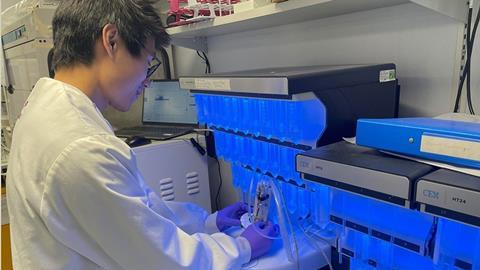
The team can also add bis-alkylating reagents that enter the bacteria and react with cysteine thiol groups on the peptide side chains. This cyclises and conformationally constrains the peptides inside the cells in which they are being screened. Constraint can improve properties such as potency, selectivity and stability. Promising peptides can subsequently be chemically synthesised and tested in human cancer cells, although optimising entry into mammalian cells remains an important part of their development.
Mason suggests that computational methods could initially evaluate billions of peptide sequences, narrowing the funnel to a smaller, higher-quality experimental library. Revolver’s transcription block survival (TBS) platform can then screen that focused library for peptides that produce the desired functional effect inside cells.
So far, the team has been exploring different targets in-house. Mason explains that they have a collaboration with the UK’s Institute of Cancer Research, looking at childhood gliomas. However, these pose other challenges, as targeting these brain tumours involves getting peptides across the blood–brain barrier. ‘Our next step is to optimise the leads that we have that we think are strongest,’ says Mason.

‘We’re also looking at partnership and licensing opportunities where we can apply our technology to transcription factors of interest to others,’ says Mason. Such collaborations could use the TBS platform to identify and develop functional peptide inhibitors against selected targets.
Revolver won the health category in this year’s Royal Society of Chemistry Emerging Technologies competition, after being a finalist in the competition in 2025. ‘It felt like things were progressing, and we hadn’t sort of stalled or stagnated,’ says Mason. In his view, Revolver’s technology stands out from other biological assays. ‘We’re not asking if [a peptide] sticks to a purified protein in a test tube. We’re selecting for functional consequence inside a cell,’ he says.
Revolver Therapeutics:
Founded: 2023
Employees: 5
Origin: Spin-out from the University of Bath, UK
Location: Bath, UK
Funding: £572,000 in seed funding; lead partner in a £700,000 Innovate UK-funded collaborative project