
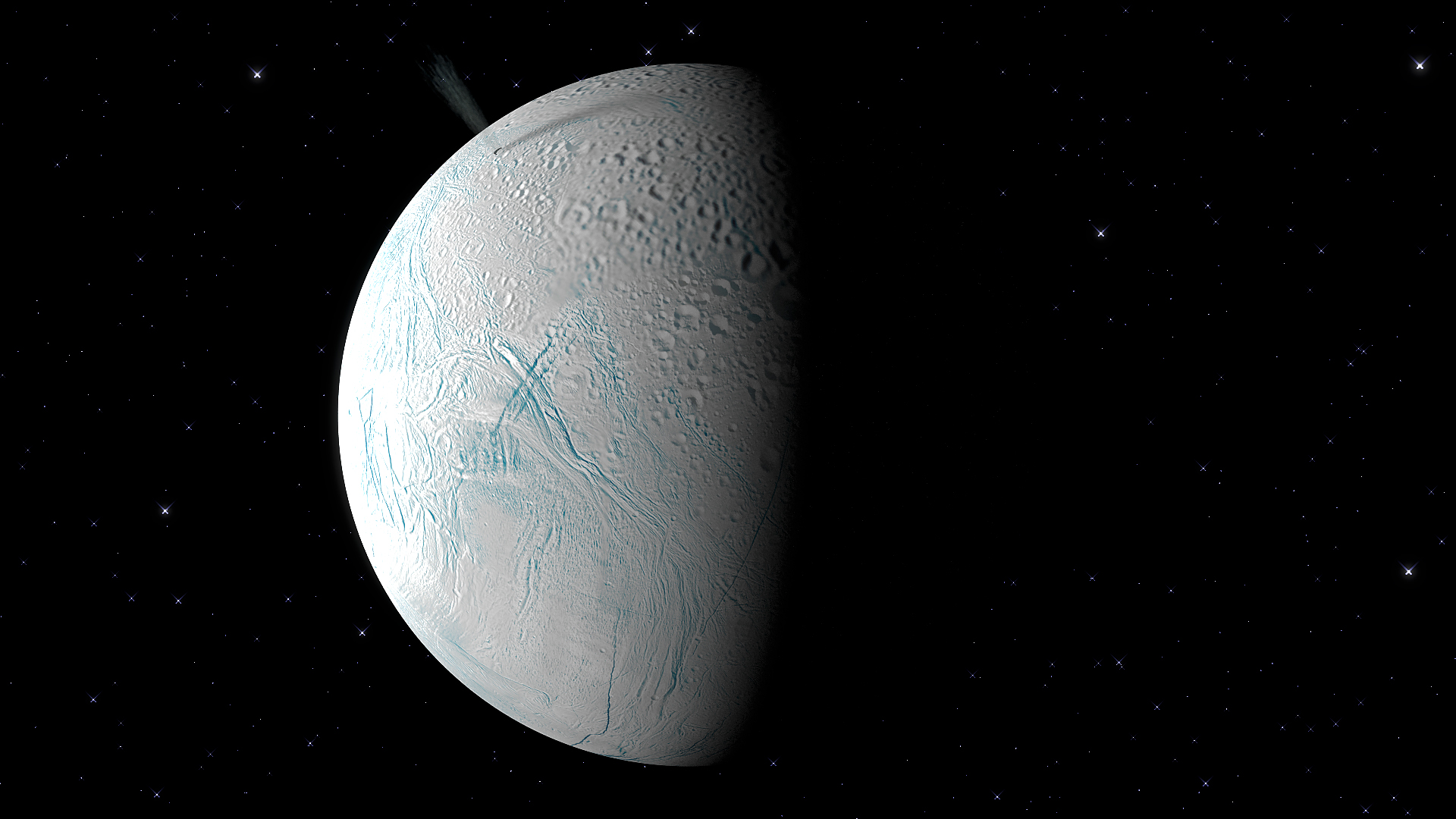




Saturn’s Enceladus moon could have a natural way of concentrating material from its subsurface ocean, potentially making signs of extraterrestrial life easier for future spacecraft to detect.
A new study published in Science Advances has examined nearly 1,000 salt-rich ice grains collected by NASA’s Cassini spacecraft and found that different salts can become separated and concentrated within individual particles as ocean water freezes and is expelled through Enceladus’s icy vents.
The finding could change how future missions analyse material from the moon’s ocean. Rather than treating each ice grain as a representative sample of the wider ocean, scientists may need to examine individual particles because rare organic compounds and potential molecular biosignatures could be concentrated in only a few grains.
Enceladus is already sending ocean material into space
Enceladus is considered one of the most promising locations in the Solar System for investigating whether life exists beyond Earth because it has a global liquid-water ocean beneath its icy crust.
At the moon’s south pole, jets of water vapour and tiny ice particles erupt from the ocean and travel hundreds of miles into space, contributing material to Saturn’s E ring.
That plume has already provided scientists with an unusual opportunity to investigate Enceladus’s ocean without needing to land on the surface or drill through its thick ice.
NASA’s Cassini spacecraft, which arrived at Saturn in 2004, repeatedly passed through the plume and detected salts, organic compounds and evidence that water is interacting with rock on the moon’s seafloor.
Freezing could separate ocean compounds
The new research focuses on what happens to ocean material as it travels through Enceladus’s vents.
Researchers combined Cassini observations with laboratory experiments, thermodynamic calculations and models of how droplets cool. They also froze alkaline salt-water droplets designed to resemble conditions in the Enceladus ocean.
The experiments showed that larger droplets cooling relatively slowly can develop separate regions containing different salts. Smaller droplets that freeze more rapidly remain more uniform.
The researchers propose that a similar process occurs naturally on Enceladus. Bursting bubbles at the ocean surface produce spray droplets, which are carried upwards by water vapour through cracks in the ice. As the droplets freeze, different salts can become concentrated in separate areas.
Nearer the surface, the material is accelerated through narrower passages. The frozen particles can then collide with the icy walls of the vents, breaking into smaller fragments with different chemical compositions.
This means the moon’s plume may effectively separate and concentrate material from its ocean before ejecting it into space.
Individual grains could hold important clues
The process has implications for the search for extraterrestrial life because organic molecules and potential molecular biosignatures may also become concentrated in particular grains.
A single ice particle therefore may not provide a representative snapshot of the ocean as a whole. Similarly, combining many particles into a single measurement could erase differences between them and make rare compounds harder to identify.
Analysing individual grains instead preserves those variations and could give scientists a more detailed picture of the ocean’s composition.
The study suggests that differences between particles may matter most when searching for unusual or rare chemical signatures.
Future missions may need to examine more particles
The researchers’ findings could influence how spacecraft investigate the Enceladus moon in the future.
If organic compounds or molecular indicators associated with life are concentrated in only a small proportion of ice grains, a spacecraft would need to analyse enough individual particles to have a better chance of detecting them.
The physical processes occurring within Enceladus’s plume may therefore give scientists an advantage. The moon’s ocean material is naturally being separated and concentrated as it travels through the vents, effectively preparing samples for analysis before they reach space.
For the search for alien life, that could make the composition of individual ice grains particularly valuable.
Rather than requiring a spacecraft to access the ocean directly, future investigations could potentially learn more by carefully examining the material Enceladus is already ejecting into space.