Dark Mode Light Mode

Keep Up to Date with the Most Important News

By pressing the Subscribe button, you confirm that you have read and are agreeing to our Privacy Policy and Terms of Use
Join us on a journey where chemistry meets creativity, and the wonders of science unfold. Quench your intellectual thirst with thought-provoking articles that transcend the boundaries of conventional knowledge.

Fifty years after he won the Nobel, Lipscomb’s insights into boranes continue to pay dividends | Research

Fifty years after he won the Nobel, Lipscomb’s insights into boranes continue to pay dividends | Research Fifty years after he won the Nobel, Lipscomb’s insights into boranes continue to pay dividends | Research


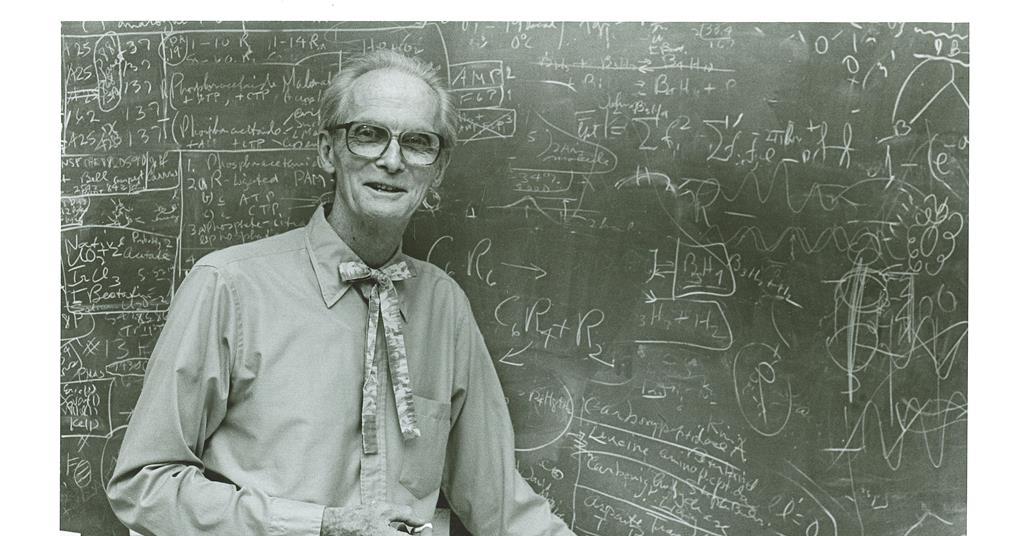
Boranes were among the most unusual compounds known to chemists in the early- to mid-20th century. William Lipscomb’s work explaining their structures and bonding earned him the 1976 Nobel prize in chemistry and helped transform scientists’ understanding of the chemical bond.

Originally described as boron hydrides, boranes have the general formula BxHyRz. Long before Lipscomb’s interest in them, Alfred Stock had synthesised the volatile compounds B2H6, B4H20, B5H9 and more.

In the 1950s, Lipscomb and colleagues Bryce Crawford and Wolfgang Eberhardt unpicked the structures of several boranes using low-temperature x-ray crystallography, a technique that was still relatively uncommon. Lipscomb determined that these compounds shared two electrons among three atoms – now known as three-centre two-electron bonds.
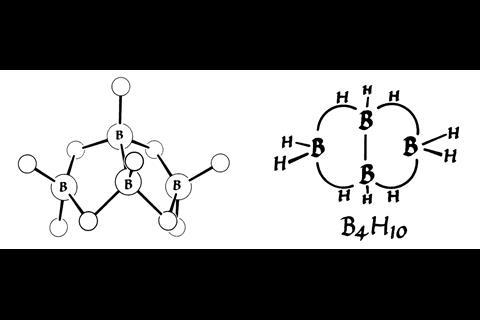
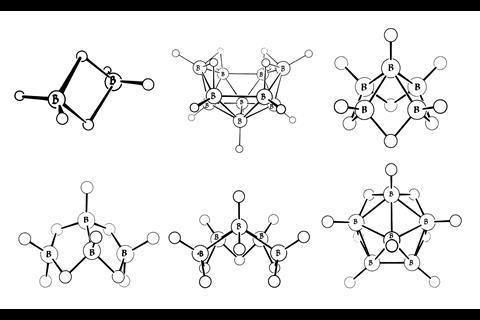
This idea accounted for boranes’ unusual geometry, unexpected dipole moments and that they were apparently electron deficient. It also added gravitas to the bridged diborane structure that Christopher Longuet-Higgins had proposed a decade earlier.

He showed us that one could make sense of the structures

Douglas Rees, a former member of the Lipscomb group, later described Lipscomb’s work as opening a ‘new era in the understanding of the chemical bond’. Indeed, that work continues to shape modern boron chemistry, underpinning advances in materials science, supramolecular chemistry and medicine.

2D borane

Borophene is boron’s take on graphene, a two-dimensional material that extends the electron-deficient bonding identified in boranes across a plane. Unlike its carbon cousin, borophene does not form a regular hexagonal lattice. Instead, its monoatomic sheets comprise a more varied arrangement of triangles and hexagons. ‘Lipscomb would have just loved these [2D sheets] and would have immediately come up with a theory of the bonding in them and the magic electron counts for them,’ says chemistry Nobel laureate Roald Hoffmann, who worked in the Lipscomb group at Harvard for a year and contributed to a book Lipscomb wrote about boron hydrides.

Borophene is exciting from an applied perspective, says Mark Hersam, a materials chemist at Northwestern University, US, adding that it ‘has potential for plasmonic, nanoelectronic, energy storage and quantum information applications’. However, it oxidises easily so isn’t very stable in ambient conditions.
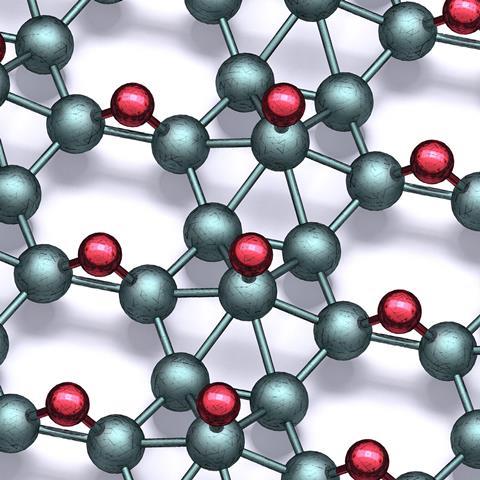
Structure where teal balls represent boron and red balls represent hydrogen

One way to address that problem is hydrogenation. In 2021, Hersam’s team found that hydrogenating borophene with atomic hydrogen results in a material that can withstand exposure to air for days.2 Hydrogenated borophene, aka borophane, also adopts the three-centre two-electron bonding first described by Lipscomb in boranes. This bonding ‘is unique among other two-dimensional materials,’ says Hersam.

By reducing its reactivity, hydrogenation allows scientists to synthesise a pristine form of ultrathin boron that can then be incorporated in plasmonic devices, for example, before the hydrogen is removed. It’s an extra step, but one that opens the door to using borophene’s promising properties in future applications.

‘Hydrogenation is one of the practical ways to make borophene usable,’ says Nevill Gonzalez Szwacki, a materials scientist at the University of Warsaw, Poland. ‘It slows oxidation, preserves metallic behaviour, and is reversible by annealing. The key is balancing stability while preserving intrinsic electronic properties.’

For Gonzalez Szwacki, much of modern boron materials science traces back to Lipscomb’s recognition that electron-deficient boron is stabilised through multicentre bonding. ‘I’ve been working with boron since 2006, it’s my favourite topic,’ he says. Over that time, his group has investigated borane clusters for sensing, extended borane-based structures into nanotubes and synthesised ultrathin boron nanoribbons. More recently, they have developed a model to explain the diversity of boron nanostructures.3 ‘But if Lipscomb hadn’t proposed the localisation framework, we could not go that far now. He gave us a broader picture of the bonding.’

Borane clusters in MOFs

While developing their explanation of borane bonding, Crawford, Eberhardt and Lipscomb also examined the molecular orbitals of other boron-containing ions, including the closo-dodecaborate anion B12H122-, which was purely theoretical at the time.

Theoretical has since become tangible, and today these closo-dodecaborate anions play a role in borane cage hybrid supramolecular frameworks (BSFs) – a subclass of metal–organic frameworks (MOFs).4 ‘Imagine a 2D network formed by metal ions connected by organic ligands. Now, take a borane cage anion – think of it as a tiny, negatively charged, icosahedral ball – and use it as a pillar that props these 2D layers apart in the third dimension,’ explains Yuanbin Zhang, a materials chemist at Zhejiang Normal University in China, ‘the result is a 3D porous framework with well-defined, one-dimensional channels.’

‘What makes BSFs special is that these borane pillars are not just structural spacers – they are chemically active,’ Zhang says. ‘Their surfaces are covered with hydridic hydrogens that can form B–H···H–C dihydrogen bonds with hydrocarbon guests. This gives BSFs a built-in molecular recognition capability for selective gas separation.’

Zhang’s group is working to expand the BSF family.5 ‘We aim to tackle more challenging multi-component separations that are of great industrial importance,’ says Zhang. ‘We are also delving deeper into the roles of dihydrogen bonding and electrostatic pre-organisation during framework assembly.’
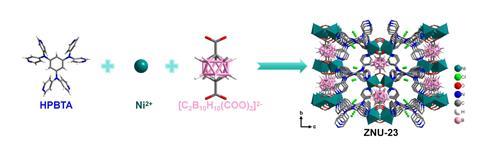
The organic ligand HPBTA, nickel(II) ions and a carboxylate-containing cluster combine to form a three-dimensional framework

Hoffmann thinks Lipscomb would have appreciated the role that boranes now play in these frameworks. ‘He was a chemist at heart, and he would have loved the chemistry.’

Carboranes and drugs

As he explored the bonding and molecular orbitals of the boron hydrides, Lipscomb suggested that adding H3+ to B11H112- would result in B11H14–. Lipscomb drew a parallel between this cluster’s orbital properties and those of cyclopentadienide, though didn’t quite see what Fred Hawthorne saw: B11H112- could be used to create a metal–borane complex, similar to ferrocene Fe(C5H5)2. Hawthorne was close to Lipscomb at Harvard University and equally fascinated by boranes. Inspired by Lipscomb, he took these ideas and realised them, bonding the B11H14– fragment to a transition metal and so created a large family of metalloboranes and metallocarboranes. ‘I remember to this day when Fred Hawthorne, a great synthetic inorganic chemist, came and told us in the Lipscomb group of his having made the carboranes,’ Hoffmann recalls.

Hawthorne’s metalloboranes and metallocarboranes helped bring borane into medicinal chemistry. Boron-containing molecules are now used in a handful of approved drugs and remain an active area of pharmaceutical research.

One such example is bicyclic boronates, which have emerged as potent compounds for countering antibiotic resistance. This has been the focus of Concepción González Bello’s work at the University of Santiago de Compostela in Spain for over a decade. Instead of trying to develop new antibiotics, which could take years, González Bello is among the scientists trying to preserve the effectiveness of existing drugs.
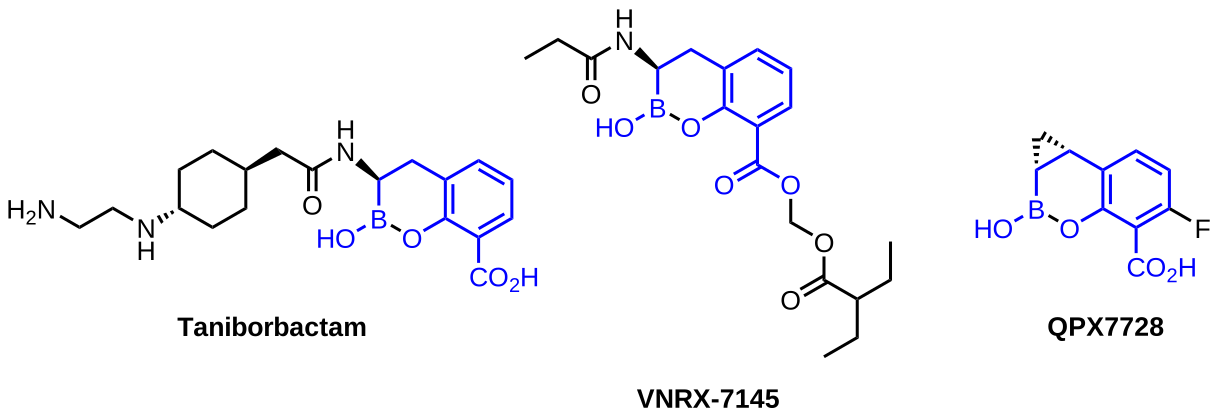
Chemical structures of three bicyclic boronate β-lactamase inhibitors under clinical development

β-lactams are among the most successful antibiotics, but β-lactamases produced by resistant bacteria can render them ineffective. Bicyclic boronates work by inhibiting these enzymes, restoring the antibiotics’ activity.6

‘It basically acts as a sacrificial molecule that stops bacteria killing the antibiotic, so the antibiotic can go off and do its thing and you’ve just inhibited the β-lactamase,’ says Michael Ingleson, a synthetic boron chemist at the University of Edinburgh, UK. ‘There are multiple classes of β-lactamases, A, B, C and D, and very few drugs that hit them all. The boron molecules that are coming through have the broadest scope.’

So far, bicyclic boronates have been able to target A, C and D β-lactamases, which all use similar mechanisms. Class B enzymes have proved harder to inhibit. ‘The problem is that bacteria can produce all of them,’ says González Bello. Developing a single inhibitor capable of targeting all four classes is challenging because ‘their architecture is completely different’.

A one-person chemistry department
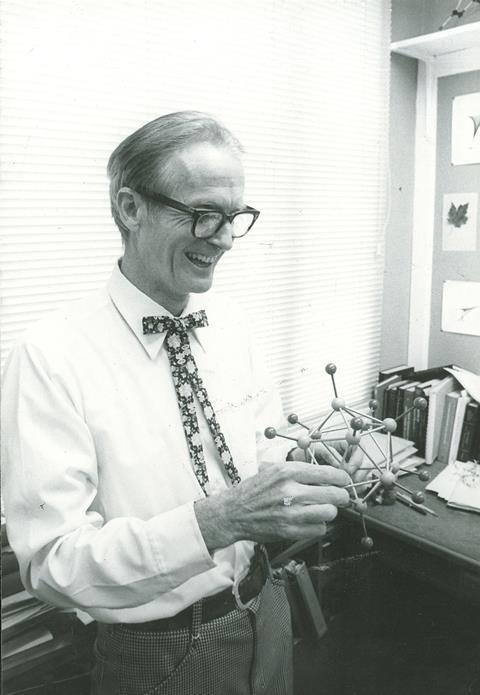
William Lipscomb holding a chemical model

Rees, who worked on protein crystallography in Lipscomb’s group at Harvard, described him as ‘effectively a one-person chemistry department’ in a biographical memoir. It is perhaps no surprise, then, that Lipscomb was so fascinated by boranes, a class of molecules whose versatility researchers are still uncovering today. ‘I’ve felt that Lipscomb was one of the most underappreciated stars of chemistry, with incredible breadth – and depth – of contributions,’ Rees adds.

‘I worked in the Lipscomb group for only one year,’ says Hoffmann. ‘But what a year it was! I learned not to be afraid of complex structures; I learned the joy of interacting with experimentalists. The boranes were quite complex structures, both geometrically, and in their bonding. Until Lipscomb’s work, I have a strong feeling that people were almost afraid to look at them. They seemed too complex to understand. He showed us that one could make sense of the structures.’



Source link

Keep Up to Date with the Most Important News

By pressing the Subscribe button, you confirm that you have read and are agreeing to our Privacy Policy and Terms of Use
Add a comment Add a comment

Leave a Reply

Your email address will not be published. Required fields are marked *

Previous Post
Batteries that break down in the body could power ingestible medical devices | Research

Batteries that break down in the body could power ingestible medical devices | Research

Next Post
Brain development research: What the new findings could change

Brain development research: What the new findings could change

Advertisement