




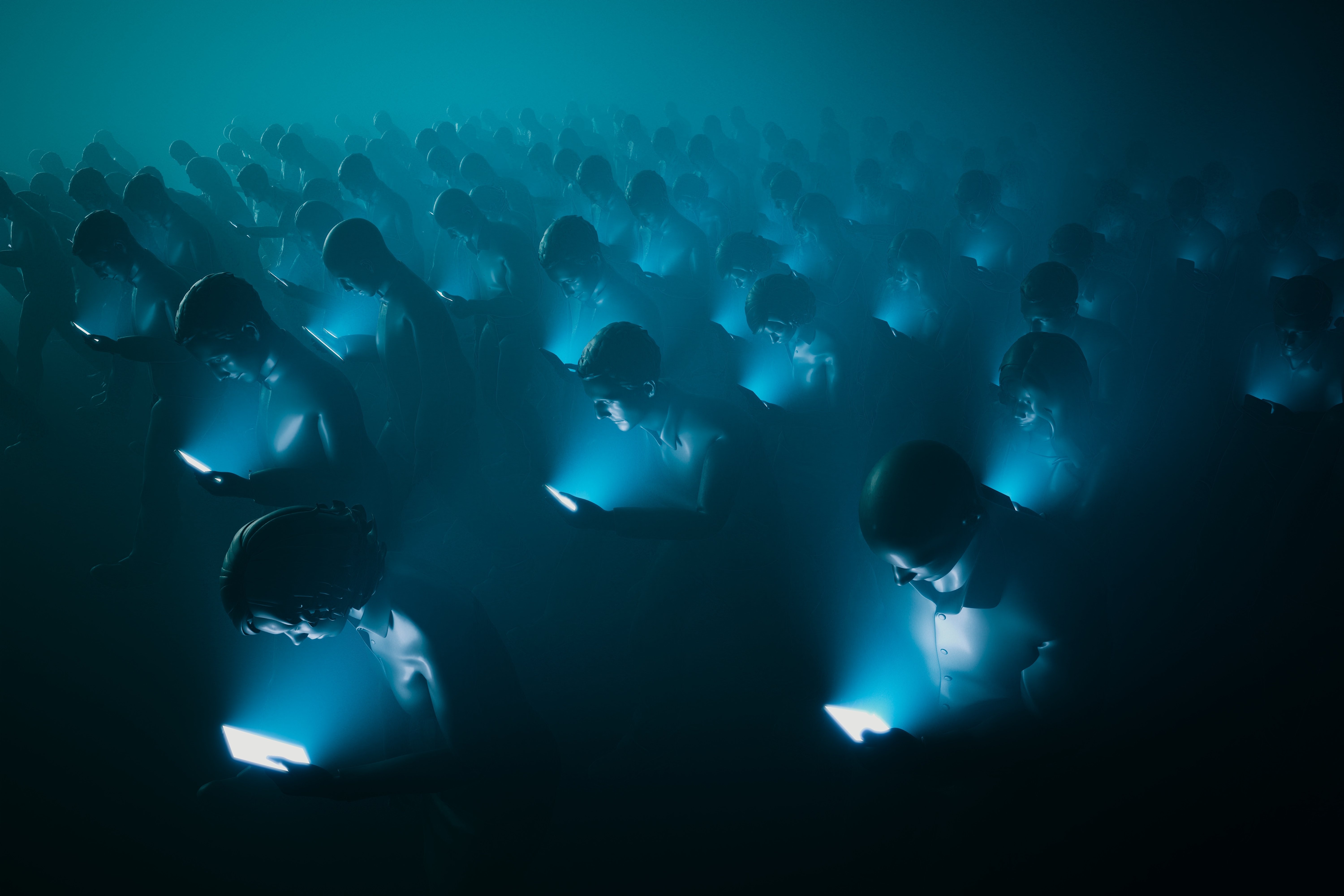
Our digital age presents a paradox, says Icelandic sociologist Vidar Halldorsson. Though humans are more connected and accessible to one another in a global and immediate way, our ability to actually bond with one another using all of the senses is eroding. With our handheld supercomputers at the ready, we are less connected to one another in the end, not more.
This is not a new idea, but Halldorsson has coined a new term he calls “social magic,” the tiny signals and exchanges of energy and empathetic connection that come from being in a physical space with another human being and which help to build a society. Facial micro-expressions, body language, spatial proximity, and even smell all carry social information, he says. French sociologist and father of social science Émile Durkheim might have called this “collective effervescence,” the sense of being part of something larger than oneself.
Read more: “How to Feel at Home in the Modern World”
Halldorsson hangs responsibility for the loneliness, polarization, anxiety, and hate of our current era in large part on how screens have come to dominate every facet of daily life. So many activities we used to do in physical spaces with others are now available at the press of a button from home: grocery shopping, taking in a movie, sports watching, even religious practice.
Halldorsson recently published a new book, How Digital Screen Use Alienates Human Societies: A Treatise on Social Magic and its Decadence. In it he argues that we need to bring back social magic. I spoke with him about team sports, human adaptation, and how we might revive cultures of collectivism.
Much of your research has focused on the psychology of athletes and team sports. Do you see any direct relationship between that work and the subject of your new book, screens and loneliness?
I’m mostly interested in social atmosphere, the energy which emerges when people gather from a social psychological point of view.
Iceland was famous eight years ago when the men’s soccer team qualified for the World Cup. We are a population of 350,000, making us one of the smallest nations ever to qualify, so it got us some attention. The reason why Iceland did well was not because we had great players, it was because we had teams that become something more than the sum of the parts. Because of the social energy, because of the social magic.
Sport can be such a powerful social force. I’ve been working a lot with the sport teams in Iceland—national teams and club teams—to create this climate or atmosphere and energy. But I see that this is now being undermined by technological rationalism, and I’m trying to revive the social so we feel better, so we connect better to make us less lonely, to make us less polarized.
Where does this concept of social magic come from?
Two years ago, I published a book of photographs in Iceland. This was a book based on visual sociology, because this social force is invisible, and we cannot really understand it. Through photographs, I tried to portray the social not only as something important and constructive, but as real magic, because it affects our brains, it affects our wellbeing, it influences our behavior.
I saw when I photographed people, everybody was on the phone. They were walking around, head down. I could see that this technological revolution, the smart technology, was changing the daily habits, the everyday rituals we use in society, that society is built on. Today, when you’re outside, you don’t see strangers, you don’t look them in the eye, you don’t say, “Good afternoon.” The social is under attack now because of technological rationalism. We can do everything through Zoom. We don’t have to go to the store.
After that book was published, I was invited to write a book on this phenomena of screens and isolation, and so I began digging deeper in a more theoretical way to understand the effect that the digital revolution is having on human society, on our health and how we relate to others, how alienated we are, because alienation is about not feeling at home in the world. It’s feeling out of place. It’s feeling hopelessness, lack of belonging. There’s a lot of literature in neuroscience, which shows that when we are associated with other people, it makes us feel a little bit better, feel a little bit more in sync with others.
And we have now all kinds of troubles all around the world in terms of human isolation, human anguish, anxiety, depression. We have all kinds of polarization, hate speech. One reason for that is that we lack the social magic that helps us make a society. Communication through screens is less civil, you know, more judgmental than face-to-face.
In the photographs, were you trying to capture this social magic, as you call it, or were you trying to capture the shift, the loss of it, the attention drawn to the phone in the hand?
I wasn’t trying to capture anything. I was just taking photographs of whatever, and then I had 500 photographs, and I put them on the wall like a detective trying to solve a murder case. I was trying to find the themes, asking, “What do these photographs show?”
The themes emerged: social magic, the genuine positive elements in social human association, the information we share, the social networks we create, the emotional connection we feel with others, the empathy we have for others, you know, that was one theme that emerged.
Another theme was the screen. And then I developed this concept of technological rationalization because the technological revolution is all based on efficiency. Life has to be more efficient is the idea behind all of it. It’s more efficient if you don’t have to go to the store or go to the bank or do this and this and that. We save time, we save energy.
But my argument is that going to the store isn’t only for shopping for groceries. It’s for building a community. It’s for meeting people, seeing people again and again, then you get acquainted with them, and you create social networks and social capital. Without that, you have a more alienated world.
Do you think that this shift toward the digital and away from in-person social rituals is playing out differently across the world? Is the erosion slower in places that have stronger local communities or cultures of collectivism?
Of course, it’s cultural, but I think overall, it has similar effects in different countries. I’ve been all over the world in the last four or five years: South America, the United States, all over Europe, Asia, Japan, Saudi Arabia. I see this everywhere, this alienation, because these technologies are everywhere. But probably in some cultures, people are able to nurture their local environments better than in others. Still, I think it’s a challenge for human societies in general because when we shift from face-to-face interaction to screen interaction, we are uprooting the everyday rituals we use to build a society.
Society is built on countless social encounters, everyday social encounters. When I say hi to my neighbor, or to somebody I meet on the street, it’s like putting pennies in a jar. And certainly we have something which is called social capital, which is mutual trust, mutual responsibility. If we are not putting the pennies in a jar, we don’t create this social capital and don’t create this trust. It’s a fundamental change in how humans interact with others in human relationships, and it’s inferior.
Are you proposing that without these in-person rituals, human society will collapse?
I’m not going to say that. Humans are adaptable. Our brains adapt to the environment. And the critique I’m making now is nothing new. This is what sociologists have criticized society for over the past 150 years. Technological changes alienate human societies at the time, but then the humans begin to find their feet again. There are ups and downs.
I’m not predicting collapse in the world, but this alienation, social isolation, human anguish, polarization, conflict is all over the world, and it leaves a lot of victims. I don’t know how it is in all countries, but I feel it very strongly here in Iceland.
But now we know more than we knew a few years ago, so people are beginning to understand and figure it out: “Oh, okay, maybe this isn’t good for us.” This is like a Titanic and we have to move the ship a little bit, but I think we are becoming more aware of the dangers of technology and its limitations. A lot of literature is coming out that talks about this, but it’s difficult because these trends are powered by big tech and the consumer capitalist industry, which is driving this technological revolution, and they frame it as progress. I am criticizing this progress because it isn’t really progress. It’s based on their own agenda, they are trying to get bigger and more powerful.
This was helped by the pandemic, because these technological gadgets, they were so important for us in COVID. It went everywhere, and now we are beginning to see, “Okay, maybe we need to take a step back and control the technology better.” Facebook said when they were starting that the vision was about connecting people, making the world a better place.
It was all so utopian.
Yes. The main issue I’m addressing in the book is the paradox. Why has more connection led to human disconnection? There are a lot of reasons for that. Part of it is that screens only allow a small percentage of the communication to get through. We cannot share eye contact through a screen. It’s impossible. We cannot have physical touch. We cannot have presence. We can’t use our sense of smell. All our perceptions are limited when we use the screens.
Screen culture has also promoted individualism and narcissism, the worship of the self instead of the collective. This has been exploited by the tech industry, which has hijacked social relationships and monetized them. I try to bring together all these elements in the book. It’s very critical. I feel the book has to be critical because the companies are so strong. They say everything is great, and they say it’s progress.
I want to revive social magic. We need more human-to-human contact to counter human anguish, loneliness, polarization.
Could team sports be one kind of antidote? Are there other forms of collectivism that could help people reconnect in a face-to-face way?
We have sports, we have all kinds of activities that we can do in third spaces—the spaces that are neither at home, nor at work. But we have to revive these third spaces, which is playgrounds, the cinema, religion. Stuff like that is important. But we see all these trends. Competitive sports, more people now watch them through the TVs. The cinema, people watch at home through Netflix instead of going out. In religion, people can have virtual churches. It’s getting in everywhere, and we need to understand that it’s not the same thing to experience these events in person versus on screen.
There are a lot of opportunities to try to reverse this trend, but I’m trying to use the concept of social magic to help people see the social as something valuable. People know this, they know that it’s good to meet other people, but I provide them with some tools, some concepts. The concept of social magic is very strong and has been very popular in Iceland. I’ve been doing that in Iceland now for probably three or four years in local communities. It illustrates that social time is not empty idleness, but something valuable and important.
Enjoying Nautilus? Subscribe to our free newsletter.
Lead Image: Dabarti CGI / Shutterstock